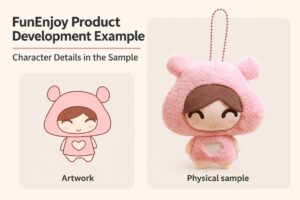
For a custom cotton doll project, start with the character artwork, finished size, face and hair details, and any removable clothing. Record the actual fabric and filling specifications for each part. Use the sewn sample to check the expression, shape, hand feel and garment fit before approving bulk production.
What to Specify for a Custom Cotton Doll
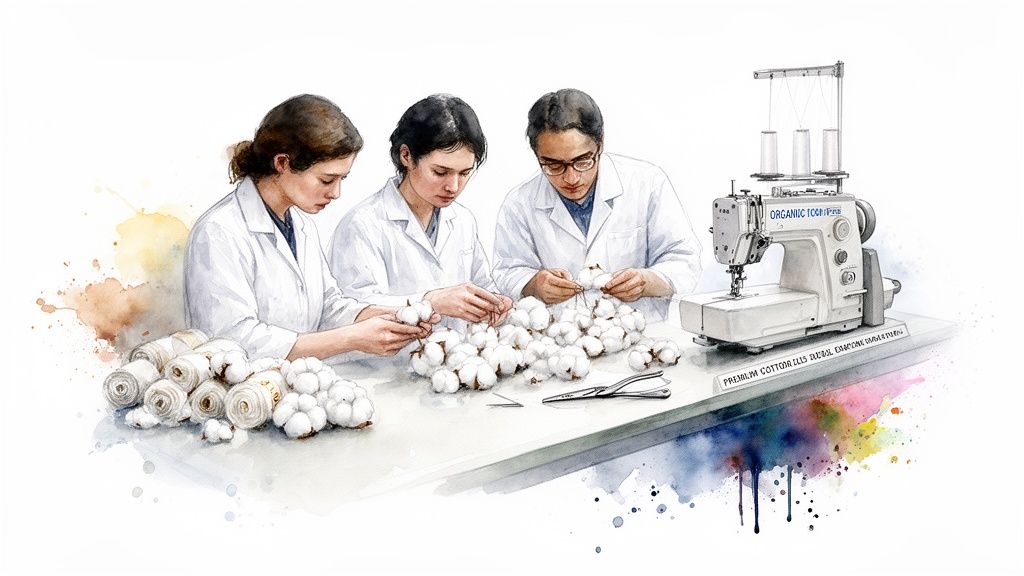
Write the face fabric, hair material, clothing fabric and internal filling as separate entries in the brief. Ask the supplier to confirm the fibre composition and grade behind each material name, then keep the approved swatch or sample reference with the specification.
Character Details to Mark on the Artwork
- Face: Mark the position and shape of the eyes, eyebrows and mouth. Show which details should be embroidered or printed.
- Hair: Show the outline from the front, side and back, including the fringe, parting and any ears or accessories.
- Clothing: Identify sewn-on and removable pieces. Mark openings, closures and graphics that need to match across the outfit.
Approve the Materials on the Sewn Doll
Compare the proposed face and hair materials with the embroidery and seams on the sample. Check how the face looks after filling and how the outfit fits the finished body. Record the selected materials and any changes before the next sample or bulk order.
Materials and Construction of a Cotton Doll
Review the shell, embroidery, clothing and filling together. Material selection affects how the pattern sews, how clearly small facial details read, and how the finished doll holds its shape.
Face, Hair and Clothing Fabrics
- Face fabric: Confirm the fibre composition, texture, stretch and colour. Test the eye and mouth embroidery on the chosen fabric, then check it again on the filled head.
- Hair material: Confirm the texture, colour and direction of the material. On the assembled sample, check that the fringe and side pieces follow the artwork and leave the intended facial details visible.
- Clothing: Specify the fabric and closure for each garment. Put removable pieces on and take them off the sample to check the openings, fit and attachment points.
If the brief specifies cotton fabric or an organic material claim, request the relevant material specification and supporting documentation for that selection.
Filling and Shape
Specify the filling by its verified fibre composition and grade. If a supplier calls it “PP cotton,” ask for the actual material specification. Compare softness, recovery, finished weight and shape on the sewn sample, then record the filling and fill level you approve.
For a weighted design, specify the weight and location of each inner pouch or compartment. Check the doll’s balance and agree on the construction and product checks for the intended user and sales market.
Review any foam insert or other internal support as part of the complete sample. Check its position and how it affects the face, body shape and hand feel.
Material Details to Record Before Approval
Use this checklist to keep the material decisions attached to the sample version.
| Part | What to list | Sample check |
|---|---|---|
| Face | Fabric code, fibre content, colour and approved swatch | Texture, stretch and stitch detail on the sewn head |
| Hair | Material, colour and position | Outline and face in approved front, side and back views |
| Clothing | Cloth, closures and parts that come off | Fit and openings with the outfit on the finished doll |
| Filling | Fibre type, grade, approved fill level and sample weight | Softness, recovery and shape on the filled sample |
| Weighted fill, if used | Bead or pellet type, pouch position and weight | Balance and secure fill in the final sample |
| Inner support, if used | Insert type, size and position | Position, shape and hand feel on the assembled sample |
From Sketch to Shipment: The Complete Manufacturing Workflow
Transforming a 2D illustration into a high-quality, tangible cotton doll is a detailed, systematic process. It relies on meticulous planning, skilled craftsmanship, and transparent communication between the client and our factory team. Understanding this workflow is essential for setting realistic timelines, preparing design files, and making informed decisions.
FunEnjoy coordinates development, sampling and bulk production against the approved sample and written specifications.
The entire operation follows a standardised, multi-stage path.
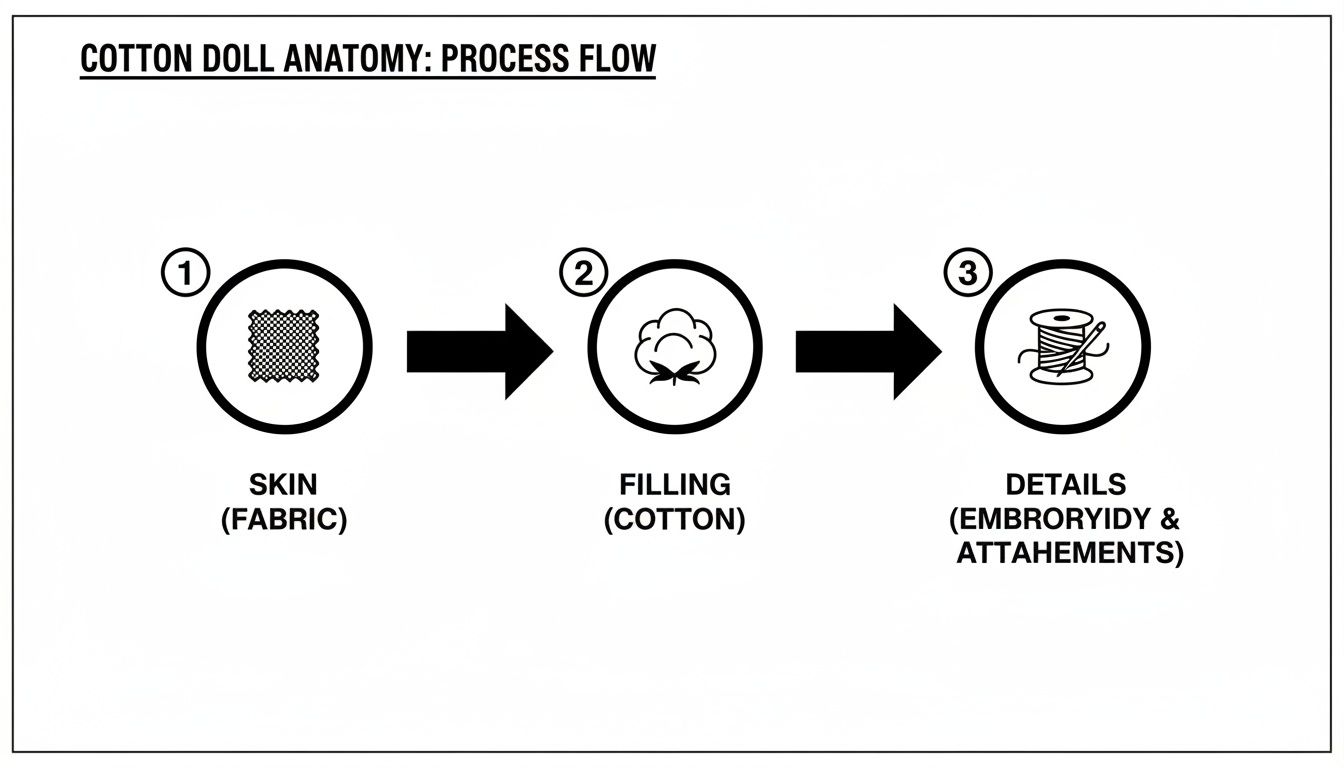
As illustrated, every component is critical. The choice of skin fabric, the type of embroidery thread, and the density of the filling all converge to create the final doll’s appearance and tactile quality.
OEM Versus ODM: A Key Distinction
Before delving into the workflow, it is crucial to understand the two primary production models: OEM and ODM.
- OEM (Original Equipment Manufacturing): This is the path for a fully custom product. The client provides the complete design specifications, and we act as the manufacturing partner to bring that unique vision to life. The client retains full creative control.
- ODM (Original Design Manufacturing): This model offers a faster route to market. The client selects a pre-existing design from our catalogue, which we then customise with their branding, colours, or minor modifications.
The vast majority of our cotton doll projects are OEM. Brands typically approach us to create unique characters exclusive to their intellectual property. Therefore, the workflow detailed below is focused on the OEM process.
The Prototyping Stage: Translating Concept to Physical Form
This is the most critical phase of the project. We are creating the master sample—the physical blueprint for the entire production run. Any imprecision here will be replicated thousands of times, so meticulous accuracy is paramount.
- Design Finalisation and Pattern Making: The process begins with your 2D design file. Our master pattern maker, an artisan with decades of experience, translates this illustration into a series of 3D fabric patterns. This is an art form, requiring a deep understanding of how to capture a character’s essence in textile form.
- Material Sourcing and Cutting: Confirm the fabric, thread, filling and accessory specifications before cutting the sample pieces. Check that the selected materials and decoration methods match the approved brief.
- Embroidery and Initial Assembly: Details define the doll. Features like eyes, mouths, and logos are embroidered onto the flat fabric pieces before they are sewn together. This is essential for achieving a clean, professional finish.
Sample development typically takes 10 working days after the project specifications are confirmed. This excludes sample revisions and shipping time. The sample is sent to you for evaluation. Review its shape, size, materials, and overall quality.
Check the Face, Hair and Outfit on the Sample
Look straight at the filled head to check the eye and mouth placement. Compare the fringe and side hair with the artwork from the same views. Put removable clothes on and take them off, checking the openings and closures. Photograph each change and record it against the sample version. Use the plush doll prototyping and revision guide to organize the review.
Mass Production: The Factory Floor in Action
Once you approve the final prototype, we initiate mass production. This stage is defined by efficiency and stringent quality control.
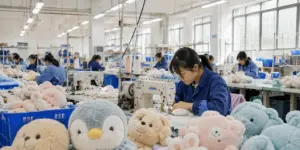
The process mirrors the sampling stage but on a much larger scale, with specialised teams dedicated to each task. We establish assembly lines where one team handles sewing, another focuses exclusively on stuffing, and a third manages finishing touches like attaching accessories and trimming loose threads. For a more detailed look, see our guide on how plush toys are made.
Sample revisions require additional time. The revision schedule should be confirmed before proceeding to mass production.
Carry the approved materials, facial details, outfit configuration and packing requirements into the production specification. Review any proposed material or construction change against that reference.
For orders below 30,000 pieces, mass production typically takes 35 days after sample approval, excluding shipping time. Lead times for larger orders are assessed individually.
Navigating Production Costs and Minimum Order Quantities
The quote for a custom cotton doll depends on the finished size, materials, embroidery, clothing, accessories, packaging and quantity per design. Send the same specification when comparing prices.
- Materials: Identify the face, hair, clothing and filling references.
- Construction: Show the pattern details, embroidery and removable pieces.
- Packaging: Specify labels, unit packs and carton requirements.
- Quantity: List the number of units for each design and outfit version.
How MOQ Impacts Pricing
FunEnjoy’s minimum order is 1,000 pieces per design for standard custom cotton dolls and 2,000 pieces per design for plush with built-in electronic modules. Provide the quantities for your designs so the team can confirm the order requirements and prepare a quote.
Ask for the unit price at each quantity you are considering. Confirm any separate sampling, setup, packaging, testing and shipping charges before comparing the total order cost.
Explaining Material and Design Cost Drivers
Ask for a quote based on the specified face and hair fabrics, filling, embroidery, clothing, accessories and packaging. List the quantity for each design or outfit version so the supplier can assess the work and material requirements.
| Detail | What to list | Quote check |
|---|---|---|
| Fabric and filling | Fibre type, grade, colour and fill level | Same fabric, fill and finished size |
| Face and hair | Art, stitch detail and how the parts join | Stitch work and sewing included |
| Clothing | Clothes, closures and parts that come off | Price for the outfit as agreed |
| Packaging | Unit pack, labels and carton details | Packing and any extra charges |
For a complete procurement brief and the information needed for a bulk quote, use the custom plush doll buying guide.
Practical Negotiation and Cost Trade-Offs
Mark the character details that must stay recognisable before discussing cost changes. Ask the supplier to quote any proposed adjustment to the fabric, embroidery, clothing or packaging separately, then review its effect on the sample.
Balancing Quality and Cost
Use the approved sample and specification when agreeing on production checks. Record which measurements, materials and visual details will be reviewed and how corrections will be confirmed before shipment.
Quote Breakdown to Confirm
Check the unit price, design quantities, outfit configuration and packaging against your brief. Record the sample and production schedule, destination, shipping arrangement and separately quoted charges with the order.
Meeting Global Safety Standards and Quality Control

Confirm the intended age group, sales market and finished configuration before agreeing on the product checks. Include the shell, filling, embroidered or attached features, clothing, accessories and labels in that review.
Agree on the Applicable Safety Checks
For dolls sold as children’s toys in the United States, use the U.S. CPSC toy safety guidance to review the applicable requirements with your testing provider. The scope depends on the intended age group, materials and finished design.
Keep reports and supporting records with the product specification. Check the named product, materials, dates and test scope against the configuration you plan to order.
The Multi-Stage QC Inspection Process
An effective QC system is designed to identify issues early, saving costs, reducing waste, and maintaining the production schedule. Our process is divided into three critical checkpoints.
- Incoming Quality Control (IQC): Before any material enters the production line, our IQC team conducts a thorough inspection. They verify that fabric colours match the specified Pantone standard, check fibre consistency, and ensure stuffing is clean and free of contaminants.
- In-Process Quality Control (IPQC): During assembly, line supervisors continuously monitor the work. They look for common defects such as misaligned stitching, inconsistent stuffing density, or off-centre embroidery. Any unit that fails to meet the standard is immediately removed from the line for correction.
- Final Quality Control (FQC): Before packaging, each doll undergoes a final, meticulous inspection. This is the last opportunity to catch any defect, from a loose thread to a minor cosmetic blemish. We use an AQL (Acceptable Quality Limit) system to maintain an extremely low defect rate.
Keep inspection notes and correction photographs with the approved sample reference. Record the agreed correction and check the revised detail before closing the review.
How to Choose the Right Manufacturing Partner
Selecting a manufacturing partner for your cotton doll is one of the most critical business decisions you will make. A great factory functions as an extension of your team, whereas a poor one can lead to delays, quality issues, and reputational damage. While a low price is appealing, it should never be the sole evaluation criterion.
From our experience, the most successful partnerships are built on technical expertise, reliability, and clear communication. A rock-bottom quote often signals compromises in these areas, which ultimately incurs higher costs in the long run.
Evaluating Technical Expertise and Communication
The initial test of a potential partner is their communication protocol. Do they respond to inquiries promptly? Are their answers to technical questions clear and detailed, or vague? A manufacturer who communicates effectively from the outset is more likely to be a reliable partner during production.
Next, assess their technical capabilities by reviewing their past work.
- Look for similar work: Ask to see examples of cotton dolls they have produced with similar materials or construction techniques to your design.
- Talk through challenges: Present a complex aspect of your design and ask how they would approach its production. A competent team will offer practical, viable solutions.
- Get the details on their sampling process: Inquire about their sampling fees, timelines, and the number of revision rounds included. This provides insight into their attention to detail and client service process.
A significant positive indicator is a factory’s willingness to conduct a technical design review before providing a quotation. An experienced manufacturer will identify potential production challenges early, such as embroidery that is too fine to be stitched cleanly or a seam placement that could compromise durability.
Reviewing Factory and Product Records
Ask which facility will make your order. Match any relevant quality-management certificate or social-audit record to the facility name, date and scope. For the product, review the reports and documents applicable to the intended user, sales market and finished configuration.
Discuss the sample review, production checks, packing requirements and responsibility for resolving defects before confirming the order.
Answering Your Top Questions About Cotton Doll Manufacturing
For those new to custom cotton doll production, the process can seem complex. Over decades of working with brands, we have found that a few key questions consistently arise.
Here are the answers to the most common inquiries we receive.
How Long Does It Take to Make a Custom Doll?
Sample development typically takes 10 working days after the project specifications are confirmed. This excludes sample revisions and shipping time.
For orders below 30,000 pieces, mass production typically takes 35 days after sample approval, excluding shipping time. Lead times for larger orders are assessed individually.
What Is Your Minimum Order Quantity for Custom Cotton Dolls?
Our MOQ is 1,000 pieces per design for standard custom cotton dolls and 2,000 pieces per design for custom plush with built-in electronic modules. Send your design and specifications for a production quote.
What are the Biggest Pitfalls to Avoid in Production?
Based on our extensive experience, the most common and costly problems stem from a single source: unclear technical specifications. Vague design files or incomplete material details inevitably lead to delays and unforeseen costs during the sampling phase.
The most effective way to prevent this is to provide a comprehensive “tech pack” at the project’s inception. This document should include:
- Clear, multi-view illustrations of your doll (front, back, and side profiles).
- Specific Pantone colour codes for all fabrics and embroidery threads.
- Material specifications for the face, hair, clothing and filling, including composition, grade, colour and approved reference.
Investing time in creating a crystal-clear technical brief at the beginning is the single most important action you can take to ensure a smooth production process and a final product that perfectly matches your vision.
Share your character artwork, finished size, quantity per design, intended user and packaging requirements. Request a cotton doll project quote.