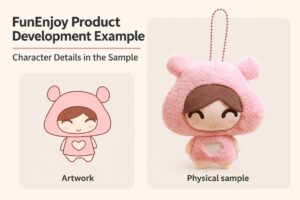
When a brand asks us to make a custom plush mascot in bulk, we start by marking the features that make the character recognizable. A small mouth, a tilted ear or a prop held in front of the body can be the hardest part to reproduce. Those details tell our sample team where to spend time on the pattern and the first sewn sample.
How We Review the First Sample
We check the shape after sewing and stuffing
Our pattern maker breaks the artwork into fabric panels. At that stage, we check seam allowance, the fabric left beyond the stitching line, and pile direction, the way the fibers lie on each panel. Matching left and right panels can catch the light differently if they’re cut with the pile running in opposite directions. We check the face and outline again after stuffing, when the seams have taken their finished shape.
For a character with long ears, we’d record two things separately: the finished body height and the overall height including the ears. That gives the sample team and production inspectors the same points to measure from.
We test the embroidery on the production fabric
A fine mouth line can look sharp on screen and disappear into long plush fibers. We recommend a stitch-out, a trial of the embroidery at the finished size on the proposed fabric. We look at the eye and mouth edges, then check the sewn sample for puckering or a face that pulls out of shape.
If the detail gets lost, we can review the stitch density and underlay, the supporting stitches beneath the visible design. A shorter-pile face panel is another option if it suits the character. We compare those choices on fabric before approving the look. Madeira on stitches sinking into pile and its stitch density guide explain the two issues.
We give the sewing team an attachment point
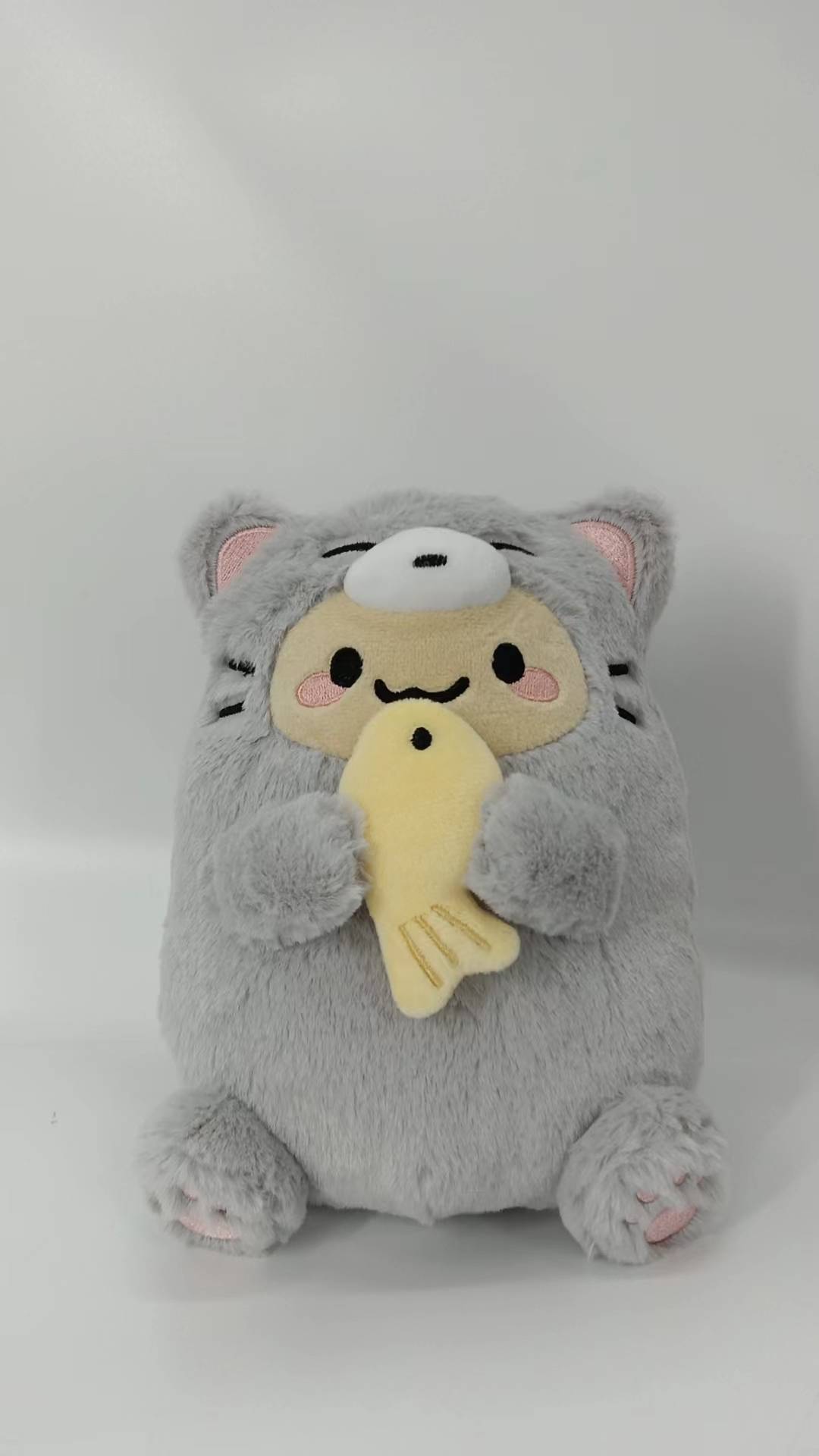
On the gray character in our FunEnjoy sample gallery, the yellow fish sits between the paws. In a review like this, we use the front photo to agree how much of the fish should show. On a side photo we mark the attachment point. The person sewing the piece can then see where it goes and what the finished pose should look like. If the toy will be sold in a display pack, we check the pose in the pack as well. We can work through those details during plush toy sampling.
What We Hand to Production
The approved sample, the BOM and the measurement points
The signed-off sample, often called the golden sample, is the reference for appearance and workmanship. Alongside it we keep the dated photos and the production specification. The bill of materials (BOM) lists the agreed fabrics, filling, thread, trims and labels. The specification records where to measure, the agreed dimensional tolerances and how the toy should be packed. We use the same revision on the sample record, photos and specification so the team can tell which version the brand approved.
How we’d write an inspection method for the fish
The brand and our sample team first agree which detail the production line needs to control. For a fish held between two paws, we’d record the visible height and the attachment point. We’d check both on the approved sample and the first production piece using the same setup.
Example inspection method
- Set up the sample. Stand it upright on a flat surface, with the paws at rest. Photograph it straight on, then from the side. Use the same pose and viewing angle for both pieces.
- Define what to measure. Measure the vertical distance between the highest and lowest visible points of the fish from the front. Hold the ruler beside the toy without compressing the plush. Mark the attachment point on the approved side photo.
- Record the decision. Enter the approved target, tolerance, actual measurement and specification revision. Check the attachment against the side photo and confirm that the fish stays visible in the retail pack.
Worked example. If the agreed visible height were 30 ± 2 mm, the acceptance range would be 28–32 mm. A reading of 33 mm should be rechecked in the agreed pose. If it still reads 33 mm, flag the piece for review against the specification. The numbers illustrate the method.
Soft materials can give different readings when handled differently. A defined pose and measurement point make it easier to compare results between operators. NIST guidance on measurement variability.
Use the first production piece to check the line setup
During first article inspection, we compare the first production piece with the approved sample and current specification. For the mascot above, we’d check finished height, the face embroidery, the fish position and the packed pose. Record any discrepancy before releasing the run. If the fish sits too low, for instance, check where it was attached before changing the pattern. Agree the release checks with our OEM production team. The same criteria carry through to in-line inspection.
Plan safety testing for the intended market
Tell us the intended age group and destination while we’re reviewing the design. For applicable stuffed children’s toys in the U.S., ASTM F963 Section 4.27 covers seam testing. Confirm the applicable test scope for the finished design with the lab. The factory’s appearance and workmanship checks serve a separate purpose. CPSC toy safety guidance.
How We Confirm the Order Quantity
Our minimum order quantity (MOQ) is 1,000 pieces per design for standard custom plush mascots and 2,000 pieces per design for mascots with built-in electronic modules. If you want the same character in two sizes, send the quantity for each: a size change can mean a new pattern or a different embroidery layout. We review the versions before quoting production and quote sampling separately. FunEnjoy order minimums.
What We Need to Quote Your Mascot
Send the artwork, finished dimensions and quantity per design. Mark the details that need to match the character, especially the face, props or logos. Tell us the intended age group, packaging, destination and target arrival date. With that brief, we can review the pattern and sample work before pricing the order.