From our factory floor in China, the global hub of toy production, we see more than just playthings being made. Stuffed animals and plush toys are powerful tools for brands, creators, and businesses to build a tangible, emotional connection with their audience. Transforming a digital character or a brand mascot into a physical, huggable product creates a lasting bond that merchandise like keychains or t-shirts simply cannot match. This guide provides an insider’s look into the manufacturing process, from initial concept to global distribution, sharing the practical knowledge we’ve gained over decades of production.
The Global Market for Custom Plush Toys
The demand for custom plush toys from businesses has grown consistently. This is not a fleeting trend but a solid, expanding market. A report from Grand View Research valued the market at USD 13.68 billion in 2025, projecting it to reach USD 25.94 billion by 2033 with a compound annual growth rate (CAGR) of 8.4%. As manufacturers, we see the forces driving this expansion daily.
Market Drivers from a Production Perspective
Several key factors are pushing this growth, shifting plush products from children’s toys to strategic assets for collectors, fans, and corporate branding.
- Licensed Intellectual Property (IP): Licensed characters are a massive driver. We regularly produce plush toys for gaming studios, animation companies, and film franchises. A well-made plush toy brings a digital character into the physical world, creating merchandise that dedicated fan bases actively seek.
- The “Kidult” Demographic: A significant portion of toy sales now goes to adults. These consumers purchase plush toys as collectibles, for nostalgic value, or as unique home decor. This audience demands high-quality materials and faithful design execution, which is a core focus of any reputable manufacturer.
- E-commerce and Global Reach: Online retail has removed geographical barriers. Brands can launch custom plush lines and sell directly to a global audience. This has democratized the market, allowing niche brands and independent creators to compete effectively.
- Corporate Branding and Promotion: We’ve observed a significant increase in companies using custom plush toys for promotional purposes. A company mascot rendered as a high-quality plush toy makes a far more memorable and impactful impression than standard promotional items like pens or stress balls.
From a manufacturer’s standpoint, these trends confirm that investing in custom stuffed animals and plush toys is a sound business strategy. It enables brands to open new revenue streams, build stronger customer loyalty, and create a physical product that truly embodies their identity.
The Manufacturing Process: From Design to Finished Product
What separates a mediocre plush toy from a premium one? It begins with materials but is realized through a precise, multi-stage production workflow. As manufacturers, we know that what goes inside is as critical as the fabric on the outside. Every decision—balancing texture, safety, cost, and appearance—shapes the final product.
Material Selection: Fabric and Filling
The materials are the first physical interaction a customer has with your brand. The choice of fabric sets the tone for softness, durability, and character.
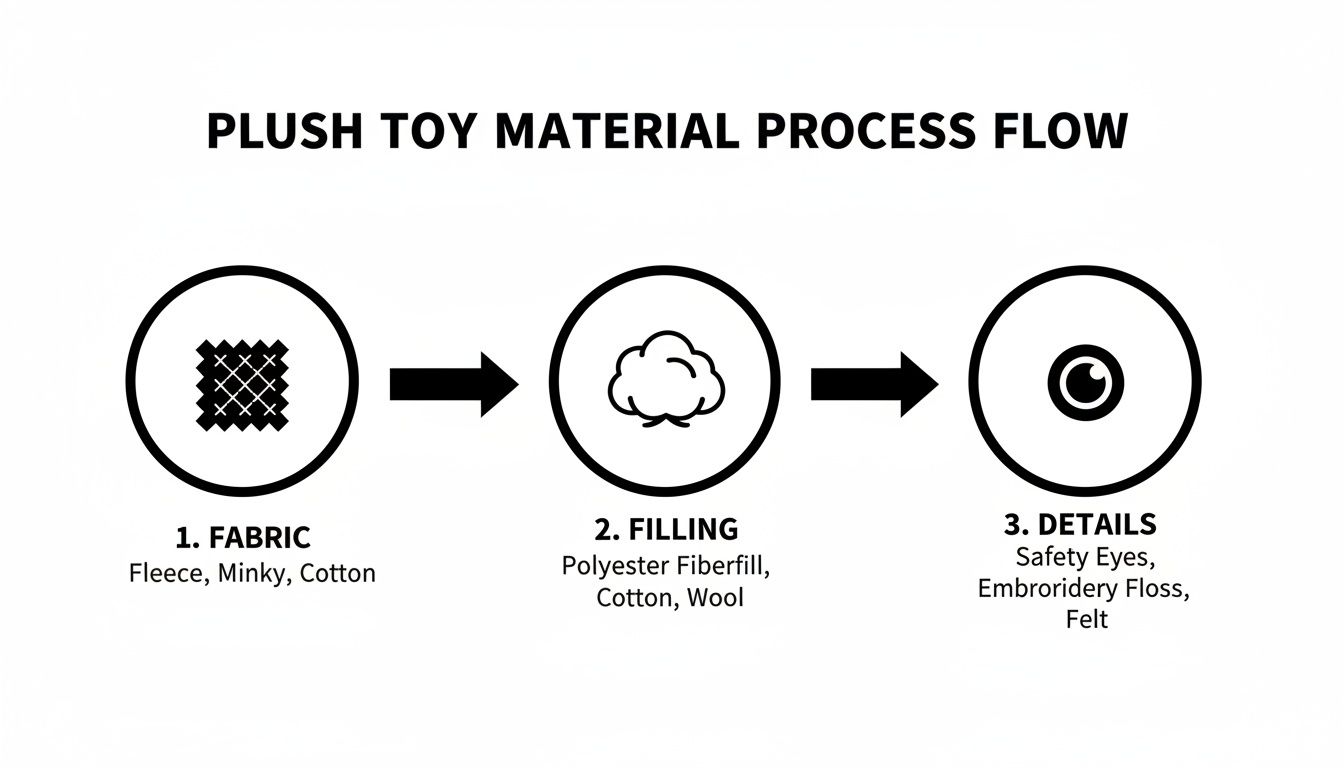
Outer Fabric Options:
- Standard Velboa: A short-pile faux fur that is durable, easy to clean, and cost-effective. It’s the workhorse material for promotional items and toys intended for heavy play.
- Soft Boa (Minky): Incredibly soft and silky with a slight stretch. This is a premium choice for retail toys, baby products, and collectibles where a luxurious feel is essential.
- Fleece: A fuzzy, lightweight fabric that doesn’t fray when cut. Ideal for simpler shapes and plush accessories like scarves or blankets.
- Sherpa Fabric: Mimics the look and feel of sheep’s wool. It provides a unique, fluffy texture perfect for plush sheep, llamas, or as a cozy trim.
Filling (Stuffing) Options:
- PP Cotton (Polypropylene Cotton): The industry standard. It is hypoallergenic, lightweight, resilient, and provides a consistent, soft fill. It also maintains its shape well after washing.
- Recycled PET Filling: For brands focused on sustainability, we offer filling made from recycled plastic bottles. It has a nearly identical feel to PP cotton but with a significantly smaller environmental footprint.
- Plastic Pellets: Used to add weight and stability, allowing a toy to sit upright. For safety, these pellets are always sealed securely inside an inner pouch to prevent access.
The Production Workflow: A Step-by-Step Breakdown
Once materials are finalized, the factory floor comes alive. This is where a 2D design becomes a 3D, tangible product through a combination of technology and skilled craftsmanship.
- Sampling (Prototyping): Before mass production, we create a physical sample. Our pattern masters draft a paper pattern from your design file, similar to a tailor. This first sample, which typically takes 5-10 working days to produce, is sent to you for review. This is the critical stage for making adjustments before committing to a full production run.
- Mass Production Cutting: Using the approved patterns, we cut the fabric. For large orders, computer-guided laser cutters ensure every piece is identical, which is essential for a consistent, professional finish.
- Embroidery and Printing: This stage adds personality—facial features, logos, or other details. Multi-head embroidery machines stitch designs with durable, high-tensile thread. For larger graphics, screen printing or heat-transfer printing is used.
- Sewing and Assembly: Our most experienced technicians stitch the fabric pieces together, turning them inside out to conceal the seams. This requires a steady hand and a deep understanding of how different fabrics behave.
- Stuffing and Closing: Specialized machines blow a precise amount of filling into the toy’s shell to achieve the desired firmness. Electronic modules, such as those in a singing plush toy, are inserted at this stage before the final opening is meticulously hand-sewn shut, leaving an invisible seam.
- Finishing and Quality Control: Every toy is brushed and air-cleaned to remove stray threads. It then passes through a metal detector to ensure no broken needle fragments are inside—a critical safety step. Finally, our QC team performs a final inspection, including pull tests on eyes and seams, before the toy is approved for packing.
Pricing, MOQ, and Partnership Models
Understanding the business side of manufacturing is crucial for a successful project. The final cost per toy is a direct reflection of the materials, labor, and complexity involved.
Key Factors Impacting Cost
Several variables determine the unit price. Understanding these allows you to optimize your design for your target budget.
- Materials: Premium fabrics like Minky cost more than standard velboa. Similarly, eco-friendly recycled PET fill is priced higher than standard PP cotton.
- Design Complexity: A simple round character requires less labor than a complex dragon with individual scales and wired wings. The number of pattern pieces and intricacy of embroidery are significant cost drivers.
- Order Volume (Quantity): Economies of scale are a major factor. An order for 5,000 units allows us to purchase materials in bulk and optimize production line efficiency, significantly lowering the cost-per-unit compared to a 500-piece run.
- Size and Accessories: A larger toy requires more fabric and stuffing. Custom add-ons like a branded t-shirt, a removable hat, or a sound box also increase material and assembly costs.
OEM vs. ODM: Which Model Is Right for You?
When working with a factory, you’ll choose between two primary partnership models.
- OEM (Original Equipment Manufacturer): You provide a complete, production-ready design. Your team handles creative development, and we act as your manufacturing partner, producing the toy to your exact specifications. This is ideal for brands with in-house designers or established IP.
- ODM (Original Design Manufacturer): This is a collaborative partnership. You might start with a basic sketch or concept, and our in-house design team works with you to develop it into a manufacturable product. This is an excellent option if you need design and engineering expertise to bring your vision to life.
Understanding Minimum Order Quantities (MOQ)
MOQ (Minimum Order Quantity) is the smallest order a factory can accept for a custom production run. We have MOQs because setting up the production line—creating cutting molds, programming embroidery machines, and ordering specific materials—involves significant upfront costs. These costs are amortized across the entire run. For a very small order, the per-unit cost becomes prohibitively high.
At FunEnjoy Toys, we understand that new brands or special projects may not require thousands of units initially. We offer flexible MOQs, often starting as low as 100–500 pieces for simpler designs, to help you test the market without a large upfront investment. This flexibility is a key advantage of the diverse stuffed animal and plush toy market research shows is available.
Quality Control and Global Safety Standards
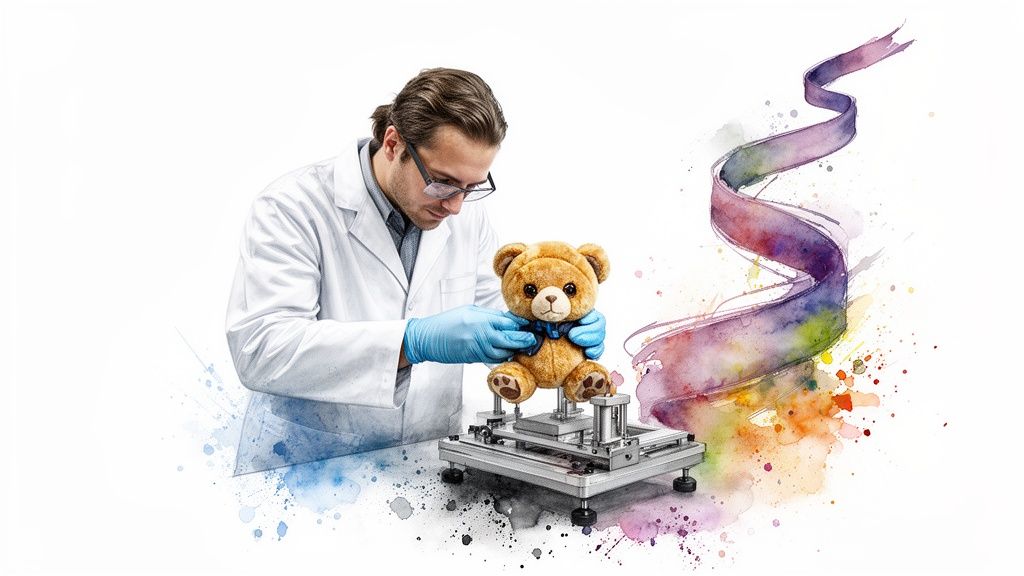
In the toy industry, safety is not optional—it is the foundation of our business. A single safety recall can destroy a brand’s reputation. A rigorous quality control (QC) process is a non-negotiable part of production that protects your brand, your customers, and our partnership. Our process begins with an incoming quality check on all raw materials before they ever reach the factory floor.
Quality Inspection: The AQL Framework
To ensure consistency across thousands of units, we use a globally recognized statistical sampling system called the Accepted Quality Limit (AQL). This method allows us to assess the quality of an entire production run by inspecting a randomized sample, replacing guesswork with measurable benchmarks.
Defects are categorized into three tiers:
- Critical Defects (AQL 0): Zero tolerance. A defect that poses a direct safety hazard, such as a broken needle tip inside a toy.
- Major Defects (AQL 1.5%): Flaws that would likely result in a customer return, like a large tear in a seam or misaligned facial features.
- Minor Defects (AQL 4.0%): Small imperfections that don’t affect safety or function, such as a single loose thread.
If a sample batch fails to meet the agreed-upon AQL, the entire lot is flagged for a 100% manual inspection and rework. This data-driven approach ensures consistent quality.
Navigating International Safety Standards: EN71 & ASTM F963
To sell stuffed animals and plush toys in Europe or the United States, they must comply with strict legal safety standards. The two primary standards are EN71 (for the EU) and ASTM F963 (for the US). Compliance requires sending production samples to an accredited third-party laboratory for rigorous testing.
These tests include:
- Physical & Mechanical Tests: Technicians use specialized equipment to pull, twist, and drop the toys to ensure no parts come loose and create a choking hazard.
- Flammability Tests: The fabric is exposed to a flame to measure its rate of combustion; it must self-extinguish almost immediately to pass.
- Chemical Analysis: Materials are tested for a long list of harmful substances, including heavy metals (lead, mercury) and banned phthalates, to ensure the toy is non-toxic.
Our job as a manufacturer is to engineer your toy from the ground up using materials and construction techniques designed to pass these tests.
How to Choose a Supplier: A Buyer’s Checklist
Selecting a manufacturing partner is the most critical decision you will make. A great partner acts as an extension of your team, providing expertise and transparent communication. As the heart of the global toy industry, China has unparalleled production infrastructure, but finding the right factory is key. You can discover insights on the China toys market here.
Vetting Potential Manufacturing Partners
Do not focus solely on the unit price. A low price often indicates compromises in material quality, safety testing, or ethical labor practices—risks that can destroy a brand.
Key vetting criteria:
- Experience and Portfolio: Have they worked with global brands? Do they have experience producing toys similar to your design?
- Transparent Pricing: A trustworthy factory provides a detailed cost breakdown. You should understand how materials, complexity, and volume affect the final price.
- Documented Quality Control: Ask for their QC process and AQL standards. Request copies of safety certificates (e.g., ISO 9001, BSCI). Hesitation is a major red flag.
- Clear Communication: Is the team responsive and fluent in your language? Miscommunication is a primary cause of production errors and delays.
Common Problems and Risks with Low-Quality Factories
Choosing a supplier based on the lowest price is a common mistake that often leads to serious problems:
- Inconsistent Quality: The final product may not match the approved sample due to cheap materials or poor workmanship.
- Safety Failures: Cutting corners on safety testing can lead to product recalls, legal liability, and irreparable brand damage.
- Communication Breakdowns: Language barriers and poor project management result in missed deadlines and costly errors.
- Ethical Concerns: Low prices may be linked to poor labor conditions, which can create a public relations crisis for your brand.
Tips to Reduce Costs Without Sacrificing Quality
- Simplify Your Design: Reducing the number of unique pattern pieces and embroidery details can lower labor costs.
- Increase Order Quantity: Larger orders benefit from economies of scale, reducing the per-unit price.
- Optimize Materials: Discuss material options with your manufacturer. Sometimes a slightly different but equally safe and high-quality fabric can offer cost savings.
- Plan Ahead: Rushed production schedules often incur extra fees. Planning your timeline well in advance avoids these costs.
Finding the right fit among stuffed animal companies is about building a long-term relationship based on trust and expertise.
Why FunEnjoy Is a Trusted Manufacturer
Over the years, we’ve guided countless brands through the process of creating their own custom plush toys. We understand the common questions and concerns that arise.
What Is a Realistic MOQ?
For a custom production run, a typical Minimum Order Quantity (MOQ) ranges from 100 to 500 pieces. The exact number depends on design complexity. These minimums are necessary to cover the fixed setup costs associated with creating a new custom product.
How Long Does Sampling Take?
Once we have your finalized design, a physical prototype typically takes 5 to 10 working days to produce. This timeline covers pattern creation, material cutting, and initial assembly. Complex features like custom-molded parts may require additional time.
What Causes Production Delays?
Common causes of delays include vague design files, slow feedback on prototypes, and last-minute design changes after production has begun. Unforeseen issues like material shortages or shipping logistics can also occur. A partnership built on clear, proactive communication is the best way to mitigate these risks and keep your project on track.
At FunEnjoy PlushToys, we have spent decades transforming creative concepts into high-quality, safe, and beloved plush toys. We pride ourselves on a transparent, predictable, and expert-guided manufacturing process. Get a free quote today and let’s discuss bringing your character to life.