From our factory floor in China, we see a singing plush toy as far more than a simple novelty. It is a sophisticated product that merges soft toy craftsmanship with consumer electronics, creating an interactive experience that captivates both children and adults. As a B2B buyer, understanding the intricacies of its creation is the first step toward launching a successful product. This guide provides an inside look at the manufacturing process, from a factory perspective.
The Global Market for Interactive Plush Toys
The demand for interactive toys is not a fleeting trend; it represents a fundamental shift in market expectations. Consumers, particularly parents and gift-givers, seek products that offer educational value, aid in developmental milestones, or simply provide a more engaging play experience. A singing plush toy directly addresses this demand.
The technology powering these toys has matured significantly. Modern sound modules, power sources, and activation sensors are now compact, reliable, and cost-effective enough for seamless integration into mass-produced plush toys without compromising safety or tactile appeal. This accessibility allows brands of all sizes to enter this lucrative market.
Tapping Into a Growing Market
Market data from our region, a global manufacturing epicenter, validates this trend. The plush toy sector is experiencing robust growth.
This trajectory indicates a market ripe for innovation. While standard plush toys form the foundation, the significant growth is fueled by value-added products like the singing plush toy.
In 2023, China’s stuffed and plush toy market was valued at USD 976.3 million. With forecasts projecting a rise to USD 1,729.1 million by 2030—a compound annual growth rate (CAGR) of 8.5%—the opportunity is clear. You can read more about these market dynamics for a detailed analysis. For any B2B buyer, this data signals that investing in the interactive plush category is a strategic move with strong potential for returns.
Deconstructing the Singing Plush Toy: Anatomy and Materials
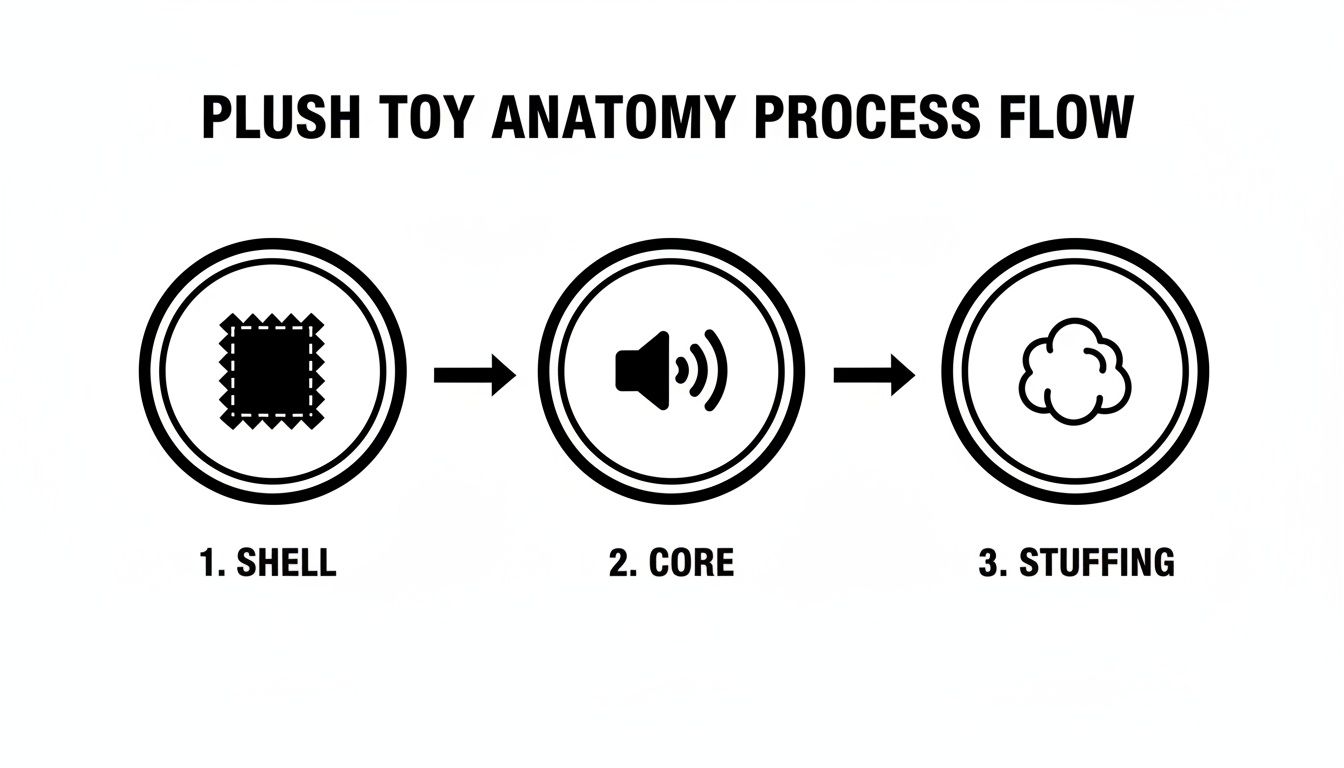
From a manufacturer’s standpoint, a singing plush toy is an assembly of two distinct products: a plush outer shell and an electronic core. The selection of materials and components for each directly influences the final product’s quality, durability, function, and cost.
The Plush Shell: Materials and Filling Types
The tactile experience begins with the plush shell. The choice of fabric is critical, as it is the primary point of contact for the end-user.
- Soft Minky: A premium, ultra-soft polyester fabric with a slight sheen, commonly used in high-end baby products. It offers a luxurious feel ideal for premium toy lines.
- Classic Velboa: The industry standard. A durable, short-pile faux fur that is cost-effective and well-suited for detailed printing and embroidery, making it a versatile choice for mass-market products.
- Textured Sherpa: Mimics the texture of wool, providing a unique, fluffy feel. It is excellent for characters like sheep, bears, or any design intended to appear cozy.
The filling determines the toy’s weight, form, and “huggability.” The standard is Polypropylene (PP) cotton, a hypoallergenic, lightweight, and washable synthetic fiber. For structural integrity, we may incorporate foam inserts or weighted pellets, depending on the design requirements.
The Electronic Core: Sound and Activation Mechanisms
The “singing” functionality originates from the electronic core, which consists of a sound module, an activation mechanism, and a power source.
Sound modules range from simple pre-loaded chips playing a 10-second melody to advanced modules with longer, high-fidelity audio. A popular option for personalization is a plush toy with a voice recorder, allowing end-users to record custom messages. Audio duration and clarity are primary cost factors.
Activation is achieved through various sensors:
- Squeeze Sensors: The most common and cost-effective method. A simple pressure-activated switch is placed within a limb or the torso.
- Motion Sensors: Trigger audio upon movement, adding an element of surprise and enhancing interactivity.
- Light Sensors: Activate sound when the toy is exposed to light, creating a unique unboxing experience.
Power is typically supplied by button-cell or AA/AAA batteries housed in a child-safe, screw-secured compartment—a mandatory feature to comply with international safety standards like EN71 and ASTM F963.
The Manufacturing Workflow: From Technical Pack to Final Product
Transforming a design concept into a finished singing plush toy is a meticulous process honed through years of factory operations. A clear understanding of this workflow enables our clients to plan their product launches effectively.
Phase 1: Prototyping and Sampling (5-10 Business Days)
Upon receiving your technical pack (tech pack) and design files, our engineering team creates a production blueprint. The first physical iteration is the prototype sample. Master pattern makers translate your 2D designs into 3D templates, which are used to hand-cut the initial fabric pieces. This sample, complete with materials, embroidery, and a functional sound module, allows you to physically review and approve the design before committing to mass production.
A common pitfall for new buyers is rushing this stage. A well-executed prototype is a critical risk mitigation tool, identifying potential design flaws and ensuring the final product aligns with your quality standards and customer expectations.
Phase 2: Material Sourcing and Preparation
Following sample approval, we initiate mass production by sourcing bulk materials. Each lot of fabric, thread, stuffing, and electronic components undergoes incoming quality control (IQC) to verify consistency and compliance with specifications. While prototypes are hand-cut, mass production utilizes industrial die-cutting machines that slice through dozens of fabric layers simultaneously, ensuring absolute uniformity across the entire production run.
Phase 3: Assembly, Stuffing, and Electronic Integration (20-30 Days for Mass Production)
Components converge on our specialized assembly lines for production.
- Embroidery and Printing: Facial features, logos, and other flat details are applied to the fabric panels before sewing to ensure maximum precision.
- Sewing: Skilled operators stitch the panels together, forming the 3D “skin” of the toy while leaving a small opening for stuffing.
- Electronic Integration: The pre-tested sound module is inserted and secured within an internal fabric pouch to prevent shifting. The activation sensor is precisely aligned with its designated location (e.g., a paw or the abdomen).
- Stuffing: A pneumatic stuffing machine fills the toy with a precise weight of PP cotton to achieve the specified density—firm enough for structure, yet soft enough for comfort.
- Closing and Finishing: The opening is hand-sewn shut using an invisible stitch. Each toy then proceeds to a finishing station for thread trimming, fabric brushing, and final shaping to match the approved prototype.
For a detailed look at the machinery and techniques involved, you can learn how to make plush toys in our comprehensive guide. A final quality control inspection is performed on every unit before packaging.
Pricing Factors: How Design Complexity and MOQs Impact Your Cost
A frequent question from B2B buyers is, “What is the unit cost?” The answer is determined by a balance between design specifications and order volume. A high-volume order of a simple design will have a lower per-unit cost than a small-batch order of a complex character.
Core Cost Drivers
The unit price of a singing plush toy is an aggregate of several factors:
- Design Complexity: The number of unique fabric panels and sewing operations directly correlates with labor time and cost. A simple spherical character is less labor-intensive than a dragon with wings, scales, and multiple appendages.
- Size and Weight: Larger toys require more raw materials (fabric, stuffing) and also incur higher shipping costs due to volumetric weight.
- Material Grade: Premium materials like minky fabric and high-density PP cotton carry a higher cost than standard velboa and basic fill.
- Sound Module Specifications: A key variable. A simple 10-second pre-recorded sound chip is significantly cheaper than a 60-second, high-fidelity recorder module.
- Packaging: A standard polybag is the most economical option. Custom-printed retail boxes with acetate windows add to the unit cost but enhance shelf appeal.
Understanding Minimum Order Quantity (MOQ)
Factories establish an MOQ because setting up a production line for a custom product involves fixed costs (e.g., creating cutting molds, programming embroidery machines, meeting raw material supplier MOQs). Spreading these setup costs over a larger number of units reduces the per-unit price.
We recognize that high MOQs can be a barrier for new brands. We offer flexible MOQs, often starting at 100–500 pieces, to enable market testing without a prohibitive initial investment.
However, some constraints are external. Our suppliers for custom-dyed fabrics or specialized electronic components have their own MOQs. If an order is too small to meet these upstream requirements, production may not be feasible.
Practical Tips for Cost Reduction
Cost optimization does not require sacrificing quality. Strategic design choices can yield significant savings.
- Simplify Construction: Reducing the number of fabric panels can lower sewing time by 10-15%.
- Use Printing for Complex Details: For intricate patterns or color gradients, high-quality fabric printing is often more cost-effective than multi-layered embroidery.
- Plan Ahead: Rush orders incur premium charges for expedited material sourcing and production line scheduling. A longer lead time allows for more economical planning.
Quality Control and Global Safety Standards
For any toy, particularly one intended for children, safety is non-negotiable. Rigorous quality control is not an option but a core principle of responsible manufacturing. Our process begins with stringent inspection of all incoming raw materials for defects and compliance with chemical safety standards.
This vigilance continues throughout production. Our quality control teams conduct in-line inspections, testing seam strength, electronic functionality, and stuffing consistency.
Adherence to Key International Standards
To sell globally, products must comply with the regulatory standards of the target market. The two most prominent standards for toys are:
- EN71 (European Union): A comprehensive set of standards covering physical and mechanical properties (EN71-1), flammability (EN71-2), and migration of certain chemical elements (EN71-3). It places a strong emphasis on preventing choking hazards.
- ASTM F963 (United States): A similarly thorough standard addressing physical hazards like sharp points, sharp edges, and small parts. It also mandates secure battery compartments to prevent ingestion.
Both standards enforce strict limits on heavy metals like lead and chemicals like phthalates. A proficient factory builds these compliance requirements into the design and production process from the outset.
The Risks of Partnering with Low-Quality Factories
A low price from a non-compliant factory presents a significant risk. Such facilities often cut costs by using untested materials that may contain banned substances or by skipping critical safety checks like needle detection scans. The consequences can be catastrophic, including customs seizures, forced product recalls that damage brand reputation, and, most critically, potential harm to a child.
As a final step in our quality assurance process, every finished plush toy passes through a metal detector. This ensures that no broken needle fragments are left inside—a critical safety measure often overlooked by low-cost producers.
Investing in a manufacturing partner with a proven commitment to quality and safety is an investment in your brand’s long-term viability.
How to Choose a Reliable Manufacturing Partner
Selecting the right factory is the most critical decision in your product journey. You are not merely procuring a service; you are forming a partnership. A true partner invests in your success by providing expert guidance, proactive problem-solving, and transparent communication. Bypassing trading companies and working directly with a factory grants you greater control, better pricing, and a direct line of communication.
Verifying a Factory’s Credentials and Capabilities
Conduct thorough due diligence before committing to a supplier. A reputable manufacturer will readily provide documentation to substantiate their claims.
- Factory Audits and Certifications: Request social compliance audit reports such as BSCI (Business Social Compliance Initiative) or ICTI (Ethical Toy Program). These audits verify ethical labor practices.
- Experience with Electronic Toys: Manufacturing a singing plush toy requires specialized expertise. Ask for a portfolio of similar electronic toys they have produced. Inquire about their specific processes for testing and integrating electronic modules.
- OEM vs. ODM Capabilities: Understand their service model. An OEM (Original Equipment Manufacturer) builds products to your exact specifications. An ODM (Original Design Manufacturer) offers pre-designed products that you can brand and modify. A factory with strong ODM experience often possesses a deeper understanding of the entire product development lifecycle.
A major red flag is a supplier’s reluctance to provide photos of their facility or participate in a video tour. Transparency is paramount in building a trusted manufacturing relationship.
Differentiating Between OEM and ODM
- OEM (Original Equipment Manufacturer): You provide a complete technical pack, and the factory manufactures the product according to your precise design. This gives you full creative control. The intellectual property (IP) belongs to you.
- ODM (Original Design Manufacturer): You select a product from the factory’s existing catalog and customize it with your branding, colors, or minor modifications. This is a faster and often cheaper route to market, but the core design IP belongs to the factory.
Understanding this distinction helps you find a partner whose services align with your business strategy.
Why FunEnjoy is a Trusted Manufacturer
Finding the right partner is about more than just price. It’s about finding a team with the experience, integrity, and capability to execute your vision flawlessly.
- Direct Factory Advantage: We are not a trading company. When you work with FunEnjoy, you communicate directly with the team that is manufacturing your product, ensuring clear communication and eliminating unnecessary markups.
- Specialized Expertise: We have over a decade of experience focused specifically on plush toys, including complex projects involving integrated electronics. Our quality control process is tailored to the unique challenges of a singing plush toy.
- Proven Compliance: We hold key certifications, including BSCI, and our products are manufactured to meet stringent international standards like EN71 and ASTM F963.
- Flexibility and Support: We offer flexible MOQs to support both established brands and new ventures. Our team provides expert guidance throughout the entire process, from design optimization to logistics management.
For a deeper analysis of the manufacturing landscape, our guide to stuffed animal companies provides valuable insights.
Ready to bring your own singing plush toy idea to life? At FunEnjoy PlushToys, we combine decades of craftsmanship with modern manufacturing to create products that delight customers worldwide. Contact us today for a free quote and let’s build something amazing together.