Sonic the Hedgehog isn’t just a character; he’s a global phenomenon. For B2B buyers in the toy market, this translates into a remarkably stable and high-value product line. Decades of nostalgia, coupled with a constant stream of new media, create a built-in, passionate fanbase. As a manufacturer, we understand that producing sonic plush toys is not just about making a toy—it’s about accurately recreating a piece of pop culture.
Market Overview: Why Licensed Characters Outperform
In the plush toy industry, there’s a clear distinction between generic designs (like teddy bears) and licensed characters. A Sonic plush isn’t merely a product; it’s a tangible link to memories of speeding through Green Hill Zone or watching the latest film. This emotional connection is the engine behind its commercial success.
The Power of Nostalgia and New Media
Sonic the Hedgehog is a perfect case study in multi-generational appeal. Original fans from the 90s now have disposable income and children of their own, creating a self-sustaining cycle of demand. This foundation is continually boosted by new games, films, and animated series, which act as global marketing campaigns, introducing the character to new audiences and re-engaging longtime fans. These events create predictable, significant spikes in merchandise demand.
The Collector Market Dynamic
Beyond casual fans, a dedicated collector market seeks high-quality, character-accurate plush toys. For this discerning audience, several factors are non-negotiable:
- Design Fidelity: The plush must be an exact representation of the character from a specific piece of media. Details are paramount.
- Premium Materials: Collectors expect high-grade fabrics and precise, dense embroidery.
- Official Licensing: Authenticity is the cornerstone of value.
From the factory floor, we’ve seen collector-grade products command higher price points and build immense brand loyalty. The global plush toy market was valued at USD 15.1 billion in 2024, with licensed characters accounting for USD 7.3 billion. The data is clear: licensed characters are not a niche; they are the main event. You can learn more about what makes certain products stand out by checking out our guide on the best stuffed animals.
The following infographic shows how a licensed character’s journey from nostalgia to new media creates a powerful investment cycle for plush toys.
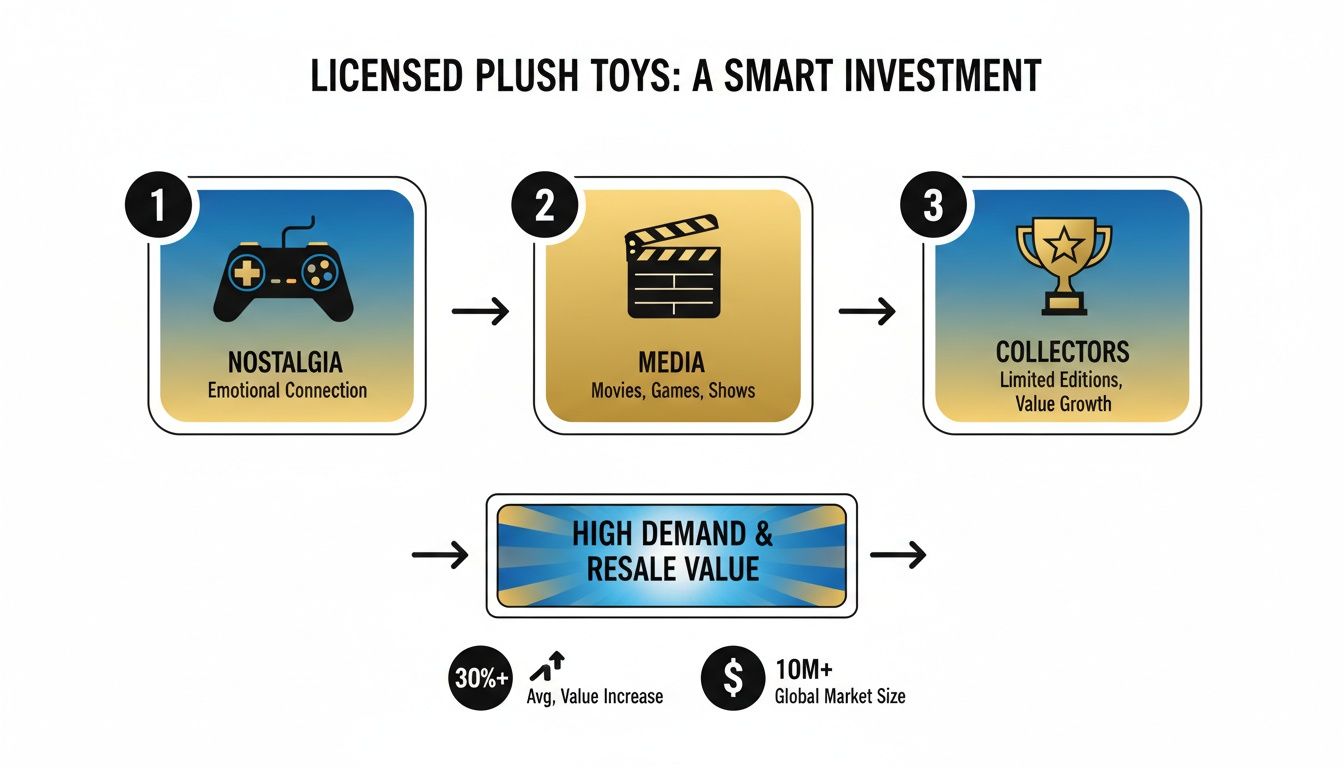
This flow highlights that a character’s deep roots in nostalgia, combined with ongoing media releases, fuels a dedicated collector market, ensuring sustained demand.
The Manufacturing Process: From Design to Reality
Transforming a 2D design file into a physical Sonic plush toy is a precise, multi-stage process that blends engineering with craftsmanship. Understanding this workflow is critical for any B2B buyer, as it demystifies timelines, cost structures, and the significant quality gap between premier manufacturers and low-cost alternatives.
OEM vs. ODM: Defining Your Production Path
Before production begins, a crucial decision is the manufacturing model.
- Original Equipment Manufacturing (OEM): This is the standard for licensed products like Sonic. The client provides the complete design files, technical specifications, and intellectual property (IP). The factory then serves as a dedicated production partner, manufacturing the toy to exact specifications. You own the design; we build it.
- Original Design Manufacturing (ODM): In this model, the factory offers its own pre-developed designs. The client can select a design from our catalog and apply their branding, perhaps with minor modifications. This is a faster route, but the core design IP remains with the factory.
For a unique and legally protected character like Sonic, OEM is the only viable path. The process begins the moment we receive your detailed design “tech pack.”
The Plush Toy Production Workflow
- Pattern Making & Prototyping: Our pattern masters translate the 2D design into a series of 3D fabric patterns—a highly skilled task, especially for complex shapes like Sonic’s quills. From these patterns, we construct a physical prototype (sample) for client approval. A typical sampling timeline is 7-10 business days.
- Material Sourcing & Cutting: Once the prototype is approved, we source the specified fabrics. Large rolls are laid out on cutting tables, and computer-guided laser cutters slice through dozens of layers simultaneously, ensuring perfect uniformity across the entire production run.
- Embroidery & Printing: Before assembly, individual components like eyes, mouths, and logos are embroidered using multi-head computerized machines. This ensures crisp, durable details that won’t fade or peel. Any printed elements are also applied at this stage.
- Sewing & Assembly: Skilled sewing teams stitch the components, starting with smaller parts like arms and ears before assembling the main body. This is the most labor-intensive stage, requiring a high degree of precision.
- Stuffing & Shaping: The sewn “skins” are turned right-side out and filled with high-grade PP cotton using a blowing machine. Workers then manually distribute the stuffing to eliminate lumps and achieve the desired firmness and shape.
- Finishing & Final QC: The toy is closed with final stitches. Each plush then undergoes a final inspection for seam strength, embroidery quality, and overall accuracy against the approved prototype. Critically, every toy passes through a metal detector to ensure no broken needle fragments are present—a non-negotiable safety step.
For a deeper dive into this workflow, please see our detailed guide on how to make plush toys.
Material Selection: The Foundation of Quality
The choice of raw materials defines a plush toy’s final look, feel, durability, and safety. This decision is a balance of texture, cost, and character accuracy. For a character defined by a specific vibrant blue and crisp white gloves, material selection is paramount.
Outer Fabric Shell (The “Skin”)
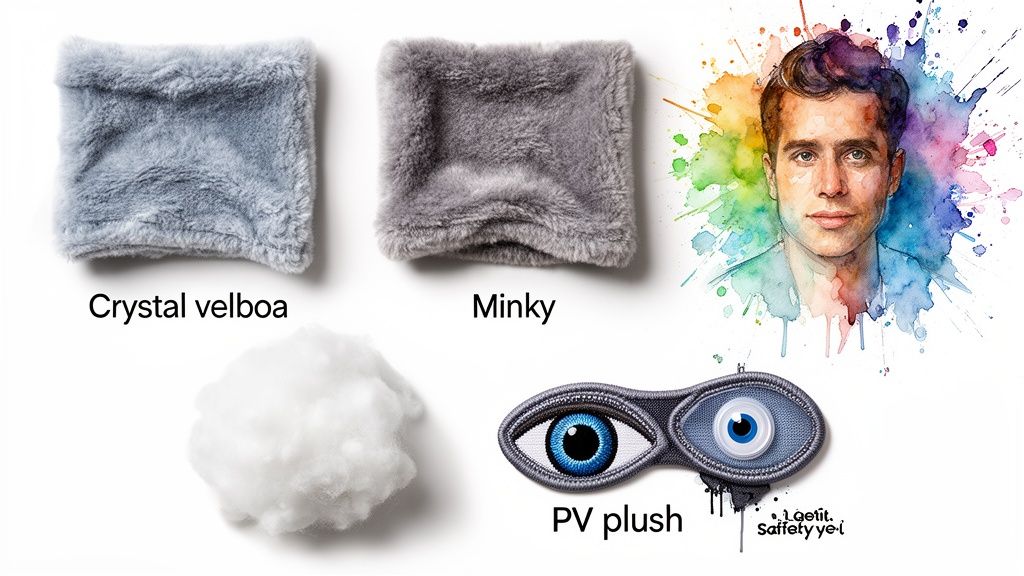
- Crystal Velboa: This is the industry-preferred material for modern sonic plush toys. It is a short-pile polyester fabric with a slight sheen and an exceptionally soft feel. Its primary advantage is excellent color vibrancy and a premium finish.
- Minky Fabric: Similar to velboa but often with a slightly longer pile, Minky is known for its luxurious softness. It is highly durable but its longer fibers can sometimes obscure fine design details.
- PV Plush: A more traditional and cost-effective option with a longer pile. While soft, it can hide intricate embroidery and is better suited for simpler, generic toy designs.
For a high-fidelity Sonic plush, we almost exclusively recommend crystal velboa. It provides the optimal combination of brilliant color, tactile quality, and the structural integrity needed for Sonic’s sharp silhouette.
Inner Filling & Components
- Filling: The industry standard is 7D or 3D PP (Polypropylene) cotton, a type of polyester fiberfill. The “D” (denier) refers to fiber fineness; it offers an excellent balance of softness, resilience, and loft, preventing lumps. Recycled polyester fiberfill is a sustainable alternative with comparable performance.
- Structural Elements: For parts requiring rigidity, such as the soles of Sonic’s shoes, we use EVA foam inserts to maintain their shape.
- Eyes & Details: The choice is between embroidered eyes and plastic safety eyes. For a premium, collector-grade product that is also safer for all ages, high-density embroidery is the superior option. It eliminates the risk of small parts detaching, a key requirement for passing EN71 and ASTM F963 safety tests.
Pricing Factors & MOQ: Understanding the Numbers
Two questions dominate initial conversations: “What is the unit cost?” and “What is the MOQ?” The final price is a composite of several key factors, and understanding them is crucial for effective budget planning.
It’s a common misconception that smaller toys are inherently cheaper. Complexity, not size, is the primary cost driver. A simple 30cm character can be less expensive to produce than a highly detailed 15cm Sonic with intricate embroidery and numerous fabric patterns.
The market itself is robust. China’s plush toy market reached USD 976.3 million in 2023 and is projected to hit USD 1,729.1 million by 2030, growing at a CAGR of 8.5%. You can explore the full research on this market trend for more data.
Key Cost Drivers
- Design Complexity: The number of individual fabric patterns directly impacts cutting and sewing time. Complex shapes like Sonic’s quills require more skilled labor and time to assemble correctly.
- Embroidery Stitch Count: Cost is calculated by the total number of stitches. More stitches mean more thread, more machine time, and a higher unit price.
- Materials & Components: Premium materials like crystal velboa cost more than standard plush. The grade of PP cotton and any add-ons like sound chips or custom hangtags also affect the final price.
- Order Quantity: Economies of scale apply. Larger orders reduce the per-unit cost.
Manufacturer’s Insight: Labor is the most significant cost variable. A plush toy that takes 45 minutes of skilled sewing will be significantly more expensive than one of the same size that takes only 20 minutes. This is why a detailed “tech pack” is essential for an accurate quote.
Minimum Order Quantity (MOQ) Explained
MOQ is the minimum number of units a factory will produce in a single run. It’s about efficiency; setting up a production line incurs fixed costs. Spreading these costs over a larger volume makes each unit more affordable.
- Typical MOQ Ranges: For a mid-sized, professional factory, a standard MOQ is 500-1,000 pieces. This range offers a good balance of per-unit cost and manageable investment for most brands. Small workshops may offer lower MOQs (100-300), but often at the expense of consistent quality and scalability.
Tips to Reduce Cost
- Simplify the Design: Reducing the number of patterns is the most effective way to lower labor costs.
- Optimize Embroidery: Discuss with your manufacturer if stitch density can be adjusted without compromising the look.
- Increase Order Volume: The most direct way to achieve a lower per-unit price.
- Plan for Sea Freight: Air freight is fast but expensive. Planning production timelines to allow for sea shipping can drastically cut logistics costs.
Quality Control & Safety Standards
For a globally recognized character, quality control isn’t a final step; it’s a philosophy embedded throughout the production process. Rigorous QC protects children, your brand’s reputation, and your investment. A reputable manufacturer builds quality in at every stage.
Global Safety Standards: EN71 & ASTM
Compliance with international safety standards is non-negotiable for market access.
- EN71 (Europe): The mandatory safety standard for toys sold in the EU. It covers mechanical properties, flammability, and strict limits on chemical substances like heavy metals and phthalates.
- ASTM F963 (USA): The mandatory safety specification for toys in the United States. It focuses heavily on preventing choking hazards, seam strength, and hazardous materials.
Failure to meet these standards can result in entire shipments being rejected at customs, a catastrophic outcome for any business.
Our Multi-Point Quality Inspection System
To ensure every plush toy is compliant and perfect, we implement a rigorous, multi-stage inspection process.
- Incoming Quality Control (IQC): All raw materials are inspected upon arrival. We verify Pantone colors, fabric weight (GSM), and component specifications. Substandard materials are rejected before they enter the production line.
- In-Process Quality Control (IPQC): Our inspectors monitor the factory floor. They check cutting accuracy, embroidery sharpness, and seam strength at regular intervals during assembly. This catches deviations early.
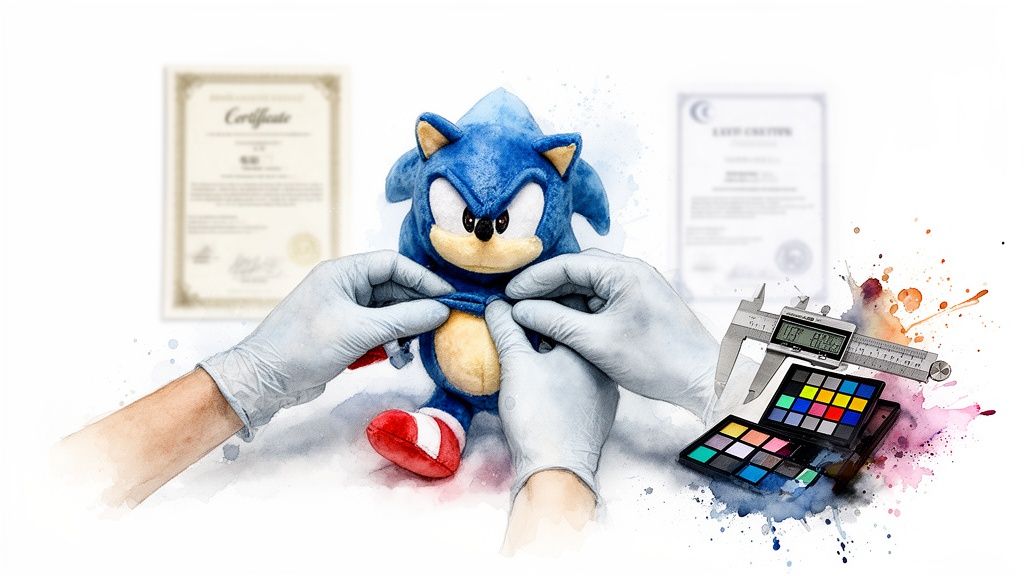
- Final Quality Control (FQC): Every finished toy undergoes a comprehensive audit. We check for overall appearance, symmetry, and stuffing consistency. A random sample from each batch is subjected to destructive testing.
The Pull Test: A critical FQC step is the pull test. We use a tension gauge to apply a specified force (e.g., 90 Newtons for 10 seconds) to seams, eyes, and other attachments. This simulates rough play and ensures no parts can detach and become choking hazards, a core requirement of both EN71 and ASTM F963.
Finally, every single toy passes through a metal detector before packing. This is the final safety check to guarantee no broken needle fragments are inside, providing complete peace of mind. For more detail on materials and components see our overview of what makes a good stuffed toy.
How to Choose the Right Manufacturing Supplier
Selecting a manufacturing partner for your Sonic plush toys is the single most important decision you will make. This choice extends far beyond price. A true partner acts as an extension of your team, safeguarding your quality, ensuring compliance, and providing reliability.
The Chinese toy market is vast, reaching USD 22.8 billion in 2024 with projections to hit USD 50.6 billion by 2033. While Guangdong province is a major hub, regions like Zhejiang offer unique advantages in supply chain efficiency. More insights are available on the expanding China toy market on imarcgroup.com.
Vetting a Supplier Beyond Price
An unusually low quote is often a red flag, signaling potential compromises on materials, labor standards, or safety testing. A professional manufacturer will be transparent about their cost structure.
- Factory Audits & Certifications: Request proof of social compliance audits like BSCI or ICTI. These ensure the factory meets ethical labor standards, a crucial requirement for global brands.
- Experience with Licensed IP: Manufacturing licensed characters requires expertise in navigating strict brand guidelines and approval processes. Ask for case studies or examples of work with other well-known brands.
- Robust QC Systems: A trustworthy factory will proudly detail their multi-stage QC process (IQC, IPQC, FQC). If they are hesitant to explain it, be wary.
Common Problems & Red Flags to Avoid
- Poor Communication: Slow, unclear, or unprofessional responses during the quoting phase are indicative of future problems.
- Vague Technical Answers: A supplier should be able to clearly explain their material sourcing, safety protocols, and production workflow.
- Risk of Low-Quality Factories: The risks are substantial: unsafe products, failed compliance tests, inconsistent quality, and potential damage to your brand’s reputation.
A reliable partner prioritizes clear, timely communication and demonstrates deep technical expertise from the first interaction.
Why FunEnjoy is a Trusted Manufacturer
We believe in building long-term partnerships based on transparency, expertise, and an unwavering commitment to quality. Our process is designed to de-risk production for our clients and deliver a final product that exceeds expectations.
How Much Will a Sample Cost and How Long Does it Take?
A prototype for a moderately complex design typically costs between $100 and $300. This fee covers the skilled time of our pattern makers, material sourcing, and initial hand-assembly. The sample is usually delivered within 7 to 10 business days. For most clients, this sample fee is credited back upon placement of a bulk production order.
How Do You Protect Our IP?
We take intellectual property protection extremely seriously. We execute a Non-Disclosure Agreement (NDA) before viewing any design files. Internally, access to your designs is restricted to only the essential team members working on your project. Our reputation is built on the trust we’ve earned from global brands.
Can You Handle International Shipping and Customs?
Yes. We offer end-to-end logistics solutions. We provide quotes for various freight options and manage shipping under standard incoterms.
- FOB (Free On Board): We deliver the goods to the designated port in China, and you manage the subsequent shipping.
- DDP (Delivered Duty Paid): A turnkey solution where we handle all shipping, insurance, customs clearance, and final delivery to your warehouse.
What Happens If I Find a Quality Issue After Delivery?
Our multi-stage QC process is designed to prevent defects from ever leaving the factory. However, in the rare event that a genuine manufacturing flaw is discovered upon delivery, we stand by our work. Depending on the nature and scale of the issue, we will offer a fair resolution, which could range from a credit on a future order to a remake of the affected units. Our goal is a long-term partnership, not a one-time transaction.
Ready to turn your plush toy idea into a reality with a partner you can count on? The team at FunEnjoy PlushToys brings decades of hands-on experience, transparent communication, and a commitment to quality that global brands trust. Contact us today for a no-obligation quote.