From a manufacturer’s perspective, the term Best Stuffed Animals isn’t about subjective cuteness. It’s a technical definition: a product that perfectly balances creative intent, material integrity, scalable production, and uncompromising safety. As a factory that has produced millions of plush toys for global brands, we understand that success lies in transforming a design concept into a tangible, consistent, and compliant product. This guide shares our direct, on-the-floor knowledge to help you navigate the sourcing process like an expert.
The Global Plush Toy Market: A Manufacturer’s Overview
The global plush toy market has evolved significantly. Decades ago, the primary driver was cost. Today, while cost remains a key factor, the discussion around Best Stuffed Animals is dominated by brand integrity, safety compliance, and supply chain reliability. Brands are no longer just buying a product; they are sourcing a manufacturing partner who can protect their IP and reputation.
The market now demands sophisticated products. To deliver the Best Stuffed Animals, manufacturers must support toys tied to digital media, characters with complex emotional expressions, and sensory products using innovative materials. This shift places immense pressure on factories to be more than just assemblers—we must also act as consultants, engineers, and quality guardians.
The Benefits of Sourcing Directly from a Manufacturer
Sourcing directly from a factory offers unparalleled advantages for serious brands. It’s about more than just cost savings; it’s about control, transparency, and collaboration.
- Cost Efficiency: By eliminating intermediaries, you access direct factory pricing, maximizing your profit margins.
- Creative Control: Working with the source allows for direct feedback during prototyping, ensuring the final product perfectly matches your vision. Tweaks to seam placement or embroidery density can be communicated and executed efficiently.
- Supply Chain Transparency: You gain direct insight into production timelines, material sourcing, and quality control checkpoints.
- Expert Consultation: An experienced factory provides invaluable advice on material selection, design-for-manufacturability, and cost optimization—insights you won’t get from a trading company.
Common Types of Stuffed Animals We Manufacture
While the possibilities are endless with custom designs, most projects aimed at creating the Best Stuffed Animals fall into several core categories. Understanding these categories helps clearly define your product’s scope.
- Character Plush: Replicas of licensed characters from movies, games, or books. These demand extreme precision to match the IP.
- Branded Mascots: Corporate mascots turned into promotional products. Simplicity and durability are often key.
- Retail Teddy Bears & Animals: Classic designs intended for general retail. Quality of materials and huggability are paramount.
- Educational & Sensory Toys: Products with unique textures, weighted fillings, or interactive elements designed for developmental purposes.
The Plush Toy Manufacturing Process: From Tech Pack to Shipping Carton
Understanding the production workflow is critical for B2B buyers. It demystifies the timeline and highlights key approval stages. Here is the step-by-step process on our factory floor. For a more visual guide, see our article on how plush toys are made.
1. Prototyping (The Sampling Stage)
This is the most critical phase. Your design file (a “tech pack”) is translated into a physical prototype.
- Pattern Making: Our master pattern-maker deconstructs your 2D design into 3D fabric shapes. This is a highly skilled art.
- Material Selection: We source the specified fabrics (e.g., Minky, Velboa) and fillings (typically 100% new PP Cotton).
- Cutting & Sewing: The initial sample is cut by hand and sewn.
- Client Approval: We ship the prototype to you for review. Revisions are common and expected.
Timeline: A first-round sample typically takes 7-10 working days. Each revision round adds another 5-7 days. Clear feedback is essential to avoid delays.
2. Mass Production
Once the final prototype is approved, we move to bulk production.
- Material Procurement: We order all raw materials in bulk.
- Cutting: Fabric is stacked in layers and cut using either steel dies (for high volume) or precision lasers (for complex shapes).
- Embroidery/Printing: Details like eyes, mouths, and logos are added to the flat fabric pieces for maximum precision.
- Sewing: Assembly lines of skilled workers stitch the fabric pieces together, leaving a small opening for stuffing.
- Stuffing: The sewn “skins” are filled with a precise weight of PP Cotton via blowing machines to ensure consistent density.
- Closing & Finishing: The final seam is closed by hand with a hidden stitch. Accessories are securely attached.
3. Quality Control & Packing
- Final Inspection: Each toy is inspected for symmetry, stitching quality, and cleanliness.
- Needle Detection: Every single toy passes through a metal detector to ensure no broken needle fragments are inside—a critical safety step.
- Packing: Toys are packed into individual polybags and then into master shipping cartons.
What Really Drives Plush Toy Pricing?
Every B2B buyer needs to understand the key factors that determine the unit cost of producing the Best Stuffed Animals. Misunderstanding these elements can easily lead to unrealistic budget expectations.
- Size & Materials: Larger toys require more fabric and filling. A premium fabric like custom-dyed Minky costs significantly more than standard Velboa.
- Complexity: The single biggest cost driver after materials. We literally count the number of individual fabric pieces and seams. A character with complex clothing and multiple appendages requires far more labor than a simple spherical plush.
- Order Quantity (MOQ): Higher volume spreads fixed costs (material sourcing, machine setup) over more units, drastically lowering the per-unit price.
- Details: Embroidery cost is calculated by stitch count. A large, dense logo is more expensive than simple eyes. Printed details require their own setup process.
- Safety Testing & Certification: The cost for third-party lab testing for standards like EN71 or ASTM F963 is factored into the total project cost. This is non-negotiable for legitimate manufacturers.
Pro Tips to Reduce Your Costs
- Simplify the Design: Reduce the number of separate fabric panels or seams.
- Optimize Size: A small reduction in size (e.g., from 30cm to 25cm) can result in significant material savings.
- Use Stock Materials: Choosing a high-quality fabric from our existing stock avoids custom-dyeing fees and lowers the MOQ.
- Increase Order Volume: The most effective way to lower unit cost. The price difference between 500 units and 2,000 units is substantial.
Understanding MOQ (Minimum Order Quantity)
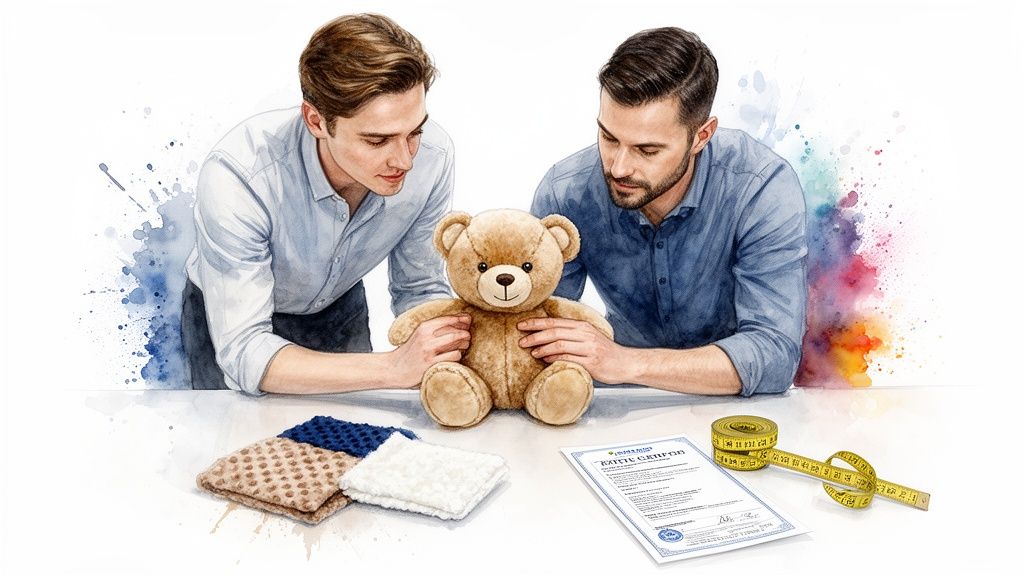
MOQ is the minimum number of units a factory can produce in a single run. This isn’t an arbitrary number; it’s an economic necessity.
- Fabric Mills: Our suppliers sell fabric in large rolls, often with a minimum order of 500-1000 meters per color.
- Production Line Efficiency: Setting up a dedicated sewing line for a specific design is a significant undertaking. A minimum run is needed to make this process viable.
Typical MOQ Ranges:
- 500 – 1,000 units: A common starting point for most custom OEM designs using standard materials.
- 1,000 – 3,000+ units: Required for designs that involve custom-dyed fabrics or highly complex production processes.
For businesses needing smaller quantities or faster turnaround, exploring wholesale stuffed animals from a manufacturer’s existing stock (an ODM model) can be a strategic alternative.
OEM vs. ODM: What’s the Difference?
- OEM (Original Equipment Manufacturing): You provide a 100% unique design, and we build it exclusively for you. You own the IP. This is our primary business model for branded clients.
- ODM (Original Design Manufacturing): You choose a pre-existing design from our catalog and customize it with your logo and branding. This is faster and has a lower MOQ.
Quality Control: The Foundation of a Safe Product
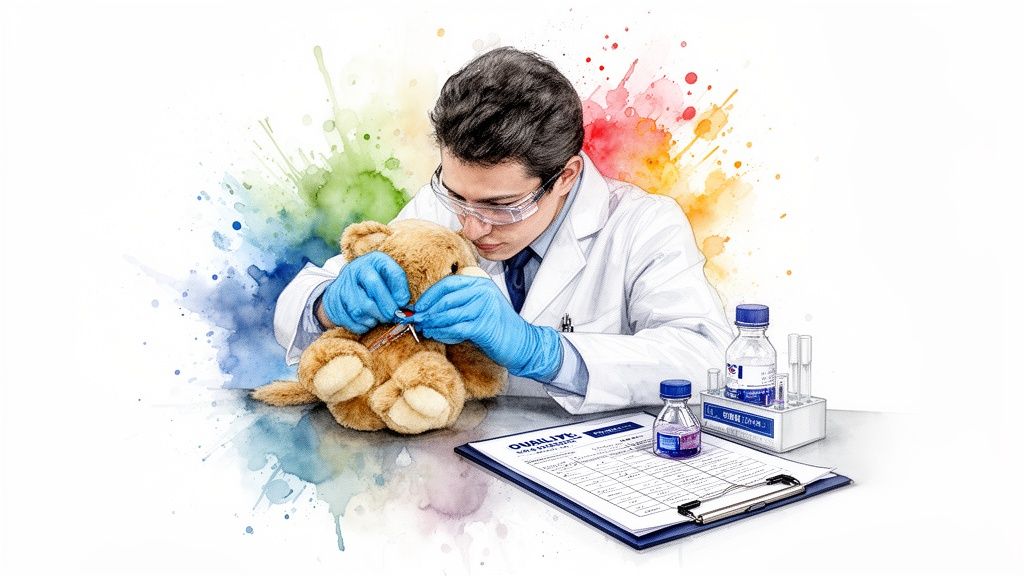
For a toy manufacturer, quality control is not a department; it’s a culture. Maintaining this culture is essential to producing the Best Stuffed Animals, as a low-quality factory poses a direct risk to your brand through recalls, safety liabilities, and long-term reputational damage.
Mandatory Safety Standards: EN71 & ASTM F963
These are not optional guidelines. They are legal requirements for selling toys in Europe and the USA, respectively.
- EN71 (EU): Covers mechanical properties (pull tests on eyes/noses), flammability, and chemical composition (heavy metal limits).
- ASTM F963 (USA): Similarly tests for physical hazards (choking, sharp points) and chemical toxicity (lead, phthalates).
A reputable factory builds your product to be compliant from the very first stitch, using pre-tested materials. We work with accredited labs like SGS, Intertek, and TUV to provide official certification.
Our Multi-Step Quality Inspection Process
- Incoming Quality Control (IQC): All raw materials (fabric, thread, stuffing) are inspected upon arrival for defects, color accuracy, and compliance.
- In-Process Quality Control (IPQC): Supervisors monitor the sewing and stuffing lines to catch deviations from the approved prototype in real-time.
- Final Quality Control (FQC): Every finished product undergoes a 100% visual inspection. We check for seam strength, embroidery cleanliness, and overall appearance before the crucial metal detection step.
Navigating Logistics & Shipping
Once production is complete, the final step is getting the products to your warehouse.
- Shipping Terms: Most pricing is quoted as FOB (Free On Board), meaning the price includes delivery to the designated port in China (e.g., FOB Shanghai). The buyer is responsible for ocean freight, customs, and inland transport from that point.
- Lead Times: Ocean freight from China to the US or Europe typically takes 30-45 days. Air freight is much faster (7-10 days) but significantly more expensive.
- Customs & Duties: You will need a customs broker in your country to handle import documentation and pay applicable tariffs.
How to Choose the Right Plush Toy Supplier
Selecting a manufacturing partner is the most important decision you will make.
- Look for Specialization: A factory that specializes in plush toys will have the right expertise and machinery. A general toy factory may not understand the nuances of fabric and stitching.
- Verify Certifications: Ask for proof of factory audits (like BSCI or SEDEX) and examples of past products that have passed EN71/ASTM testing.
- Communication is Key: Your contact should be fluent in English and demonstrate a deep technical understanding of the product. Poor communication is a major red flag.
- Avoid Unrealistic Prices: If a quote is dramatically lower than all others, it’s a sign that corners are being cut—likely in material quality, labor standards, or safety compliance.
Common Problems B2B Buyers Face
- Prototype vs. Production Discrepancies: The final bulk order doesn’t match the quality of the approved sample. This is a classic sign of poor in-process quality control.
- Hidden Costs: The initial quote is low, but costs are added later for things that should have been included, like packaging or testing.
- Communication Breakdowns: Language barriers or inexperienced sales staff lead to critical misunderstandings about design specifications.
Why FunEnjoy is a Trusted Manufacturing Partner
At FunEnjoy, we operate as a dedicated plush toy manufacturer, not a trading company. Our expertise is built on years of producing the Best Stuffed Animals through high-quality custom stuffed animal projects for brands worldwide.
- In-House Expertise: From pattern makers to quality control inspectors, our entire team is focused on one thing: creating the best stuffed animals.
- Transparent Process: We provide clear communication and visibility at every stage, from sampling to shipping.
- Commitment to Safety: We design every product with EN71 and ASTM F963 standards as our baseline, ensuring your product is market-ready and safe for all ages.
- Collaborative Approach: We see ourselves as your production partner, providing expert guidance to optimize your design for quality, cost, and safety.
Bringing a custom plush toy to life is a collaborative journey. With the right manufacturing partner, creating the Best Stuffed Animals becomes a smooth and rewarding process.