A high-quality Sonic plush is not just a toy. From a manufacturing perspective, it's a tangible piece of a global intellectual property, connecting fans to decades of entertainment. For brands and IP holders, producing a Sonic plush means tapping into a market fueled by powerful nostalgia and a constant stream of new media. Understanding the manufacturing process is critical to creating a product that meets fan expectations and brand standards.
An Insider's View of the Sonic Plush Market
From our factory floor in China, we have a direct view of how iconic characters like Sonic the Hedgehog drive production schedules and material sourcing. The character's enduring popularity, revitalized with each new film or game, creates a consistent demand that dictates the flow of our entire supply chain. A clear understanding of this commercial landscape is the first step for any business entering this space.
The global demand for plush toys is immense, and China is its manufacturing heartland. We produce over 70% of the world's plush toy exports, a scale that enables highly specialized production and provides access to competitive material pricing.
Sizing the Opportunity from a Production Standpoint
The data validates the demand we see on our production lines. In 2023, the market for stuffed and plush toys in China was valued at USD 976.3 million. Projections show it climbing to an estimated USD 1,729.1 million by 2030.
This projected compound annual growth rate (CAGR) of 8.5% signals a stable and expanding market for any brand involved. For a deeper analysis, you can review the China stuffed and plush toys market data.
This chart provides a clear breakdown of the market segments.
As the data shows, the "Stuffed Animals" category, where a Sonic plush resides, commanded the largest market share at 35.95% in 2023. This underscores its commercial significance for IP holders and retailers.
What This Means for B2B Buyers
For a business planning a Sonic plush project, these figures are a clear indicator of market viability. They confirm several key points:
- Sustained Demand: This is not a fleeting trend. The market is built on a loyal, multi-generational fanbase ensuring long-term product relevance.
- Mature Production Infrastructure: An efficient manufacturing ecosystem is already in place, capable of handling large-volume, high-quality orders.
- Commercial Viability: There is a proven, high-value market awaiting well-executed, officially licensed products.
As a manufacturer, we advise clients to view this not as making a toy, but as creating a collectible. To succeed, the quality, safety, and fidelity to the character must meet the high expectations of the Sonic fanbase. This is why the choice of a production partner is paramount.
From Technical Pack to Physical Prototype
This is the critical translation phase. When your design files for the Sonic plush arrive, our team begins the process of converting a 2D concept into a 3D physical sample. The process starts with your technical pack—this document is the blueprint for the entire project. Accuracy here prevents costly revisions later.
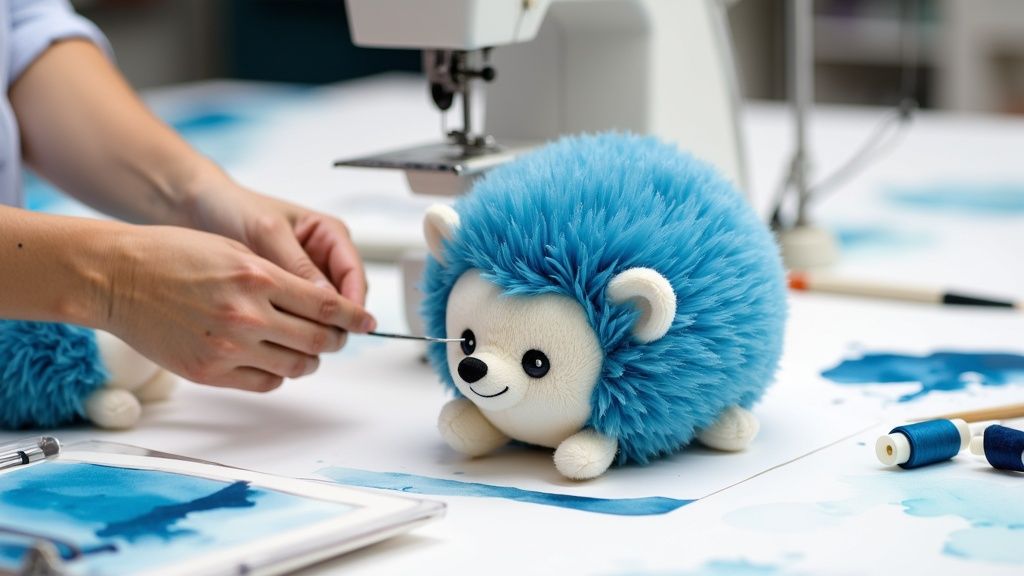
Our master pattern makers are the first to engage. These artisans interpret 2D drawings into 3D forms, meticulously creating the physical pattern pieces required to capture Sonic’s iconic silhouette—from his distinctive quills to his smirk. This step is a fusion of art and engineering; an imprecise pattern will result in a flawed final product, regardless of sewing quality.
The Prototyping Workflow
Once the pattern is finalized, we proceed to sample creation. Fabric is cut according to the new patterns and sent to the embroidery department. For a character like Sonic, this stage is crucial. We use high-precision, computer-controlled machines to stitch his eyes, nose, and facial details, ensuring the character-accurate expression that fans demand.
The embroidered pieces are then passed to our most experienced sewing craftsmen. They assemble the plush, focusing on precise stitch work and seam alignment. Finally, the sample is lightly stuffed to give it shape. The entire process—from receipt of your tech pack to a physical sample ready for review—typically takes 7 to 15 business days.
It is standard for the first prototype to require adjustments. Consider it a physical draft for collaborative refinement, not a finished product. It is a tool to align our production with your vision.
Feedback and the "Golden Sample"
Upon receiving the first sample, your feedback guides the revision process. Specificity is essential. Vague feedback like "the head looks wrong" is not actionable. Instead, provide precise instructions such as, "The muzzle is too pointed; it needs to be 5mm rounder," or "The left eye's embroidery is 2mm lower than the right." This clarity allows our team to make exact adjustments, saving time and avoiding additional sampling fees. For a deeper look at this process, see our guide on how to design your own plush toy.
We will revise the sample based on your notes. This iteration may occur several times until every detail is perfected. The final, approved prototype is known in the industry as the 'golden sample'.
This golden sample becomes the non-negotiable quality standard for mass production. Our quality control teams use it on the production line as a master reference, ensuring the 1,000th Sonic plush is identical to the first. It is your guarantee of consistency.
A Realistic Sonic Plush Sampling Timeline
The creation of a pre-production sample follows a structured timeline.
| Stage | Process Description | Typical Duration |
|---|---|---|
| Pattern Creation | Our pattern masters translate the tech pack into physical fabric patterns. | 2–3 Days |
| Material Cutting & Embroidery | Fabric is cut; features like eyes and logos are machine-embroidered. | 1–2 Days |
| Sewing & Assembly | Skilled technicians stitch the cut pieces into a 3D form. | 2–4 Days |
| Stuffing & Finishing | The plush is filled, shaped, and final details (e.g., tags) are added. | 1–2 Days |
| Internal QC & Shipping | We conduct a final internal review before shipping the sample to you. | 1–4 Days |
These are typical durations for one sample iteration. Revisions will extend the overall timeline, highlighting the importance of clear, consolidated feedback for maintaining project momentum.
Material and Filling Specification
The materials selected for your Sonic plush define the final product's look, feel, durability, and safety. This choice impacts everything from perceived value to production complexity.
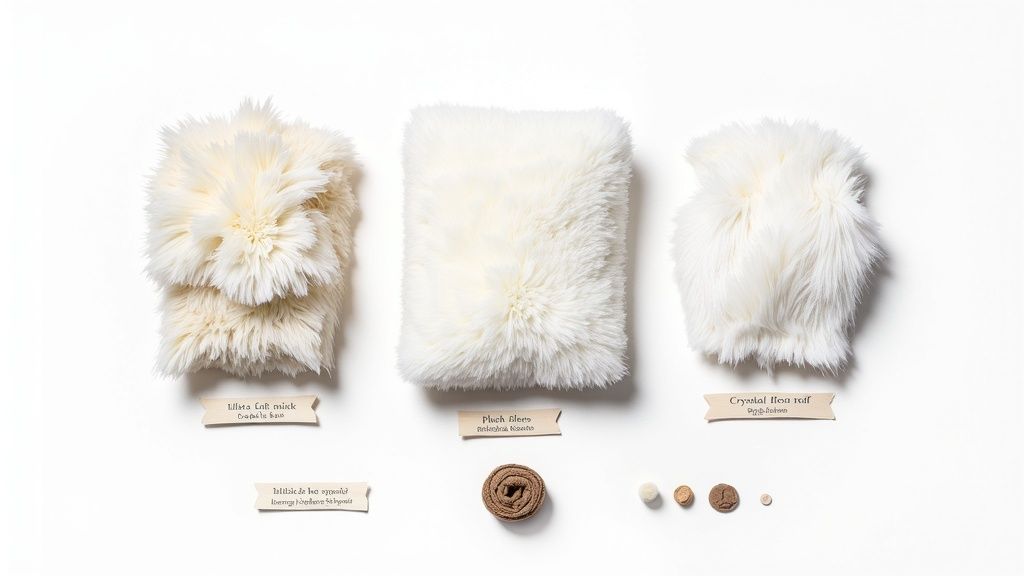
Let's examine the primary material options we utilize for characters like Sonic.
Fabric Selection: The Outer Shell
The exterior fabric is the first point of physical contact for the consumer. It establishes the initial quality perception and influences both cost and production difficulty.
-
Crystal Velvet (Minky Fabric): This is the industry standard for premium plush toys. Its short, dense pile provides an exceptionally soft and smooth texture. For a character like Sonic, its slight sheen enhances the vibrancy of his signature blue colour and is ideal for achieving crisp, detailed embroidery.
-
Plush Fleece (PV Fleece): A more traditional choice, PV fleece has a longer pile, creating a fluffier, classic "teddy bear" feel. While very soft, the longer fibers can sometimes obscure fine embroidered details. It might be used for specific textural elements.
-
Faux Fur: Used for specific details requiring a very long pile, such as the fluffy tails of the character Tails. It is more expensive and requires specialized cutting and sewing techniques to manage the long fibers.
For a modern Sonic plush, Crystal Velvet is typically the optimal choice due to its premium feel and its suitability for precise character detailing. A strategic combination of materials, however, can create a more dynamic and texturally interesting product.
From a production standpoint, shorter pile fabrics facilitate cleaner seams and sharper embroidery. This is a primary reason Crystal Velvet is often recommended for licensed characters where accuracy is paramount.
Internal Filling: Weight and Feel
The filling determines the plush's density, weight, and posture. While standard fillings are common, premium options can differentiate your product.
Standard Filling
The industry workhorse is Polypropylene (PP) Cotton. It is a synthetic polyester fiber that is lightweight, hypoallergenic, and maintains its shape well. It provides the classic, huggable feel expected in a plush toy and is highly cost-effective.
Premium Filling Options
To create a more unique product, consider these alternatives:
- Memory Foam Particles: Blended with PP cotton, these create a slow-rising, "squishy" texture.
- Weighted Beads: Poly-pellets or glass beads, secured in an internal pouch, add heft to the base or paws, allowing the plush to sit upright.
- Acoustic Cotton: For any plush that includes a sound box, this specialized cotton dampens vibrations and improves audio clarity.
Note that your choice of filling directly impacts unit cost, not only due to material price but also the additional labor required for insertion, especially for weighted components.
Material Compliance with Global Safety Standards
This is a non-negotiable aspect of production. All materials—fabric, thread, and filling—must comply with international safety standards for legal sale in major markets. Our supply chain is fully traceable, and our raw material suppliers must provide documentation certifying compliance with key regulations:
-
EN71 (Europe): The European standard for toy safety. For plush toys, we focus on Part 1 (Mechanical and Physical Properties), Part 2 (Flammability), and Part 3 (Migration of Certain Chemical Elements).
-
ASTM F963 (USA): The mandatory toy safety standard in the United States. It covers potential hazards such as small parts (choking), sharp points, and hazardous materials like lead and phthalates.
Our protocol involves using pre-certified materials and conducting batch tests on finished products. This ensures every Sonic plush is both true to the character and safe for all ages, protecting consumers and your brand's reputation.
Understanding Costs and Minimum Order Quantities (MOQ)
The most common initial questions from clients are, "What is the unit cost?" and "What is your minimum order?" These figures are fundamental to your budget and business plan. As a manufacturer, these numbers are determined by the practicalities of our production floor and supply chain.
The Rationale Behind Minimum Order Quantities (MOQs)
A Minimum Order Quantity (MOQ) is the smallest production run for a single design, typically ranging from 500 to 3,000 pieces for custom plush toys. This is not an arbitrary number; it's a practical limit dictated by our material suppliers and the efficiencies of mass production.
For instance, fabric mills will not dye a small 10-meter run of Sonic's specific Pantone blue; their own minimums are in the hundreds or thousands of meters. The same applies to thread, stuffing, and all other raw materials. We must procure components in bulk.
Furthermore, setting up a production line for a new design involves dedicating pattern makers, sewing teams, and embroidery machines. Spreading these setup costs over a very small run would make the per-unit price prohibitively high. An MOQ ensures an efficient production run, which keeps your unit cost viable.
Key Factors Driving Per-Unit Cost
The unit price of a Sonic plush is a function of materials, labor, and complexity. Minor design changes can significantly impact the final quote. Here is what we analyze when preparing your estimate:
- Design Complexity: A simple, rounded character is faster to sew than one with numerous appendages. Sonic's quills are a prime example; each must be cut, sewn, stuffed, and attached, adding significant labor time.
- Embroidery Detail: The size, density, and color count of embroidery for features like eyes directly impact machine time and material consumption, making it a major cost factor.
- Material Specification: Premium Crystal Velvet costs more per meter than standard fleece. Adding components like weighted beads or a sound module, such as in a plush toy with a voice recorder, increases both material and assembly costs.
- Size: A larger plush requires more fabric, stuffing, and thread. It also increases shipping volume, impacting logistics costs.
- Safety Testing & Certification: The cost of third-party lab testing to meet standards like EN71 or ASTM F963 is factored into the overall project budget.
A common error is underestimating the cost impact of intricate details. Features like multi-layered quills or detailed shoe buckles require more seams and thread colors, increasing labor time, which is the largest component of the unit price.
How Design Choices Impact Sonic Plush Costs
Every design decision affects the final unit price. This table illustrates how common choices influence costs.
| Feature | Lower-Cost Option | Higher-Cost Option | Cost Rationale |
|---|---|---|---|
| Facial Details | Screen-printed eyes and mouth | Multi-color, dense embroidery | Printing is a rapid, low-material process. Complex embroidery requires significant machine time, programming, and thread. |
| Body Shape | Simple, unified body shape | Multiple attached parts (quills, limbs) | Fewer pattern pieces reduce cutting and sewing labor. Each additional component adds an assembly step. |
| Fabric Choice | Standard plush (e.g., fleece) | Premium velboa or crystal velvet | Premium materials have a higher procurement cost per meter. |
| Size | 6-8 inches (15-20 cm) | 12+ inches (30+ cm) | Larger sizes require proportionally more fabric, stuffing, and packaging, increasing both material and freight costs. |
| Add-Ons | Standard polyester fill | Weighted beads, voice box, or squeaker | Special components add material costs and require additional, often manual, assembly steps. |
Strategic adjustments can yield significant cost savings without compromising the character's core design.
Strategies for Cost Reduction
While quality must be maintained, we understand budget constraints. Cost reduction is achievable through strategic design modifications.
For instance, simplifying a complex embroidery design by reducing its color count or stitch density can lower costs. Substituting printing for smaller stitched details can also be effective. Reducing the number of separate pattern pieces minimizes sewing labor. Our team will always provide cost-engineering suggestions to help you achieve your target price while preserving the integrity of the Sonic design.
The Manufacturing Workflow and Quality Control
Once the "golden sample" is approved, your Sonic plush project transitions from prototyping to mass production. This shift relies on a structured workflow with integrated quality control at every stage.
The unit cost is heavily weighted toward materials and production labor.
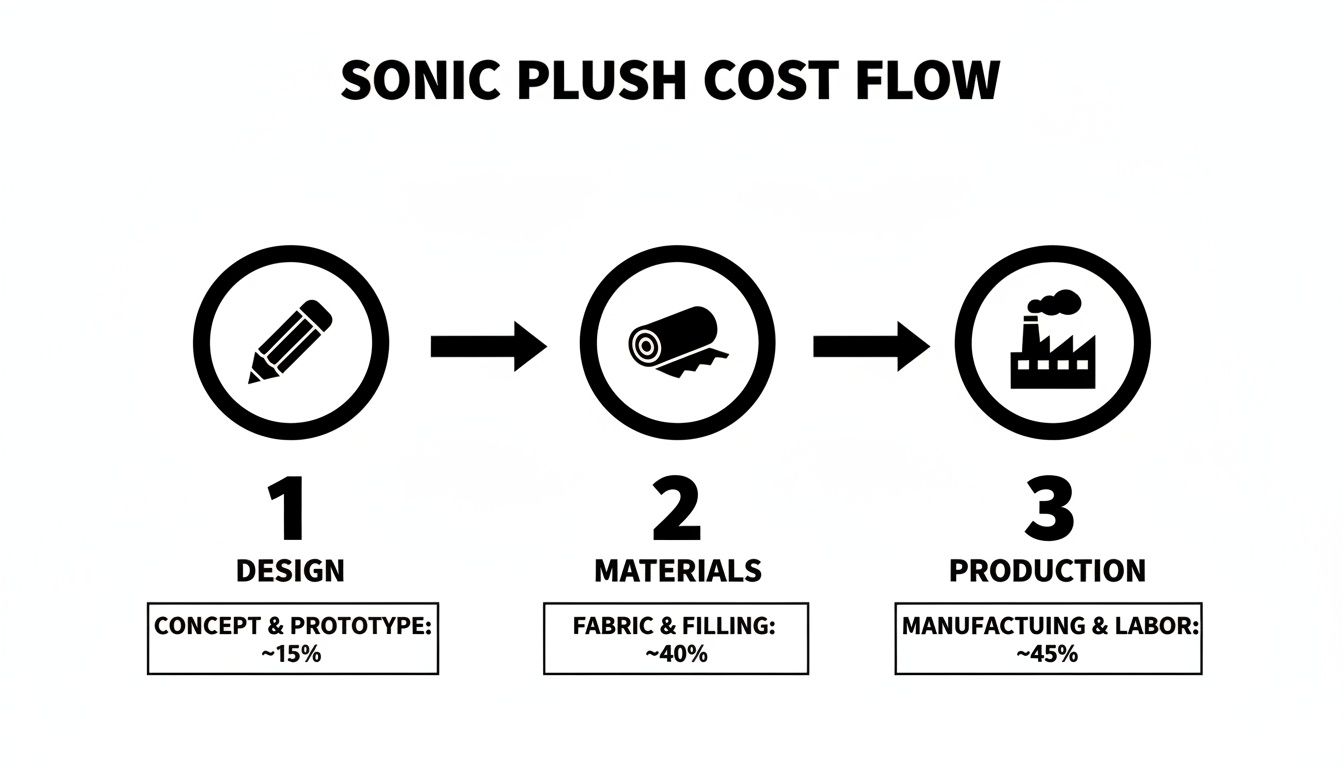
This breakdown highlights why an efficient, quality-driven manufacturing partner is essential, as materials and production constitute the majority of your cost.
From Bulk Material to Assembled Product
Upon receiving your production order, our procurement team places bulk orders for the specified fabric, thread, and stuffing. These materials do not go directly to the production line. They first undergo Incoming Quality Control (IQC).
Our IQC inspectors verify:
- Color Consistency: Does the fabric match the approved Pantone swatch precisely?
- Material Integrity: We inspect rolls for defects, blemishes, or textural inconsistencies.
- Specification Compliance: We confirm the quantity, weight, and thickness of materials received.
Only approved materials proceed to the cutting department, where hydraulic presses or laser cutters slice through multiple fabric layers simultaneously. These cut pieces then move to embroidery, where automated machines stitch facial features, programmed to replicate the golden sample exactly.
Assembly Line and In-Process Checks
The components are then distributed to specialized sewing teams. One team may focus exclusively on assembling the head and quills, while another handles the body and limbs. This division of labor enhances speed and consistency.
Throughout assembly, our In-Process Quality Control (IPQC) team patrols the floor. They randomly pull units from the line at various stages to check for crooked seams, mismatched parts, or poor stitch quality. Identifying deviations early prevents them from propagating through the entire batch, saving significant time and resources.
Quality is not inspected at the end; it is built in from the start. A robust IPQC process is what distinguishes a reliable manufacturer from one that delivers unforeseen problems upon delivery.
Final Inspection and Safety Assurance
After sewing, the plush shells are sent to the stuffing station. Our technicians use a precise amount of filling to ensure each plush has the same density and feel as the approved sample.
Following stuffing, every single plush passes through a metal detector. This is a critical safety step to ensure no broken needle fragments or other metallic foreign objects are inside the toy.
The final stage is Final Quality Control (FQC). A dedicated team conducts a thorough inspection based on the Acceptable Quality Limit (AQL) standard, a statistical sampling method used globally to assess batch quality.
The FQC team inspects for:
- Aesthetic Defects: Stray threads, dirt, or stains.
- Dimensional Accuracy: Does the final size conform to the specifications?
- Symmetry and Placement: Are eyes, ears, and quills positioned correctly?
- Component Security: We perform pull tests on sewn-on labels and other attachments to ensure they meet safety standards for the target age group.
Only batches that pass this final AQL inspection are approved for packing and shipment. This multi-layered quality assurance system ensures the final bulk order matches the quality of the golden sample.
How to Select a Manufacturing Partner
The selection of your factory partner is the most critical decision in the production process. A strong partner will enhance your product, protect your intellectual property, and simplify the global supply chain. A poor choice can lead to missed deadlines, failed safety tests, and inconsistent quality.
A proper evaluation looks beyond unit price to assess experience, transparency, and documented processes. This due diligence ensures the Sonic plush you designed is the one delivered to your warehouse.
OEM vs. ODM: Defining the Partnership Model
Understanding the two primary manufacturing models is key to finding a partner whose services align with your needs.
-
OEM (Original Equipment Manufacturer): This is the standard model for licensed products. You provide a complete technical pack, and we act as your production arm, manufacturing the plush to your exact specifications. You own the design; we provide the manufacturing expertise.
-
ODM (Original Design Manufacturer): In this model, we contribute to the design process. You might approach us with a concept—"a classic-style Sonic plush for the collector market"—and our in-house team develops sketches and the tech pack.
For a major IP like Sonic, an OEM partnership is the required approach, as the brand owner will provide strict, non-negotiable design guidelines.
Vetting Criteria for a Reliable Plush Toy Factory
A suspiciously low price is often a red flag for underlying problems. True value is found in reliability, quality, and compliance.
1. Verifiable Certifications
Internationally recognized certifications demonstrate a factory's commitment to quality management and ethical practices. Key certifications to request include:
- ISO 9001: Verifies a robust quality management system is in place.
- BSCI (Business Social Compliance Initiative): Confirms ethical working conditions, fair wages, and a safe environment.
2. Proven Experience with Licensed Characters
Manufacturing a generic teddy bear is fundamentally different from recreating an iconic character with precision. Request to see a portfolio of work with other major licensed brands. A factory with IP experience understands brand integrity, strict approval processes, and the necessity of confidentiality. You can explore examples of high-quality stuffed animals to gauge a factory's capabilities.
3. Transparent and Professional Communication
Your primary contact should be fluent in your business language, responsive, and clear. Misunderstandings are a primary cause of production errors. A good partner provides regular updates, asks clarifying questions, and is transparent about potential challenges.
4. A Documented Quality Control System
Request a detailed walkthrough of their QC process. They should be able to articulate their procedures for Incoming Quality Control (IQC) on raw materials, In-Process Quality Control (IPQC) during assembly, and Final Quality Control (FQC) pre-shipment.
The most significant risk of choosing a low-cost, unvetted factory is not just poor quality, but IP theft. Unscrupulous factories may produce unauthorized "ghost runs" to sell on the grey market, devaluing your brand. Additionally, they often fail safety tests, leading to entire shipments being seized and destroyed at customs—a catastrophic and avoidable financial loss.
Common B2B Buyer Questions
Here are direct answers to the most common questions we receive from brands and IP holders planning to produce a Sonic plush.
What’s a Realistic MOQ for a Custom Sonic Plush?
For a custom plush, a realistic Minimum Order Quantity (MOQ) starts at around 500 pieces per design. This figure is driven by the minimums required by our fabric suppliers for custom-dyed materials. It also ensures the economic viability of setting up a dedicated production line with unique patterns and embroidery programs. For highly complex designs, the MOQ may be higher.
How Long Does It Take to Make 1,000 Plush Toys?
Once the "golden sample" is approved, mass production for an order of 1,000 Sonic plushies typically takes 30 to 45 days. This timeline includes material procurement, inspection, cutting, sewing, stuffing, and final quality control. This does not include shipping transit time, which varies based on destination and freight method.
What Are the Essential Safety Tests for Plush Toys?
Product safety is mandatory. For major Western markets, two standards are critical:
ASTM F963 for the United States and EN71 for the European Union. Non-compliance can result in your shipment being rejected at customs, a costly and preventable outcome.
These standards cover physical and mechanical safety (e.g., seam strength, small parts), flammability, and chemical content. A reputable manufacturer will manage the entire compliance and testing process to ensure your product is market-ready and safe for consumers.
Ready to bring your own plush toy idea to life? The team at FunEnjoy PlushToys has decades of experience turning concepts into high-quality, safe, and beloved products for brands worldwide. Get a free quote for your project today!