From our factory floor in China, we see firsthand what drives the global toy market. A Sonic plush backpack isn’t just another product; it’s a case study in merging licensed IP with everyday utility. It represents a significant and consistent demand signal from B2B buyers worldwide.
The appeal is a calculated mix of brand recognition and functional design. For us as manufacturers, understanding this synergy is key to optimizing production and delivering a product that succeeds in a competitive landscape.
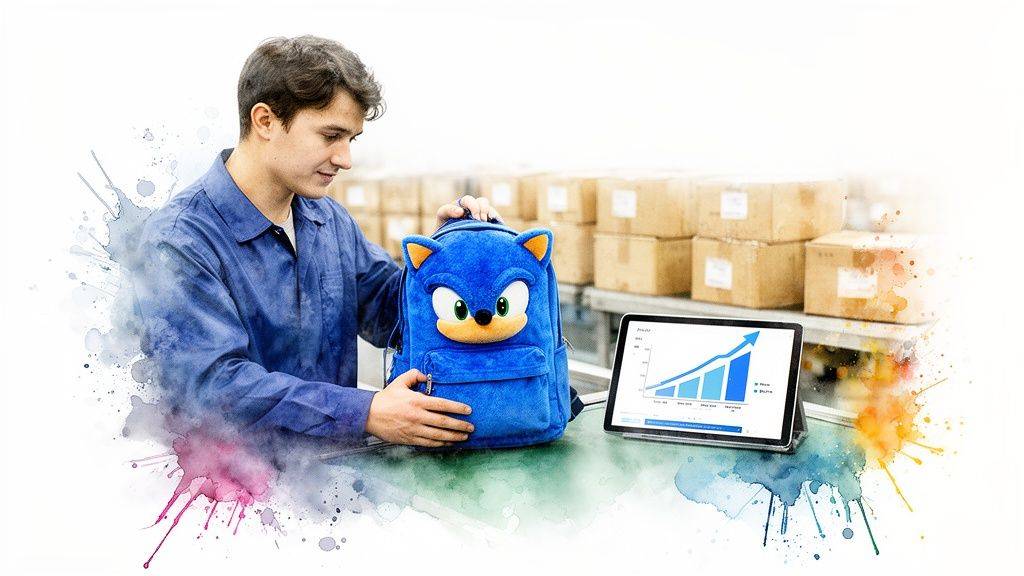
Market Overview: Why Sonic Plush Backpacks Command Production Priority
In our industry, production capacity is allocated to products with proven market viability. The Sonic plush backpack is a consistent priority on our production lines, not based on trends, but on concrete order data and direct feedback from our global B2B clients.
The Power of Licensed IP
Sonic the Hedgehog is a globally recognized intellectual property with decades of market presence. This established brand equity significantly reduces the marketing burden for our clients.
From a manufacturing standpoint, this translates to two core advantages:
- Predictable Demand Cycles: New media releases—games, films, or series—reliably trigger new waves of orders. This creates a predictable and sustainable business flow for our partners and for our factory.
- Higher Perceived Value: Licensed merchandise typically commands a premium retail price. This allows our clients to invest in superior materials and construction without eroding their margins, aligning with our commitment to quality.
The Fusion of Play and Utility
A standard plush toy serves a decorative or play-based function. A backpack is a utility item. The Sonic plush backpack merges these categories, expanding its market appeal exponentially. Parents see a practical item for school or travel; children see a beloved character they can take anywhere.
From a production perspective, this hybrid nature dictates specific manufacturing considerations. The product must possess the soft, tactile appeal of a plush toy while demonstrating the durability of a daily-use bag. This requires reinforced strap attachment points, robust zippers, and plush fabrics selected for their resilience to wear and tear.
The toy manufacturing hub in Zhejiang province, where we operate, is fiercely competitive. Functional plush items like these have secured a stable and growing market segment. Analysis shows China’s stuffed toy market is projected to grow substantially, with a significant portion of this growth attributed to functional licensed merchandise like the Sonic plush backpack.
Production Snapshot for B2B Buyers
This table provides a realistic overview of key manufacturing metrics for sourcing Sonic-themed plush backpacks from an established Chinese factory.
| Metric | Industry Benchmark (China Factory) |
|---|---|
| Minimum Order Quantity (MOQ) | 500 – 1,000 units per design |
| Prototyping Lead Time | 7 – 14 days |
| Mass Production Lead Time | 30 – 45 days (post-sample approval) |
| Unit Cost Driver | Material grade, design complexity, order volume |
| Key Compliance Standards | EN71 (EU), ASTM F963 (USA) |
These benchmarks are crucial for realistic project planning. To optimize your time-to-market, mastering production efficiency is non-negotiable. Efficiently planned production results in faster turnarounds and superior cost control, making a product line more viable for large-scale manufacturing.
Anatomy of a Quality Sonic Plush Backpack: A Manufacturer’s Breakdown
Successful product development requires a deep understanding of materials and construction. To an end-user, it’s a cute bag. To us, it’s an assembly of carefully specified components, each chosen to meet a precise functional and aesthetic requirement. Similar to web development, you must understand what key features define a quality product for it to succeed.
The Plush Exterior Shell: Material Science
The tactile experience is paramount. The choice of fabric determines the character’s look, feel, and durability.
- For Sonic’s Blue Fur: The industry standard is short-pile velboa. Its dense, short fibers provide excellent color retention for Sonic’s iconic blue, offer a slight sheen that mimics his on-screen appearance, and exhibit high resistance to pilling and daily abrasion.
- For Softer Accents: For details like the muzzle or inner ears, we use minky fabric. It is noticeably softer than velboa, creating a textural contrast that signals a higher-quality product to the consumer.
Using an inappropriate material, such as long-pile fur, would be aesthetically incorrect for the character and functionally disastrous for a backpack, as it would quickly become matted and soiled.
The Filling: The Core of the Product
The filling dictates the product’s shape, weight, and “cuddle factor.”
We exclusively use 100% new, high-loft 7D polyester fiberfill. While cheaper recycled or standard PP cotton is an option, it is prone to clumping and moisture absorption over time. This results in a lumpy, heavy, and potentially unhygienic product. High-loft polyester is lightweight, resilient, and maintains its shape, ensuring Sonic’s quills and head remain well-defined, not misshapen. This is a non-negotiable quality standard for a premium product.
The Functional Backpack Components
The “backpack” functionality is where low-cost manufacturers often fail, leading to product returns and brand damage.
1. Reinforced Adjustable Straps
Straps are the highest stress points. We use high-density nylon webbing and reinforce all attachment points with bar-tack stitching—the same technique used in high-performance outdoor equipment to prevent tearing.
2. Durable Zippers
We source from proven zipper suppliers. A quality nylon or metal zipper is essential. A single zipper failure renders the product useless. During QC, zippers are tested through hundreds of cycles.
3. Quality Internal Lining
The interior pouch is lined with a durable, easy-to-clean fabric like 210D polyester. This prevents small items from snagging on the filling and adds structural integrity.
By focusing on these specific material and construction details, we manufacture a Sonic plush backpack that is not merely a toy, but a durable, functional product. For further insights into character-based bags, our guide on creating a custom backpack plush provides more detail.
Manufacturing Process: From Design to Delivery
The journey from a digital design file to a container of finished Sonic plush backpacks is a structured process. For the buyer, it begins with a fundamental decision: the choice between an OEM or ODM manufacturing model.
OEM vs. ODM: A Critical Strategic Choice
This initial decision dictates creative control, timeline, and investment.
-
OEM (Original Equipment Manufacturer): You provide a unique, fully developed design for your Sonic plush backpack. We act as your production partner, leveraging our manufacturing expertise to execute your exact specifications. This offers complete creative control but requires a production-ready design package from your end.
-
ODM (Original Design Manufacturer): You select a design from our existing catalog of pre-vetted, market-proven plush backpacks. We then apply your branding. This path offers a significantly faster time-to-market and lower development risk, but customization is limited to elements like branding, colorways, and select materials.
This table provides a direct comparison for B2B decision-making.
OEM vs. ODM for a Sonic Plush Backpack
| Factor | OEM (Original Equipment Manufacturer) | ODM (Original Design Manufacturer) |
|---|---|---|
| Design Ownership | You provide a 100% unique, custom design. You own the IP. | You choose from our pre-existing, factory-vetted designs. |
| Creative Control | Total. Every material, stitch, and dimension is dictated by you. | Limited. Customization is mainly branding, colors, and materials. |
| Time to Market | Slower. Requires a full R&D, prototyping, and sampling cycle. | Faster. The design is engineered and ready for mass production. |
| Upfront Investment | Higher. Includes design, development, and potential tooling costs. | Lower. Minimal R&D costs as the design already exists. |
| Best For | Brands with design resources seeking a completely unique product. | Brands prioritizing speed-to-market, lower risk, and proven concepts. |
Regardless of the model chosen, the core components remain constant. We manage the sourcing and quality for all fundamental materials.
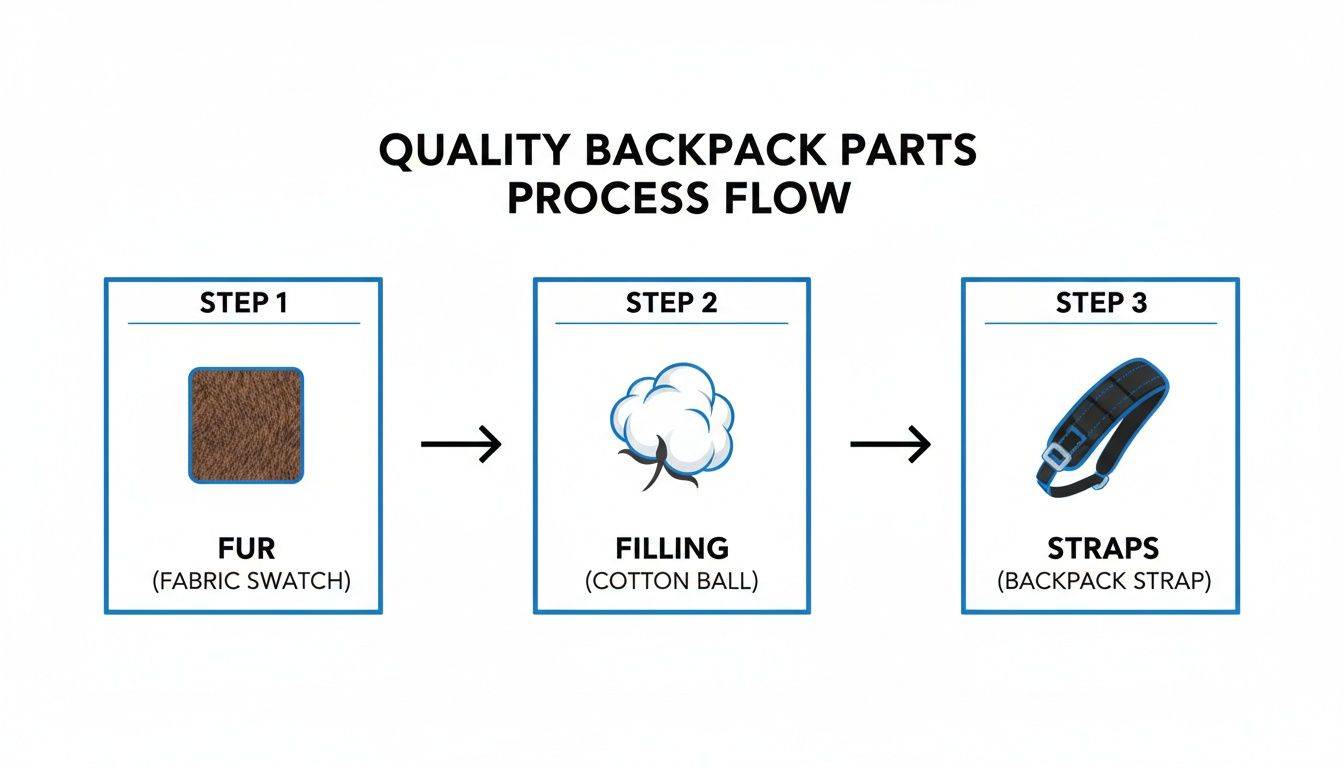
These material pillars—fabric, filling, and hardware—are the foundation of every product we produce.
The Sampling Stage: The Most Critical Phase
Once the design direction is set, we proceed to sampling. This is where the concept becomes a tangible product. A first prototype, or “counter-sample,” typically takes 7–14 working days, contingent on design complexity and material sourcing.
Client feedback at this stage is critical to the project timeline. Vague feedback such as “make it look better” is unproductive. We require precise, actionable instructions. For example: “Increase stuffing density in the quills by 15% for a firmer shape,” or “The strap length is 5cm too short for the target age group; extend to 45cm.” Clear, technical feedback enables our pattern makers to make precise adjustments, accelerating the approval of the final “golden sample.”
The market for such items is robust. The broader toy sector in China is on a significant growth trajectory, with plush and stuffed toys being a major component. Backpacks linked to popular media are seeing strong growth, driven heavily by e-commerce, a trend explored in this deep dive into China’s toy market.
From Sample Approval to Mass Production
Upon your approval of the golden sample, we initiate mass production. This phase typically requires 30–45 days. This schedule allows for meticulous execution at each stage.
- Material Sourcing & Cutting: We procure the exact materials specified in the approved sample. Large bolts of fabric are then cut into precise pattern pieces using industrial die-cutting machines for absolute uniformity.
- Machine Embroidery: Sonic’s facial features are applied using computer-controlled embroidery machines. This ensures perfect consistency of expression across the entire production run.
- Sewing & Assembly: Skilled sewing teams assemble the flat pieces into their three-dimensional form.
- Stuffing & Closing: The shells are filled with high-loft polyester using calibrated machines to ensure consistent density. A small opening is then hand-stitched closed.
- Final Inspection & Packing: Every unit undergoes a final quality inspection against the golden sample before being packed according to client specifications for shipment.
Pricing Factors: Understanding the Unit Cost of a Sonic Plush Backpack
The most common question from B2B buyers is about price. The per-unit cost of a Sonic plush backpack is not an arbitrary figure; it is a direct calculation based on specific production inputs. Understanding these cost drivers is essential for effective budgeting and product development.
The Three Core Pricing Factors
The final unit cost is determined by three main variables: materials, design complexity, and order volume.
- Materials and Components: This is a primary cost driver. Using premium short-pile velboa and 7D polyester fill costs more than lower-grade alternatives, but the resulting difference in product quality and durability is substantial. Custom-dyeing fabric to a specific Pantone shade also incurs higher costs than selecting from our extensive in-stock color library.
- Design Complexity: A more complex design requires more labor and machine time. The number of individual pattern pieces, the density of embroidery, and the addition of accessories all increase production time and, therefore, cost. A design with fewer seams and selective use of printing over embroidery is inherently more cost-effective to produce.
- Order Quantity (Volume): This is the most significant factor influencing unit price. Higher volumes allow us to procure raw materials at a lower cost and optimize production line efficiency, drastically reducing the cost-per-unit. A 5,000-unit order will have a significantly lower unit cost than a 500-unit order.
The Rationale Behind Minimum Order Quantities (MOQs)
From a buyer’s perspective, an MOQ can seem like an obstacle. From a manufacturer’s perspective, it is a necessity for custom production. The setup process involves creating custom patterns, programming embroidery machines, and calibrating cutting equipment.
Our MOQ, typically 500-1,000 units, exists to ensure the production run is large enough to amortize these upfront setup costs. For smaller runs, the per-unit setup cost becomes prohibitively high for both the client and the factory.
We understand the needs of new brands and test runs. We can sometimes accommodate smaller orders, particularly for simpler designs or for returning clients. Building long-term partnerships is a priority. You can explore our work with other character lines, such as our different Sonic plush toys, to see how we balance scale and customization.
Cost Engineering: Strategies to Reduce Unit Price
Reducing unit cost does not have to mean compromising quality. There are several effective cost-engineering strategies we recommend to our clients.
- Optimize Embellishments: A dense, multi-layered embroidered patch can sometimes be replaced with a high-quality sublimated print or a simpler patch design. Reducing stitch count is a direct way to cut production time and cost.
- Utilize In-Stock Materials: Selecting a color from our vast library of high-quality, in-stock fabrics avoids custom-dyeing fees and associated minimum yardage requirements.
- Increase Order Volume: This is the most direct method to achieve a lower unit price. A larger order commitment provides the best possible economy of scale.
- Slight Size Adjustments: A marginal reduction in the product’s overall dimensions (e.g., 10%) can yield significant material savings by allowing for more efficient nesting of pattern pieces on the fabric, reducing waste.
The most effective approach is a transparent discussion with your manufacturer. By aligning on budget targets and product goals, we can engineer a final product that meets both quality standards and financial objectives.
Quality Control & Safety Compliance: A Manufacturer’s Mandate
For a product like the Sonic plush backpack, quality is not a final inspection; it is a comprehensive system integrated into every stage of production. Delivering a safe, durable, and perfectly manufactured product is our core commitment. This is how we ensure every unit meets both customer expectations and regulatory requirements.
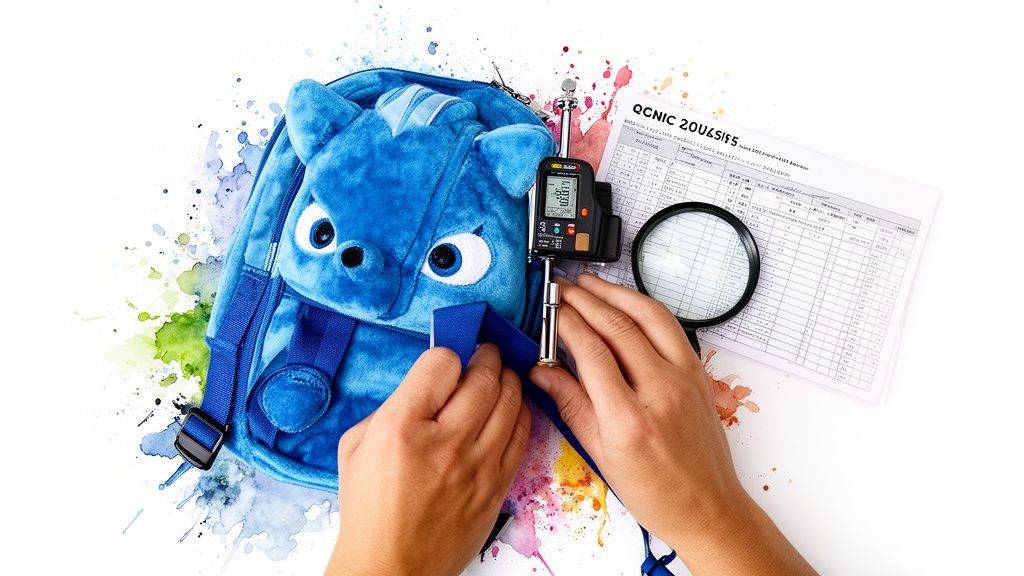
Our quality assurance process begins with raw material verification and concludes only when the final shipping container is sealed.
Multi-Stage Quality Control (QC) System
Our QC process is designed for early defect detection. Identifying a flaw in a bolt of fabric is a minor issue; identifying the same flaw in 5,000 finished units is a catastrophic failure.
1. Incoming Quality Control (IQC)
Before production begins, our IQC team inspects all raw materials. This includes verifying color consistency against Pantone standards, checking for fabric defects, and confirming material weight. Zippers, straps, and buckles are mechanically tested for durability.
2. In-Process Quality Control (IPQC)
Inspectors monitor the assembly lines at critical junctures.
- Embroidery: We check for stitch density, thread tension, and accurate character representation.
- Sewing: Seam allowance and stitch density are continuously monitored. Seam failure is the most common point of failure in low-quality plush products.
- Stuffing: We ensure even filling distribution to maintain the product’s intended shape and tactile feel.
3. Final Quality Control (FQC)
Every finished Sonic plush backpack undergoes a 100% final inspection. Inspectors compare each unit against the approved “golden sample,” checking for any deviation, from strap alignment to cosmetic blemishes.
From a manufacturer’s perspective, this rigorous QC system is a form of risk management for our clients. A single non-compliant batch can lead to recalls, legal action, and irreparable brand damage. Our QC process is your best insurance policy.
Navigating Global Safety Standards: EN71 & ASTM F963
A product must comply with the mandatory legal safety standards of its target market. For plush toys, the most critical are EN71 for the European Union and ASTM F963 for the United States.
EN71 (European Standard for Toy Safety)
- Part 1 (Mechanical and Physical Properties): Involves tensile tests on seams, straps, and small attachments to ensure they do not detach and create a choking hazard.
- Part 2 (Flammability): Materials are tested to ensure their rate of flame spread is below a strict legal limit.
- Part 3 (Migration of Certain Elements): This chemical analysis screens for heavy metals like lead, cadmium, and mercury in all materials.
ASTM F963 (American Standard for Toy Safety)
This standard has significant overlap with EN71, with a strong focus on:
- Small Parts Test: Any component that fits within a standardized “small parts cylinder” (approximating a child’s throat) is prohibited for toys intended for children under three.
- Sharp Points & Edges: All accessible edges and points are tested to ensure they are not sharp enough to cause injury.
- Stuffing Cleanliness: The internal filling material must be certified as new, clean, and free of contaminants.
By engineering the product for compliance from the initial design phase, we ensure your Sonic plush backpack is safe, legal, and ready for global distribution.
How to Choose a Supplier: A Factory Insider’s Perspective
The success of your Sonic plush backpack hinges on selecting the right manufacturing partner. An attractive low price can be tempting, but a partnership built on transparency, proven expertise, and verifiable compliance is what delivers long-term value. The most important question is not “What is your price?” but “How will you ensure quality and protect my brand?”
You are not just buying a product; you are entrusting a factory with your brand’s reputation.
Questions to Ask Beyond Price
When vetting a potential factory, move beyond price and probe their operational standards. Their answers will reveal their legitimacy and competence.
-
“Can you provide your factory audit reports, such as BSCI or SEDEX?” The BSCI (Business Social Compliance Initiative) and SEDEX (Supplier Ethical Data Exchange) are third-party audits verifying ethical labor practices, workplace safety, and environmental responsibility. Reputable factories will have these reports readily available and will be transparent about them.
-
“What is your experience with licensed IP like Sonic?” Manufacturing for a major brand like SEGA requires a deep understanding of IP protection protocols. A professional factory will immediately request your licensing agreement and offer to sign a Non-Disclosure Agreement (NDA). Any hesitation, or a willingness to proceed without verifying your license, is a major red flag indicating a lack of professionalism and potential legal risk.
-
“Can you detail your quality control process for this specific product?” A generic answer like “we check quality” is insufficient. A competent partner should be able to articulate their multi-stage QC process, including IQC (incoming material checks), IPQC (in-process inspections), and FQC (final product inspection).
Critical Red Flags for B2B Buyers
Certain warning signs should immediately disqualify a potential supplier. Ignoring them can lead to catastrophic outcomes, including defective products, financial loss, and legal liability.
-
Unrealistically Low Pricing: A quote that is significantly lower than competitors is not a bargain; it’s a warning. It almost certainly indicates corner-cutting on materials, safety testing, or labor practices.
-
Vagueness on Compliance: When asked about EN71 or ASTM F963, the only acceptable answer is an unequivocal “Yes, we are fully compliant and can provide test reports.” Any evasiveness or suggestion that testing is “optional” signals that they cannot produce a product legal for sale in Western markets.
-
Poor Communication: Slow responses, persistent language barriers, or a reluctance to provide clear information during the vetting process are precursors to the communication problems you will face once a deposit has been paid.
Selecting a factory is analogous to hiring a critical team member. The relationship must be built on trust, proven capability, and clear communication. The objective is to find a long-term partner who understands your brand’s standards and can deliver consistent quality, order after order.
This philosophy is central to our own operations. This is why we have built lasting partnerships with some of the world’s leading brands. For more context on the supplier landscape, our overview of different stuffed animal companies can provide valuable benchmarks.
Common Questions We Hear from Buyers
We field inquiries from B2B buyers daily. The same critical questions consistently arise regarding intellectual property, cost management, and production timelines. Here are our direct, manufacturer-level answers to the most common queries about producing a sonic plush backpack.
What Are the IP Requirements for a Licensed Sonic Plush Backpack?
This is the first and most critical gate. Before we can engage in any production discussion, we must verify your official licensing agreement from the IP holder, SEGA. Without this legal authorization, we cannot and will not produce any licensed character.
This is a non-negotiable legal requirement that protects your business, the IP holder, and our factory from infringement. Any professional manufacturer will demand this documentation and should readily offer to sign a Non-Disclosure Agreement (NDA) to protect your proprietary information.
How Can I Reduce Unit Costs Without Sacrificing Quality?
Your primary tool for cost reduction is order volume. Larger orders enable economies of scale in material purchasing and production line efficiency, significantly lowering the per-unit cost. A second effective strategy is design optimization. We can collaborate to simplify the design—for example, by reducing the number of pattern pieces or substituting high-quality printing for complex embroidery on smaller details.
A third tactic is to select materials from our extensive in-stock library. We maintain a curated selection of high-quality fabrics in various colors. This avoids the cost and minimum order quantities associated with custom-dyeing fabric, and our team can advise which substitutions offer the best cost savings with minimal aesthetic impact.
What Is the Most Common Cause of Production Delays?
From our experience, the single most common cause of delay is inefficient feedback during the sampling phase. Protracted approval times or vague, non-actionable revision requests create a cascade effect, pushing back the entire mass production schedule.
The second most common issue is the sourcing of unique, custom materials with long lead times. This highlights the importance of partnering with a factory that has strong, established supplier relationships and communicates proactively about potential sourcing risks early in the process.
Ready to bring your sonic plush backpack concept to market with a manufacturer who understands the entire process from a technical and commercial perspective? The team at FunEnjoy PlushToys is equipped to guide you from design and compliance to final delivery.