As a manufacturer based in China, we’ve seen the evolution of plush stuffed animals toys from the factory floor. They are no longer just simple playthings. For brands, retailers, and creators, a custom plush toy is a powerful physical medium—a tangible connection that turns a digital character or company logo into a memorable, huggable experience. To succeed, you must first understand the manufacturing realities.
Market Overview: From Plaything to Asset
From our vantage point, the market for plush toys has fragmented into dynamic and valuable segments. A plush toy is just as likely to be a promotional centerpiece at a corporate event or a limited-edition collectible for an adult fan as it is a child’s companion. This evolution is driven by distinct market forces, creating significant opportunities for businesses that understand the landscape.
Benefits of Custom Plush Toys for Brands
The “kidult” phenomenon—adults buying toys for themselves—is a major driver. This demographic seeks high-quality, often licensed, plush collectibles, fueling demand for premium materials and intricate designs. Brands leverage custom plush toys as a core marketing tool to forge an emotional connection with their audience.
A custom plush toy is a three-dimensional storyteller. It communicates brand values, evokes nostalgia, and creates a lasting physical impression in a way digital marketing cannot.
Market Growth and Opportunity
The scale of the industry is significant. The China stuffed and plush toys market alone reached approximately USD 976.3 million in 2023 and is forecast to climb to USD 1,729.1 million by 2030, reflecting a compound annual growth rate (CAGR) of about 8.5%. Stuffed animals constitute the largest segment, accounting for nearly 36% of the market. This growth indicates a robust field for brands investing in quality and creativity. Whether developing a unique mascot or exploring popular stuffed animals, the potential for return on investment is higher than ever.
The Manufacturing Process: A Factory Floor Perspective
Transforming a 2D sketch into a 3D plush toy is a process of precision engineering and skilled craftsmanship. It is less about simple sewing and more about bespoke tailoring, requiring a deep understanding of material behavior and production logistics. Here is the workflow we follow daily.
Step 1: Prototyping and Sampling (The Blueprint)
It begins with your concept—a detailed character sheet or a simple napkin sketch. Our first role is technical consultation. We analyze the design for manufacturability, identifying potential challenges like overly complex shapes or minute details that won’t translate well to fabric before a single piece is cut.
Once the design is finalized, our pattern master translates the 2D artwork into a 3D pattern. This is the blueprint for the toy. Each component—a limb, an ear, the torso—is meticulously drafted, accounting for seam allowances and the specific stretch and pile of the chosen fabric.
The first physical sample is then created:
- Fabric Cutting: Pattern pieces are laid out. For mass production, we use high-precision laser cutters; for small, intricate parts, manual cutting by skilled artisans remains superior.
- Embroidery & Printing: Facial features, logos, and other details are applied at this stage. High-density embroidery machines stitch eyes and mouths, while screen or heat-transfer printing is used for complex graphics. This is done before the pieces are sewn together for maximum precision.
- Initial Stitching: Our sewing teams assemble the flat pieces into a three-dimensional, unstuffed “skin.”
This first prototype is a critical milestone. We ship it to you for physical evaluation. The initial sampling timeline is typically 5–10 business days. It is standard to undergo one or two revision cycles to perfect the design.
Step 2: Mass Production and Assembly
With prototype approval, we move to mass production. The process is scaled, but the attention to detail remains. Skins are sewn in batches, using a combination of machine stitching for long seams and hand-stitching for complex curves or attaching small parts like ears and tails.
Next is stuffing. Achieving the correct fill density is crucial to the toy’s final feel. We use calibrated blowing machines for consistent distribution, with manual adjustments by our team to eliminate lumps or empty corners. The final opening is closed with a hidden “ladder” stitch, making the seam nearly invisible.
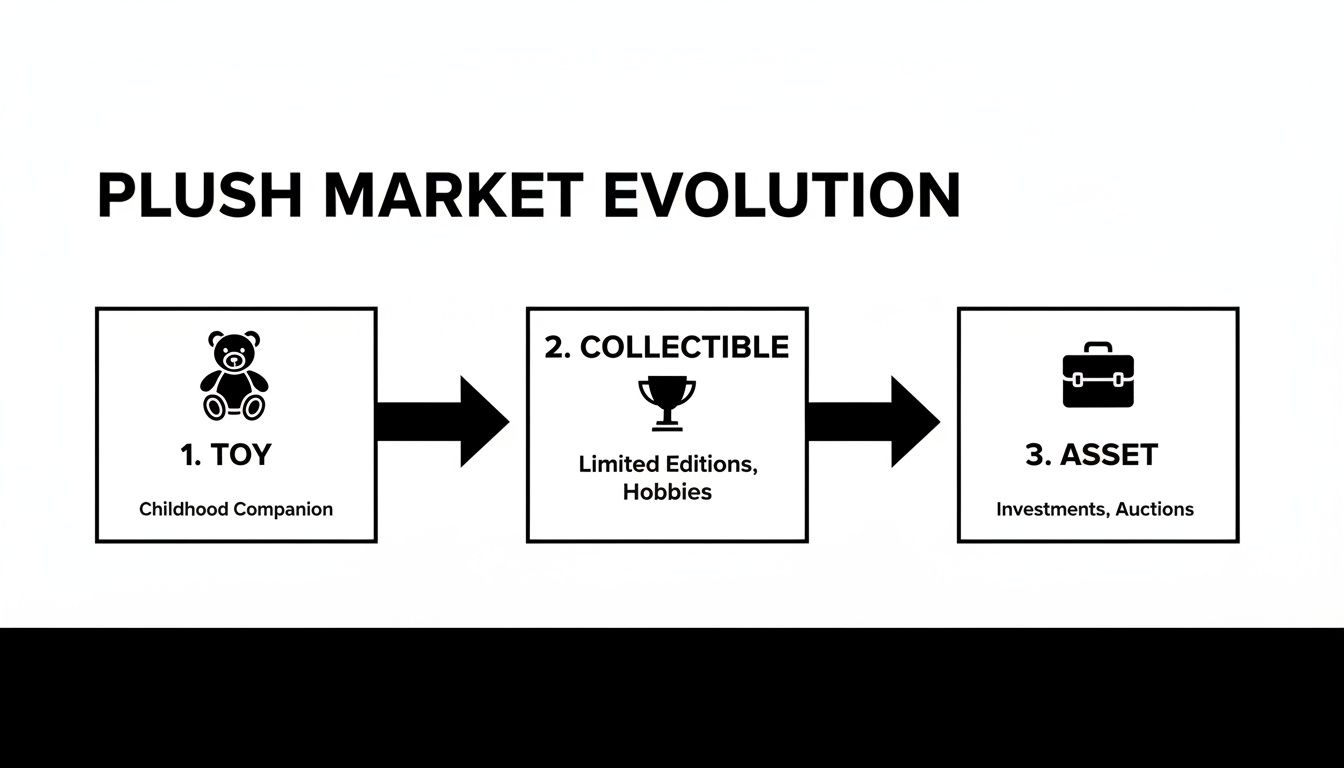
This evolution underscores the importance of a plush toy for branding and as a genuine collectible.
The final stage involves finishing and quality control:
- Cleaning: Each toy is brushed and air-cleaned to remove loose fibers.
- Metal Detection: This is a mandatory safety step. Every toy passes through a metal detector to ensure no broken needle fragments are present.
- Final Inspection: Our QC team performs a final check against the approved master sample, verifying symmetry, seam strength, and overall construction.
Only after passing every check is a toy packaged for shipment. This rigorous process ensures each plush we create is not only true to the original design but also safe, durable, and of exceptional quality. For a closer look at our machinery and techniques, see how we make plush toys in our detailed factory guide.
Types of Materials: Fabric and Filling Explained
The tactile quality of a plush toy is defined by its materials. The choice of fabric and filling dictates its feel, durability, safety compliance, and ultimately, its production cost. These decisions directly impact manufacturing complexity and the ability to pass stringent safety standards like EN71 (Europe) or ASTM F963 (USA).
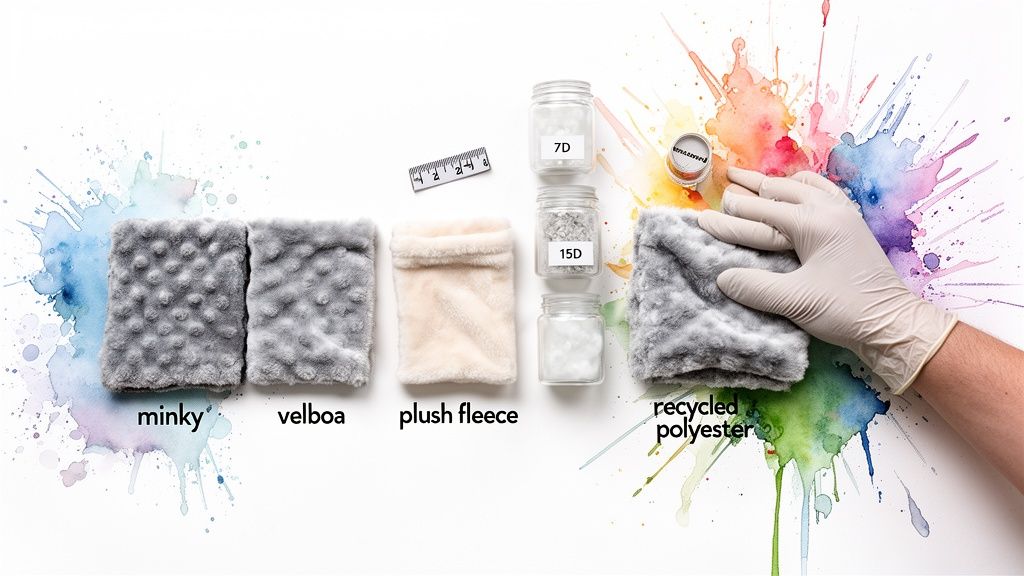
A Guide to Plush Toy Fabrics
The fabric is the primary sensory interface with the consumer. While hundreds of options exist, a few core materials are the workhorses of the plush stuffed animals toys industry due to their reliability and distinct characteristics.
- Plush Fleece: The classic, cost-effective option. It is soft, fuzzy, durable, and easy to work with, making it an excellent all-rounder for standard stuffed animals.
- Minky (or Cuddle) Fabric: A premium material known for its exceptional softness, gentle sheen, and smooth, silky feel. We reserve it for high-end baby toys and collectibles where a luxurious touch is paramount.
- Velboa: Characterized by a shorter, denser pile similar to velvet. Its durability and short pile make it ideal for toys with detailed printed patterns or embroidery, as designs remain crisp and are not obscured by fluff.
- Recycled Polyester (rPET): For eco-conscious brands, this fabric offers a feel comparable to virgin polyester while meeting sustainability goals.
Choosing a fabric is like casting an actor. Soft Minky is perfect for a cuddly baby bear, while durable Velboa is better suited for a vibrant, licensed character designed for play.
Inside the Toy: The Critical Role of Filling
The filling determines a toy’s weight, density (“squish factor”), and posture. The industry standard is Polypropylene (PP) cotton, a synthetic polyester staple fiber that is hypoallergenic, washable, and retains its shape. The key differentiator is the fiber’s thickness, measured in denier (D).
- 7D PP Cotton: A finer, softer fiber that creates a smooth, cloud-like, high-end feel. It is our preferred choice for premium plush toys where a soft, squishy texture is essential. Its finer processing results in a higher cost.
- 15D PP Cotton: A coarser, more resilient fiber that provides a firmer, bouncier fill. It is more budget-friendly and is the standard for most general-purpose stuffed animals and larger toys requiring structural integrity.
- Foam or Plastic Pellets: These are often mixed with fiberfill in the base or limbs to add weight and a “beanie” feel, helping the toy sit upright.
The combination of fabric and filling creates the product’s final character. A toy made with Minky fabric and 7D PP cotton will feel far more luxurious—and be priced higher—than one made with standard fleece and 15D PP cotton. Our role as your manufacturing partner is to guide you to the optimal balance of quality, feel, and cost.
Pricing Factors and Cost Reduction Tips
Understanding the cost structure of plush toy manufacturing is essential for B2B buyers. A “cheaper” quote almost always signifies a compromise in materials, craftsmanship, or safety compliance. The final unit cost is a direct reflection of the resources invested in your toy.
What Impacts the Cost?
- Materials: Premium fabrics like Minky and finer 7D PP cotton cost more than standard fleece and 15D filling. This is the most significant cost driver.
- Complexity & Size: A large, intricate character with multiple accessories, limbs, and detailed embroidery requires more fabric, stuffing, and skilled labor hours than a small, simple design. More pattern pieces equal more sewing operations and higher labor costs.
- Order Quantity: Higher volume allows for bulk raw material purchasing at lower prices and more efficient production line setup. A 5,000-unit order will have a lower unit cost than a 500-unit order.
- Safety Testing & Certification: We manufacture all toys to meet standards like EN71 or ASTM F963. The cost of third-party lab certification is typically factored into the project budget.
Common Problems Buyers Face and How to Reduce Costs
A common problem for new buyers is overlooking hidden complexities. A design that looks simple in 2D may require complex internal structuring to stand correctly in 3D, increasing labor costs.
Tips to Reduce Costs Without Sacrificing Quality:
- Simplify the Design: Reducing the number of unique pattern pieces or embroidery details can significantly lower labor costs.
- Optimize Size: A small reduction in overall size can lead to substantial savings in material consumption across a large run.
- Increase Order Quantity: If possible, increasing your order volume is the most direct way to lower the price per unit.
- Choose Cost-Effective Materials: Opting for high-quality standard fleece instead of Minky, or 15D instead of 7D filling, can reduce material costs. We can provide samples to ensure you are happy with the feel.
Understanding MOQ (Minimum Order Quantity)
Minimum Order Quantity (MOQ) is a manufacturing necessity, not an arbitrary number. It represents the minimum production run required to cover the costs of setup—calibrating cutting machines, programming embroidery patterns, and dedicating a sewing line to a single design.
An MOQ is like a professional bakery’s minimum batch size. It is inefficient to fire up industrial ovens to bake a single cupcake. MOQs ensure we can run the production line efficiently, which keeps the unit price viable for you.
For a fully custom OEM (Original Equipment Manufacturing) project, our MOQ typically starts at 500 pieces per design. For ODM (Original Design Manufacturing), where you customize one of our existing designs, MOQs can be as low as 100-300 pieces. If you require smaller quantities, exploring plush toys wholesale options may be a suitable alternative.
Quality Control and Safety Standards
For plush stuffed animals toys, safety is non-negotiable. Quality control is not a final step but a continuous process integrated into every stage of production. Your brand’s reputation and consumer safety depend on it. Given that China supplies approximately 70–75% of all toy imports to the U.S., our adherence to global standards is paramount. You can explore more data on China’s role in the toy market to understand the scale of this responsibility.
Multi-Stage Inspection Process
- Incoming Quality Control (IQC): All raw materials are inspected upon arrival for color consistency, texture defects, and correct weight. Stuffing is tested for cleanliness and loft.
- In-Process Quality Control (IPQC): Our QC team patrols the production floor, pulling samples from sewing lines to check seam strength, stitch density, and embroidery alignment against the approved prototype.
- Final Quality Control (FQC): Every fully assembled toy undergoes a rigorous final inspection.
Our final inspection is a comprehensive physical examination. We actively search for potential flaws. Every seam is pulled, every accessory is tugged, and each toy is checked for symmetry and proper fill density.
Following this, 100% of our plush toys pass through a metal detector to ensure no foreign metal objects are present. This is a critical, non-negotiable safety measure. The risk of working with low-quality factories is immense, often leading to product recalls, legal liability, and irreparable brand damage.
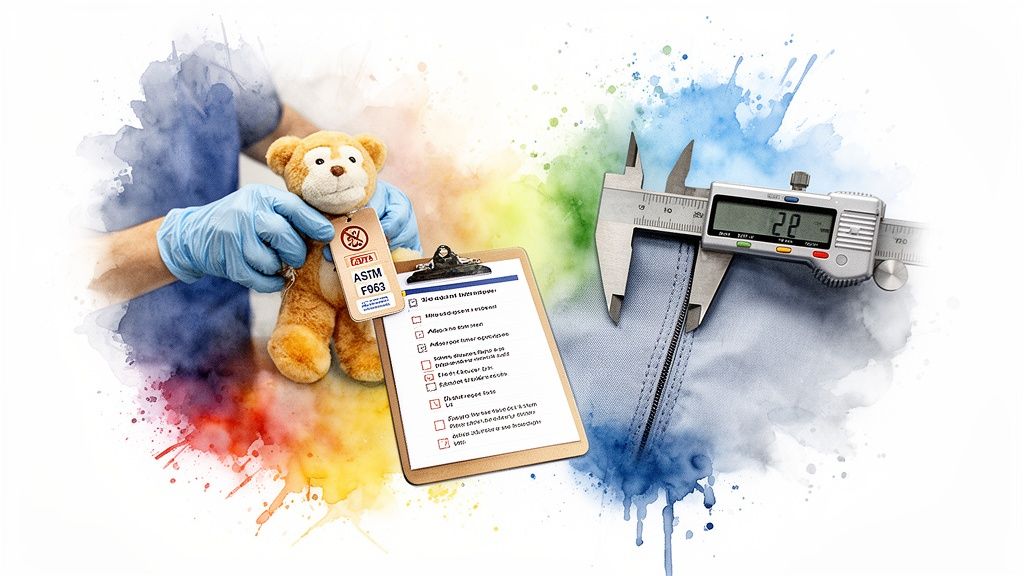
Navigating International Safety Standards (EN71/ASTM)
Compliance with international safety standards is mandatory. The two primary standards for plush toys are:
- EN71 (European Standard for Toy Safety): We focus on EN71-1 (physical and mechanical properties), EN71-2 (flammability), and EN71-3 (migration of certain chemical elements). This involves testing seam strength to prevent detachment of small parts and ensuring fabrics are flame-retardant.
- ASTM F963 (US Standard Consumer Safety Specification for Toy Safety): This standard mandates rigorous pull tests on components like eyes and noses to prevent choking hazards and sets strict limits on chemicals like lead and phthalates.
Compliance is achieved through proper design, certified materials, and safe construction methods from the start—not just by passing a final test.
Logistics: From Our Factory to Your Warehouse
A realistic production timeline is crucial for a successful launch. Rushing the process invites errors. A typical project follows these stages:
| Phase | Duration | Key Activities |
|---|---|---|
| 1. Prototyping & Sampling | 5–10 Business Days | Creation of the first physical sample, including shipping time for your approval. |
| 2. Sample Revisions | 3–7 Days per Revision | If tweaks are needed, we create a revised sample. This cycle repeats until you are 100% satisfied. |
| 3. Mass Production | 20–30 Days | Full production begins after final sample approval. Duration depends on order quantity and complexity. |
| 4. Shipping | 7–45 Days | Air freight is faster (7-10 days) but more costly. Sea freight is economical but takes longer (30-45 days). |
A realistic end-to-end timeframe, from initial design submission to warehouse delivery, is typically 60 to 90 days. Building this buffer into your schedule ensures a smooth launch. The growing collectible toy market, which is expected to hit over USD 15.3 billion by 2026 in China alone, means demand for quality is high. Read more on this trend in the collectible toys market at China Briefing.
How to Choose a Supplier
Selecting the right manufacturing partner is the most critical decision you will make. This choice defines your entire project, from creative control and timeline to final cost. The two main engagement models are OEM and ODM.
OEM (Original Equipment Manufacturing) vs. ODM (Original Design Manufacturing)
- OEM: You provide a completely original design, and we manufacture it exclusively for you. This is the path for creating a unique brand mascot or licensed character. You control every detail. The process involves longer sampling times, potential tooling costs for custom parts, and higher MOQs (typically 500-1000 pieces).
- ODM: You select a design from our existing catalog and we customize it with your branding (colors, logos, accessories). This is a faster, more cost-effective route for promotional items or businesses with tight deadlines and budgets. MOQs are lower (100-300 pieces), and tooling costs are often zero.
What to Look for in a Manufacturer
- Expertise and Specialization: Do they specialize in plush toys? Look for a factory with a long history and deep knowledge of the specific materials and techniques involved.
- Communication: Your contact should be fluent in your language and demonstrate a clear understanding of your technical requirements.
- Transparency: A good partner will be open about their pricing structure, production process, and quality control measures.
- Certifications and Audits: Ask for proof of social compliance audits (like BSCI or Sedex) and quality management systems (like ISO 9001).
- References: A reputable manufacturer will be proud to share testimonials or case studies from other international brands they have worked with.
Why FunEnjoy is a Trusted Manufacturer
At FunEnjoy PlushToys, our process is designed for clarity and quality, from initial sketch to final delivery. We serve as your manufacturing partner, guiding you through material selection, cost engineering, and safety compliance to bring your vision to life with the quality your brand deserves.
Our team is ready to help you navigate the complexities of creating a custom plush toy.
Ready to start your project? Get a free quote from our experts today.