As a manufacturer of custom plush toys, we see the global “pet humanization” trend not as a marketing buzzword, but as a tangible shift on our factory floor. A pet toy is no longer a simple chew object; it’s an engineered product that must meet the expectations of discerning pet owners. For B2B buyers and brands, understanding the manufacturing process—from material science to logistics—is the key to creating a product that is safe, engaging, and commercially successful.
Market Overview: A Factory-Floor Perspective
The demand for high-quality pet toys is expanding rapidly. We see this firsthand in the complexity and specificity of the orders we receive. Owners now scrutinize labels for material content and safety certifications with the same diligence they would for a child’s toy. This creates a significant opportunity for brands that prioritize quality.
The data confirms our observations. In 2023, China’s pet toy market reached USD 516.1 million and is projected to grow to USD 989.4 million by 2030. This growth is driven by a new generation of owners demanding superior quality and innovative designs. For a deeper analysis, you can explore more on these market dynamics, which also show that dog toys account for over 55% of this market.
Benefits of High-Quality Pet Toys for Brands
For brands, investing in well-made toys translates directly to market advantage. The key benefits we see our successful clients leverage are:
- Enhanced Brand Reputation: A safe, durable pet toy builds trust. Adhering to standards like EN71 and ASTM demonstrates a commitment to quality that resonates with modern consumers.
- Higher Customer Loyalty: Toys that withstand vigorous play and remain safe lead to repeat purchases. Durability is a key driver of positive reviews and word-of-mouth marketing.
- Reduced Product Liability Risk: Manufacturing to stringent safety standards significantly lowers the risk of product recalls, which can be financially and reputationally devastating.
As a manufacturer, our role has evolved from order-taker to technical partner. We advise brands on material selection, design-for-manufacturability, and compliance to help them translate the “pet parent” philosophy into tangible products that earn market trust.
Types of Plush Pet Toy Materials: A Technical Breakdown
The foundation of a superior pet toy is material science. The choice of outer fabric and internal filling dictates the toy’s durability, safety, and sensory appeal. A manufacturer’s expertise lies in matching the right materials to the intended play style.
Outer Fabrics: The First Line of Defense
We work with a wide array of textiles, each with specific performance characteristics. For toys designed for cuddling or light indoor play, we often recommend crystal velvet or Minky fabric for their soft, plush feel.
For toys intended for more rigorous use, we utilize more robust materials. Durable canvas and reinforced Oxford fabrics offer excellent resistance to tearing and abrasion, making them ideal for larger dogs or interactive toys designed for tugging. The key is to engineer the toy for its specific purpose.
Filling & Components: Safety from the Inside Out
The internal components are just as critical as the external shell. The most common filling is polypropylene (PP) cotton, a synthetic polyester fiber that is hypoallergenic, retains its shape, and is machine washable. For added engagement, we can adjust fill density or incorporate crinkle material.
Safety is engineered into the core of the toy:
- Secure Squeaker Pockets: We never place a squeaker directly into the stuffing. It is first encased in a separate, stitched fabric pouch to prevent it from becoming a choking hazard if the toy is compromised.
- Embroidered Features: Plastic eyes and noses are a significant safety risk. We exclusively use high-density embroidery for all facial features to eliminate the possibility of small parts being chewed off and swallowed.
- Reinforced Seams: Seams are the most common failure point. We use heavy-duty thread and employ double-stitching or cross-stitching, particularly on appendages like ears and tails, to ensure they withstand tugging forces.
A plush pet toy is engineered much like a children’s toy, but with the added requirement of withstanding the bite force of a canine. This demands a deeper focus on structural integrity and material durability.
The Manufacturing Process: From Tech Pack to Final Product
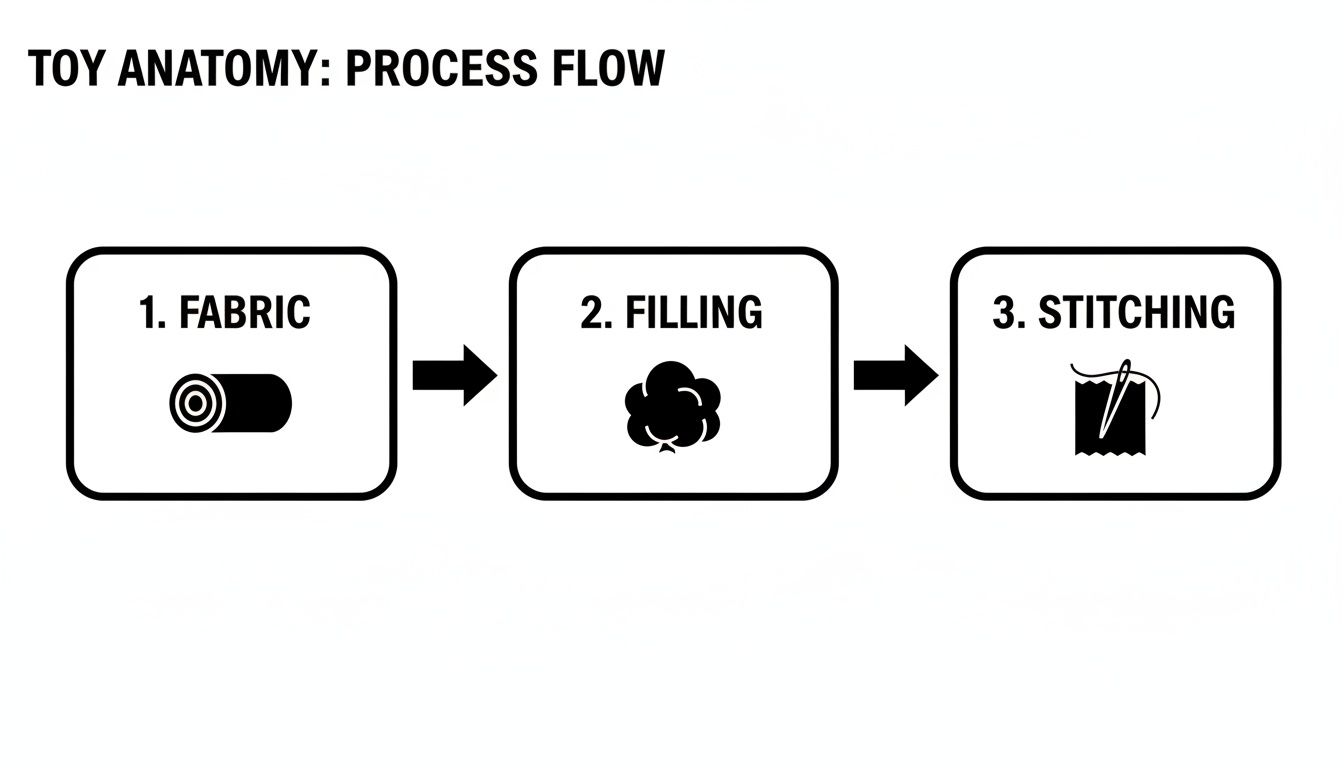
Transforming a design concept into a market-ready pet toy follows a precise and structured workflow. Our role as the manufacturer is to manage this process for predictability, quality, and efficiency.
Step 1: Design Review and Quotation
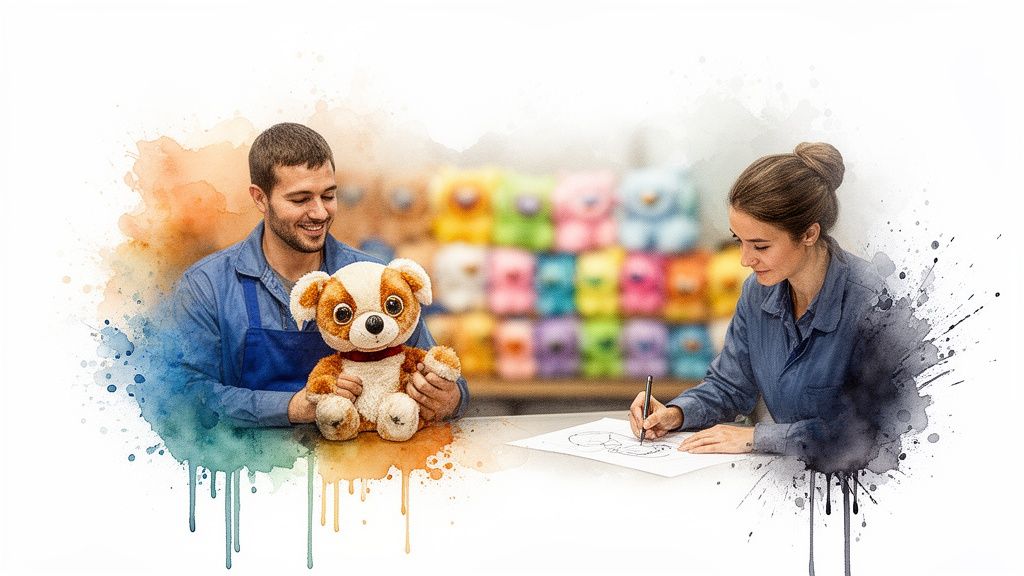
The process begins when you provide a “tech pack”—a detailed blueprint containing sketches, dimensions, material specifications, and desired features. Our engineering team reviews these specifications to provide an accurate unit cost and production timeline. This is a collaborative phase where we might suggest minor modifications to improve durability or reduce cost without compromising the design intent.
Step 2: Prototyping and Sampling
This is the most critical stage. Our pattern makers create a physical prototype, a process that typically takes 5–10 working days. This sample allows you to evaluate the materials, construction quality, and overall feel of the product. Based on your feedback, we refine the sample until it meets your exact requirements. This approved prototype becomes the “golden sample”—the quality standard against which all mass-produced units will be measured.
Step 3: Mass Production Workflow
Once the prototype is approved, we scale for mass production. This is a multi-stage process managed on our factory floor:
- Material Sourcing & Cutting: We procure the specified fabrics and use industrial die-cutting machines to cut the material into precise shapes based on the approved patterns.
- Printing & Embroidery: Any logos, patterns, or facial features are applied at this stage, before the pieces are sewn together, for maximum precision.
- Stitching & Assembly: Skilled workers sew the fabric panels together, leaving a small opening for stuffing.
- Stuffing & Component Insertion: Each toy is filled with the specified amount of PP cotton and any internal components like squeaker pouches.
- Closing & Finishing: The final seam is closed, often by hand, to create a clean, invisible finish.
- Quality Control: Each finished toy undergoes cleaning, needle detection, and a final inspection.
A professional manufacturer provides transparent communication throughout this journey, turning a complex logistical operation into a seamless product launch. For more detail on this craft, see our guide on how to make a plush doll, as the core principles of quality construction are shared.
Pricing Factors: What Influences Your Unit Cost?
Understanding the cost structure of your pet toy is essential for building a profitable business. The unit price is not arbitrary; it is a direct calculation based on four key variables: materials, design complexity, size, and order quantity.
- Material Selection: The choice of fabric is a primary cost driver. Premium materials like heavy-duty canvas or multi-textured sherpa are more expensive per meter than standard crystal velvet. Similarly, higher-density filling or the inclusion of electronic modules will increase the unit cost.
- Design Complexity: Labor is a significant component of the cost. A simple, one-piece character requires less assembly time than a complex design with multiple appendages, detailed embroidery, and various fabric panels. Simplifying a design is a direct way to reduce cost.
- Size and Weight: Larger toys consume more raw materials—both fabric and filling—which directly increases the per-unit cost.
- Order Quantity: Volume is a key factor. Larger orders allow us to procure raw materials at a lower bulk price and optimize production line efficiency. An order of 5,000 units will have a lower per-unit cost than an order of 500.
Tips to Reduce Cost Without Sacrificing Quality
- Simplify Construction: Reduce the number of separate fabric panels or opt for high-quality printing instead of multi-layered embroidery where appropriate.
- Optimize Material Usage: Work with your manufacturer to ensure the design makes efficient use of fabric to minimize waste during the cutting process.
- Consolidate Orders: If possible, group multiple designs or colorways into a single larger order to leverage volume pricing.
The goal is to find the optimal balance between a compelling design and an efficient manufacturing process. A skilled manufacturing partner will act as a consultant, suggesting adjustments that protect your profit margin while upholding quality standards.
Understanding MOQ (Minimum Order Quantity)
Minimum Order Quantity (MOQ) is a common point of discussion for new brands. The MOQ is determined by a factory’s operational scale and the minimum raw material purchasing requirements from its own suppliers.
For a flexible manufacturer like us, an MOQ can be as low as 100–500 pieces per design, allowing brands to test the market with minimal initial investment. Larger, more automated factories may require commitments of 1,000–3,000 units to cover their production setup costs. It is crucial to clarify whether the MOQ applies per design or to the total order.
Quality Control and Safety Standards (EN71/ASTM)
While pet toys are not always legally required to meet the same stringent regulations as children’s toys, we manufacture to these higher standards as a matter of best practice. Adherence to global safety standards like Europe’s EN71 and the USA’s ASTM F963 is a hallmark of a responsible manufacturer.
These standards dictate a series of rigorous tests:
- Physical & Mechanical Tests: We conduct pull tests on seams, ears, and tails with calibrated force gauges to ensure parts cannot be easily detached. Squeakers must be inaccessible to prevent choking hazards.
- Flammability Tests: Fabrics and fillings are tested to ensure they meet strict burn-rate requirements, preventing the toy from being a fire hazard.
- Chemical Analysis: All materials—from fabric dyes to thread—are tested for heavy metals, lead, and phthalates. This ensures the toy is non-toxic, which is critical for an object that will be chewed.
Our quality inspection steps are integrated throughout the production line, not just at the end. We conduct incoming material checks, in-process inspections during assembly, and a final 100% inspection of finished goods, including a pass through a metal detector to ensure no broken needle fragments are present.
Logistics: From Factory to Warehouse
A manufacturer’s responsibility extends beyond production. Efficient logistics are critical to getting your product to market on time and on budget. We manage the entire export process, including:
- Packaging: Designing retail-ready packaging (hang-tags, display boxes) and master cartons that protect the product during transit.
- Export Documentation: Preparing all necessary paperwork, including the commercial invoice, packing list, and bill of lading.
- Freight Forwarding: Coordinating with shipping carriers (sea or air) to ensure reliable and cost-effective transport to your destination port.
An experienced manufacturer has deep expertise in international logistics and can help you navigate customs requirements in your target market, preventing costly delays.
How to Choose a Supplier: OEM vs. ODM
Selecting the right manufacturing partner is the most critical decision for your brand. Look beyond price and evaluate a potential supplier on their technical expertise, communication, and transparency.
First, understand the difference between service models:
- OEM (Original Equipment Manufacturer): You provide a complete, production-ready design (a tech pack), and the factory manufactures it to your exact specifications.
- ODM (Original Design Manufacturer): You provide a concept or idea, and the factory’s design and engineering team works with you to develop it into a final product.
Vetting a Potential Manufacturer
- Verify Certifications: Request copies of their factory audits, such as BSCI (for social compliance) and ISO9001 (for quality management systems). These documents are proof of their commitment to ethical and professional operations.
- Assess Technical Communication: Their team should be able to answer detailed questions about materials, construction techniques, and safety standards. Clear, responsive communication is essential.
- Evaluate Experience: Inquire about their experience producing similar types of toys and shipping to your specific country. Look for a proven track record. The risk of working with a low-quality factory includes inconsistent product quality, production delays, safety failures, and potential intellectual property issues.
Choosing a partner is a long-term strategic decision. The objective is to build a reliable supply chain with a factory that understands your brand vision and possesses the operational excellence to execute it consistently and safely.
Why FunEnjoy is a Trusted Manufacturer
We combine decades of plush toy manufacturing expertise with a modern understanding of the pet market’s demands. Our commitment to quality, safety, and client collaboration sets us apart. We offer both OEM and ODM services, supported by a team of experienced engineers and a flexible production line capable of handling MOQs that work for both emerging and established brands. We are not just a supplier; we are a partner in your product’s success. You can design your own plush toy with our expert guidance or explore our capabilities among leading stuffed animal companies.
Ready to create a pet toy that stands out for its safety and quality? FunEnjoy PlushToys offers end-to-end manufacturing services with flexible MOQs and expert guidance. Start your project with us today!