As a manufacturer based in the heart of China’s toy industry, we see large plush toys not just as products, but as complex engineering projects. For brands, retailers, and IP holders, they represent a significant investment and a powerful asset. Sourcing them correctly requires an understanding of the entire manufacturing process, from raw material selection to navigating global logistics. This guide provides that insider’s perspective.
Think of a giant teddy bear in a retail display or a licensed character brought to life on a grand scale. These aren’t just toys; they are calculated commercial tools.
The Growing Global Demand for Large Plush Toys
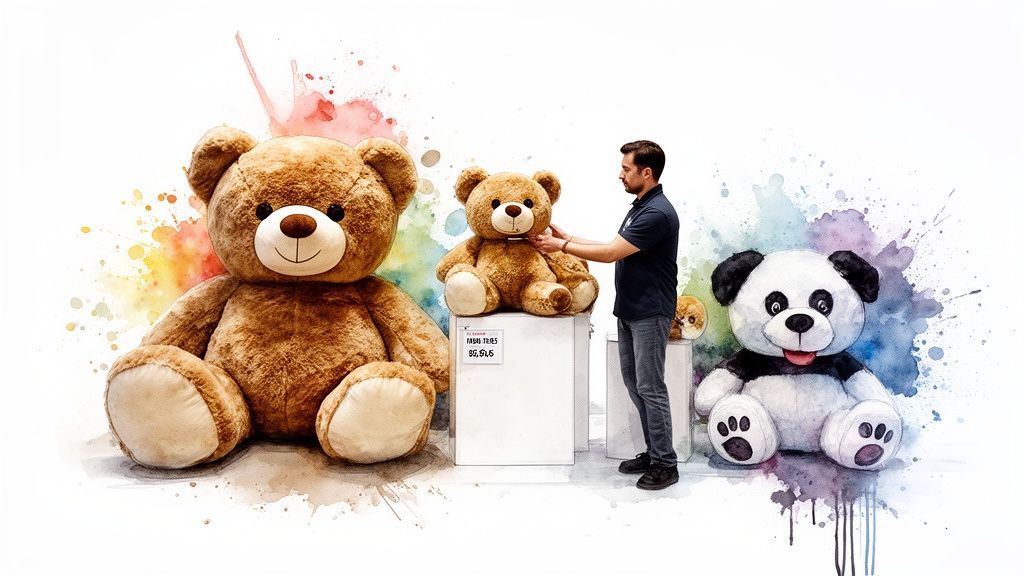
From our factory floor, we have a direct view of the global toy market’s evolution. Over the past decade, large plush toys have transitioned from a niche category to a major growth driver for brands. This isn’t about simply scaling up toys for children; it’s a strategic move to leverage their unique commercial power. The visual impact of an oversized plush creates opportunities that smaller products cannot match.
Key Market Drivers for Oversized Plush
The business applications for large plush toys extend far beyond the traditional toy aisle. Astute brands use them to achieve specific objectives:
- High-Impact Retail Displays: A custom-made mascot can anchor a storefront or event, drawing in foot traffic and generating organic social media engagement through photo opportunities.
- Premium Collectibles and Licensed IP: For franchises with dedicated fan bases, a large-scale plush character becomes a high-value collector’s item, commanding premium pricing.
- Corporate Gifting and Promotional Campaigns: A large, branded plush is a memorable corporate gift or a grand prize in a marketing campaign, leaving a lasting impression.
- Interior Decor and Ambiance: Large, well-designed plush toys are increasingly used in commercial spaces like hotels, cafes, and offices to create a unique and welcoming atmosphere.
China’s role in this market is central. We produce nearly 70% of the world’s toys, with exports exceeding $54 billion in 2025. This dominance is particularly pronounced in the plush category. We’ve witnessed a significant increase in demand for large plush from global brands, partly driven by demographic shifts. For instance, the relaxation of the one-child policy in 2015 has led to Chinese parents spending more on premium toys. You can find more about the global toys market on marketingtochina.com.
What Goes Into a Large Plush Toy? A Look at Materials and Construction
The success of a giant plush toy—its huggability, durability, and visual appeal—is determined by its raw materials. As manufacturers, we view material selection as the foundational decision that dictates cost, safety, and the end-user’s tactile experience. It’s a technical balance: a fabric must feel luxurious while also having the structural integrity to hold the shape of a one-meter-tall character without sagging or stressing the seams.
The Fabric: The Outer Shell
The outer fabric, or “skin,” is the primary interface with the consumer. It defines the toy’s look and feel. While countless options exist, three core materials dominate large plush toy production due to their reliability and specific performance characteristics.
Short-Pile Velboa: This is the industry workhorse. A low-pile polyester with a smooth, velvet-like hand feel, its primary advantage is durability. The short fibers resist matting, and it provides an excellent surface for printing and detailed embroidery. From a cost perspective, Velboa is the most economical choice for high-volume orders.
Long-Pile Faux Fur: This material creates the classic, shaggy look associated with giant teddy bears and realistic animals. It provides a luxurious feel but is more expensive and requires greater skill in cutting and sewing. Managing the long fibers along seam lines increases labor time and, therefore, cost.
Minky Fabric: Minky is the premium choice for softness. It’s an ultra-plush fabric with a subtle sheen, often used for high-end baby products and collectibles. While its tactile quality is unmatched, it is the most expensive of the three and presents challenges in manufacturing, particularly with large, complex patterns.
From a production standpoint, the fabric choice is the first major cost driver. Simply switching a design from a standard velboa to a high-density Minky can jump the raw material cost per unit by 30-50% before we even account for sewing time.
To provide clarity, here is a comparison based on our daily factory operations.
Comparison of Common Plush Toy Materials
| Material Type | Best Use Case | Feel & Texture | Cost Impact |
|---|---|---|---|
| Short-Pile Velboa | High-volume promotional toys, detailed character designs. | Smooth, low-pile, durable. | Low |
| Long-Pile Faux Fur | Classic teddy bears, realistic animal plush. | Shaggy, soft, luxurious. | Medium-High |
| Minky Fabric | Premium collectibles, baby-safe large plush, soft cushions. | Ultra-soft, plush, slight sheen. | High |
The optimal choice depends on the project’s strategic goals, target demographic, and budget.
The Filling: The Heart of the Plush
The internal filling is as critical as the external fabric, especially for a large toy that must maintain its form. The filling determines the toy’s weight, firmness, and “cuddle factor.”
The undisputed industry standard is polyester fibre fill, known as PP cotton. It is lightweight, hypoallergenic, and provides excellent volume, making it ideal for efficiently stuffing large items. We utilize different grades; a higher-end, siliconized fiber offers superior resilience and prevents clumping over time. For brands seeking specialized fills, you can explore materials for a custom cotton doll.
For specific functional requirements, we incorporate other materials:
- Memory Foam: For large plush items intended for seating, such as cushions, shredded memory foam provides a denser, more supportive feel that contours to pressure.
- Weighted Beads: We often place sealed pouches of plastic or glass beads in the extremities or base of a large plush. This lowers the toy’s center of gravity, enabling it to sit upright independently and providing a satisfying weight.
Achieving the correct stuffing density is a skilled process. Under-stuffing results in a limp, sagging product. Over-stuffing can stress seams to the point of failure and makes the toy feel rigid. Our teams use specialized equipment to ensure even distribution and achieve the precise firmness specified in the technical pack.
The Manufacturing Journey From Concept to Container
Transforming a design concept into a container of finished goods is a systematic process we manage daily. It requires precision, clear communication, and deep manufacturing expertise. The first step is determining the production model: OEM or ODM.
OEM (Original Equipment Manufacturing): Clients provide a complete, production-ready design package (tech pack). We function as the manufacturing arm, executing the design to exact specifications.
ODM (Original Design Manufacturing): This is a collaborative approach. Clients provide a concept, and our design team helps develop it into a manufacturable product. This can involve adapting one of our existing “white-label” models or creating a new design from the ground up.
The choice depends on the client’s in-house design capabilities and speed-to-market goals.
From Digital Design to Physical Prototype
Once the design is finalized, we enter the sampling phase. Our pattern makers, true artisans of the trade, translate 2D technical drawings into a set of 3D pattern pieces. A complex large plush toy can require dozens of individual components that must fit together with millimeter precision.
These patterns are used to create the first physical prototype. This sample is a proof-of-concept, allowing you to evaluate proportions, materials, and overall character. We typically produce this first sample within 5-10 working days.
It is standard for the first prototype to require revisions. This is an expected part of the development process. We anticipate client feedback, such as “increase ear size by 10%” or “adjust embroidery placement.” One to two rounds of revisions are typical to perfect the design before mass production.
Scaling Up: The Mass Production Workflow
With an approved prototype, we activate the production line. This is a highly orchestrated workflow optimized for efficiency and quality assurance.
Material Sourcing and Inspection: We procure all necessary fabrics, threads, and fillings. Every batch undergoes incoming quality control (IQC) for color consistency and defects before entering production.
Mass Cutting: Using the master patterns, industrial cutting machines process large stacks of fabric simultaneously. Precision is critical to ensure uniformity across thousands of units.
Embroidery and Printing: All decorative elements (eyes, logos, patterns) are applied to the flat fabric pieces at this stage. Complex, multi-color embroidery can be a significant time factor in the production schedule.
Sewing and Assembly: Skilled sewing teams stitch the individual pieces, transforming 2D fabric into a 3D “skin.” For posable toys, internal plastic or metal armatures are integrated at this point.
Stuffing and Closing: The assembled skins are sent to the stuffing department. We use high-pressure air hoses for consistent PP cotton filling. The final closing seam is hand-stitched for a nearly invisible finish.
Final Cleaning and Inspection: Each finished toy undergoes a final quality check. This includes cleaning loose threads, brushing the pile, and passing through a metal detector to ensure no foreign metal objects are present before packaging.
The infographic below illustrates the assembly of these core components.
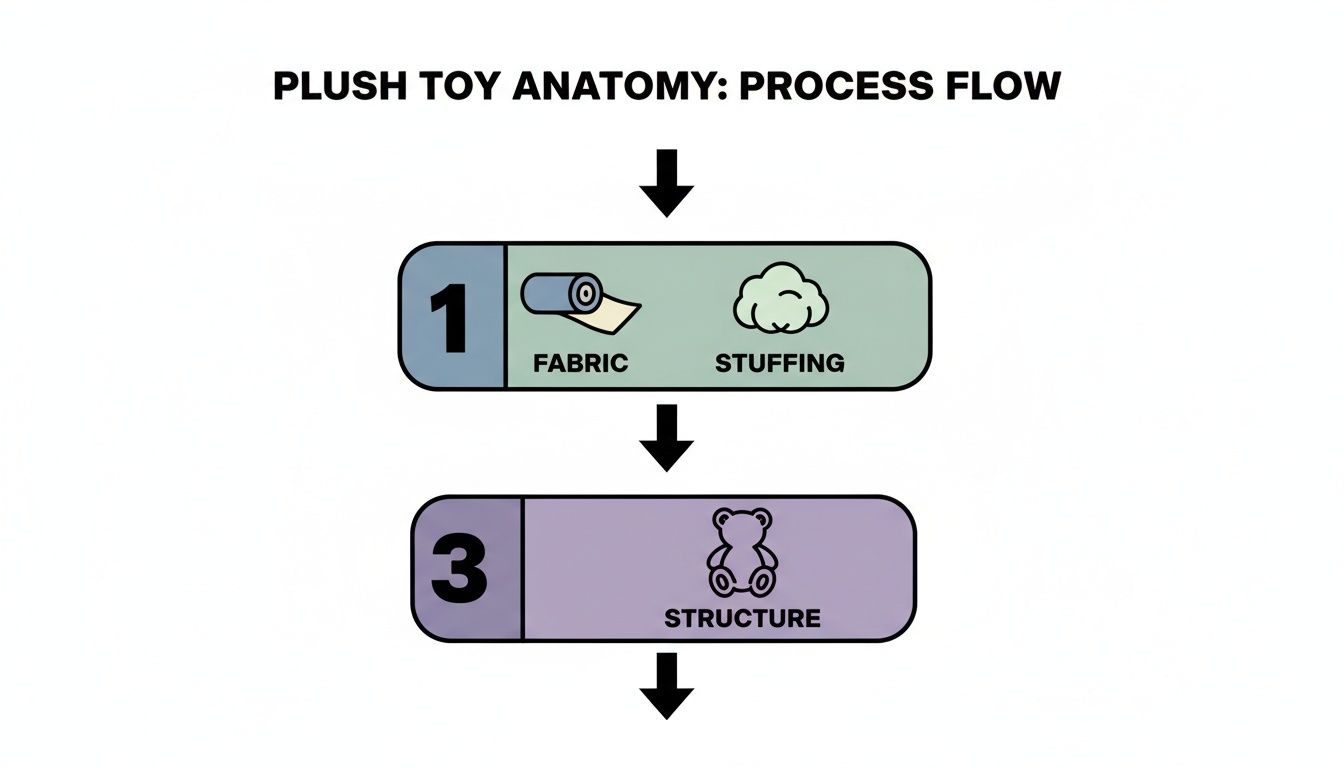
This methodical sequence of fabric skin creation, internal filling, and structural integration is essential for achieving consistent quality at scale. For a deeper look into these techniques, our guide on how to make plush toys provides further manufacturing insights.
Getting to Grips with Pricing and Minimum Orders
A price quote for a large plush toy is a detailed calculation reflecting all material, labor, and complexity inputs. Understanding these cost drivers empowers buyers to make informed sourcing decisions and manage budgets effectively. The primary factors are size and material selection. A one-meter bear using premium long-pile faux fur will inherently cost more than a 50cm version in standard velboa due to higher material and filling consumption. However, the nuances of the design often have a greater impact.
What Really Drives Up the Cost?
Beyond the basics, design complexity is a major cost variable. When preparing a quote, we analyze several key factors:
- Pattern Complexity: This refers to the number of individual fabric pieces required. A simple cushion may have two pieces. A detailed character with wings, scales, and horns could exceed 50 separate pieces. More pieces increase cutting and sewing time, which directly drives up labor costs.
- Custom Features: The inclusion of elements like a posable wire armature, an electronic sound module, or intricate, multi-color embroidery adds material costs and additional assembly steps.
- Order Volume: Economies of scale are fundamental in manufacturing. Larger orders allow us to secure better pricing on raw materials and optimize production line efficiency, resulting in a lower per-unit cost. A small trial order will always have a higher unit price than a full-scale production run.
The “Why” Behind Minimum Order Quantities
Our Minimum Order Quantity (MOQ) for large plush toys typically ranges from 100 to 500 pieces. This is not an arbitrary number but a necessity dictated by the economics of manufacturing. Our raw material suppliers have their own MOQs; for a custom Pantone-dyed fabric, we may need to purchase hundreds of meters at once. The setup time for cutting machines and sewing lines for a new design is also a significant fixed cost. The MOQ ensures that the production run is efficient enough to be commercially viable and allows us to offer competitive pricing.
The principle is similar to a commercial bakery. The industrial ovens are not fired up to bake a single loaf of bread. The cost and effort are only justified for a full batch. The same logic applies to scaled plush toy manufacturing.
How to Trim Costs Without Sacrificing Quality
A limited budget does not necessitate compromising on quality. An experienced manufacturing partner can help identify cost-saving opportunities.
- Simplify the Pattern: Minor design modifications can yield significant savings. For example, integrating arms into the main body pattern instead of as separate attached pieces can reduce sewing operations.
- Optimize Embellishments: A large, fully embroidered logo with ten thread colors is costly. A design with fewer colors, or a combination of high-quality printing with a smaller embroidered element, can be more economical.
- Plan for the Off-Season: Our production capacity is highest in the run-up to major holidays. Placing orders during our quieter seasons can provide more flexibility on pricing and faster turnaround times.
These financial considerations are increasingly relevant as the collectible toy market in China is projected to reach RMB 110.1 billion by 2026. Large plush toys are a significant part of this trend, as detailed in the research on the China toy market on hktdc.com.
Getting Quality Control and Global Safety Standards Right
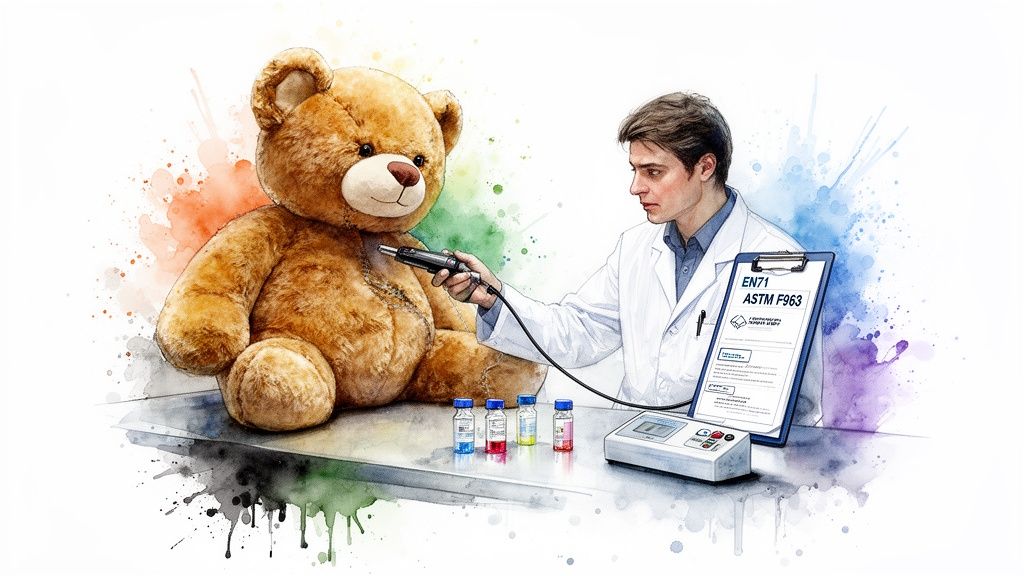
In manufacturing, quality is not a final inspection step; it is a continuous process integrated into every stage of production. For large plush toys, where any defect is magnified, this is paramount. A low price from a factory often indicates compromises in quality control, leading to costs far greater than the initial savings, such as recalls, reputational damage, or safety failures. Our process begins with rigorous inspection of all incoming raw materials to prevent downstream issues.
How We Catch Problems Before They Happen
We employ multiple quality control checkpoints throughout the production workflow to identify and rectify issues early.
- In-Line Checks: Quality control staff patrol the factory floor, performing random checks on seam strength, embroidery quality, and stuffing density to ensure consistency and adherence to specifications.
- Final Inspection: Every fully assembled toy undergoes a detailed final review. We inspect for loose threads, ensure all components (eyes, noses) are securely attached, and conduct a final metal detection scan to guarantee no needles or pins remain inside.
- AQL Inspections: For large orders, we utilize the Acceptable Quality Limit (AQL) standard. This statistical sampling method allows us (or a client-appointed third-party inspector) to assess the overall quality of the entire production run with a high degree of confidence.
This systematic approach ensures every large plush toy we ship is not just aesthetically pleasing but also structurally sound and durable.
A common mistake among buyers is assuming all factories maintain this level of diligence. An unusually low price is a red flag for skipped in-process checks, which can miss critical structural or safety flaws that a simple final glance will not catch.
Meeting the World’s Toughest Safety Standards
Adherence to international safety standards is non-negotiable. The primary regulations for plush toys are EN71 for the European Union and ASTM F963 for the United States. Compliance is a core part of our design and production philosophy.
These standards cover a wide range of potential hazards:
- Physical & Mechanical Tests: Seams are subjected to tension tests to ensure they withstand force. Small parts like plastic eyes are pull-tested to prevent them from detaching and becoming a choking hazard.
- Flammability Tests: The fabric’s reaction to an open flame is tested to ensure a slow burn rate, providing time for a child to safely drop the toy.
- Chemical Restrictions: All materials are tested for hazardous substances, including lead, phthalates, and other heavy metals, to ensure they are well below legally mandated limits.
We engineer for safety from the initial design phase, selecting compliant materials and construction methods proactively. For any brand developing a line of large stuffed animals, this commitment to safety is crucial for market access and building consumer trust.
Partnering with the Right Manufacturer: Your Buyer’s Checklist
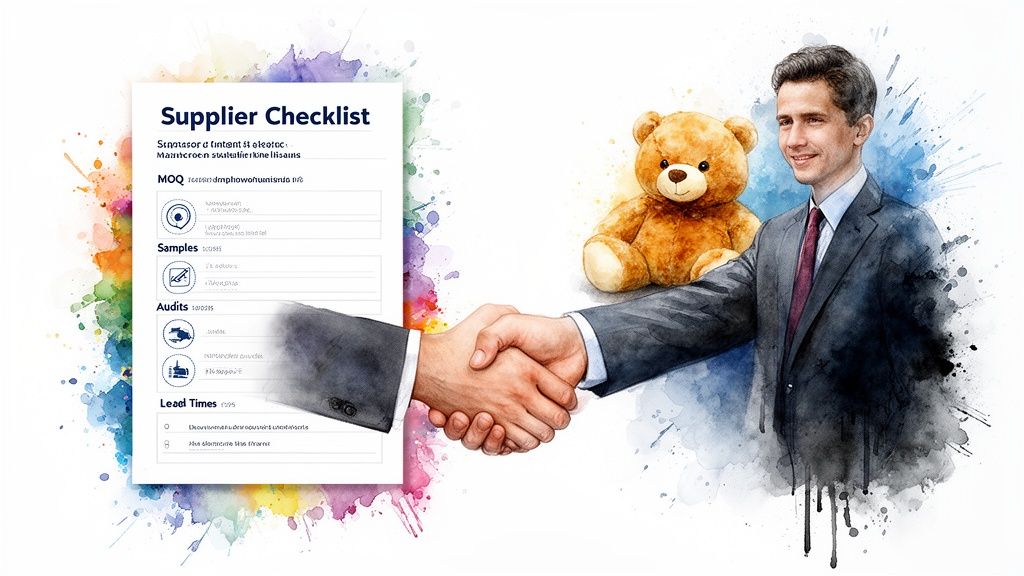
Selecting a manufacturing partner is the most critical decision in the product development lifecycle. It is a strategic collaboration that directly impacts product quality, safety, and commercial success. A proficient partner acts as an extension of your team; a poor one creates delays, quality issues, and reputational risk. Based on our experience with hundreds of brands, we’ve developed a structured vetting process that goes beyond comparing price quotes.
The Essential Vetting Checklist
Before committing to a production run, conduct a thorough assessment of a factory’s capabilities.
Proven Experience: Request a portfolio of past work. Have they successfully manufactured large plush toys of similar complexity and scale? Experience in your target market is a significant advantage.
Factory Audits and Certifications: A reputable manufacturer will be transparent about third-party audits (e.g., BSCI, Sedex) and readily provide documentation for safety compliance, such as EN71 and ASTM F963 test reports for their materials.
Communication and Transparency: Evaluate their communication responsiveness and clarity. A dedicated, fluent point of contact is essential for managing feedback on samples and resolving production issues efficiently.
A common red flag is a factory that is evasive when questioned about its quality control processes. Transparency is the foundation of a successful manufacturing partnership.
Critical Questions to Ask a Potential Supplier
Once you have a shortlist, ask targeted questions to gauge their professionalism and operational capacity.
What is your typical sampling fee and timeline? Clarify the costs, lead time for prototypes, and how many revision rounds are included in the fee.
Can you explain your quality inspection points? Ask for a detailed walkthrough of their QC process, from incoming raw materials to pre-shipment inspection.
What is your production capacity for a project of this scale? Ensure they have the capacity to handle your order volume without compromising quality or delivery timelines.
How do you handle logistics and shipping? Determine if they only offer FOB (Free On Board) or can provide more comprehensive logistics support to your destination warehouse.
This diligence is vital in a market as dynamic as this. The China toys market, where large plush toys are a key segment, is projected to reach $52.19 billion by 2033. This growth, which you can read more about in the projected growth of the China toys market on globenewswire.com, underscores the importance of a reliable manufacturing partner.
Your Top Questions About Sourcing Large Plush Toys, Answered
For those new to custom plush manufacturing, several common questions arise. Here are our answers based on years of experience.
How Much Should I Expect to Pay for a Sample?
A custom prototype typically costs between $100 and $500. This price reflects not just materials, but the intensive, manual labor of our most skilled pattern makers and sample teams. They translate a 2D design into a physical 3D form, a process that is entirely hands-on. The cost is dependent on complexity; a simple pillow character is at the lower end, while a complex mascot with internal armatures and detailed embroidery is at the higher end. This fee usually includes one to two rounds of revisions.
Can I Place a Small Test Order, Something Below Your MOQ?
While our standard MOQ is 100–500 pieces, smaller trial runs are sometimes possible, but they significantly impact the unit price. Mass production efficiency relies on amortizing fixed setup costs (fabric sourcing, machine calibration, line setup) over a large number of units. When these costs are spread over a small run of 50 units, the per-unit price can increase by 50% to 100% compared to a full production order.
What’s the Biggest Pitfall for First-Time Buyers?
The most common and costly mistake is selecting a manufacturer based solely on the lowest price. An exceptionally low quote is a strong indicator that corners are being cut in critical areas: low-grade materials, insufficient stuffing, weak stitching, or, most dangerously, skipping mandatory safety testing. The result is an inferior product that can fail to meet safety standards like EN71 or ASTM F963, exposing your brand to significant liability and reputational damage. A slightly higher price from a trustworthy, transparent, and quality-committed partner is always a better long-term investment.
At FunEnjoy PlushToys, we aim to be that trusted partner. We build long-term relationships based on transparent communication and uncompromising quality. If you are ready to transform your concept for a large plush toy into a high-quality, commercially successful product, we are here to assist.
Let’s start a project together. You can explore our capabilities and get a quote with no strings attached by visiting us at https://funenjoytoys.com.