From our perspective here on the factory floor in Dongguan, China, we’ve had a front-row seat to the rise of the jumbo plush. Over the past 30 years, we’ve watched these giant creations evolve from a novelty prize to a serious commercial powerhouse for businesses worldwide. They are far more than just big toys; they are attention-grabbing marketing tools, high-value retail centerpieces, and unforgettable brand statements.
Their sheer size is an undeniable magnet for attention, sparking instant photo opportunities and the kind of social media buzz you just can’t buy.
The Growing Commercial Demand for Jumbo Plush
It’s been fascinating to see the market for jumbo plush animals evolve. What was once a rare prize at a carnival is now a core product category for retailers, marketing agencies, and brands. We’re seeing it drive real revenue.
This isn’t just a feeling; the numbers back it up. The global plush toy market was valued at USD 15.1 billion in 2024 and is on track to hit USD 21 billion by 2034. The Asia-Pacific region, with China at its manufacturing heart, is leading that charge. If you’re interested in the details, you can dig into the full plush toys market research. This growth highlights a major shift—businesses are hungry for products that make a big, unique impact.
Key Market Drivers for Oversized Plush
So, why the huge commercial appeal? It really boils down to a few key factors we see every day from our factory perspective:
- Viral Marketing Gold: Jumbo plush are naturally ‘Instagrammable’. Place a giant branded mascot in-store or at an event, and it becomes a content machine as customers line up to take and share photos.
- Creating an Experience: In a world dominated by e-commerce, physical retail needs to offer more. A life-sized plush animal provides a fun, interactive focal point that draws in shoppers of all ages.
- High Perceived Value: Thanks to their impressive size, jumbo plushies command higher retail prices and healthier profit margins compared to standard-sized toys.
- A Living Brand Statement: For our corporate clients, a custom jumbo plush is their mascot brought to life. It’s a physical, huggable piece of their brand that creates a deeper emotional connection than a digital ad ever could.
As a manufacturer, I can tell you the real difference between a standard plush and a jumbo one isn’t just the amount of fabric. It’s an engineering challenge. A great jumbo plush needs structural integrity, durable materials, and perfectly consistent stuffing density. Otherwise, it will sag and lose its shape, especially in a busy retail environment.
This evolution has opened up very distinct business applications, turning these giant toys into strategic assets.
| Business Application | Strategic Goal | Typical Use Case |
|---|---|---|
| Retail Collections | Create a “hero” item that increases a product line’s average spend. | A 4-foot tall teddy bear as the centerpiece of a holiday toy display. |
| Promotional Events | Drive foot traffic, boost brand visibility, and create memorable fun. | A giant custom mascot for a product launch or a trade show booth. |
| Corporate Branding | Solidify brand identity and create unique, high-value corporate gifts. | A life-sized version of a company’s character for office decor. |
| Attractions & Venues | Boost merchandise sales and provide unique photo ops for visitors. | Custom jumbo animals of local wildlife sold in a zoo’s gift shop. |
Inside the Factory: The Jumbo Plush Production Workflow
Turning a 2D sketch into a giant, huggable plush isn’t just scaling up. It’s a craft we’ve perfected over decades, blending artistry with engineering. From our factory floor, here’s a look at how we take a concept and bring it to life, ensuring every jumbo plush is not just big, but built to last.
The entire journey starts with your design. Once we have your artwork, our master pattern maker begins what is arguably the most critical stage. A small error on a pattern for a 6-inch toy might be unnoticeable, but on a 6-foot creation, that same mistake becomes a glaring, costly flaw.
From Digital Design to Physical Pattern
First, we translate your 2D illustration into a set of 3D patterns. Our pattern maker meticulously breaks down the character into individual fabric components. For a jumbo animal, this isn’t a few simple shapes; it can be dozens of complex pieces, each calculated precisely to create the right contours and structure.
With the paper patterns ready, we create the first physical sample.
The prototype is everything. It’s our physical conversation with the client. This is the moment we prove we can turn an idea on paper into something real that meets every expectation for quality and feel.
Making a single jumbo plush sample usually takes 5–10 working days. In that time, we cut the fabric, add any embroidery or printing, and hand-assemble the first unit. This sample is your chance to see and feel the product, check proportions, and request tweaks before mass production. We always tell clients to be brutally honest with feedback here—it’s far easier to adjust a pattern now than to fix thousands of finished toys later.
This process is the bedrock for all business needs, whether you’re launching a retail line or planning a viral marketing stunt.
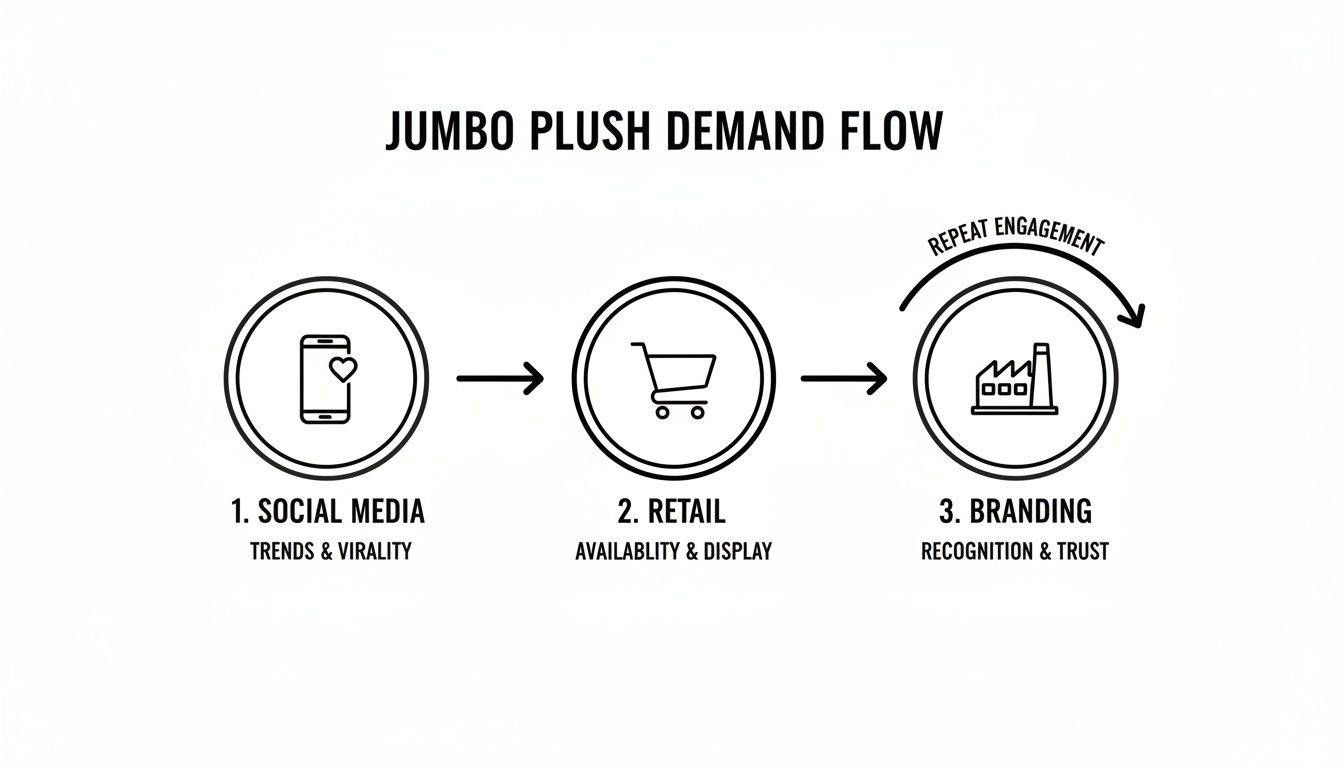
As you can see, no matter the end goal, it all flows back to a reliable production partner who can get the product right from the start.
The Mass Production Process
Once you approve the final sample, we move into full-scale production. The approved patterns are digitized and fed into our automated cutting machines, which slice through hundreds of layers of fabric at once with pinpoint accuracy. This step is essential for ensuring every unit is identical.
From there, the cut pieces head to specialized stations:
- Embroidery and Printing: Any logos, facial features, or other custom details are applied at this stage, while the fabric is still flat.
- Sewing: Our team of skilled artisans uses heavy-duty sewing machines—some with long needles designed for thick fabrics—to stitch the pieces together, always leaving a small, hidden opening for stuffing.
- Stuffing and Closing: The empty plush “skin” is filled. For jumbo toys, this requires high-capacity blowers to blast PP cotton filling evenly, preventing lumps. The final opening is then hand-stitched closed by our most experienced sewers for a seamless finish.
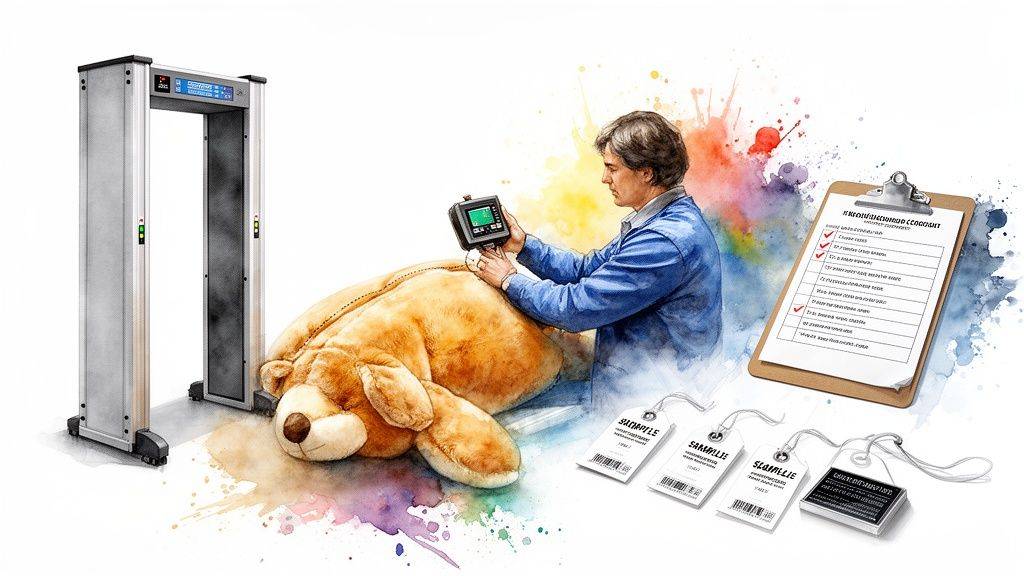
Finally, every plush goes through a final quality check, including metal detection and seam-strength tests, before packaging. To see even more of the craftsmanship involved, you can learn more about making stuffed animals in our detailed guide. This workflow guarantees that every jumbo plush leaving our factory is a product you can be proud of.
Materials and Filling: The Anatomy of a Jumbo Plush
When creating a jumbo plush, the materials you choose are everything. This is where the final look, feel, and lifespan of the animal is decided. Getting this right is a balancing act between softness, durability, and cost.
The first decision is the fabric—the “skin” of the plush. Each fabric has a unique texture and performance. A good plush fleece vs fleece guide can offer a starting point, but for jumbo-sized toys, the specifics really matter.
Comparing Common Plush Fabrics
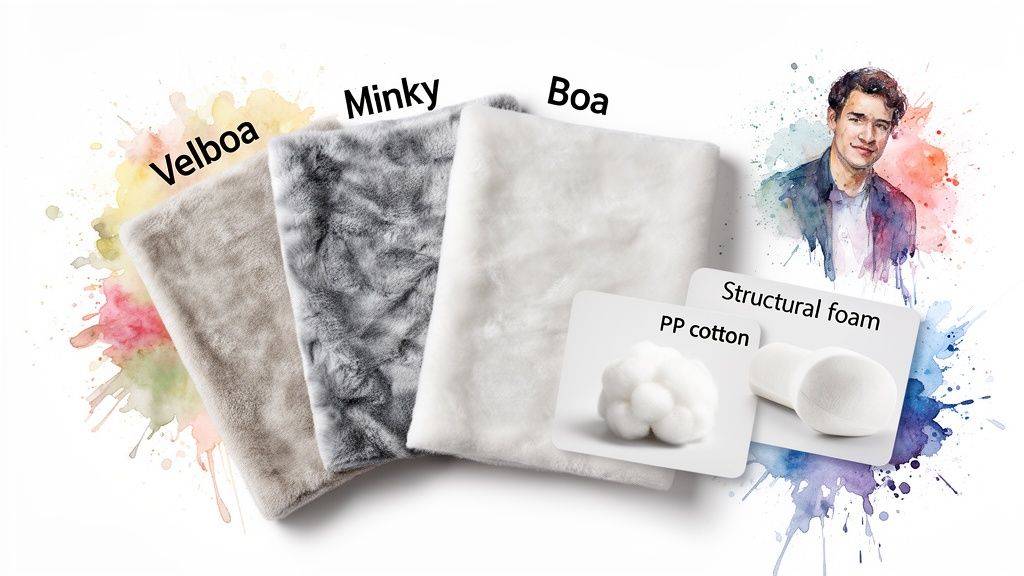
For jumbo plush animals, we almost always work with one of three core fabrics: soft boa, velboa, or minky. Each has its own place.
-
Soft Boa (PV Plush): Think classic, cuddly, and fluffy. This is a go-to for retail toys because its medium-length pile gives it that soft feel. It hits a sweet spot between comfort and cost but may not be the toughest option for high-traffic promotional items.
-
Velboa: This is our workhorse fabric. Velboa has a short, dense pile, making it incredibly durable and easy to clean. It’s fantastic for holding crisp printed patterns and detailed embroidery. We frequently recommend velboa for commercial projects like store mascots or trade show characters.
-
Minky (Crystal Velboa): For a premium feel, minky is the answer. It’s exceptionally soft with a smooth, velvety texture and a subtle sheen. We use minky for high-end retail collections and corporate gifts where you want the quality to be felt immediately. It’s the priciest of the three, but the luxurious result speaks for itself.
A key factory insight: On a jumbo plush, the pile direction of the fabric is absolutely critical. Our cutters must lay out the patterns so the pile runs the same way across every piece. If they get it wrong, the finished plush will look patchy and feel inconsistent—a classic mistake from less experienced factories.
Selecting the Right Filling for Structure
What’s inside your jumbo plush is just as important as the outside. The filling dictates shape, weight, and huggability.
To help you navigate these choices, here’s a manufacturer’s cheat sheet for matching the right material to your project goals.
Material and Filling Comparison for Jumbo Plush Animals
| Material Type | Key Characteristics | Best Use Case | Relative Cost |
|---|---|---|---|
| Soft Boa | Medium pile, very soft and fluffy | Cuddly retail toys, general-purpose plushies | $$ |
| Velboa | Short, dense pile, extremely durable | Promotional mascots, high-use commercial items | $ |
| Minky | Silky-smooth, luxurious feel, slight sheen | High-end retail, premium corporate gifts | $$$ |
| PP Cotton | Lightweight, hypoallergenic, soft and squishy | Standard filling for most huggable plush toys | $$ |
| Structural Foam | Firm, provides internal support and rigidity | Large, free-standing plush animals (e.g., life-sized figures) | $$$ |
The most common filling by far is 100% new Polypropylene (PP) cotton. It’s lightweight, hypoallergenic, and gives that classic soft, squishy feel. For most jumbo plush animals, virgin PP cotton is our standard as it offers great loft and resilience. We strictly use new, non-recycled material to ensure compliance with global safety standards like EN71 and ASTM F963.
However, sometimes a plush needs more than just fluff. If you’re designing a giant giraffe that needs to stand tall, PP cotton alone won’t cut it. For these projects, we engineer an internal “skeleton” using structural foam or a lightweight plastic armature. This framework provides rigidity to prevent sagging, while we pack PP cotton around it to keep the toy soft and huggable. It’s a complex process that demands advanced patterning and assembly skills.
Breaking Down the Costs of Jumbo Plush Production
“How much will my custom jumbo plush cost?” It’s usually the first question we get, and the honest answer is: it depends. The final cost is a direct reflection of your creative decisions. Understanding these cost drivers is key to sourcing these products without budget surprises.
The price isn’t just about size. It’s a detailed calculation based on core factors. Every choice nudges the final quote up or down. This is particularly true here in China, the global heart of toy manufacturing. The toy market in China hit USD 22.8 billion in 2024, and it’s still growing. That scale is what makes this level of production possible. You can see more insights into the China toys market on imarcgroup.com.
Primary Cost Factors in Manufacturing
The journey from a sketch to a finished giant involves several costs. Here’s a look at what we on the factory floor are calculating when we build your quote.
-
Material Selection: A premium fabric like minky costs more per meter than velboa. On a jumbo plush, that difference adds up. The filling matters, too. A plush with an internal foam structure will be more expensive than one simply packed with PP cotton.
-
Design Complexity: A simple, round bear made from ten pattern pieces is much faster to make than a dragon with 50 different pieces, wings, and scales. More pieces mean more cutting time, more complex sewing, and higher labor costs.
-
Custom Features: All the extras are major variables. Detailed embroidery, printed fabric, custom-molded plastic eyes, or a sound box all add to the unit price. Each requires its own materials, machinery, and skilled labor.
From our point of view, the number of pattern pieces is the single biggest indicator of required labor. A complex pattern slows down the entire assembly line. This is exactly why simplifying a design is often the best way to lower costs without compromising on material quality.
Understanding Minimum Order Quantity (MOQ)
You’re going to hear the term MOQ, or Minimum Order Quantity, a lot. It’s the smallest number of units a factory needs to produce in one run to cover fixed setup costs—like preparing cutting dies, programming embroidery machines, and buying materials in bulk.
For jumbo plush animals, our MOQ usually falls between 100 to 500 units. A smaller quantity within that range means a higher price per unit, as setup costs are shared across fewer items. Conversely, a larger order triggers economies of scale, bringing the cost per plush down significantly.
How to Manage Your Production Budget
Hitting your target price doesn’t mean you have to settle for less. It’s a team effort. Here are a few practical tips we share with our clients:
- Simplify the Design: Could two small pattern pieces become one? Can we swap a complex embroidered patch for a high-quality print? Small simplifications often lead to big savings.
- Increase Order Volume: If your plans allow, bumping an order from 200 to 500 units can dramatically lower your cost per plush.
- Plan for Sea Freight: Air freight is fast but very expensive for bulky items. Planning your production timeline to allow for 30-45 days of sea shipping is the most cost-effective choice.
By understanding these variables, you can make smart decisions that balance your creative vision with your budget. For a deeper look, have a look at our complete manufacturer’s guide to stuffed toy production.
Getting Safety Standards and Quality Control Right
When you’re creating jumbo plush animals, product safety isn’t just another item on a checklist. It’s the foundation of your brand’s reputation. At any professional plush toy factory, quality control (QC) is a constant, ongoing process. Cutting corners here is one of the biggest gambles a buyer can take, leading to recalls and a damaged brand image.
A solid QC process kicks off the moment raw materials arrive. Every roll of fabric and bag of PP cotton gets inspected for defects, color accuracy, and texture before it touches the production floor. This prevents bigger problems down the line. To really get a handle on this, it’s worth understanding the bigger picture of a proper quality assurance framework.
Our Multi-Point Inspection System
Quality isn’t a one-and-done check. We build inspections into the entire production timeline to catch issues early.
- Raw Material Inspection: All incoming materials—fabrics, threads, fillings—are checked against the approved sample specifications.
- In-Line Inspections: Supervisors constantly walk the sewing and embroidery lines, spot-checking stitch quality, pattern alignment, and assembly.
- Final Pre-Packing Inspection: Before any jumbo plush gets packed, it goes through one last, intensive check. This is our most detailed inspection stage.
One of the most critical steps, often skipped by low-cost factories, is metal detection. Every single plush toy must pass through a metal detector before packing. This ensures no broken needle fragments are accidentally left inside. For us, this is a non-negotiable safety requirement.
Conforming to EN71 and ASTM F963
Adhering to international safety standards is what separates a professional manufacturer from a risky one. The two main standards are EN71 for the European market and ASTM F963 for the United States.
EN71 (European Standard for Toy Safety):
- EN71-1: Covers physical and mechanical safety. Are seams strong enough? Are there choking hazards?
- EN71-2: Deals with flammability, testing how fast material catches fire and spreads.
- EN71-3: Regulates chemicals, ensuring no toxic substances like lead can leach out.
ASTM F963 (US Standard for Toy Safety): This standard is legally required for any toy sold in the USA. It covers similar areas to EN71 but has its own specific tests for physical durability, flammability, chemical content, and strict labeling rules.
Compliance is not optional. We partner with accredited third-party labs like SGS or Intertek to test both raw materials and finished products. This independent verification provides the certificates you need to legally import and sell your products. Sourcing from a factory that skips these crucial tests exposes your brand to huge legal and financial risks.
How to Select the Right Plush Toy Manufacturer
Choosing your manufacturing partner is the single most important decision you’ll make. This isn’t just about placing an order; it’s about forging a partnership that defines your product’s quality and your brand’s reputation. As a factory in the heart of China’s toy industry, we’ve seen how a great partner can build a business—and how a poor one can break it.
It’s tempting to chase the lowest price, but true value lies in finding a reliable team with the right expertise and a commitment to quality. The demand is certainly there. The plush toy market in China alone is on track to hit USD 2.2 billion by 2035. The stuffed animals segment is growing at a staggering 11.27% CAGR. You can see more on the China plush toy market’s growth trends to get a better sense of the opportunity.
Differentiating Between OEM and ODM
First, you need to understand two key industry terms: OEM and ODM.
-
OEM (Original Equipment Manufacturer): This is the “from scratch” route. You bring us a unique design—your vision—and we build it from the ground up. OEM is perfect for brands creating a custom mascot or launching an original line of jumbo plush animals.
-
ODM (Original Design Manufacturer): This is your fast track to market. With ODM, you start with one of our existing, factory-developed designs. You can then add your branding, switch colors, or make other small changes. It’s a great option for a proven product without the time and expense of a full design cycle.
Your Vetting Checklist
When evaluating potential factories, you need to dig deeper than their website. Ask for tangible proof of their capabilities.
-
Verify Factory Audits: Don’t be shy about asking for current social compliance certificates like BSCI or Sedex. These audits are independent proof that the factory meets ethical labor standards.
-
Review Their Portfolio: Ask for physical samples of past work so you can inspect stitch quality, feel the materials, and see the construction for yourself.
-
Assess Communication: How quickly and clearly do they reply? A responsive, professional team is usually a sign of a well-organized factory. Miscommunication is a top cause of costly production mistakes.
-
Confirm Production Capacity: Be upfront about your order volume. Ensure the factory can handle your quantity and timeline without secretly outsourcing to unvetted workshops—a classic recipe for quality control nightmares.
The most common trap we see B2B buyers fall into is “quality fade.” The first sample looks perfect, but with each new production run, the quality slowly declines. This is a tell-tale sign of a factory that lacks strict in-line quality control and is cutting corners.
An experienced partner helps you steer clear of these problems. We anticipate challenges and offer practical solutions. If you’re ready to get started, our guide to ordering large plush toys is a great resource.
Your Jumbo Plush Questions, Answered
When you’re looking to produce jumbo plush, a few key questions always come up. Based on our experience on the factory floor, here are the straight answers.
What’s a Realistic Timeline for a Custom Jumbo Plush Order?
From start to finish, the process has several stages. Creating the prototype usually takes about 5–10 days. This is where we bring your design to life and get a physical sample into your hands for approval.
Once you approve the prototype, mass production begins. This phase typically lasts 20–30 days, depending on design complexity and order size. Finally, ocean freight can take another 30–45 days. All in, it’s smart to budget for a total lead time of 60–90 days from initial order to final delivery.
How Do You Ship Jumbo Plush Without Breaking the Bank?
Shipping something huge can get expensive fast. The solution is vacuum compression.
We carefully place each plush into a heavy-duty plastic bag, use a machine to suck out all the air, and then heat-seal it shut. This simple step can shrink the shipping volume by over 50%. When your shipment arrives, you just open the bags, and the plush animals will puff back up to their full, cuddly size within a few hours.
While vacuum-packing is an industry standard, the quality of the bag and the seal is everything. A weak seal can let air seep back in during transit. This causes cartons to swell, which can lead to damage and unexpected surcharges from the shipping company.
Can I Add Electronics Like Sound or Lights?
Absolutely. Adding sound chips that play a custom message or LED lights for a soft glow are very popular customizations.
The key is to plan for this from the beginning. Adding electronics changes the internal pattern of the plush and requires specific safety considerations. We ensure all components are safely enclosed in their own fabric pouch inside the stuffing and that the final product passes all necessary electronic toy safety standards.
At FunEnjoy PlushToys, we know that a successful project is built on clear answers and real manufacturing expertise. We’re here to walk you through every step, from your first sketch to the final product. Contact us today, and let’s get started on your jumbo plush collection.