As manufacturers of custom plush toys, we’ve witnessed a fundamental market shift. What were once children’s playthings are now high-demand, adult-focused collectibles. This evolution is most pronounced in the K-Pop sector, where bts plush toys have transitioned from simple fan merchandise into a significant cultural and economic phenomenon. For brands, understanding the manufacturing realities behind this trend is critical for success.
Market Overview: From Fan Merch to Collectible Art
Decades ago, our production lines were dedicated almost exclusively to toys for children. Today, a substantial portion of our output is high-fidelity collectibles for adult consumers. K-Pop fandoms, particularly the BTS ARMY, are at the forefront of this movement.
For a fan, a plush toy of their favorite artist is not just a doll; it is a tangible connection to their identity and community. This “emotional economy” drives value far beyond the physical product, creating a powerful incentive for brands and licensors.
The Adult-Driven Collectibles Market
This is not an anecdotal observation; it is a data-driven reality. The China Toy and Juvenile Products Association (CTJPA) reports that 43% of plush toy purchases are now made by consumers born after 2000, with another 36% from those born in the 1990s. This demographic realignment represents a seismic shift in consumer behavior.
This is further amplified by explosive growth in collectibles. In 2024, China’s collectible plush toy market surged by 1,289% year-on-year, reaching sales of approximately RMB 2.83 billion (US$394.60 million). You can discover more insights into the collectible toy market from China Briefing.
From a manufacturer’s perspective, this means a pivot from a ‘toy’ to a ‘collector’ mindset. Production tolerances become tighter, material selection is more critical, and capturing the authentic details of an artist’s likeness is paramount.
B2B Implications for Your Brand
To successfully enter this market, it is essential to understand the collector’s perspective. Fans are not merely buying a product; they are investing in an artifact of their fandom.
This requires excellence in three key areas:
- Authenticity is paramount. The plush must meticulously capture the artist’s likeness, from specific facial expressions to iconic outfits from music videos or performances. Minor details differentiate a successful product from a failure.
- Quality signifies respect. Collectors expect premium materials and expert craftsmanship. A well-constructed plush feels substantial and valuable, justifying its place as a display piece.
- Scarcity creates demand. The collectibles market thrives on limited editions. Strategic drops, special variants, and exclusive designs generate significant market excitement and drive sales velocity.
The rise of BTS plush toys as collectibles is a clear indicator of market direction. Brands that prioritize quality and respect the deep emotional connection between fans and artists are positioned for significant success.
The Manufacturing Process: From Tech Pack to Final Product
Every custom plush toy begins not on an assembly line, but as a technical design. Let’s demystify the factory-floor workflow for creating a custom BTS-inspired plushie, from a design brief to a finished, quality-inspected collectible.
The process initiates with your design, ideally in the form of a professional tech pack, although a clear drawing can suffice. Our pattern makers translate these visuals into a 2D technical pattern—the fundamental blueprint for the toy. This initial step is critical, as it dictates the final shape, size, and proportions.
From Blueprint to Physical Form: The Sampling Timeline
With the pattern approved, we proceed to cutting. Large bolts of specified fabric are laid out, and our craftspeople cut each piece with precision. A complex BTS plushie with a detailed outfit can require dozens of individual components for the body, hair, and clothing. A typical sampling timeline is 5-10 working days, a period dedicated to iterative, hands-on creation and refinement by a senior sample maker.
Next, detailing is applied before assembly:
- Embroidery: Computer-guided embroidery machines are used for premium, textured finishes on eyes, mouths, and intricate logos.
- Printing: For complex graphics like fabric patterns or color gradients, we employ screen printing or heat transfer techniques.
Once detailed, the cut pieces are sent to our stitching teams. Skilled operators assemble the toy piece by piece, ensuring strong seams and perfect alignment. This is a meticulous process, from attaching limbs to constructing miniature clothing. We have a detailed guide on how we turn drawings into plush toys with our help.
Filling and Finishing: The Final Stages
An un-stuffed plush is merely a fabric shell. The character is formed during the stuffing stage. We use specialized equipment to blow high-quality, hypoallergenic PP cotton into the stitched toy.
Our workers then carefully distribute the filling by hand to ensure consistent density, eliminating lumps or empty spots. This is a skilled task; achieving the correct firmness—enough to hold its shape while remaining soft—requires an experienced touch.
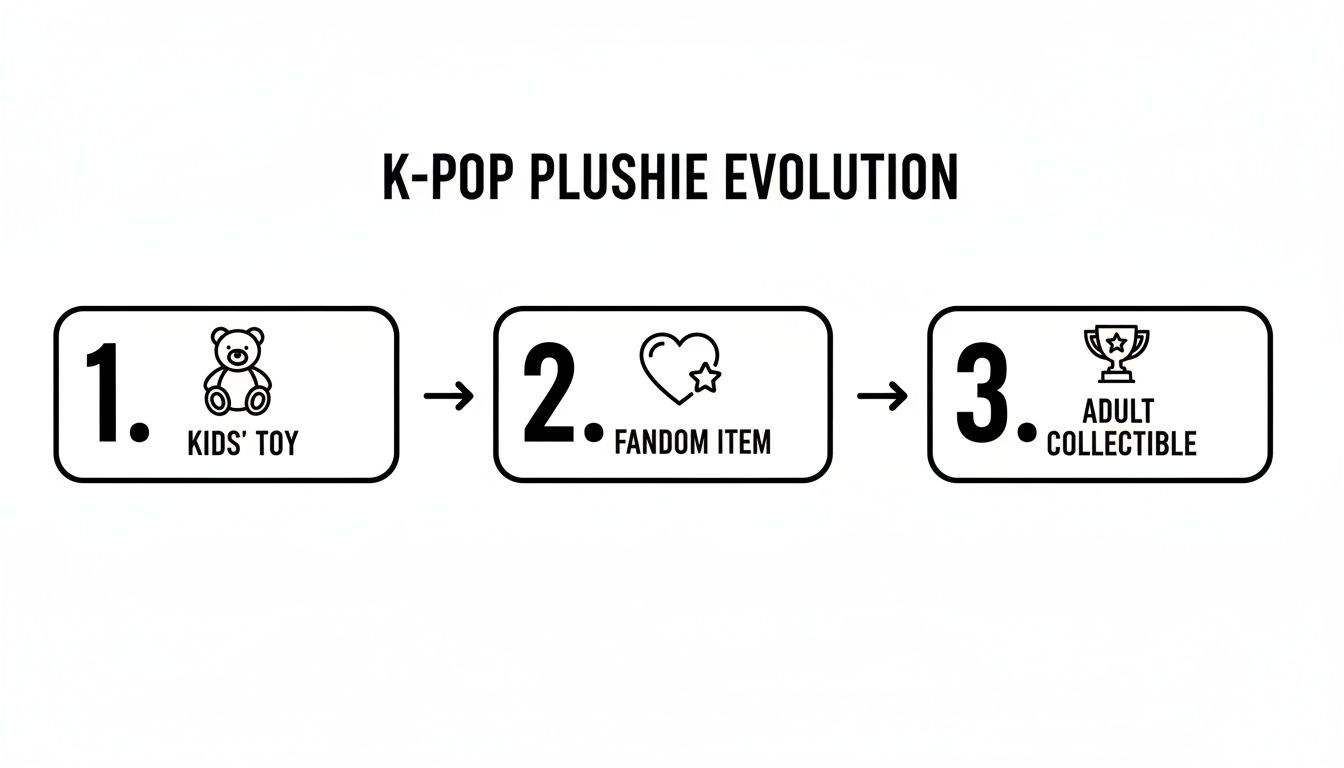
The evolution from a simple teddy bear to a detailed adult collectible like a BTS doll demonstrates the increased market expectation for quality and detail.
Finally, the plushie moves to finishing. This includes a final quality check, trimming of any stray threads, and cleaning with air guns to remove dust or loose fibers. It is then ready for packaging according to your specific branding requirements.
Mass Production Timelines
Understanding the timeline is crucial for planning your launch. Mass production is not simply a scaled-up version of sampling; it is a different process entirely, focused on replication and efficiency.
Prototyping is an iterative, craft-based process of creation and refinement. Mass production is a linear, scaled system designed to replicate a perfected prototype with absolute consistency.
This table outlines a typical manufacturing schedule:
| BTS Plush Toy Manufacturing Timeline | ||
|---|---|---|
| Production Stage | Typical Duration | Key Activities & Manufacturer Notes |
| 1. Prototyping & Sampling | 5–10 working days | Pattern creation, material sourcing, hand-assembly by a senior sample maker. Includes time for client feedback and revisions. |
| 2. Material Procurement | 7–15 days | Bulk ordering of fabrics, stuffing, and accessories post-sample approval. This runs concurrently with pre-production planning. |
| 3. Mass Production | 20–30 days | Includes mass cutting, embroidery/printing, assembly line stitching, stuffing, and finishing. Duration is dependent on order quantity and design complexity. |
| 4. Quality Control & Packaging | 3–5 days | Unit-by-unit final inspection, cleaning, hangtag attachment, and packing into individual bags and master cartons. |
| 5. Logistics & Shipping | Varies by method | Goods are prepared for ex-factory pickup. Sea freight offers cost savings for longer transit times; air freight is faster but more expensive. |
Design changes mid-production can cause significant delays and cost overruns. It is imperative to finalize the design during the prototype stage.
Pricing Factors: Materials and Filling Types
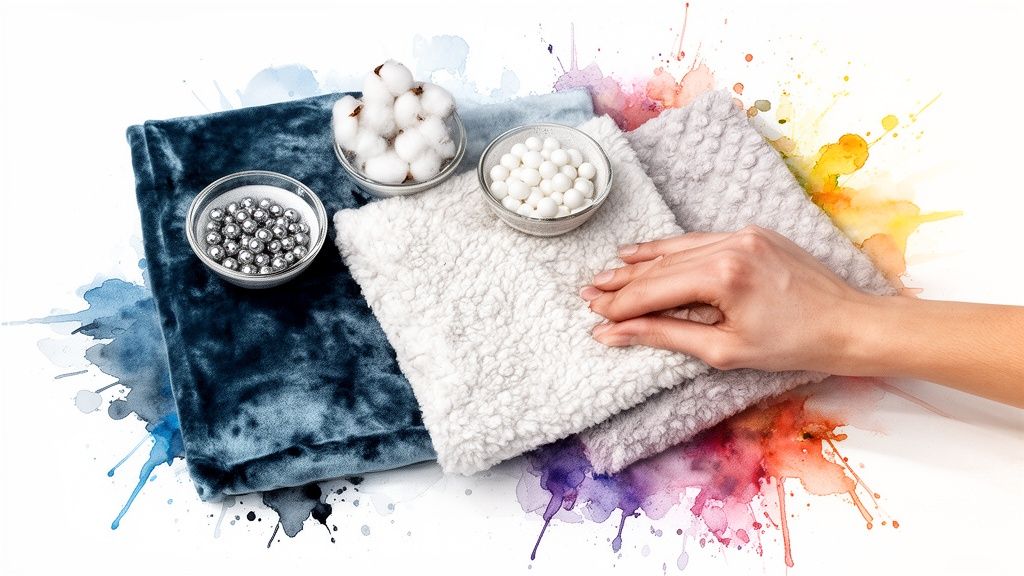
The tactile experience of a plush toy is its defining characteristic. The choice of fabric and filling directly impacts the final look, feel, cost, and safety compliance of the product.
The market for emotionally resonant products is expanding rapidly. In 2023, the China stuffed & plush toys market reached USD 976.3 million. While classic stuffed animals comprised 35.95% of this, plushies based on cartoon and media characters—a category that includes BTS-inspired toys—are the fastest-growing segment. You can read the full research on this emotional economy boom from Grand View Research.
Outer Fabric Selection
The “skin” of the plush toy is the first point of contact. The texture, pile length (fiber height), and weight of the fabric define the character.
Common materials for high-quality character dolls include:
- Crystal Velvet (Super Soft Spandex): Our primary recommendation for high-end collectibles. Its short, dense pile and slight stretch provide a smooth, premium feel, ideal for capturing delicate facial features.
- Short Plush (Velboa): An industry-standard material that is durable, cost-effective, and offers the classic “stuffed animal” texture.
- Minky Fabric: Recognized for its signature dotted texture, Minky is exceptionally soft and often used to add tactile detail to clothing elements like hoodies.
- Sherpa or Fleece: Excellent for recreating textured clothing like jackets or creating stylized, fluffy hair, adding visual depth and sensory contrast.
Manufacturer’s Note: Fabric choice impacts production complexity. Stretchy materials like crystal velvet require more skilled operators to prevent puckering during stitching. Long-pile fabrics demand precise cutting to ensure consistent “fur” direction across all components—a detail that distinguishes a premium product.
Internal Filling and Weighting
The internal components are equally critical. The filling determines the toy’s density, “squish factor,” and ability to retain its shape.
- Polypropylene (PP) Cotton: The industry standard. It is lightweight, resilient (high rebound), and hypoallergenic, making it a safe and reliable choice.
- Memory Foam: Shredded memory foam can be used to create a slow-release squish, offering a satisfying, high-end tactile experience.
- Weighted Beads: Non-toxic plastic or glass beads can be added in a secure inner pouch, typically in the base or limbs. This provides a pleasing heft and improves the toy’s ability to sit upright for display.
Selecting the right materials is a balance of aesthetics, tactile feel, budget, and safety. A deeper understanding of these components enables better decision-making, ensuring your final BTS plush toys are cherished by fans. For more examples, explore our guide to the best stuffed animals to see how materials influence the final product.
MOQ and Quality Control: A Manufacturer’s Perspective
Once the design is finalized, the discussion pivots to production volume and quality assurance. These two factors—cost and quality—are inextricably linked and form the foundation of your brand’s reputation in the collector market.
Character plushies are significant emotional purchases, a trend accelerated since the pandemic, as noted by iiMedia Research. Consumers demand trustworthy quality. In response, we have structured our operations to support e-commerce sellers and brand agencies with low MOQs of 100-500 pieces while maintaining an obsessive focus on international safety standards. Read more on these market dynamics from the South China Morning Post.
Pricing Factors: What Impacts Cost?
The final per-unit cost is a function of materials, complexity, and volume.
- Design Complexity: A simple, single-piece plush is inherently faster to produce than a doll with a removable hoodie, layered hair, and multiple embroidery points. Each additional seam, fabric color, and accessory adds to both material cost and the skilled labor time required for assembly.
- Material Grade: The price difference between standard short plush and premium crystal velvet is tangible. Specialty fabrics or custom Pantone-matched dyes also influence the final cost.
- Order Quantity (MOQ): This is the most significant cost driver. Economies of scale are powerful in manufacturing. A larger order allows for bulk material procurement at lower prices and more efficient production line setup, reducing the per-unit cost.
Common Problem: Clients sometimes approve a complex prototype and then attempt to reduce costs by simplifying the design for mass production. This often results in a final product that disappoints fans. It is more effective to design with a target price point in mind from the outset.
Understanding Minimum Order Quantities (MOQ)
The MOQ is the minimum volume a factory will produce for a single order. For large-scale factories, this can be thousands of units, creating a significant barrier to entry.
We offer flexible MOQs, typically starting between 100 and 500 pieces. This allows new creators to enter the market and established brands to test new designs without a massive capital investment. The trade-off is a higher per-unit cost on smaller runs, as fixed setup costs (pattern making, machine calibration) are amortized over fewer items.
Our Quality Inspection Steps
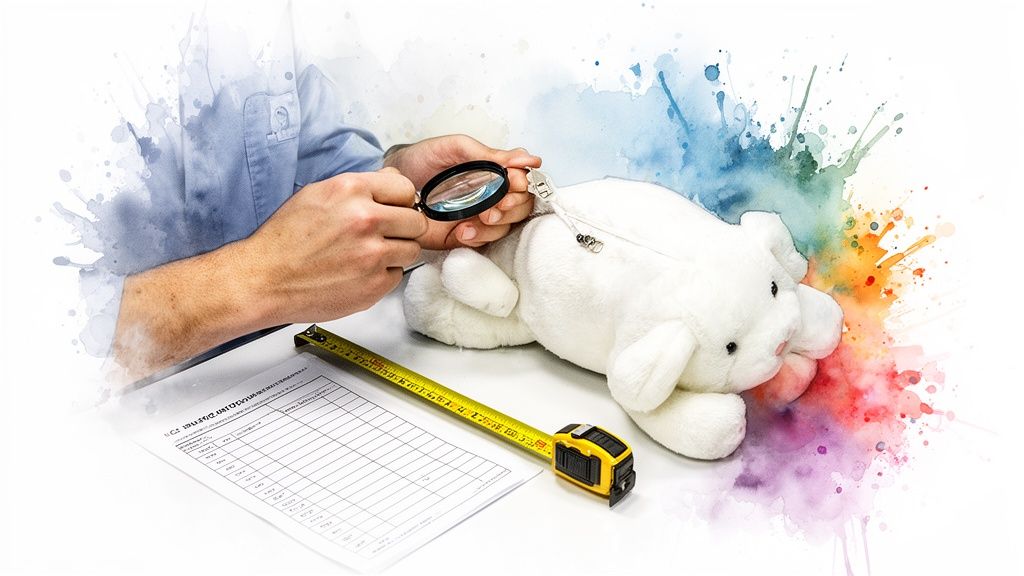
For a collectible BTS plush, quality is not a feature; it is the entire product. Passionate fanbases scrutinize every detail. A loose thread or off-center embroidery can severely damage brand credibility.
Our quality control (QC) is not a final step but an integrated system throughout production.
Our QC inspectors are trained to identify potential issues at every stage:
- Material Inspection: All incoming fabrics and fillings are checked for correct color, weight, texture, and defects before production begins.
- In-Line Inspection: QC teams monitor the factory floor, spot-checking embroidery accuracy, performing pull-tests on seams to ensure strength, and verifying secure attachment of all parts.
- Metal Detection: Every finished plush toy passes through a metal detector. This is a critical, non-negotiable safety step to ensure no broken needle tips or other foreign metal objects are present.
- Final Inspection: Before packaging, each toy undergoes a final, hands-on review for overall appearance, symmetry, cleanliness, and correct labeling. Any unit that fails to meet our standards is rejected.
Attempting to reduce costs by selecting a supplier with lax QC is a high-risk strategy. It can lead to product inconsistencies, negative reviews, and, in the worst-case scenario, a safety recall that causes irreparable brand damage. A robust QC process is the best insurance for your brand’s reputation.
How to Choose a Supplier
Selecting the right factory is the single most critical decision in your product journey. This partnership dictates product quality, adherence to timelines, and ultimately, your brand’s perception among fans.
Before initiating contact, you must define the type of collaboration required. This will shape your entire product development strategy.
Differences Between OEM/ODM
OEM and ODM are two distinct manufacturing models.
- OEM (Original Equipment Manufacturer): This model is for clients with a finalized, production-ready design. You provide a detailed tech pack (blueprints, material specifications, color codes), and we function as your manufacturing arm, producing the plush exactly to your specifications. You retain all intellectual property.
- ODM (Original Design Manufacturer): This is a collaborative partnership for clients who have a concept but require design and engineering expertise. We help develop the pattern, recommend materials, and optimize the design for mass production.
Most licensed BTS plush projects are executed on an OEM basis. However, a competent factory must possess strong ODM capabilities to solve the design challenges that inevitably arise during prototyping.
B2B Buyer-Focused Insights: Questions to Ask
When vetting potential suppliers, look beyond the price quote. A low price can conceal significant risks.
- Request Business Licenses and Certifications: This is fundamental due to diligence. Ask for factory audit reports like BSCI (Business Social Compliance Initiative) or Sedex, which verify ethical labor practices.
- Inquire About Experience with Licensed IP: Request examples of work with other well-known brands. A factory experienced with licensed IP understands the importance of confidentiality, quality consistency, and adherence to strict brand guidelines.
- Assess Communication Protocols: A dedicated, English-speaking account manager is essential. Inquire about typical response times and their process for providing production updates. Poor communication is a major red flag.
- Analyze Their Prototyping Process: A reliable partner will have a clearly defined sampling process. Ask how feedback is handled and how many revisions are included in the sampling fee. The quality of the first prototype is an indicator of their overall capability.
Manufacturer’s Tip: The first sample is a factory’s resume. Scrutinize stitch quality, symmetry, and how accurately they captured the design. A sloppy first sample is a preview of the quality you can expect in mass production.
Safety Standards and Compliance (EN71/ASTM)
Beyond social compliance audits, you must verify a factory’s ability to meet international toy safety standards. This is a legal requirement for market access.
- ASTM F963: The mandatory safety standard for toys sold in the United States.
- EN71: The equivalent standard for toys sold in the European Union.
A reputable manufacturer will have established relationships with accredited testing labs (e.g., SGS, Intertek) and can guide you through the testing process for your target markets. Partnering with a supplier ignorant of these regulations exposes your business to significant legal and financial risk. The risk of low-quality factories is not just poor product, but potential legal action.
The Importance of Transparent Communication
Manufacturing is a complex process with many moving parts. A fabric shipment may be delayed, or a machine may require unexpected maintenance. The difference between a good partner and a bad one is how they manage these challenges. A trustworthy manufacturer communicates proactively, informing you of potential issues and presenting solutions. This transparency builds trust and is the cornerstone of a successful long-term partnership, an asset far more valuable than the lowest possible price. Learn more about what distinguishes top-tier stuffed animal companies.
Why FunEnjoy is a Trusted Manufacturer
As you navigate the complexities of bringing your BTS plush toys to market, you’ll encounter common problems: high MOQs, communication barriers, and concerns about quality and IP protection. At FunEnjoy PlushToys, we’ve built our business to solve these exact issues for brands like yours.
What’s a Realistic Minimum Order Quantity (MOQ)?
A typical MOQ for custom plush toys ranges from 100 to 500 pieces. We maintain this accessible range to empower both emerging creators and established brands. While a lower volume results in a higher per-unit cost due to fixed setup expenses, it provides the flexibility to test new designs with minimal risk.
How Can I Be Sure the Final Plush Looks Just Like My Design?
Our prototype process is designed for absolute accuracy and client satisfaction. We will not begin mass production until you have approved a physical sample.
The process is collaborative:
- First Prototype: Our senior sample makers create the initial physical version from your tech pack.
- Client Feedback: We ship the sample to you for hands-on review of materials, stitching, and overall execution.
- Revisions: We implement your feedback, refining the sample until it perfectly matches your vision.
Tip to reduce cost and time: Provide specific, measurable feedback. Instead of “the face looks off,” specify “move the eyes 2mm closer together and increase smile embroidery thickness by 1mm.” This precision accelerates the revision process.
What Safety Certifications Do I Actually Need?
Product safety is non-negotiable. We manage the entire testing process to ensure compliance with the required standards for your target market.
The two most critical standards for Western markets are:
- ASTM F963: The mandatory safety standard for toys sold in the United States.
- EN71: The mandatory safety standard for toys sold in the European Union.
We ensure every component, from fabric to thread, is tested and compliant, making your product legally ready for sale.
How Do You Protect Our Intellectual Property (IP)?
Protecting your IP is our highest priority. The first step is executing a Non-Disclosure Agreement (NDA). As a factory with extensive experience in licensed products, we have strict internal controls to manage access to design files and prevent unauthorized production overruns. Our long history of working with global brands is your assurance that your IP is secure with us.
Ready to bring your own custom plush toy collection to life? The team at FunEnjoy PlushToys combines decades of expertise with a passion for quality, helping brands create collectibles that fans will treasure. From initial design to global shipping, we manage every step with precision and care.