When brands ask how to sew a stuffed animal for commercial production, they are really asking how to navigate the complex world of mass manufacturing. It’s a process that goes far beyond a needle and thread. As a plush toy manufacturer based in China, we’ve guided hundreds of brands from a simple 2D sketch to a retail-ready product. This guide demystifies that journey, offering the practical, factory-floor knowledge necessary for success.
The global toy market is vast, and the plush toy segment represents a significant share. Success in this market hinges on understanding the industrial process—from material science and supply chain logistics to quality control and international safety standards.
The Global Plush Toy Market: An Overview
China is the undisputed leader in global toy manufacturing, a status solidified over decades. The province of Zhejiang alone, where our factory is located, produces a significant portion of the world’s plush toys. The booming Chinese toy market is built on a sophisticated ecosystem of raw material suppliers, skilled labor, and logistical infrastructure. For B2B buyers, partnering with a Chinese manufacturer provides direct access to this ecosystem, offering unparalleled efficiency and cost-effectiveness.
The primary benefit for brands is achieving economies of scale. Manufacturing in a specialized hub allows for bulk purchasing of materials, streamlined production lines, and access to machinery that is too costly for smaller operations. This results in a lower cost-per-unit, which is critical for achieving viable retail margins.
Types of Plush Toys and Manufacturing Models
Before production begins, a brand must decide on its manufacturing approach. This choice between OEM and ODM dictates the entire product development workflow.
OEM (Original Equipment Manufacturing)
In the OEM model, the brand provides a complete, unique design. We act as the production partner, tasked with translating that design into a manufacturable product. This offers maximum creative control but requires a more intensive development and sampling process. It is the standard for brands creating proprietary characters or intellectual property (IP).
ODM (Original Design Manufacturing)
In the ODM model, a brand selects a pre-existing, factory-tested design from our catalog. They can then customize it with their own branding, colors, and minor modifications. ODM is a faster and more cost-effective route to market, as it bypasses the lengthy initial design and pattern-making phases. It is ideal for promotional items or brands seeking a quick product launch.
The Manufacturing Process: From Concept to Container
The industrial process for creating a stuffed animal is a highly structured workflow designed for consistency, safety, and efficiency across thousands of units.
Phase 1: Design, Pattern-Making, and Sampling
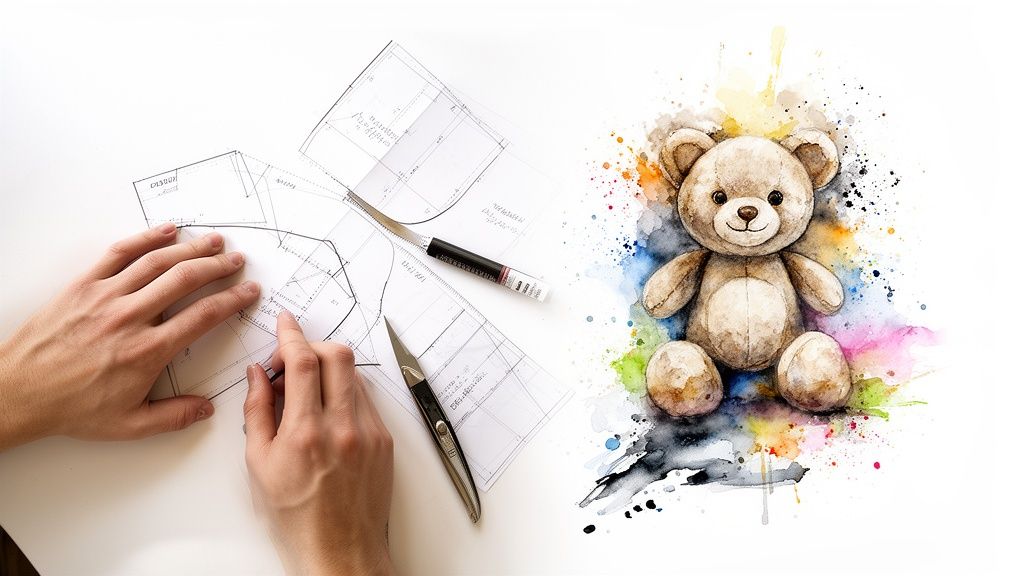
This is the most critical phase. A flaw here is magnified thousands of times on the assembly line.
- Manufacturability Review: Our engineers and pattern masters analyze your 2D design. We identify potential production issues, such as limbs that are too thin to be sewn and turned, or details too complex for consistent embroidery. We provide feedback to optimize the design for mass production without compromising its core identity.
- Pattern Creation: The approved 2D design is deconstructed into a series of flat pattern pieces with precise seam allowances. This is a highly skilled task that balances aesthetics with the physical limitations of fabric and machinery.
- Prototyping (Sampling): We create a physical sample. This allows the client to approve materials, construction quality, embroidery, and overall feel. A typical sampling timeline is 5-10 days. Multiple revisions may be necessary to perfect the design. The final approved prototype becomes the “master sample” against which all mass-produced units are measured.
Phase 2: Material Sourcing and Preparation
Material selection directly impacts cost, safety, and the final product’s tactile quality.
- Fabrics: Common choices include high-density short plush (Velboa) for durability and smooth embroidery, Minky for its ultra-soft texture, and long-pile faux fur for realistic animal characters. Fabric weight, measured in Grams per Square Meter (GSM), is a key quality indicator; a higher GSM (e.g., 300-400) results in a denser, more premium feel.
- Filling: The industry standard is PP cotton (polyester fiberfill), chosen for being hypoallergenic, lightweight, and cost-effective. We use different grades (e.g., 7D, 15D) to control softness and resilience. For added weight and stability, we strategically add plastic poly pellets or glass beads, often in the base or paws.
All materials are sourced from trusted suppliers and must be accompanied by safety certifications to comply with international standards.
Phase 3: Cutting, Sewing, and Assembly
This is where the factory floor comes alive, and where understanding how to sew a stuffed animal at an industrial level becomes critical.
- Cutting: For mass production, we use multi-layer die-cutting presses. A custom steel die, shaped like the pattern piece, cuts through dozens of fabric layers simultaneously, ensuring perfect uniformity. For complex shapes or short runs, CNC laser cutters are used to maintain precision before sewing begins.
- Assembly Line Sewing:This stage defines how to sew a stuffed animal efficiently at scale. Production is organized into an assembly line, with specialized teams handling tasks such as sewing limbs, attaching ears, and assembling the main body. Industrial overlock machines ensure strong internal seams, while lockstitch machines are used for visible topstitching. Stitch density (SPI) is tightly controlled, typically within an 8–12 range, to ensure durability and consistency.
- Embroidery and Detailing: Facial features and logos are machine-embroidered for safety and precision. Multi-head embroidery machines work on dozens of pieces simultaneously, delivering consistent results across large production runs.
Phase 4: Stuffing, Finishing, and Packing
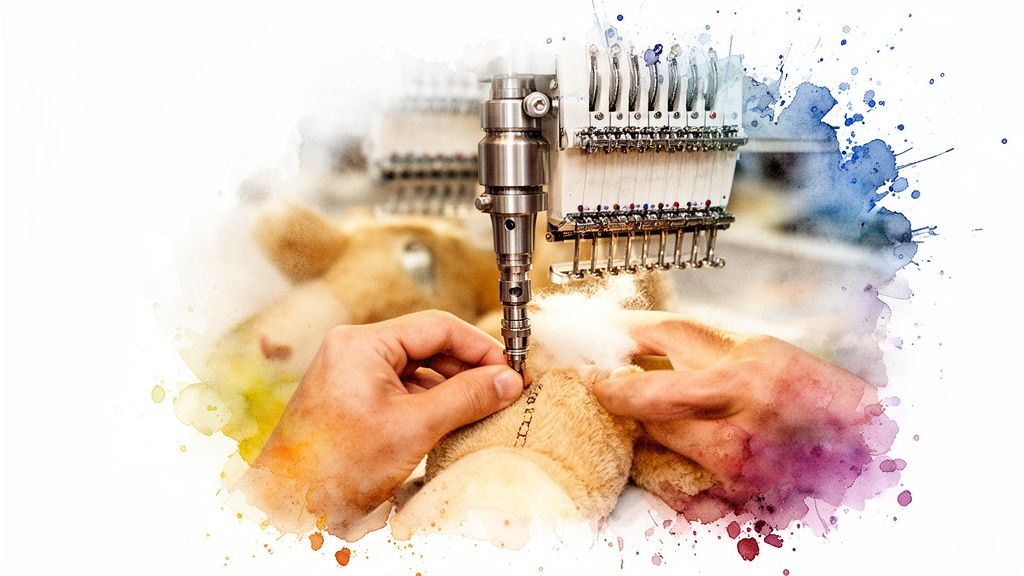
The final stages bring the character to life.
- Stuffing: Industrial blowing machines inject PP cotton into the toy shells with compressed air. This guarantees a consistent fill density across all units. The exact weight of filling is predetermined during sampling and is a key checkpoint during final quality control.
- Closing: A small opening left for stuffing is hand-sewn shut by skilled workers using a ladder stitch (blind stitch). This technique makes the final seam invisible, creating a flawless finish.
- Final QC and Packing: Each toy undergoes a final inspection, cleaning, and metal detection scan before being packed according to client specifications.
Pricing Factors: What Impacts Your Cost?
Understanding the cost structure is vital for B2B buyers. The price per unit is not arbitrary; it is a calculation based on several key factors:
- Order Quantity (MOQ): This is the single largest factor. Higher volumes allow for better material pricing and more efficient production line setup, reducing the per-unit cost.
- Design Complexity: A toy with many small parts, complex curves, or multiple fabrics requires more labor and time, increasing the cost.
- Materials: Premium fabrics like Minky or long-pile faux fur cost more than standard Velboa. The type and amount of filling also affect the price.
- Size: Larger toys require more material and filling.
- Accessories and Features: Custom elements like sound boxes, clothing, or printed accessories add to the unit cost.
To reduce costs, consider simplifying the design, choosing standard materials, and increasing the order quantity. We work with clients to value-engineer their designs, finding ways to lower costs without compromising quality.
Minimum Order Quantity (MOQ) Explained
MOQ is the minimum number of units a factory will produce in a single run. For most established plush toy factories, the standard MOQ ranges from 500 to 1,000 pieces per design. This number is determined by the economics of purchasing raw materials in bulk and the cost of setting up machinery for a specific product. Ordering below the MOQ is often not feasible as material suppliers have their own minimums, and the setup costs become prohibitively high on a per-unit basis.
For new brands or test runs, some factories, including FunEnjoy, may offer lower MOQs (100-500 pieces) to provide greater flexibility, though this typically comes at a higher per-unit price.
Quality Control and Safety Standards
Robust quality control is non-negotiable. It protects end-users, your brand’s reputation, and prevents costly recalls. Our QC process is integrated throughout production:
- Incoming Quality Control (IQC): All raw materials are inspected upon arrival to verify they meet specifications (color, weight, safety certifications).
- In-Process Quality Control (IPQC): Checks are performed at multiple stages on the assembly line to catch errors early. This includes seam strength tests, embroidery alignment checks, and correct limb placement.
- Final Quality Control (FQC): 100% of finished products are inspected. This includes checks for symmetry, cleanliness, and a final pass through a metal detector to ensure no broken needle fragments are inside.
Global Safety Standards
Compliance with international safety standards is mandatory. The two primary standards for plush toys are:
- EN71 (Europe): This comprehensive standard covers physical and mechanical safety (e.g., seam strength, no sharp points), flammability, and chemical composition (strict limits on heavy metals).
- ASTM F963 (USA): This is the legally required standard in the US. It places a strong emphasis on preventing choking hazards from small parts, in addition to chemical and physical safety requirements.
A reputable manufacturer will have extensive experience with these standards and can provide the necessary testing and documentation for your product. Risking production with a low-quality factory that cuts corners on safety testing can lead to product seizure by customs, mandatory recalls, and severe damage to your brand.
Logistics: Getting Your Product to Market
Once production is complete, the final step is shipping. B2B buyers have two main options:
- Sea Freight: The most cost-effective option for large orders, but with longer transit times (typically 30-40 days to North America or Europe).
- Air Freight: Much faster (5-10 days) but significantly more expensive. It is typically used for urgent orders or high-value, low-volume products.
We handle all export documentation and can arrange shipping to your port of choice (FOB – Free on Board) or directly to your warehouse (DDP – Delivered Duty Paid).
How to Choose the Right Supplier
Choosing a manufacturing partner is a critical business decision. Look for these key attributes:
- Experience and Specialization: Partner with a factory that specializes in plush toys.
- Strong Communication: Your contact should be fluent in your language and provide clear, prompt updates.
- Transparency: They should be open about their processes, pricing, and material sources.
- Proof of Compliance: Ask for factory audits (e.g., BSCI, SEDEX) and proof of previous product safety testing.
- Flexibility: A good partner will work with you to solve problems and meet your needs, including offering reasonable MOQs.
Common problems B2B buyers face often stem from choosing a supplier based solely on the lowest price. This can result in poor quality, missed deadlines, communication barriers, and unexpected costs. A reliable partner acts as an extension of your team.
Why FunEnjoy is a Trusted Manufacturer
At FunEnjoy, we combine decades of manufacturing expertise with a modern, client-focused approach. We understand the challenges that brands face when entering the plush toy market. Our process is built on transparency, quality, and partnership. We guide you through every step, from design optimization and material selection to ensuring full compliance with international safety standards. Our flexible MOQs and commitment to clear communication make us an ideal partner for brands of all sizes. We don’t just sew stuffed animals; we build long-term relationships based on trust and consistent results.
We offer a complete solution for creating high-quality plush stuffed animals toys for brands worldwide. From our factory floor, we’ve seen firsthand how a well-executed manufacturing plan can turn a great idea into a beloved product. If you are ready to bring your vision to life, we are here to help. Explore our full range of custom plush toy services today. For more information on materials, see our guide to plush toy stuffing.