Sourcing wholesale stuffed animals is more than a simple transaction; it’s an intricate manufacturing process. As a factory based in Yiwu, China, we see brands navigate this journey daily. The gap between a character sketch and a container of finished goods is vast, filled with critical decisions about materials, safety compliance, and logistics. This guide provides an insider’s look from the factory floor, focusing on the practical, manufacturer-level knowledge you need to succeed.
Your success hinges on understanding the production realities. It’s not about finding the cheapest quote. It’s about finding a manufacturing partner who can execute your vision with precision, ensuring every plush toy is safe, durable, and commercially viable.
The Reality of Sourcing Wholesale Stuffed Animals
From our perspective on the production line, the most successful brands are those who grasp the technical details. Every choice—from the tactile feel of a fabric and the density of the stitching to navigating complex international safety standards—has a ripple effect on quality, cost, and time-to-market.
The Global Plush Toy Market: An Overview
The demand for plush toys is not just stable; it’s expanding rapidly. The global market, valued at USD 12.65 billion in 2024, is projected to reach USD 26.23 billion by 2033, growing at a CAGR of 8.35%. This growth signifies a massive global opportunity for brands that can master their supply chain. Read the full research about the plush toy market
While North America and Europe remain dominant markets, we are fulfilling an increasing volume of orders for the Asia-Pacific and Latin American regions.
A manufacturer’s advice: Long-term success isn’t built on chasing fleeting trends. It’s built on a foundation of quality manufacturing and a deep understanding of your target audience, whether for retail, promotional campaigns, or licensed merchandise.
Navigating this process requires a partner with both creative insight and technical expertise. At FunEnjoy, we act as that partner, guiding you through the manufacturing journey to avoid common pitfalls and achieve your commercial goals.
The Manufacturing Process: From Design to Delivery
Transforming a concept into a tangible plush toy is a systematic, multi-stage process. For wholesale stuffed animals, a detailed production workflow is essential to ensure quality, safety, and consistency across thousands of units.
The process begins with a detailed design consultation. We clarify every specification: the character’s expression, precise fabric textures, accessory details, and, crucially, the exact Pantone Matching System (PMS) codes for color accuracy. This initial step is critical, as it forms the blueprint for all subsequent stages.
This flowchart provides a high-level view of the journey from concept to market-ready product when collaborating with a manufacturer.
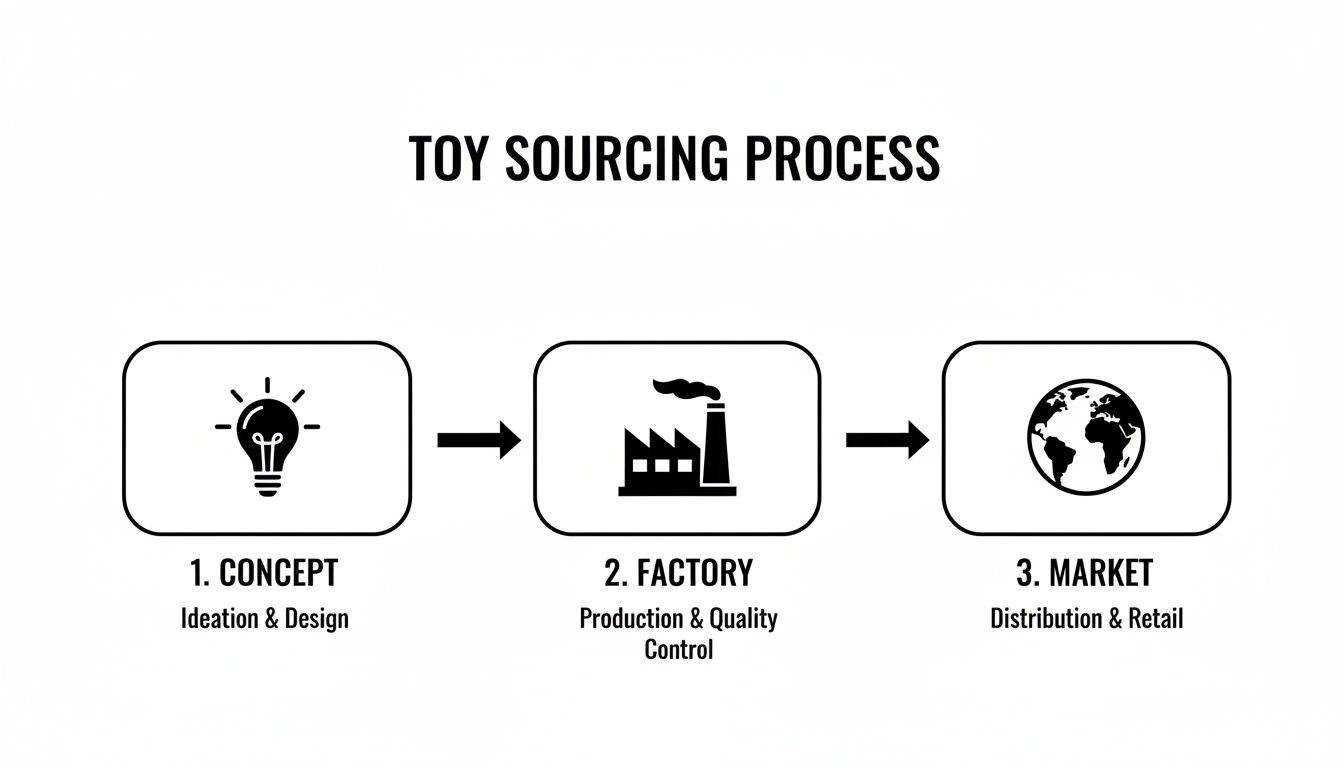
A successful launch is the result of a strong partnership: your brand’s vision combined with our factory’s execution capability.
OEM vs. ODM: Defining Your Production Path
One of the first strategic decisions is choosing between an OEM or ODM model. This choice dictates the project’s entire trajectory.
- OEM (Original Equipment Manufacturer): You provide a unique, proprietary design. We act as your production partner, manufacturing the product according to your exact specifications. This route offers complete brand originality but requires a fully developed design concept from you.
- ODM (Original Design Manufacturer): You select a proven design from our existing catalog. We then customize it for your brand by modifying colors, fabrics, or adding your logo. ODM significantly reduces development time and is an efficient way to enter the market.
The optimal choice depends on your business strategy. OEM is ideal for established brands with strong IP, while ODM provides a faster path to market for startups and promotional projects.
The Production Workflow and Timelines
Once your design is finalized, our specialized teams begin execution. Pattern makers create precise digital templates from your design files. These are fed into automated cutting machines to ensure every fabric piece is identical—a non-negotiable for mass production consistency. Simultaneously, embroidery and printing are applied to these flat fabric pieces before assembly.
The sampling stage is where your design becomes a physical reality. This critical phase typically takes 7–14 days. We produce a physical prototype for your approval. This allows you to evaluate materials, stitching, and overall feel before committing to mass production.
Upon sample approval, mass production commences. This stage generally requires 30–45 days, depending on order volume and design complexity. The workflow includes assembly-line sewing, precise stuffing to achieve the desired density, final stitching, and rigorous quality control checks at every step.
For a deeper dive into the initial creative stages, you can learn how to design your own plush toy with our detailed guide. This level of coordination is how we guarantee every unit perfectly matches the approved prototype.
Materials, Quality Control, and Safety Standards
The quality of wholesale stuffed animals is dictated by the raw materials used. These choices impact the product’s tactile feel, durability, cost, and, most importantly, safety.
The customer’s first interaction is with the outer plush fabric. While options are vast, several industry-standard materials are favored for their reliability, feel, and performance in a production environment.
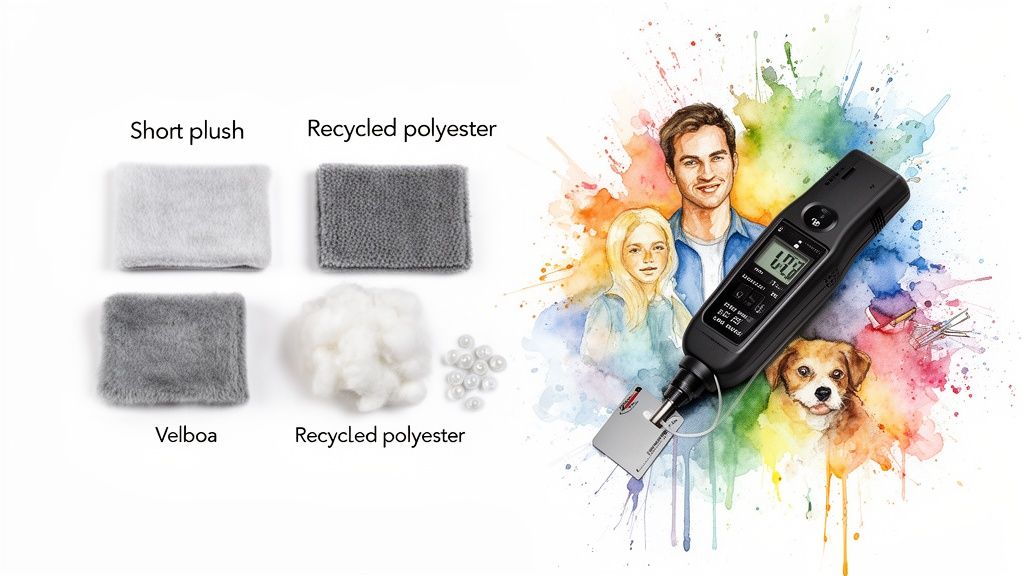
Fabric and Filling: The Anatomy of a Plush Toy
Here is a breakdown of the common materials we utilize daily, outlining their characteristics, applications, and relative cost.
Plush Toy Material and Filling Comparison
| Component | Type | Key Characteristics | Best For | Cost Index |
|---|---|---|---|---|
| Outer Fabric | Standard Short Plush | Versatile, cost-effective, short pile, ideal for printing/embroidery. | High-volume promotional items, classic teddy bears, detailed characters. | $ |
| Outer Fabric | Crystal Super Soft Velboa | Silky, smooth texture with a slight sheen, luxurious feel. | Premium retail products, high-end collectibles, infant-safe toys. | $$ |
| Outer Fabric | Recycled Polyester (rPET) | Eco-conscious, soft, durable, similar hand-feel to virgin polyester. | Brands with a sustainability focus, environmentally-themed products. | $$ |
| Filling | PP Cotton | Lightweight, hypoallergenic, fluffy, provides classic compressibility. | The industry-standard filling for nearly all plush toy applications. | $ |
| Filling | Weighted Plastic Pellets | Small, dense beads adding weight and stability. | High-end collectibles, toys designed to sit upright, sensory products. | $$$ |
The right combination is key. A premium collectible may use crystal velboa with a blend of PP cotton and weighted pellets for a substantial feel. In contrast, a promotional item would typically use standard plush and 100% PP cotton to optimize for cost while maintaining quality.
Navigating Global Safety Standards: EN71 & ASTM F963
Safety is non-negotiable. Low-cost factories often cut corners here, creating significant liability for your brand. We integrate safety compliance into our manufacturing process from the ground up, testing rigorously to meet stringent international standards required for market access.
The two primary standards are EN71 for Europe and ASTM F963 for the United States. These regulations cover everything from the chemical composition of dyes to the physical durability of seams and attachments.
Our quality inspection includes several mandatory steps:
- Needle Detection: Every finished toy passes through a metal detector to ensure no broken needle fragments are left inside. This is a critical safety check.
- Tension Tests: We apply mechanical force to seams, eyes, and other small parts to ensure they cannot be detached, preventing potential choking hazards.
- Chemical Screenings: All materials, including fabrics, threads, and dyes, are tested to be free from harmful substances like lead, phthalates, and other toxins.
This rigorous process provides clients with the assurance that their products are not only well-made but also completely safe for end-users. When vetting suppliers, always demand evidence of their safety compliance protocols. Explore our range of compliant wholesale plush animals to see these principles in practice.
Understanding Pricing, MOQ, and Logistics
Two questions dominate initial conversations: “What is the unit price?” and “What is your MOQ?” The answer is never a simple number from a price list, as every custom plush project is unique. The final cost is a detailed calculation based on materials, labor, and complexity.
What Impacts Your Unit Price?
Understanding the cost drivers for wholesale stuffed animals is key to managing your budget effectively.
- Design Complexity & Labor: A simple spherical plush with printed eyes requires far less labor than a character with articulated limbs, multi-layered clothing, and detailed embroidery. More pattern pieces and complex assembly steps directly increase labor time and, therefore, cost.
- Materials and Filling: Premium fabrics like crystal velboa have a higher per-meter cost than standard short plush. Similarly, incorporating weighted plastic pellets is a cost-adder compared to using 100% PP cotton filling.
- Specialized Components: Adding features like sound modules, articulated skeletons for posing, or custom accessories involves sourcing additional components and integrating extra assembly steps, which increases the unit price.
- Order Volume: Economies of scale are a major factor. Larger orders allow us to procure raw materials in bulk at a lower cost and optimize production line efficiency. This is why an order of 5,000 units will have a lower per-unit cost than an order of 500 units of the identical toy.
Minimum Order Quantity (MOQ) Explained
Minimum Order Quantities (MOQs) are a manufacturing necessity. Our raw material suppliers have their own MOQs for custom-dyed fabrics—often hundreds of meters. Setting up a production line for a new design also involves significant time for tooling, calibration, and training.
Our typical MOQ starts from 500–1000 pieces, which is standard for custom manufacturing. This allows us to run production efficiently while remaining accessible to a range of businesses.
The specific MOQ depends on the project. A design requiring unique, non-stock materials will naturally have a higher MOQ than one using standard materials we keep in inventory. Exploring our portfolio of plush toys wholesale projects can provide valuable insight into the range of possibilities and help you align your design with your budget.
Logistics and Shipping
A full-service manufacturer also manages logistics. We handle everything from final packaging to preparing your order for freight. Our standard shipping term is FOB (Free On Board), meaning we manage transport to the designated port in China, after which your freight forwarder takes over. We can also accommodate other Incoterms like EXW (Ex Works) or DDP (Delivered Duty Paid) and provide all necessary documentation for smooth customs clearance.
How to Choose a Supplier
Selecting a manufacturing partner is the single most critical decision for your plush toy venture. A reliable partner executes your vision with precision and consistency. A poor one leads to production delays, quality issues, and reputational damage.
The selection process must go beyond comparing price sheets. As a manufacturer located in the production hub of Yiwu, we see firsthand that successful brands conduct thorough due diligence, vetting a factory’s technical capabilities, communication, and track record.

Key Vetting Criteria for a Manufacturing Partner
Look for tangible evidence of a factory’s professionalism and capabilities. Manufacturing hubs like Yiwu and Dongguan offer access to a mature supply chain and a highly skilled workforce, providing inherent advantages.
Key areas to investigate:
- Audits and Certifications: Request proof of social compliance audits (e.g., BSCI, Sedex) and quality management certifications (e.g., ISO 9001). These documents are evidence of an ethical and professional operation.
- Communication and Expertise: Does their team communicate clearly and responsively in English? A small miscommunication during sampling can result in thousands of incorrect units. Their ability to provide technical suggestions is also a key indicator of expertise.
- Proven Track Record: Review their portfolio for projects similar in complexity to yours. Experience manufacturing for recognized global brands demonstrates a proven ability to meet high standards for quality, safety, and reliability.
A significant red flag is a factory that is evasive about its quality control processes or unable to provide safety testing documentation. Transparency is the foundation of a successful manufacturing partnership.
The Risks of Low-Quality Factories
New buyers sourcing wholesale stuffed animals often fall into predictable traps. Partnering with an inexperienced or low-quality factory inevitably leads to missed deadlines, inconsistent quality between the approved sample and the bulk production, and communication breakdowns.
China’s dominance in the toy market is due to its unparalleled manufacturing ecosystem. In 2024, it supplied approximately 73.3% of the USD 41 billion in toys imported by the U.S. By selecting an established manufacturer within this ecosystem, you mitigate significant operational risks. You can learn more about China’s role in the global toy market.
At FunEnjoy, our business is built on transparency, reliability, and decades of manufacturing expertise. We build long-term partnerships by delivering on our commitments and ensuring every product meets the highest global standards.
Why FunEnjoy is a Trusted Manufacturer
Over the years, we’ve guided countless brands—from startups to multinational corporations—through the complexities of custom plush manufacturing. Here are our answers to some of the most common questions we encounter.
What is the most common problem new buyers face?
The biggest mistake is selecting a supplier based solely on the lowest unit price. An unusually low quote is often indicative of substandard materials, poor labor practices, or a disregard for safety standards. This approach frequently leads to a defective product that cannot be sold, resulting in costly remakes that negate any initial savings. A true partner collaborates with you to value-engineer the product, reducing costs without compromising on quality or safety.
How do you protect my intellectual property (IP)?
IP protection is a valid and critical concern. A reputable manufacturer operates on a foundation of trust. We always execute a Non-Disclosure Agreement (NDA) before you share any proprietary design files. Our internal systems are secure, and our long-standing relationships with major brands are built on our proven discretion and commitment to protecting our clients’ creative assets.
Why might colors vary between the sample and mass production?
Achieving perfect color consistency across different production batches is a technical challenge in textile manufacturing. The primary factor is that dyeing is a chemical process subject to slight variations between dye lots. To manage this, we use the Pantone Matching System (PMS). You provide a Pantone code, and we produce a “lab dip”—a physical fabric swatch dyed to match—for your approval before ordering bulk material. This ensures the final product color is within a tightly controlled, acceptable tolerance.
While the plush toy market is diverse, classic stuffed animals remain the dominant category, holding a 39.85% market share in 2023. Interestingly, despite the growth of e-commerce, traditional retail channels still accounted for 82.76% of sales, underscoring the importance of the physical product experience. Learn more about plush toy market segmentation.
Navigating custom toy manufacturing can seem daunting, but with the right partner, it becomes a streamlined and rewarding process. At FunEnjoy PlushToys, we combine decades of craftsmanship with modern production efficiency to bring your vision to life.
Reach out for a no-obligation quote today to discuss your project with our experts.