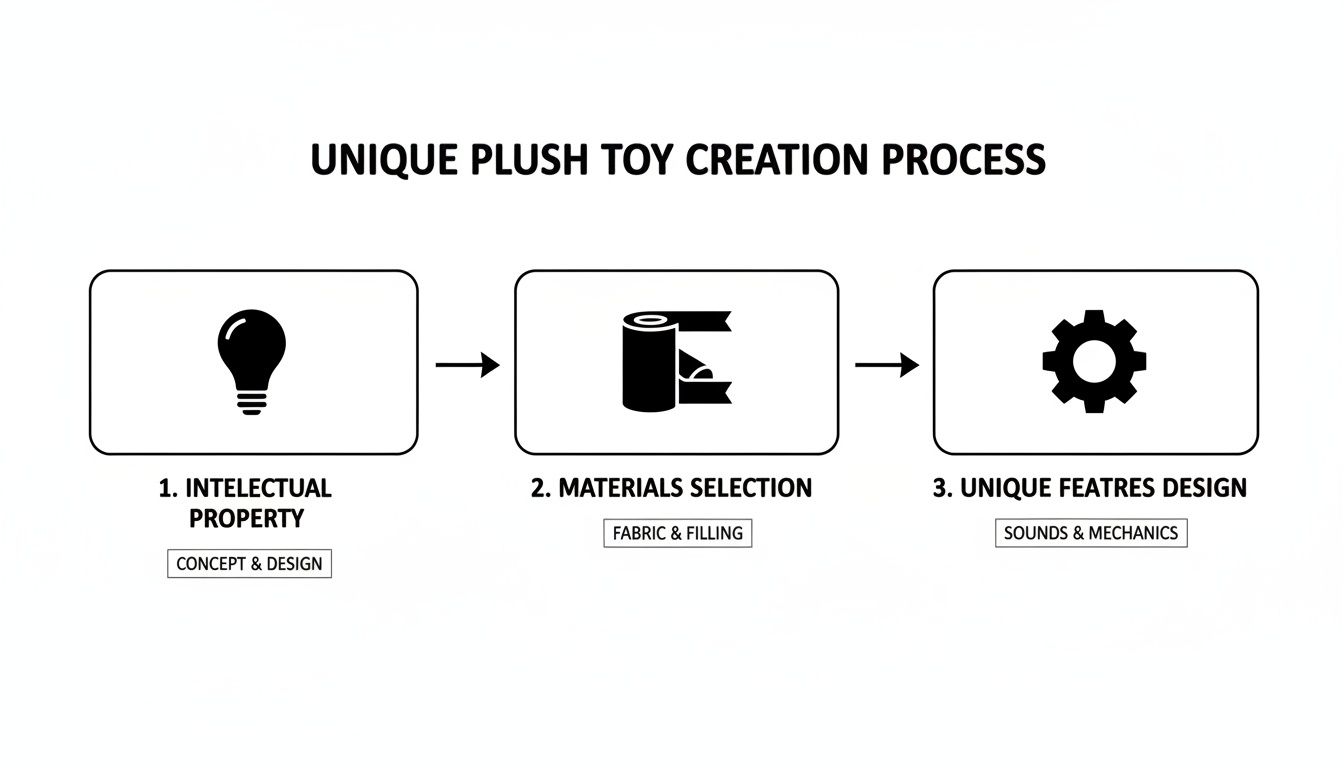
Unique Plush Toys stand out in a world overflowing with teddy bears—but what actually makes them different? It’s not just about a quirky design. From our perspective on the factory floor, a truly unique plush toy is a carefully engineered product: a mix of distinct character design, innovative materials you can’t help but touch, and interactive features that turn customers into fans.
This is the secret sauce that transforms a simple stuffed animal into a high-margin, collectible item that tells a story.
Market Overview: Beyond Cuddly
We see countless designs come through our doors, but the ones that become market hits share a common thread. A client might bring us a cool character concept, but the real magic begins when we figure out how to give that 2D idea a 3D personality. A unique plush isn’t just about how it looks; it’s a complete sensory experience built for a specific audience.
For any business buying plush toys, grasping this is key. When you know what elements create that “wow” factor, you can develop products that not only justify a higher price but also build genuine brand loyalty.
| Element | Description | Manufacturing Consideration |
|---|---|---|
| Intellectual Property (IP) | The character, brand, or story behind the toy. It creates an immediate emotional connection and collectibility. | Licensing agreements, design accuracy to the source material, and brand guideline adherence are critical. |
| Material Innovation | The fabrics and textures used. The tactile feel is a huge differentiator and can define the character’s personality. | Sourcing specialized fabrics can impact cost and lead times. Material choice must also align with safety standards. |
| Interactive Features | Electronic components like sound chips, lights, or simple mechanical elements that add a layer of engagement. | Requires integrating electronics with soft materials, complex safety testing, and sourcing reliable components. |
| Thoughtful Packaging | The unboxing experience. Custom boxes, story cards, or themed packaging elevate the product’s perceived value. | Adds to the overall unit cost and requires careful design to protect the product during shipping. |
Each of these elements works together to create a product that feels special and intentional, making it far more than just another toy on the shelf.
The Benefits of IP-Driven Plush Toys
Everything starts with a great character. A unique plush toy almost always begins with compelling intellectual property (IP) that people connect with on an emotional level. This could be a famous character from a movie, a beloved brand mascot, or a completely new creation with an interesting backstory.
This IP-driven strategy creates an instant bond and gives customers a reason to buy more than one, turning a single purchase into a collection.
Look no further than the massive success of Pop Mart’s Labubu character from ‘The Monsters’ series. This little mischievous plush figure brought in an incredible RMB 3 billion (about US$418 million) in just one year, making up nearly 23% of the company’s total revenue. That kind of explosive growth shows just how hungry consumers are for IP-driven plush toys that mix cute designs with the thrill of collecting. You can learn more about this phenomenon in the China toy market.
Types of Unique Plush Toys & Materials
How a toy feels is just as important as how it looks. A toy with a distinct texture immediately stands out. We go way beyond standard polyester and work with a whole range of interesting fabrics to get the feel just right.
Fabric & Outer Shell Materials
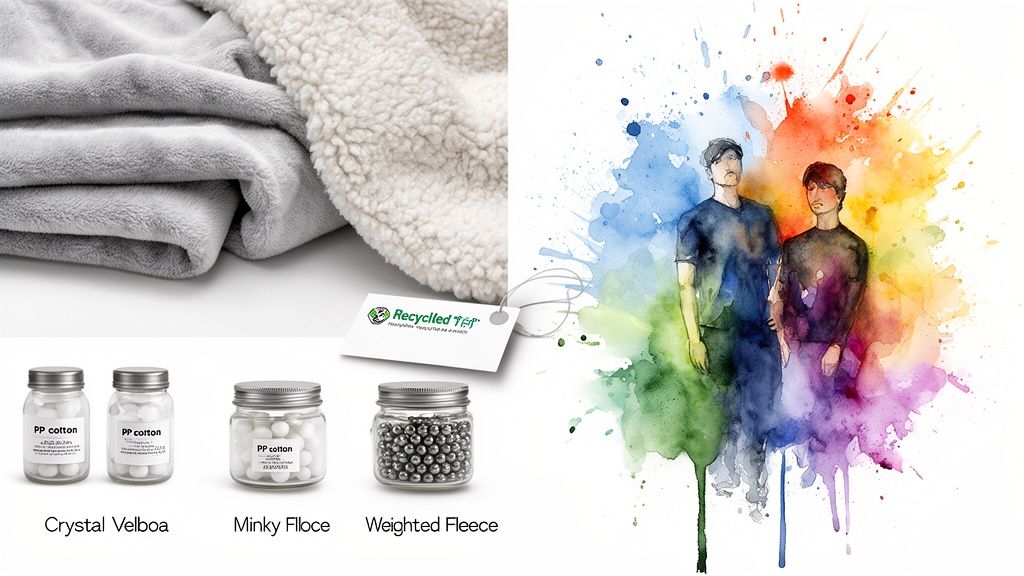
The fabric is the plush toy’s “skin.” It’s what people see and touch first, forming their initial impression of its quality. While standard polyester gets the job done, picking a more specialized material is how you start to create something truly memorable.
- Crystal Velboa: This fabric has a super-soft, almost shiny finish that feels incredibly luxurious to the touch. It is ideal for premium retail toys.
- Minky Fabric: Famous for its signature dotted texture, it adds a sensory element that’s perfect for toys aimed at babies or even pets.
- Sherpa Fleece: Designed to mimic the feel of wool, this material gives a toy a cozy, rustic, and comforting texture.
- Recycled PET Fabric: For brands focused on sustainability, fabric made from recycled plastic bottles offers an eco-friendly story that resonates with modern consumers.
Filling & Inner Materials
The stuffing is just as important as the outer shell. It determines the toy’s weight, its shape, and how it feels when you give it a squeeze. The industry standard is polypropylene (PP) cotton—it’s soft, bounces back well, and is hypoallergenic. But different fillings can create entirely different experiences.
| Material Type | Key Characteristics | Best Use Case | Relative Cost |
|---|---|---|---|
| PP Cotton | Lightweight, soft, hypoallergenic, holds shape well. | The standard for most retail and promotional plush toys. | Low |
| Memory Foam | Dense, slow-rising, provides a satisfying squish. | “Squishy” style collectibles and stress-relief toys. | Medium |
| Weighted Beads | Small plastic or glass beads add significant heft. | Sensory and therapeutic toys for calming effect. | High |
| Mixed Fillings | Combining beads in paws/bottom with PP cotton. | Creates a premium feel with a stable, weighted base. | Medium-High |
The Plush Toy Manufacturing Process
Turning a simple sketch into a truckload of finished plush toys is a journey we’ve perfected over decades on the factory floor. It’s part art, part precision engineering. For any brand, getting a handle on this workflow is the key to clear communication and realistic timelines.
Stage 1: Prototyping and Sampling
Before mass production, we create a physical sample. This prototype is a non-negotiable step for quality control. Our dedicated sample room, staffed by ‘paper pattern masters’ with years of hands-on experience, takes charge here. They painstakingly create a precise 2D pattern from the 3D design—like a tailor’s pattern for a plush.
You can expect the sampling process to take between 5 to 10 working days. This gives us enough time for pattern making, sourcing the right sample materials, sewing, and running our first round of quality checks. Once you get that first prototype, you can provide feedback for revisions.
Stage 2: Mass Production Workflow
Once you approve the final sample, we activate the production line. This is a highly organized workflow designed for quality and efficiency.
- Material Sourcing and Inspection: We order all fabrics, fillings, and accessories in bulk. Nothing gets used until it’s inspected upon arrival to meet our quality and safety standards.
- Precision Cutting: Using the master patterns, the fabric is cut into individual pieces. For consistency, we often cut huge stacks at once using industrial machines.
- Embroidery and Printing: This is when we add the details. Any logos, facial features, or decorative patterns are applied before the toy is sewn together.
- Assembly and Sewing: Our skilled sewing teams take over, stitching the pieces together on industrial machines, leaving a small opening for stuffing.
- Controlled Stuffing: Each toy is filled with a precise amount of stuffing (like PP cotton) using a special blowing machine. This ensures every single one has the same firmness and shape.
- Final Stitching and Finishing: The opening is carefully sewn shut, and our team does a final once-over, trimming any loose threads.
- Multi-Stage Quality Control: Before anything leaves our factory, every toy undergoes a final, rigorous inspection.
OEM vs. ODM Services Explained
When you’re looking for a manufacturing partner, you’ll mainly hear about two service models: OEM and ODM.
- Original Equipment Manufacturer (OEM): You bring us a complete design, and our job is to manufacture it exactly to your specifications. It’s the go-to model for brands with their own characters or a clear product vision.
- Original Design Manufacturer (ODM): We offer our existing plush toy designs that you can add your branding to and sell. It’s a much faster way to get to market if you don’t have a design of your own.
The majority of our partners choose the OEM route. If you’re just starting, you can learn more about how to turn drawings into plush toys in our detailed guide.
Plush Toy Pricing Factors
Sooner or later, every conversation we have with a new partner gets to the heart of the matter: “What’s the unit cost?” The final price isn’t a number we pull out of thin air; it’s a direct result of the creative choices you make. A simple, pocket-sized character is a world away from a large, complex plush with multiple textures and a built-in sound chip.
What Really Drives the Unit Price?
The price of your plush toy is built piece by piece. Here are the main factors:
- Design Complexity: A plush with many small parts, detailed embroidery, or a tricky sewing pattern requires more hands-on time from our skilled team. More pattern pieces mean more time cutting and sewing, which increases cost.
- Material Choices: Premium fabrics like custom-dyed sherpa fleece or eco-friendly recycled PET cost more than standard options. The type of filling also matters—weighted beads, for example, cost more and must be added by hand.
- Size and Weight: Bigger toys use more fabric and stuffing. They also take up more room in a shipping container, which adds to logistics costs.
- Special Features: Electronics like sound modules or LED lights mean extra components, specialized assembly work, and tougher safety testing, all of which influence the price.
- Safety Certifications: Getting your toys certified to standards like EN71 (for Europe) or ASTM F963 (for the USA) is non-negotiable. This involves specific lab tests, and those costs are factored into the final price.
Smart Ways to Reduce Cost
Creating a unique plush on a tight budget is a classic challenge, but there are clever ways to lower the price without sacrificing quality.
- Simplify the Sewing: Reducing the number of separate fabric pieces can make a real difference, cutting down on both cutting and sewing time.
- Be Smart with Embroidery: Instead of a large, fully embroidered logo, you could opt for a smaller one. For some details, high-quality printing might be a more cost-effective choice.
- Use Materials Strategically: Use a premium fabric for the main body, but choose a more standard material for smaller accents where it’s less noticeable.
The key is to work closely with your manufacturing partner. A good one will help you find creative solutions to bring your vision to life on budget. For more ideas, take a look at our guide on sourcing stuffed animals in bulk to find more cost-saving strategies.
Understanding Minimum Order Quantity (MOQ)
For most custom plush toys, our MOQ is usually between 100 to 500 pieces. That number isn’t random. It’s the sweet spot where a production run becomes efficient enough to be affordable. Firing up the machinery, ordering materials in bulk, and dedicating a production line all have fixed setup costs, which must be spread across enough units to be viable.
This is where economies of scale kick in. When you order a larger quantity, the cost for each individual toy drops, often significantly. That’s because all those initial setup costs get divided by a much bigger number.
This is a key principle for any brand planning a launch. You can see this in action with the growth of collectible plush toys in China. Pop Mart’s plush category, for instance, grew by a jaw-dropping 1,289% in a single year, hitting RMB 2.83 billion (US$394.60 million). This shows how China’s manufacturing can scale up to meet huge global demand. You can dive into the details in the Pop Mart annual report.
Quality Control & Safety Standards
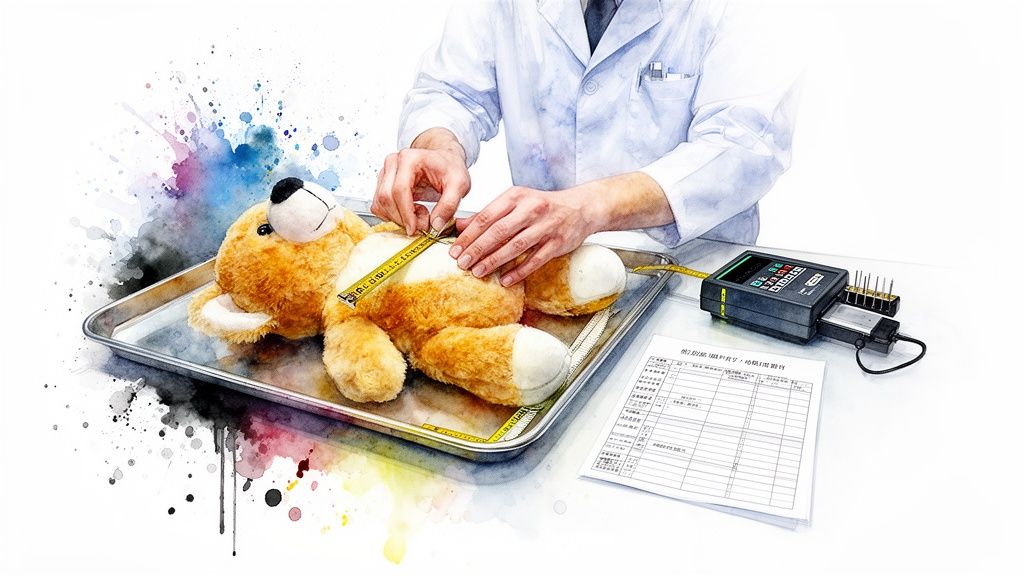
When you put your brand name on a product, its safety and quality are everything. Creating unique plush toys that are safe for all ages demands a rigorous, multi-stage quality control (QC) process that starts long before the first stitch is sewn. This is not just about catching loose threads; it’s a systematic approach to ensure every toy is flawless and safe. A single safety recall can demolish a brand’s credibility overnight.
Our Multi-Stage QC Workflow
We build quality control into every step of production to prevent problems from happening in the first place.
- Raw Material Inspection: Before any fabric or filling touches the production line, our QC team inspects it for defects, color consistency, and texture.
- In-Process Checks: As the toys move through sewing and stuffing, our line supervisors constantly monitor stitch density, embroidery quality, and proper stuffing levels.
- Final Product Inspection: This is the most intense stage. Every finished toy goes through a series of hands-on tests and machine scans before packaging.
This final inspection is a zero-tolerance gateway. We check for aesthetic perfection against the approved prototype, test seam strength with a pull gauge to ensure parts don’t detach, and run every single toy through a needle detection machine to guarantee no metal fragments are left inside.
Navigating International Safety Standards
Complying with international safety standards isn’t optional. The two most critical standards are EN71 for the European Union and ASTM F963 for the United States.
- EN71 (European Standard): Key parts for plush toys include EN71-1 (Mechanical and Physical Properties), EN71-2 (Flammability), and EN71-3 (Migration of Certain Elements, i.e., heavy metals).
- ASTM F963 (US Standard): This standard covers similar hazards, with key tests for physical properties (like pull tests on eyes and noses), flammability, and heavy metal content.
A reliable manufacturer manages this entire certification process for you, working with accredited third-party labs like SGS or Intertek. China’s role as the world’s leading toy producer has built a deep ecosystem for testing and compliance. With the global plush toy market recently hitting USD 15.1 billion, this scale allows experienced factories to deliver safe, creative plush toys efficiently.
Logistics: From Factory to Warehouse
So, your plushies are finished and ready to go. How do they get from our factory in China to your warehouse? You’ve got a few options, and the best one boils down to your budget and how quickly you need your order.
- Sea Freight: This is your go-to for large orders and the most budget-friendly choice. It’s slower—think 30-40 days to North America or Europe—but the savings on a per-item basis are significant.
- Air Freight: Need it fast? Air freight is the answer. It’s much quicker, usually around 7-10 days, making it perfect for tight deadlines or smaller shipments. The trade-off is a higher cost.
- Rail Freight: For clients in Europe and parts of Asia, rail is a popular middle ground. It strikes a great balance between sea and air freight in terms of cost and speed.
We can handle all the export paperwork for you, whether you need EXW, FOB, or DDP terms. Our team will work directly with your freight forwarder to ensure a smooth journey from our door to yours.
How to Choose the Right Manufacturing Partner
Picking a manufacturing partner is the biggest decision your brand will make. It’s tempting to chase the lowest price, but that’s rarely the best value. Too many B2B buyers get tunnel vision on the per-unit cost, only to be hit with hidden fees, inconsistent quality, and blown deadlines. A solid partner provides transparency and expertise that saves you money and stress in the long run.
Vetting Potential Suppliers Beyond the Price Tag
When you’re evaluating a potential manufacturer, you need tangible proof of their skills and dependability.
- Factory Certifications: Look for audits like BSCI (Business Social Compliance Initiative) and ISO9001 (Quality Management). These are proof that the factory follows ethical labor standards and has a reliable quality system.
- Experience with Similar Products: Ask to see examples of plush toys they’ve made before, especially ones similar to your design in complexity or materials.
- Clear and Responsive Communication: How fast and how well do they answer your technical questions? A great partner has English-speaking staff who understand the nuances of design and production.
- Process Transparency: Are they open about their production workflow, quality control, and safety testing? A confident manufacturer is an open book.
The Risks of Low-Quality Factories
A lot of buyers find their way to us after having a bad experience somewhere else. The usual complaints—inconsistent quality, missed deadlines, and surprise costs—almost always stem from a lack of control and poor communication.
A reliable manufacturing partner tackles these risks proactively. We run strict quality checks throughout production, letting us catch potential problems on the line, not when the final container is being inspected. It’s this proactive approach that makes the difference between a smooth launch and a total mess.
A quality factory will also provide detailed production timelines and keep you in the loop with regular updates. Hidden costs are avoided with detailed, all-in quotations that cover materials, labor, testing, and packaging from the start. For a deeper look, check out our guide on the top stuffed animal companies and what makes them stand out.
Why FunEnjoy is a Trusted Manufacturer
We believe in being more than just a supplier; we are a production partner. Our commitment is to bring your unique vision to life with the precision and quality it deserves. We have seen firsthand how a well-executed plush toy can build a brand and delight customers, and we bring that expertise to every project.
Our process is built on transparency, from the initial quote to the final shipment. We guide our partners through every stage, offering practical advice to optimize their design for cost-effectiveness without compromising on the final product’s magic. With a deep understanding of global safety standards and a robust quality control system, we ensure that every toy that leaves our factory is one your brand can be proud of.
Ready to turn your unique plush toy idea into a reality with a partner you can count on? At FunEnjoy PlushToys, we bring together decades of manufacturing know-how with a serious commitment to quality and transparency. Let us guide you from that first sketch to the final shipment. Start Your Custom Plush Project Today.