From our factory floor in China—a global hub for stuffed animals & plush toys—the market is a dynamic engine driven by cultural trends, intellectual property (IP), and the powerful ‘kidult’ economy. This isn’t just about children’s play anymore. For B2B buyers, understanding the manufacturing realities is the first step to creating a successful product line.
This guide offers a manufacturer-level perspective on turning a design concept into a high-quality, market-ready plush toy.
Market Overview: The Modern Plush Toy Industry
The plush toy industry is no longer about mass-producing generic teddy bears. It’s a fast-paced, trend-focused business where collectible, character-driven products are paramount. Brands are not ordering a “cute cat plush”; they are commissioning a specific IP character with a backstory. Getting the character’s look and feel exactly right is a non-negotiable requirement.
The primary driver of this shift is the collectible toy market, which is deeply integrated with plush manufacturing. China’s collectible sector is projected to exceed US$21.5 billion by 2025, largely fueled by IPs like Pop Mart’s Labubu figures. The target demographic is overwhelmingly women under 35—’kidults’ who comprise over 60% of the market. You can explore China’s collectible toy market trends for deeper insights.
This trend directly impacts our factory operations:
- Blind-Box Dynamics: The “blind box” model requires producing an entire series of character variations, each with unique patterns and materials, complicating production planning.
- IP Licensing Complexity: Licensed characters demand strict, multi-stage approvals from prototype to final production, which extends the overall timeline.
- Premium Material Sourcing: High-end collectibles require premium materials and finishes to justify their price, pushing us beyond standard plush fabrics.
Manufacturer’s Insight: Think beyond the toy itself. Consider the story, the unboxing experience, and social media presentation. These elements are as critical as the physical product for driving sales.
Benefits of Custom Plush Toys
For businesses, custom plush toys are more than just products; they are powerful tools for brand building and marketing.
- Brand Loyalty: A unique character can become a brand mascot, creating a tangible, emotional connection with your audience.
- High Perceived Value: Well-designed plush toys are seen as high-quality items, justifying premium pricing and boosting profit margins.
- Marketing Versatility: They can be used as promotional giveaways, retail products, or limited-edition collectibles, offering diverse revenue streams.
Types of Stuffed Animals & Plush Toys
To understand the production process, it’s essential to know the different types of plush toys we manufacture.
- Classic Stuffed Animals: Traditional designs like teddy bears and jungle animals, often focused on softness and huggability.
- Character Plushies: Replicas of characters from games, anime, and movies. Accuracy to the source IP is the top priority.
- Promotional Plush: Custom toys designed around a brand’s logo or mascot, typically for marketing campaigns or corporate giveaways.
- Collectible Art Toys: High-end, limited-edition figures aimed at the ‘kidult’ market, often featuring premium materials and intricate details.
The Manufacturing Process: From Tech Pack to Final Product
Bringing a plush toy to life is a multi-stage process refined through years of experience. For a B2B buyer, understanding this workflow is key to efficient project management. For a more detailed look, you can explore our guide to crafting the perfect plush from start to finish.
Stage 1: Prototyping (The “Golden Sample”)
It begins with your design, ideally a detailed tech pack with dimensions, materials, and Pantone color codes. Our pattern makers deconstruct this 2D design into a master pattern of fabric pieces.
The sampling timeline is typically 7-10 working days.
- Pattern Creation: Translating the 2D design into precise fabric templates.
- Sample Sewing: The initial prototype is hand-stitched by our most skilled artisans.
- Client Feedback & Revisions: We ship the sample for your review. It’s common to have 1-2 rounds of revisions to perfect details like ear placement or embroidery.
This approved prototype becomes the “golden sample”—the benchmark against which every mass-produced unit is measured.
Stage 2: Mass Production
With an approved sample, we scale up.
- Material Sourcing & Cutting: Fabric is laid out in stacks hundreds of layers thick and cut using high-precision die-cutting or laser machines. A millimeter’s deviation here can cause significant issues in sewing.
- Embroidery & Printing: Details like logos and facial features are added while the fabric pieces are still flat. Embroidery cost is calculated by stitch count and the number of colors.
- Sewing & Assembly: Production is divided into specialized stations. One team sews heads, another limbs. These are joined at a final assembly station, leaving a small opening for stuffing.
- Stuffing & Closing: We use calibrated machines to dispense a precise weight of filling, followed by a manual check for uniform density. The opening is closed with a hidden ladder stitch.
- Finishing & Cleaning: Each toy goes to a finishing station for thread trimming, surface cleaning with high-pressure air, and its first full quality inspection.
Stage 3: Quality Control & Packaging
The final steps ensure every toy is perfect and safe. This includes final inspection, passing through a metal detector, and packaging according to client specifications.
OEM vs. ODM: Choosing Your Production Model
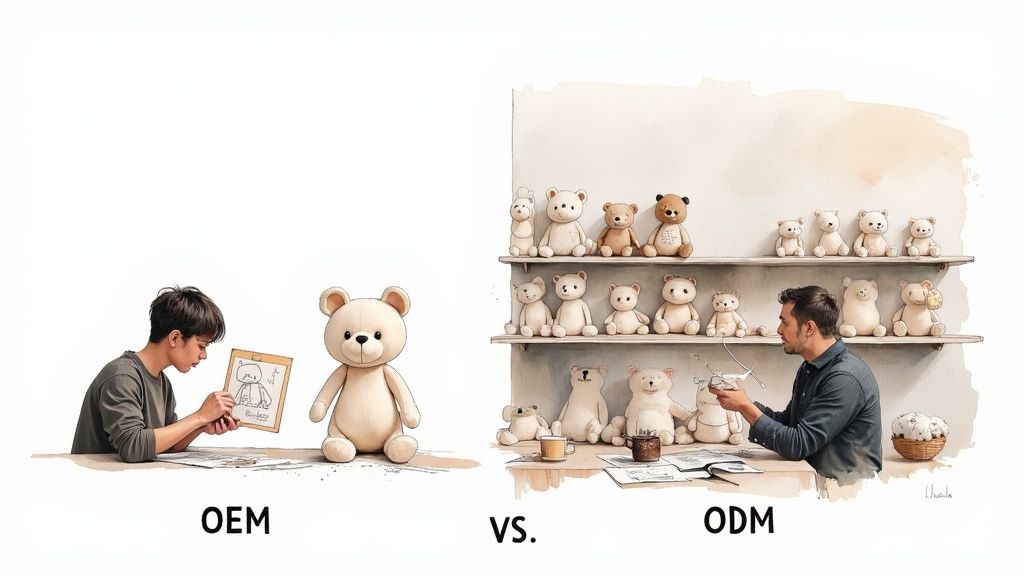
- Original Equipment Manufacturer (OEM): You provide a complete, custom design (tech pack), and we manufacture it exclusively for you. This offers full creative control but requires more upfront design work and a longer development timeline. It’s ideal for brands with existing IP. For examples, see our custom stuffed animal designs.
- Original Design Manufacturer (ODM): You choose from our existing, factory-developed designs and customize them with your branding (logo, colors, packaging). This model significantly reduces development time and cost, making it perfect for startups or promotional products. You can find options in our plush toys wholesale catalog.
Pricing Factors: What Impacts Your Unit Cost
The final unit cost is a calculation of several key variables. Transparency here is critical.
- Materials & Filling: This is the largest cost driver. Premium faux fur is more expensive than standard velboa. Recycled polyester fill costs more than virgin PP cotton.
- Complexity & Labor: A toy with more pieces, intricate embroidery, or complex seams requires more skilled labor and time to assemble. A higher stitch count in embroidery directly increases cost.
- Size and Weight: Larger toys consume more raw materials and cost more to ship, which affects the final landed cost.
- Certifications: Third-party lab testing for safety standards like EN71 or ASTM F963 costs $500-$1500 per design and is factored into the project budget.
- Accessories & Electronics: Custom molded parts (e.g., plastic eyes) require a one-time tooling fee ($500-$2,000). Sound modules or LEDs add to the unit cost and typically raise the MOQ.
Pro Tip to Reduce Cost: Simplify your design by reducing the number of fabric pieces or embroidery complexity. Sourcing materials locally in China, rather than importing specific fabrics, can also significantly lower costs. Opting for a slightly smaller size can reduce both material and shipping expenses.
MOQ (Minimum Order Quantity): The Factory Reality
MOQ is often the biggest hurdle for new brands. For a standard custom plush toy, our MOQ is typically 500–1,000 units. For toys with custom electronics or molded plastic parts, it can rise to 2,000–3,000 units.
This isn’t an arbitrary number. Setting up for a new design involves creating patterns, calibrating machines, and dedicating a production line. These fixed setup costs are the same whether we produce 100 or 1,000 units. A minimum order quantity allows us to amortize these costs, making the per-unit price economically viable for you.
Quality Control & Global Safety Standards
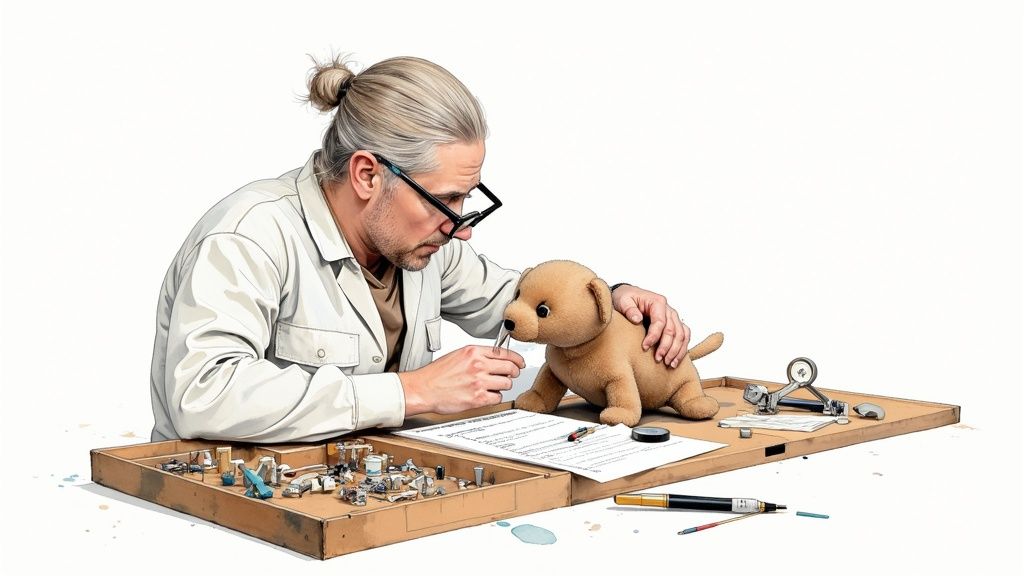
Quality control is not a final step; it is integrated into the entire production process. Cutting corners is a recipe for product recalls and brand damage.
Key Inspection Steps:
- Raw Material Inspection: We check all incoming fabrics for color consistency against Pantone standards and for weaving defects.
- In-Process Inspection: Our QC team monitors the sewing lines to catch errors early. We conduct tension tests on seams and pull tests on small parts like plastic eyes to ensure they are secure.
- Needle Detection: Every single stuffed toy must pass through a metal detection tunnel to ensure no broken needle tips or metal fragments are inside. This is a non-negotiable safety gate.
- Final Pre-Shipment Inspection: A random sample of finished, packaged goods is inspected against a comprehensive checklist to ensure 100% compliance with the “golden sample.”
Global Safety Standards (EN71/ASTM)
Compliance is mandatory for selling in major markets.
- EN71 (European Union): This standard covers mechanical properties (EN71-1), flammability (EN71-2), and toxic element migration like lead and cadmium (EN71-3).
- ASTM F963 (USA): The mandatory toy safety standard in the U.S., covering similar physical, chemical, and flammability hazards.
A reputable factory must provide recent, legitimate test reports from accredited labs (SGS, Intertek, TUV). The risk of partnering with a low-quality factory that skips these steps can lead to seized shipments, legal action, and irreparable harm to your brand. The market for dolls and stuffed toys in China is set to hit US$3.53 billion by 2025, and reputable manufacturing is key to this growth. Dive deeper with Statista’s detailed analysis of the Chinese toy market.
Logistics: From Our Factory to Your Warehouse
Once production is complete, getting your products safely and cost-effectively to your destination is the final step.
- Sea Freight: The most common and cost-effective method for large orders. Transit time is typically 30-40 days to North America or Europe.
- Air Freight: Much faster (5-10 days) but significantly more expensive. Best for urgent orders or high-value, low-volume items.
- Incoterms: We typically work with FOB (Free On Board), meaning our responsibility ends once the goods are loaded onto the vessel at the designated Chinese port. The buyer is responsible for shipping, insurance, and import duties from that point. We can also provide DDP (Delivered Duty Paid) quotes where we handle the entire process to your door.
How to Choose a Supplier: A Buyer’s Checklist
Choosing the right manufacturing partner is the most critical decision you will make.
- Verify Certifications: Ask for business licenses and quality management certificates like ISO 9001, BSCI, or ICTI. These demonstrate a commitment to ethical and quality standards.
- Request Safety Reports: Demand recent EN71 or ASTM test reports for similar products they have manufactured.
- Evaluate Communication: A good partner communicates clearly, professionally, and transparently. Poor English or slow responses are red flags.
- Assess Expertise: Do they understand your vision? A good manufacturer will offer suggestions to improve your design for production efficiency and cost-effectiveness.
- Conduct a Factory Audit: If possible, visit in person. If not, request a live video tour or hire a third-party inspection service to conduct an audit. A factory with nothing to hide will welcome this.
One of the most common problems buyers face is an incomplete design brief. A simple sketch is not enough. A professional “tech pack” detailing dimensions, materials, Pantone codes, and construction notes is essential to avoid ambiguity and delays.
Why FunEnjoy is a Trusted Manufacturer
At FunEnjoy PlushToys, we combine decades of hands-on manufacturing expertise with a commitment to quality, safety, and transparency. We don’t just make toys; we build partnerships. Our team guides you through every step of the process, ensuring your vision becomes a high-quality reality.
Contact us today for a free quote and let’s create something amazing together.