Bringing a custom stuffed animal from a design file to a retail-ready product is a complex, multi-stage process. For any brand, from a startup to an established name, the key to transforming a concept into a high-quality, safe, and profitable product lies in partnering with an experienced manufacturer. This guide offers a direct, behind-the-scenes look from the factory floor, providing the practical, manufacturer-level knowledge B2B buyers need to navigate the world of plush toy production.
Your Guide to Custom Plush Toy Manufacturing
As a manufacturer based in China, we oversee the transformation of creative concepts into tangible, cherished plush toys daily. This process is far more than simple sewing and stuffing; it’s a meticulously planned operation involving design refinement, strategic material selection, adherence to stringent international safety standards, and complex logistics management. Understanding these stages is essential for any brand to make informed decisions, control costs, and ultimately launch a successful product.
The global demand for high-quality plush toys continues to grow, making a reliable production partner indispensable. In 2023, the stuffed and plush toy market in China generated USD 976.3 million in revenue, with stuffed animals commanding a 35.95% market share—a testament to the scale and expertise concentrated here. (Grand View Research provides further market analysis).
This guide will break down every critical step from a manufacturer’s perspective:
- Prototyping: How we translate your 2D design into a 3D physical sample and refine every detail.
- Material Selection: A deep dive into fabrics and fillings to achieve the desired feel, safety, and budget.
- Safety Standards: Navigating the mandatory EN71 and ASTM regulations to ensure global compliance.
- Cost & Logistics: A transparent look at what drives unit pricing and how we manage global shipment.
Whether your goal is a promotional item or a flagship retail product, this insider knowledge will equip you to manage your project effectively. When you’re ready, we can help you design your own plush toy with a team that understands every nuance of production.
The Factory Floor: A Step-By-Step Production Workflow
Taking a custom stuffed animal from a design concept to a finished product is a disciplined journey. It’s a carefully managed process where artistry and technical skill converge to turn your vision into a tangible, consistent product. This is not just about sewing; it is a detailed workflow engineered to ensure quality, safety, and uniformity across an entire production run.
This visual guide outlines the complete manufacturing journey, from initial concept to a retail-ready toy.
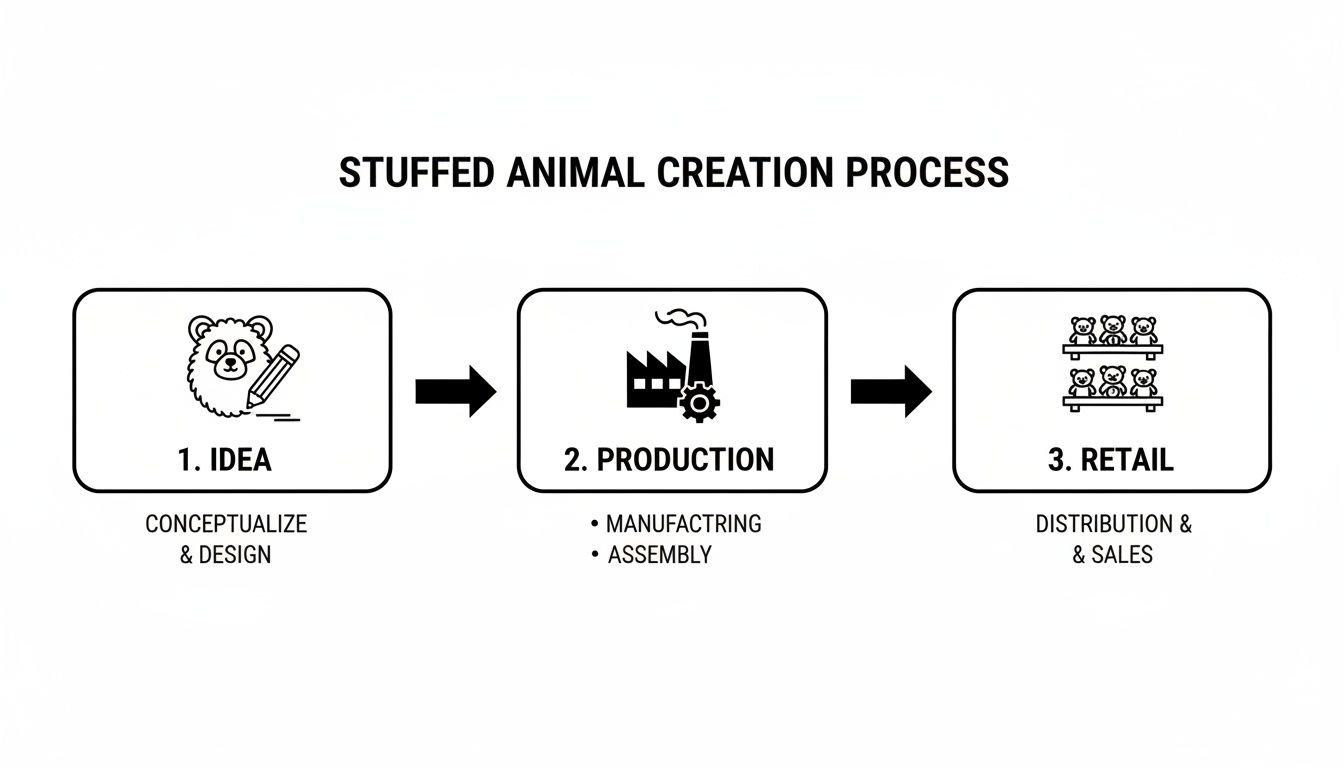
As illustrated, progression between stages is contingent upon clear communication and client approval, particularly between the creative design phase and the commencement of mass production. This checkpoint ensures the final product aligns perfectly with your expectations.
Stage 1: Prototyping and Sampling
The entire process begins with the prototyping or sampling phase. This is arguably the most critical step, as we create the physical benchmark—the “golden sample”—against which every unit in the mass production run will be measured. Upon receiving your design files, our master pattern makers translate 2D drawings into a 3D fabric pattern.
Creating this initial prototype typically takes 7-14 days. We provide comprehensive photos and videos for your review. Your feedback at this stage is crucial. We will revise patterns, adjust embroidery details, or change materials based on your input until the sample is perfect. Each revision cycle may add several days, but meticulous attention here prevents costly errors later.
Stage 2: Material Sourcing and Cutting
Once you approve the final pre-production sample, mass production officially begins. The first step is procuring all necessary raw materials. We source the exact fabrics, threads, and fillings required to match the approved sample’s specifications.
Our quality control team immediately inspects all incoming raw materials for defects, colour consistency, and correct texture before they enter the production line.
With materials approved, we proceed to cutting. We utilize two primary methods:
- Laser Cutting: For intricate shapes and complex designs, automated laser cutting provides unmatched precision, ensuring every piece is identical. It is highly efficient for large-scale orders.
- Die-Cut Moulds: For simpler designs and high-volume runs, we create custom steel moulds (dies). These moulds stamp out fabric pieces with speed and uniformity, offering a cost-effective solution for long-term production.
Stage 3: Embroidery and Assembly
The cut pieces then move to the embroidery department, where logos, facial features, and other decorative details are stitched. We use computerised embroidery machines programmed to replicate the approved design flawlessly. This step is always completed before the pieces are sewn together to ensure a clean, high-quality finish.
Next is assembly. Here, skilled artisans sew the flat, cut pieces into a 3D form. We use an assembly-line system where each worker specializes in a specific task—attaching limbs, sewing body seams, or closing the final opening. This division of labor enhances efficiency and maintains consistent quality. For a basic understanding of these techniques, our guide on how to sew a stuffed animal offers a simplified overview of the skills our team has mastered.
As an industry veteran, I can attest that a factory’s most valuable asset is its sewing team. The tension of a stitch or the precise placement of an ear distinguishes a generic toy from a character with true personality.
Stage 4: Stuffing and Finishing
Once the outer “skin” is assembled, it moves to the stuffing station. We use specialized machines to blow PP cotton or other specified fillings into each plush toy. The critical skill here is achieving the correct stuffing density—firm enough to hold its shape yet soft enough for cuddling. Our operators are trained to ensure every toy is stuffed to a consistent weight and feel.
After stuffing, the final seam is closed by hand with a hidden stitch to create a seamless finish. The toys then undergo final finishing touches:
- Shaping: Each toy is manually shaped and groomed to match the golden sample.
- Cleaning: Air guns are used to remove any loose threads or fabric dust.
- Metal Detection: A mandatory safety step. Every single toy passes through a metal detector to ensure no broken needle fragments are present.
Finally, the toys undergo a final quality inspection, where our team compares them against the approved sample one last time for any potential defects before they are packaged for shipment. This systematic workflow ensures every stuffed animal leaving our factory meets the high standards your brand expects.
Choosing the Right Materials for Your Plush Toy
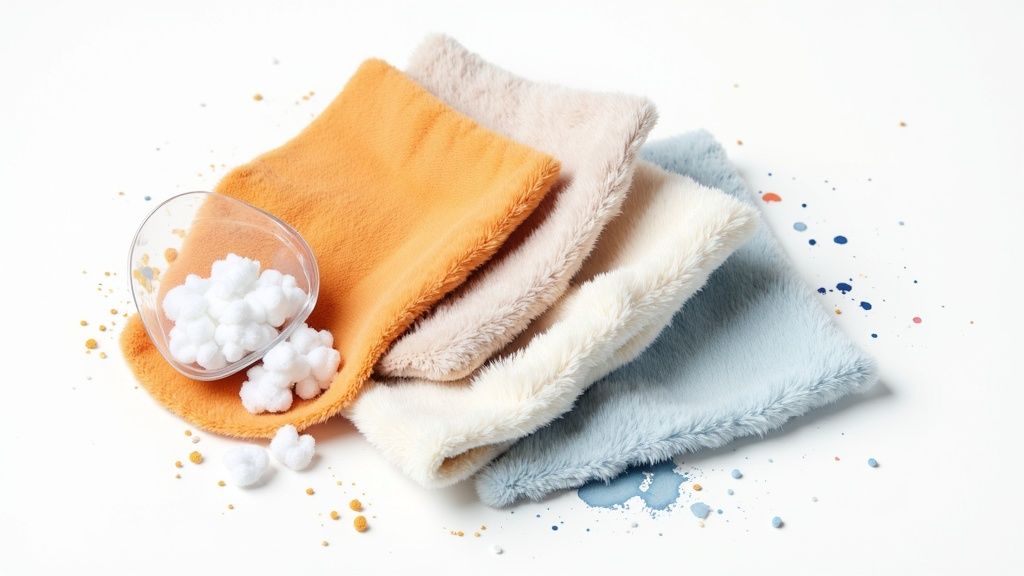
The tactile feel, visual appeal, and final cost of your stuffed animal are determined long before the first stitch. Material selection is one of the most critical decisions a brand makes, impacting everything from safety compliance and durability to consumer perception and price point.
The right choice balances your brand identity, target demographic, and budget. A premium plush for a baby boutique requires different materials than a mass-produced mascot for a promotional event. Understanding the properties of common fabrics and fillings is the first step toward making an informed manufacturing decision.
Common Plush Fabrics: A Factory Comparison
The outer fabric, or “skin,” is the primary point of contact for your customer. Each material offers a unique texture, durability, and cost. In our factory, we work with a vast range of textiles, but several have become industry standards for high-quality stuffed animals.
Soft Velboa: This is the workhorse of plush fabrics. It is a short-pile faux fur that is exceptionally durable and has a smooth finish, making it ideal for toys intended for heavy handling. It is also cost-effective and accepts printing well, which is beneficial for detailed designs.
Crystal Super Soft Plush (PV Fleece): This fabric represents a significant step up in softness. It features a slightly longer pile and a distinct sheen that provides a premium look. Its exceptionally soft texture makes it a prime choice for extra-cuddly characters, particularly for younger children. It is more expensive than velboa, but the luxurious feel often justifies the cost.
Minky Plush: This is a premium-tier option. Minky is incredibly soft, often featuring a signature embossed dot texture. It is commonly used for high-end baby products and luxury stuffed animals due to its superior hand-feel. It is the most expensive of the three and requires more skilled handling during the manufacturing process.
From the factory floor, material selection is an engineering choice. A fabric’s stretch, thickness, and pile direction dictate how patterns are cut and how the toy is assembled to accurately capture a character’s form.
Exploring Filling Options: It’s What’s on the Inside That Counts
The internal filling is as critical as the external fabric. It determines the toy’s weight, posture, and “huggability.” While Polypropylene (PP) Cotton is the industry standard—it’s hypoallergenic, lightweight, and economical—alternative options can provide unique characteristics.
Comparing Standard vs. Specialised Fillings
| Filling Type | Primary Use Case | Key Characteristics |
|---|---|---|
| PP Cotton | The industry standard for most plush toys | Lightweight, hypoallergenic, soft, and cost-effective. |
| Recycled Polyester | For eco-conscious brands | Made from post-consumer plastics, offering a sustainable narrative. |
| Plastic Pellets | Adding weight and stability | Small, bean-like pellets used in the base or paws to help a toy sit upright. |
| Memory Foam | “Slow-rise” squishy toys | Provides a unique, satisfying compression that slowly returns to its original shape. |
The choice of filling can fundamentally alter a toy’s character. We often combine materials to achieve optimal results. For instance, we might use plastic pellets in a teddy bear’s base and paws to provide weight and stability for display, while filling the rest with soft PP cotton for maximum cuddliness.
Ultimately, selecting the right materials should be a collaborative process. By discussing your design goals with your manufacturer, you can determine the ideal combination of fabric and filling that brings your vision to life, meets all safety standards, and creates a product consumers will value.
OEM vs. ODM: Which Manufacturing Path Is Right for You?
When commissioning a line of stuffed animals, one of the first strategic decisions is the manufacturing model: Original Equipment Manufacturing (OEM) or Original Design Manufacturing (ODM).
This choice fundamentally impacts your project’s timeline, budget, and degree of creative control. As a manufacturer, we guide partners through this decision daily, ensuring the selected path aligns with their business objectives.
Let’s dissect what each model entails to determine the best fit for your brand.
What Is OEM (Original Equipment Manufacturing)?
OEM is the “from-scratch” manufacturing route. This model is for brands with a unique, proprietary design for a new character or plush toy. You provide us with a detailed, exclusive design—your intellectual property—and our role is to engineer and produce that specific concept to your exact specifications.
We function as your dedicated production partner, translating your blueprints into a tangible product.
This path provides 100% creative control and ensures your product is exclusive to your brand. This exclusivity is vital for building a distinct brand identity.
However, this level of customization requires a greater investment of time and resources. The OEM process involves:
- Client-led detailed design development.
- Multiple prototyping rounds to perfect every detail.
- Higher initial costs due to custom pattern-making, sampling, and tooling.
OEM is the ideal choice for established brands launching a flagship character or any business whose strategy relies on a completely unique market offering.
What Is ODM (Original Design Manufacturing)?
ODM, in contrast, is an accelerated path to market. In this model, we offer a portfolio of our own factory-developed, market-tested designs. You select a stuffed animal from our collection, and we then customize it to align with your brand.
Common customizations include:
- Adding your company logo via embroidery or a printed tag.
- Changing fabric colors to match your brand palette.
- Modifying small features, such as adding a branded accessory.
The primary advantages of ODM are speed and cost-efficiency. The core design, patterns, and technical specifications are already finalized. This allows us to bypass the lengthy and complex initial development phase.
This approach significantly reduces both the production timeline and upfront costs, making it an excellent option for many businesses. ODM is well-suited for promotional campaigns, corporate gifting, or for brands wishing to test a new product line without a substantial investment in custom development.
Making the Right Choice for Your Brand
The choice between OEM and ODM is a strategic one.
If your objective is to build a brand around a unique, signature character, the control and exclusivity of OEM are non-negotiable. It is the foundation upon which iconic toy brands are built.
Conversely, if you require branded plush toys for an upcoming event or want to add a simple, appealing product to your merchandise line without a large R&D expenditure, ODM is the more direct and efficient route. You leverage our design expertise to bring a high-quality product to market quickly.
Ultimately, the decision rests on balancing your creative vision with your budget and time-to-market requirements.
Meeting Global Toy Safety and Quality Standards
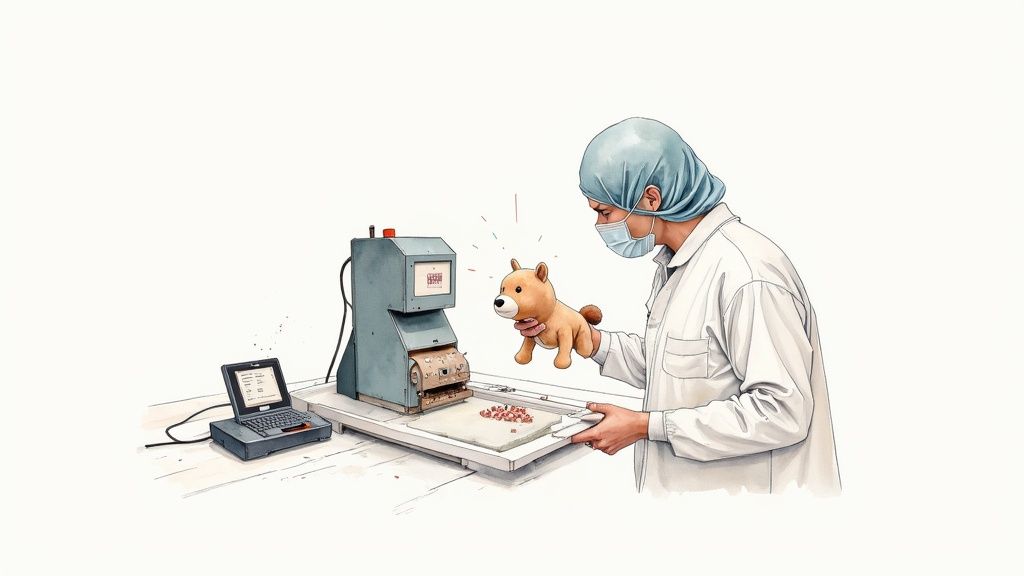
In toy manufacturing, safety is not a feature; it is the absolute foundation of our work. A single compliance failure can result in product recalls, severe brand damage, and, most importantly, potential harm to a child.
As your manufacturing partner, we serve as your first line of defense in the complex landscape of global regulations. Our role is to ensure that every plush toy leaving our facility is not only well-crafted but fully compliant with the safety standards of its destination market.
It’s an industry fact that the global toy market is heavily reliant on Chinese manufacturing. An estimated 70% of the world’s plush toys are exported from hubs here in Guangdong and Zhejiang. With over 5,000 firms in this region producing billions of toys annually, we operate under our own rigorous national GB 6675 safety standards, which foster a deep-rooted culture of quality. More details can be found in the global plush toy market on businessresearchinsights.com.
Decoding International Safety Regulations
When bringing a stuffed animal to market, you will consistently encounter two key acronyms: EN71 and ASTM F963. These represent the mandatory safety standards for the European Union and the United States, respectively. While both are designed to ensure toy safety, they have distinct testing protocols and requirements based on your sales region.
EN71 (European Union): This is the EU’s comprehensive toy safety directive. For plush toys, the most critical sections are EN71-1 (physical and mechanical properties), EN71-2 (flammability), and EN71-3 (migration of certain chemical elements).
ASTM F963 (USA): This is the mandatory safety specification for toys sold in the US. It places strong emphasis on hazards such as small parts (choking risk), seam strength, and the presence of heavy metals like lead and phthalates.
From our perspective on the factory floor, compliance isn’t about a final test. It’s about integrating safety into every production step, from sourcing certified raw materials to ensuring every stitch can withstand foreseeable use and abuse by a child.
Key Safety Standard Comparison EN71 vs ASTM F963
Understanding the primary differences between these standards is crucial for planning and budgeting. If you intend to launch a product in both the EU and the US, it must pass both sets of tests. Here is a direct comparison of their focus areas.
| Safety Test Area | EN71 (Europe) Focus | ASTM F963 (USA) Focus |
|---|---|---|
| Mechanical Tests | Focuses on tension tests for seams, labels, and small parts to prevent detachment. | Includes stringent “use and abuse” tests like drop, torque, and tension tests to simulate foreseeable play. |
| Flammability | Sets specific limits on the rate of spread of flame on the toy’s surface after exposure to a small flame. | Requires that the material does not ignite easily and has a slow rate of burn if it does catch fire. |
| Chemical Safety | Restricts the migration of 19 specific heavy metals (e.g., lead, cadmium) from toy materials. | Regulates the total content of lead and eight other heavy metals, plus restricts certain phthalates. |
| Small Parts | Uses a specific cylinder to determine if a detached part poses a choking hazard for children under 36 months. | Also uses a small parts cylinder, with strict requirements for toys intended for children under three years old. |
While both standards are rigorous, ASTM F963 often involves more aggressive physical testing, whereas EN71 has a broader scope for chemical migration analysis.
Our Multi-Stage Inspection Process
To guarantee that every product meets these stringent standards, we employ a multi-stage quality control (QC) process integrated throughout production.
Incoming Material Inspection (IQC): No raw materials—fabric, stuffing, thread—enter the production line until our QC team has inspected them for defects, color accuracy, and proper safety certifications from our suppliers.
In-Process Quality Control (IPQC): Our inspectors continuously monitor the assembly lines, checking everything from cutting precision and embroidery quality to stitch strength, constantly comparing work-in-progress against the approved “golden sample.”
Final Quality Control (FQC): Before packaging, every finished stuffed animal undergoes a comprehensive final inspection. We perform visual checks for cosmetic flaws, conduct physical pull tests on all attachments (eyes, noses), and, critically, pass each toy through a metal detector to ensure no broken needle fragments are present.
This systematic approach is our commitment to ensuring that the product you approve is the same high-quality, safe product that we deliver.
Untangling Costs, Minimums, and Logistics
Let’s discuss the commercial realities of production. A great design must be translated into a physical product within a viable business framework. This involves understanding order minimums, pricing structures, and shipping logistics—all critical components for a profitable and smooth launch.
Here, we break down the three key elements: the rationale behind Minimum Order Quantities (MOQ), the factors that determine unit price, and the process of moving finished goods from our factory to your warehouse.
Why We Have Minimum Order Quantities (MOQ)
One of the first terms a buyer encounters is Minimum Order Quantity (MOQ). For most custom stuffed animal projects, the industry-standard MOQ ranges from 500 to 1,000 pieces per design.
This figure is not arbitrary. Mass production is built on the principle of efficiency. To begin a production run, we must execute a series of fixed-cost setups: creating cutting moulds, programming embroidery machines, and purchasing materials in bulk.
By amortizing these initial setup costs over a large number of units, the per-unit price remains low for you. If we were to produce only a small batch, the cost per toy would be prohibitively high. An MOQ ensures the entire production process is commercially viable for both the manufacturer and the client.
What Drives the Price of Your Stuffed Animal?
The final unit cost of your plush toy is determined by its design specifications. Complexity is the primary cost driver. Here are the key factors we evaluate when preparing your quote:
- Size and Complexity: A larger toy requires more fabric and filling. A design with numerous small parts or complex seams demands more skilled labor and assembly time.
- Material Quality: Premium fabrics like Minky offer a superior feel but come at a higher cost per meter than standard velboa. The type of filling also influences the price.
- Embroidery and Printing: The level of detail directly impacts cost. A logo with a high stitch count (e.g., 10,000 stitches) requires more machine time and will be more expensive than a simpler design with 2,000 stitches.
- Order Volume: Economies of scale play a significant role. An order of 5,000 units will have a lower price per toy than an order of 500 units, as fixed setup costs are spread across a larger quantity.
Pro Tip: Costs can often be reduced without compromising the core design. Simplifying a pattern slightly or reducing the embroidery stitch count by 15% can lower the unit price while maintaining the toy’s appeal.
For businesses looking to purchase in larger volumes, exploring plush toys wholesale is a strategic move. This can unlock significant cost savings and streamline inventory management, which is essential for retailers and distributors seeking a competitive edge.
From Our Door to Yours: Packaging and Logistics
Once your stuffed animals are manufactured and pass final quality control, the last step is secure and efficient delivery.
We offer several packaging solutions tailored to your needs:
- Standard Packaging: Each toy is placed in an individual clear poly bag for protection. They are then packed into large master cartons for shipment.
- Retail-Ready Packaging: For products going directly to store shelves, we can design and produce custom printed boxes, branded hang tags, or even shelf-ready display cartons.
Packaging is especially crucial in the booming collectibles market. In China, collectible plush toys, exemplified by Pop Mart’s Labubu character, are a significant trend, with Labubu alone generating nearly USD 670 million in sales in early 2024. This market is driven by Gen Z and millennials sharing “blind box” unboxing experiences online, creating massive organic marketing.
Finally, understanding key shipping terms is essential for budgeting:
- FOB (Free On Board): Our price covers all costs to deliver your order to a specified port in China (e.g., FOB Shanghai). You are responsible for the ocean freight, insurance, customs duties, and final delivery costs from that point.
- EXW (Ex Works): This is the “factory gate” price. Our quote covers the finished product at our facility. You are responsible for arranging and paying for all transportation from our factory to your destination.
A clear understanding of these elements will enable you to forecast your investment accurately and make strategic decisions for a successful project.
Got Questions About Custom Manufacturing? We Have Answers.
If you are considering creating custom stuffed animals, you likely have questions. With our years of manufacturing experience, we have compiled direct answers to the most common inquiries from B2B buyers to provide clarity as you begin your planning.
What’s a Realistic Timeline for a First-Time Custom Order?
For a completely new OEM project, a realistic timeline is 90 to 120 days from initial design submission to final delivery. While this may seem long, each phase is essential for ensuring product quality and accuracy.
A typical schedule breaks down as follows:
- Prototyping & Revisions: This takes approximately 2-3 weeks. We create the initial sample, you provide feedback, and we iterate until it is perfect.
- Mass Production: Upon approval of the final sample, mass production requires 30-45 days.
- Shipping & Customs: Ocean freight, the most common shipping method, typically takes an additional 30-60 days depending on the destination.
Air freight is a faster but significantly more expensive alternative. The key takeaway is that advance planning is the most effective way to ensure a smooth and cost-efficient launch.
How Can I Be Sure the Final Product Will Match My Approved Sample?
This is the purpose of the “golden sample.” It is the cornerstone of our quality control system. Once you formally approve the final pre-production sample, that physical toy becomes the non-negotiable standard for the entire production run.
Our quality control teams use this golden sample on the factory floor during every stage of production—from inspecting incoming materials to checking the final assembled product. This ensures every unit produced has the same dimensions, material feel, stuffing density, and overall appearance. We also welcome third-party inspectors at our facility for your complete peace of mind.
From a manufacturer’s viewpoint, the golden sample is our contract with you. It is the single source of truth that ensures what you approved is exactly what we deliver, thousands of times over.
What Are the Most Common Mistakes New Buyers Make?
The most frequent error we observe is underestimating design complexity. A design with numerous small, intricate parts or complex multi-color embroidery may look excellent on paper but can significantly increase production costs and timelines. For an initial order, it is often more strategic to begin with a streamlined design.
Another common oversight is failing to budget for safety testing and shipping from the outset. These are not incidental expenses and can be substantial. We always recommend obtaining a comprehensive quote that includes all foreseeable costs to avoid unexpected financial pressures later in the process.
At FunEnjoy PlushToys, we are here to guide you through every one of these questions and more. We believe the journey from concept to finished product should be transparent, collaborative, and successful. Start your custom plush project with a team you can trust.