From our perspective on the factory floor, the world of stuffed animal design is a fascinating blend of art and engineering. It’s constantly pulled in two directions: a deep, heartfelt love for nostalgic, classic plushies, and an ever-growing appetite for licensed characters from pop culture.
This dynamic requires incredible flexibility in our manufacturing processes, from sourcing specific textiles all the way to configuring production lines. For any brand looking to enter this market, understanding the manufacturer’s viewpoint is critical to success.
Market Overview: What Really Drives Modern Stuffed Animal Designs
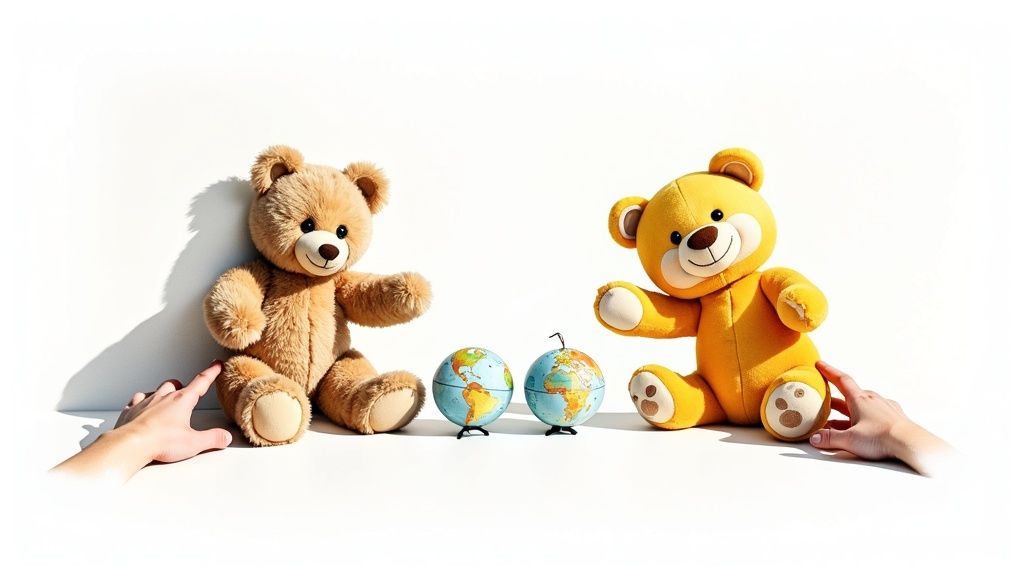
Operating from the heart of the global plush toy supply chain in China gives us a front-row seat to market trends. We see precisely what brands are developing and what consumers are buying. The most significant shift we’ve witnessed is the rise of the “kidult” market—adults purchasing toys for themselves. This has fundamentally altered design priorities.
This creates a split in demand. There is steady, reliable volume for timeless designs like the classic teddy bear, driven by nostalgia and comfort. Simultaneously, there is explosive, high-velocity demand for plush toys from video games, anime, and blockbuster films, driven by collectability.
The Impact on Manufacturing
This market bifurcation directly impacts our daily operations. One production line might be configured for a simple, classic bear, where the focus is on ultra-soft feel and durable construction. The adjacent line could be retooled for a complex, multi-component licensed character requiring precise embroidery and specific, custom-dyed fabric textures.
This dynamic means we must master both traditional craftsmanship and modern production technologies. Here’s what shapes our manufacturing approach:
- Nostalgia and Comfort: For these toys, the focus is on soft, familiar materials like fleece and long-pile plush. Construction is often straightforward, but the quality of stitching and consistency of the stuffing are paramount. The product must feel durable and exceptionally huggable.
- Collectability and Pop Culture: Licensed characters demand precision. The design must be a perfect physical representation of the intellectual property. This often requires custom-dyed fabrics to match exact Pantone codes, intricate multi-head embroidery for facial expressions, and sometimes even integrated electronics. You can explore the latest trends in plush toy design to learn more.
- Rising Global Incomes: As disposable income increases in various markets, consumers are willing to invest more in high-quality, detailed, and collectible plush toys. This opens the door for more sophisticated stuffed animal designs that serve as decorative pieces as much as toys.
From a manufacturer’s viewpoint, the challenge isn’t just making a toy. It’s about engineering a product that can be mass-produced with absolute consistency while capturing the specific emotion the design is intended to evoke—be it the comfort of a classic or the excitement of a favorite character.
The scale of this industry is massive. The stuffed and plush toys market in China alone is substantial, and insights on China’s evolving toy market show a clear trajectory of growth. This growth underscores the importance for any brand to master these market drivers to succeed.
The Manufacturing Process: From Tech Pack to Final Product
A napkin sketch is where the magic starts, but on the factory floor, a 2D drawing is insufficient for creating a 3D product. We require a detailed engineering blueprint, known in the industry as a technical pack or “tech pack.” It is the single most critical document in the entire process, translating a creative vision into precise instructions for our pattern makers, fabric cutters, and sewing teams.
Vague instructions are the primary cause of delays and costly sample revisions. Notes like “make it look cute” or “use a soft blue fabric” are not actionable and lead to interpretation. A manufacturer’s idea of “soft blue” might be sky blue, while the client envisioned baby blue. This discrepancy forces a complete sample remake, wasting time and money. A professional tech pack eliminates this ambiguity.
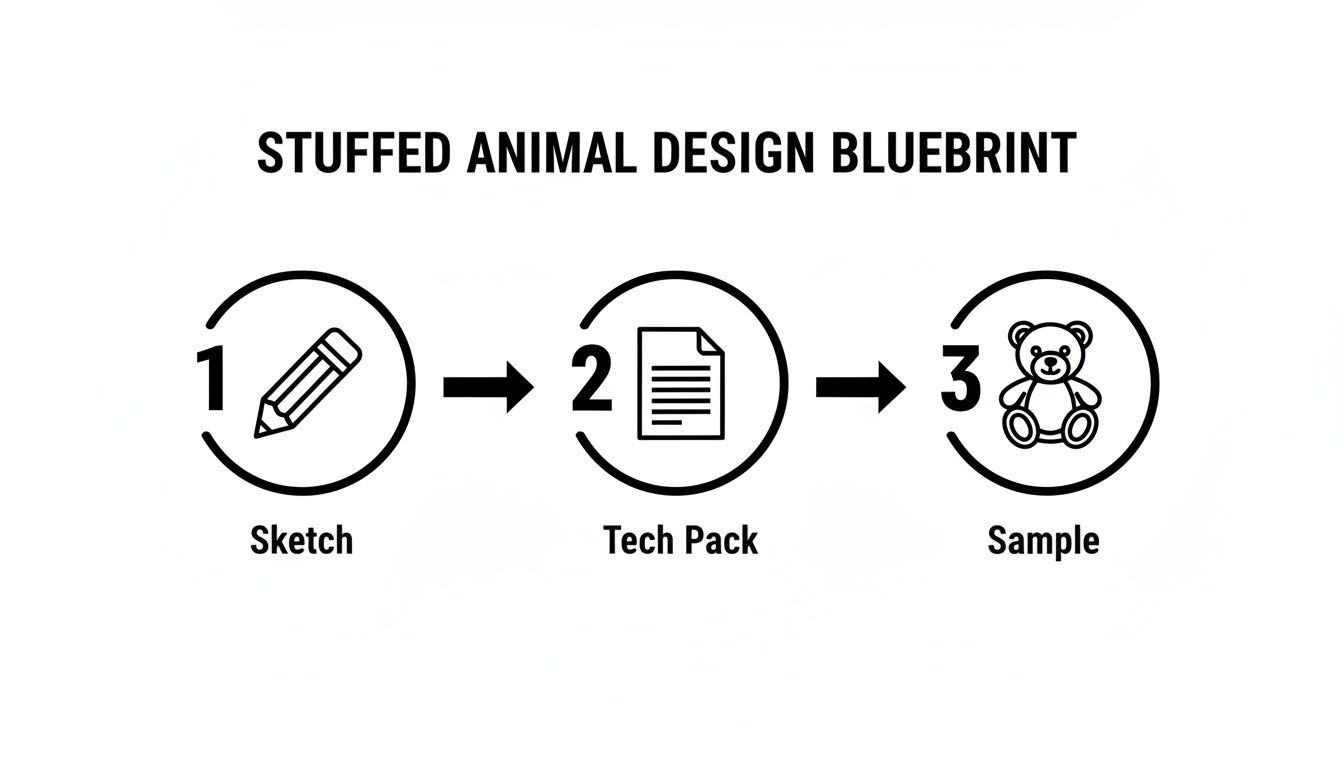
The Production Workflow
Once a design is finalized, it enters a multi-stage production workflow that balances precision technology with skilled handiwork.
- Pattern Making: Our pattern masters use your tech pack’s orthographic views (front, back, side) to create digital patterns in CAD software. This process deconstructs the 3D shape into a series of flat, interlocking 2D pieces. Accurate digital patterns are the foundation for consistency across thousands of units.
- Material Cutting: For large orders, we use custom steel die-cutting molds to press through stacks of fabric with speed and uniformity. For more complex stuffed animal designs or smaller runs, computer-guided laser cutters follow the digital patterns with absolute precision.
- Embroidery & Printing: Decorative details like logos, eyes, and other markings are applied at this stage. We use multi-head computerized embroidery machines to stitch details onto the flat fabric pieces before assembly for maximum accuracy.
- Sewing & Assembly: Skilled operators stitch the fabric pieces together, typically inside-out to hide the final seams. This step requires significant human skill to turn flat components into a three-dimensional form.
- Stuffing: The plush “skin” is filled with PP cotton using specialized blowing machines for even distribution. Our workers then manually adjust the stuffing in detailed areas like ears and limbs to achieve the desired density and shape.
- Finishing & QC: The final opening is hand-sewn closed with an invisible ladder stitch. Each toy is then groomed—stray threads are snipped, and the fur is brushed. Critically, every single unit passes through a metal detector to ensure no broken needle fragments are present, a fundamental safety protocol.
Understanding the Sampling Timeline
The sampling process is iterative. It is not a one-step approval. Understanding this timeline is crucial for planning your product launch.
| Sampling Stage | Purpose | Typical Duration (Business Days) |
|---|---|---|
| Prototype Sample | The first physical version of your design. The goal is to verify shape, size, and basic construction. Materials and colors may be approximate. | 7-10 days |
| Pre-Production Sample | A refined version using the final, correct fabrics and colors based on your feedback. This is used for marketing and final sign-off. | 10-15 days |
| Final Production Sample | A unit pulled from the first mass production run for your final confirmation that everything matches the approved pre-production sample. | Pulled from the first run |
This structured process mitigates risk and ensures the final product aligns perfectly with your vision. You can see a more detailed breakdown of our custom plush toy process.
Materials, Quality Control, and Safety Standards
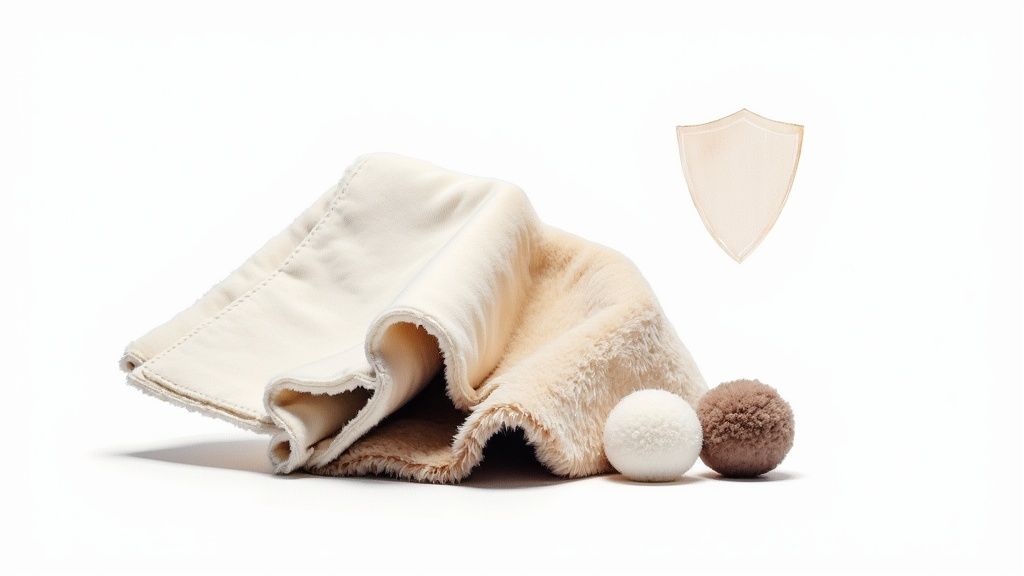
The tactile quality—the feel—of a plush toy is paramount. From a manufacturing standpoint, material selection is a calculated balance between achieving the desired aesthetic, ensuring durability, and meeting the client’s target cost.
Common Materials & Filling Types
Your fabric choice is the most significant material decision. It dictates the product’s appearance, texture, and price.
- Velboa: A low-pile, durable, and cost-effective polyester fabric. It is a standard for mass-market toys as it holds its shape well and is excellent for printing.
- Minky (Cuddle Fabric): An exceptionally soft, premium fabric with some stretch, providing a luxurious feel. It is ideal for high-end collectibles or products for young children.
- Fleece: Known for its soft and fuzzy texture, fleece creates a warm, cozy feel. It is a popular choice but can be more prone to pilling over time than Minky.
- Long-Pile Faux Fur: Used for shaggy or fluffy effects, like a lion’s mane. It requires more skilled handling during cutting and sewing to manage the direction of the fur.
The internal filling is equally critical. The industry standard is Virgin Polypropylene (PP) Cotton, which is hypoallergenic, resilient, and provides a consistent, fluffy fill. For eco-conscious brands, Recycled Polyester Fiber, made from post-consumer materials, offers a sustainable alternative with a nearly identical feel.
Quality Inspection & Safety Standards
A brilliant design is worthless if it is not safe. Compliance is a non-negotiable part of our daily operations. Every material we source and every step in our production line is governed by strict international standards.
The two most critical standards for our clients are:
- EN71 (Europe): The European Union’s comprehensive toy safety standard covering physical properties (e.g., pull tests on eyes and limbs), flammability, and chemical composition.
- ASTM F963 (USA): The mandatory safety standard in the United States, which includes rigorous testing for small parts, sharp edges, and hazardous substances like lead and phthalates.
Compliance involves sending product samples to accredited third-party laboratories for exhaustive testing. This is not optional; it is a fundamental requirement for market access and consumer safety. Reputable manufacturers build this process into their production schedule.
Pricing Factors, MOQ, and Choosing a Supplier
Once your designs are locked in, the conversation shifts to the commercial aspects of production. Understanding how manufacturers determine pricing and minimums is as important as perfecting your design.
What Impacts Cost?
The unit cost is a calculation based on several key variables:
- Design Complexity: A simple, spherical plush with few seams requires less labor than a character with detailed clothing and multiple appendages. The number of pattern pieces and total sewing time are direct cost drivers.
- Material Quality: The cost difference between standard velboa and premium minky fabric is significant. The choice of filling also impacts the final price.
- Order Quantity: This is a fundamental principle of manufacturing. A larger order (5,000+ units) allows us to purchase raw materials in bulk at a discount and optimize production line efficiency, reducing the per-unit cost. A smaller order has higher relative setup costs.
- Safety Testing: Third-party lab testing is a fixed cost. When spread across a large production run, its impact on the per-unit price is minimal.
Why MOQs Exist
Minimum Order Quantity (MOQ) is a necessity driven by the economics of the supply chain. We must purchase fabric by the roll and stuffing by the bale, and our suppliers have their own minimums. For most custom stuffed animal designs, a realistic MOQ is 500 to 1,000 pieces. Be wary of factories offering unusually low MOQs (e.g., 50 units), as they are likely compromising on material quality, process controls, or labor standards to make it work.
OEM vs. ODM: What’s the Difference?
You have two primary engagement models when working with a factory:
| Factor | OEM (Original Equipment Manufacturer) | ODM (Original Design Manufacturer) |
|---|---|---|
| Design Control | You provide a 100% complete, production-ready tech pack. We build your design. | You select from our existing designs and brand it, or we co-develop a concept. |
| Intellectual Property | You retain full ownership of the design and all IP. | The factory typically owns the base design; you are branding a pre-made item. |
| Time to Market | Longer, as it requires a full design and development phase from your side. | Faster, as you are leveraging a pre-developed product. |
| Best For | Brands with unique IP and in-house design capabilities. | Brands looking for a quick market entry or without extensive design resources. |
How Brands Choose a Supplier
Choosing the right partner is a critical business decision. A bad partner can lead to missed deadlines, quality issues, and financial loss.
Common Problems & Risks of Low-Quality Factories:
- Unrealistically Low Prices: This is the biggest red flag. It almost always indicates substandard materials, a lack of quality control, or unethical labor practices.
- Poor Communication: Slow response times, vague answers, and an unwillingness to provide detailed information are signs of a disorganized or untrustworthy operation.
- No Factory Audits: Reputable manufacturers hold certifications like BSCI or SEDEX and will willingly share audit reports. A refusal to do so is a major concern.
Tips to Reduce Cost (Without Sacrificing Quality):
- Simplify the Design: Reducing the number of unique pattern pieces lowers sewing time and cost.
- Optimize Material Usage: Minor adjustments to dimensions can significantly improve how many pieces we can cut from a single roll of fabric, reducing waste.
- Increase Order Volume: The most direct way to lower the per-unit cost.
For brands looking to source at scale, we offer transparent and reliable services for plush toys wholesale. A true partner acts as an extension of your team, invested in your success.
At FunEnjoy PlushToys, we combine decades of hands-on manufacturing expertise with a commitment to quality, transparency, and safety. We guide brands through every stage of the process, from refining a tech pack to final logistics, ensuring your unique stuffed animal designs are produced to the highest global standards.