When brands first approach us for “plush toys wholesale”, they often picture buying ready-made toys off a warehouse shelf. But from our perspective on the factory floor, it’s a completely different world. It’s a creative partnership, a manufacturing journey we take with a client to bring a unique, brand-aligned product from a simple sketch into physical reality.
What Wholesale Plush Toy Manufacturing Really Means
In our industry, “wholesale” isn’t about bulk-buying existing stock. It’s about commissioning a custom production run directly from a factory like ours. This OEM (Original Equipment Manufacturer) or ODM (Original Design Manufacturer) process is how professional brands, retailers, and IP licensors maintain absolute control over their product—from the initial design and fabric texture down to the specific safety certifications required for their target market. It’s less a simple purchase and more a strategic manufacturing decision.
The market data confirms the scale of this industry. In 2023, China’s stuffed and plush toy market reached USD 976.3 million. Projections show it climbing to USD 1,729.1 million by 2030, with a compound annual growth rate of 8.5%. You can explore the data in this market analysis from Grand View Research. This growth isn’t just a fleeting trend; it’s a clear indicator of the global demand for custom-made, high-quality plush products.
Why Go Straight to the Source?
Partnering directly with a manufacturer instead of a trading company or distributor provides a significant competitive advantage. You transition from a reseller to a creator. Here are the practical benefits we see our clients gain every day:
- Total Creative Control: You dictate the design, materials, size, and branding. This is non-negotiable when creating a unique product that must align perfectly with a brand identity or licensed character.
- Cost-Effectiveness at Scale: While there are upfront development costs for sampling, the per-unit cost drops significantly during mass production. Eliminating the middleman directly improves your profit margins.
- Guaranteed Quality and Safety: Working directly with the factory allows you to define quality benchmarks and ensure every product meets critical safety standards like EN71 for Europe or ASTM F963 for the USA.
- Access to Manufacturing Expertise: You tap into our decades of specialized knowledge. We provide guidance on pattern making, material sourcing, and production optimization—the technical details that turn a good idea into a great product.
The secret to a successful wholesale project is a shift in mindset. You are not just buying a product; you are commissioning its creation. This changes the focus from a simple price tag to the long-term value of quality, safety, and brand integrity.
Ultimately, commissioning a production run is about creating a tangible asset for your business. It’s an investment in a product that is exclusively yours, one that meets your customers’ expectations for quality and safety while positioning you for long-term success.
Before we get into the technical details, it’s helpful to understand the key decisions you’ll face. We’ve summarized them here from a manufacturer’s viewpoint.
Key Decisions for Your Wholesale Plush Toy Project
| Factor | Manufacturer’s Insight |
|---|---|
| Minimum Order Quantity (MOQ) | This isn’t an arbitrary number; it’s the production volume at which custom manufacturing becomes economically viable for both of us. It’s dictated by raw material purchasing requirements. |
| Materials & Stuffing | The tactile feel of a plush toy is paramount. We guide clients through material options like soft minky, velboa, and recycled polyester to match brand positioning and budget. |
| Safety Standards | This is non-negotiable. We build compliance with standards like EN71, ASTM F963, or CCPSA into the design from day one to avoid costly surprises later. |
| Customisation & Licensing | From unique character sculptures to precise Pantone color matching for a licensed IP, this is where your vision is translated into a physical product. We are experts in detail. |
| Budget & Timeline | Be realistic. A complex design requires more development time and a higher budget. We provide transparent timelines and cost breakdowns to help you plan effectively. |
Addressing these points early ensures a smooth and predictable production process. Now, let’s explore each area from an insider’s perspective.
From a Sketch to a Finished Plush Toy
Have you ever wondered how a 2D drawing becomes a three-dimensional, huggable plush toy? It’s a precise, multi-stage process that blends artistry with engineering—a journey we guide our clients through daily.
It begins with your design. Whether it’s a detailed character sheet or a simple concept sketch, this is our starting point. Our pattern masters—the architects of the plush world—analyze the 2D image and begin the crucial work of translating it into a 3D form.
The Prototyping Stage: Holding Your Idea for the First Time
Before we can mass-produce thousands of toys, we must perfect one: the prototype. This is your first opportunity to see, hold, and approve your creation, making it the most critical phase of the entire project.
We start by creating a master pattern. This is the blueprint for your plushie. Our team drafts and cuts these patterns from paper, meticulously shaping each piece to define the toy’s final size, proportions, and structure.
With the pattern approved, the hands-on work begins:
- Fabric Cutting: Using the master pattern, we cut the chosen fabrics with extreme precision. A deviation of even a few millimeters can alter the final look, so this step demands expertise.
- Detail Application: Personality is added here. We apply facial features, logos, or patterns using techniques like high-density embroidery for eyes or screen printing for custom designs.
- Stitching and Assembly: Our skilled sewing team assembles the flat fabric pieces into a 3D shell. This requires a deep understanding of how different materials stretch and join to form clean, durable seams.
- Stuffing and Shaping: The shell is filled with the chosen stuffing (typically premium PP cotton) to the precise density required. The goal is a toy that is both cuddly and maintains its intended shape.
- Closing and Finishing: Finally, the toy is stitched closed, cleaned of any stray threads, and given a preliminary inspection before the sample is shipped to you for final approval.
The prototype is your single most important checkpoint. It is far easier and more cost-effective to adjust a seam on one sample than to correct an error on thousands of finished products. Be meticulous in your review; this is your moment to ensure every detail is perfect.
The entire prototyping stage typically takes 7–14 days. Simple designs are faster, while complex characters with multiple accessories will require more time.
The graphic below illustrates the two primary wholesale paths: using existing factory designs (ODM) or creating a fully custom product (OEM).
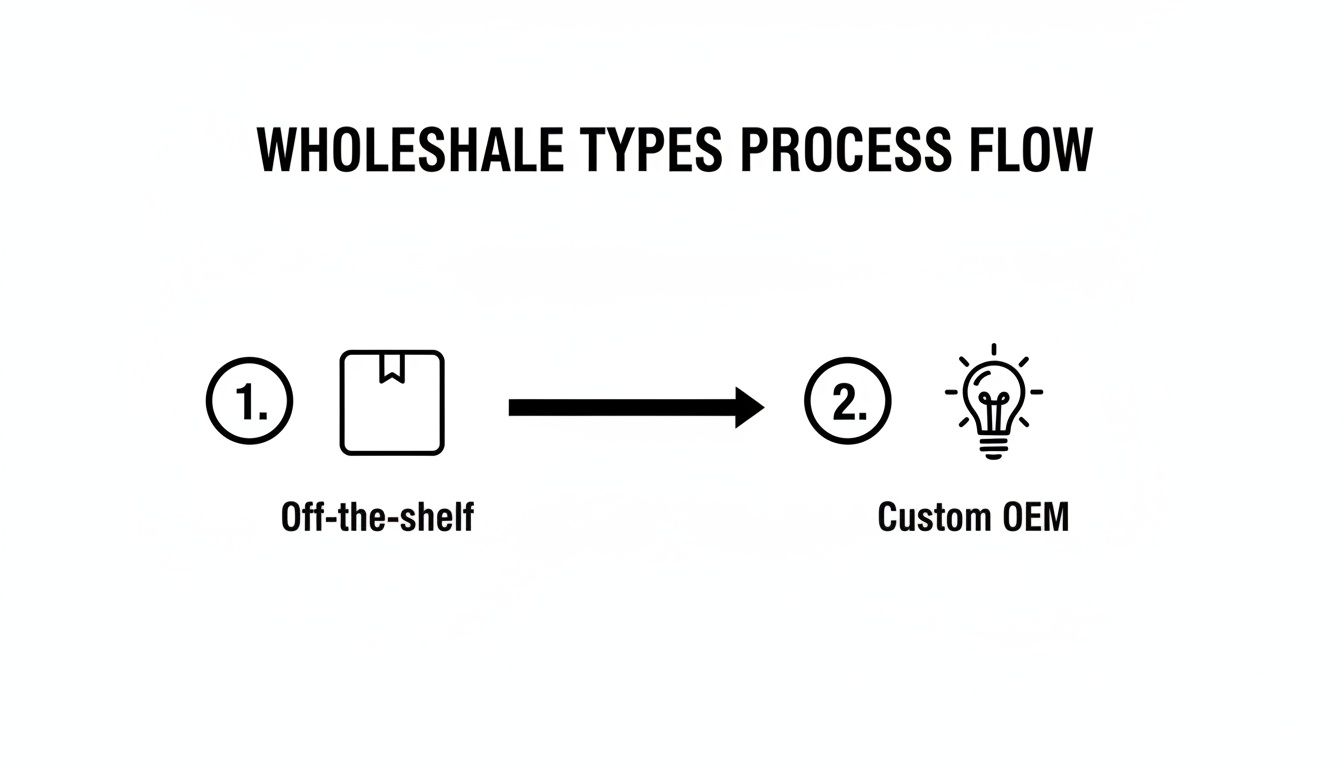
As shown, custom OEM projects are more involved, but they offer complete creative control over the final product.
Moving into Mass Production
Once you approve the final prototype, we lock in all specifications. Your approved sample is now designated the “master sample”—the gold standard that every single unit in the production run must match. This is our mechanism for guaranteeing consistency across your entire order.
Mass production typically requires 30–45 days, though this can vary with order size and complexity. A toy with intricate embroidery or numerous small parts demands more labor at each station. Sourcing custom-dyed fabrics can also add to the timeline.
Our production floor operates as a coordinated system, replicating the prototyping steps at scale. We establish dedicated lines for cutting, sewing, stuffing, and quality control to ensure efficiency without compromising on the details. We understand the importance of turning your concept into a market-ready product, and you can learn more about our process in our guide to creating a custom animal plush. Ultimately, clear communication and a robust process are the keys to a successful production run.
Getting to Grips with Materials and Costs
The final feel, durability, and cost of your plush toy are determined long before the first stitch is sewn. It all comes down to the materials selected and the complexity of the design. These decisions directly impact your unit cost and the quality your customers will experience. As manufacturers, this is where we provide critical guidance to help brands make informed choices.
It starts with the fabric, which defines the toy’s personality and tactile appeal. While options are vast, a few core materials are the workhorses of our industry. Understanding their properties is key to selecting the right one for your project.
Choosing the Right Fabric and Filling
The fabric is the first point of interaction. A toy intended for infants requires an exceptionally soft, short-pile fabric, while a stylized collectible for an older audience might use a unique texture to stand out.
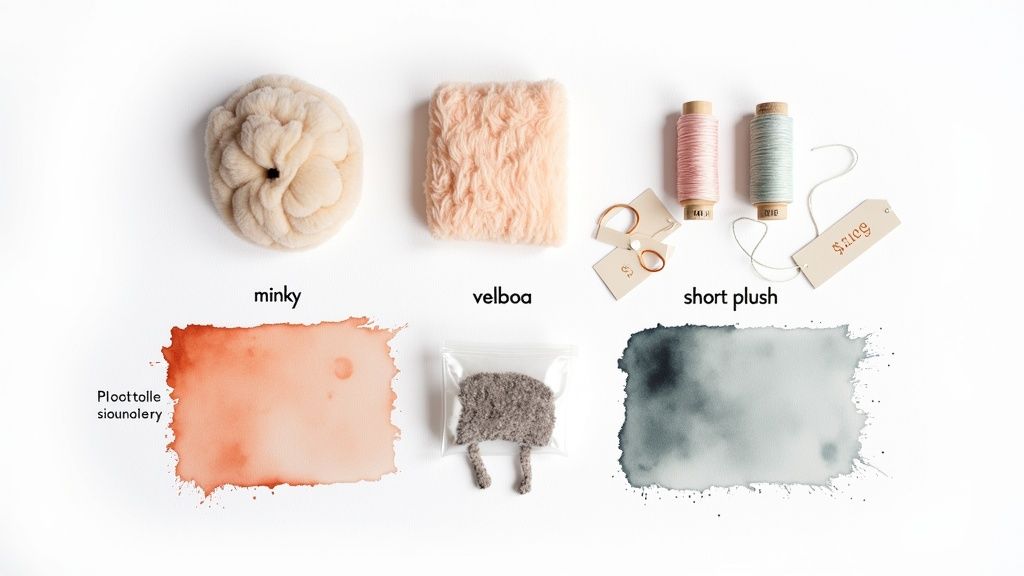
These are the most common fabrics we work with daily:
- Minky (Crystal Super Soft Velboa): This is a premium choice for its incredibly soft, smooth texture and slight sheen. It is the go-to material for baby products and high-end retail plush where a luxurious feel is essential.
- Velboa: A versatile and durable low-pile faux fur, Velboa is a cost-effective workhorse. It’s an excellent option for a wide range of products, from promotional items to classic teddy bears.
- Fleece: Known for its warmth and fuzzy texture, fleece is ideal for plush blankets and toys designed for comfort. A key production benefit is its non-fraying edges, which streamlines the sewing process.
- Faux Fur: When a design requires a realistic, shaggy appearance—like a lion’s mane or a fluffy dog—faux fur is the best choice. The pile length can be customized, but it is typically a more expensive material and requires more skill to sew correctly.
Of course, the interior is just as critical. The stuffing gives a plush toy its huggable quality and resilience.
From a manufacturing standpoint, the industry standard for quality is 100% new polyester fiber fill (PP Cotton). It is hypoallergenic, machine washable, and provides a consistent, lofty feel that resists clumping. For brands focused on sustainability, we also source recycled polyester fiber fill (rPET), which offers comparable performance with a reduced environmental footprint.
What Really Drives the Cost?
The first question every client asks is, “How much will it cost?” The honest answer from any manufacturer is: it depends. The final unit price is a calculation based on several key factors. Understanding these allows you to make strategic design adjustments to meet your target budget.
- Design Complexity: A simple, spherical character is significantly faster and easier to produce than a dragon with intricate wings and multiple fabric colors. The more individual pattern pieces that must be cut and sewn, the higher the labor cost.
- Size and Material: A larger toy requires more fabric and stuffing, which directly increases the per-unit material cost.
- Embroidery and Printing: The stitch count for details like eyes and logos, as well as the number of colors in a print, directly impacts cost. A detailed, high-stitch-count embroidery can sometimes be more expensive than the fabric it is on.
- Order Quantity (MOQ): This is a major factor. Larger orders allow us to purchase raw materials in bulk at lower prices and optimize production line efficiency, which significantly reduces your per-unit cost.
- Accessories: Finishing touches like custom-printed hang tags, ribbons, clothing, or sound modules all add to the final unit cost.
To help clarify your options, we’ve created a simple comparison of common material choices.
Plush Toy Material Comparison
This table provides a quick overview of the materials we use most frequently in our plush toys, highlighting their key features and ideal applications.
| Material Type | Key Characteristics | Best For |
|---|---|---|
| Minky | Extremely soft, short pile, slight sheen | Premium retail toys, baby products, character plush |
| Velboa | Durable, low pile, cost-effective | General purpose toys, promotional items, crane machine plush |
| Fleece | Soft, warm, non-fraying edges | Cuddly characters, plush blankets, simple designs |
| PP Cotton (Filling) | Hypoallergenic, fluffy, washable, consistent | The standard for nearly all high-quality stuffed animal toys |
Seeing how these materials compare can help you determine the best fit for your product’s vision and budget.
OEM vs. ODM: A Key Strategic Choice
When you begin your search for plush toys wholesale, you will encounter two acronyms: OEM and ODM. The path you choose significantly impacts your timeline, budget, and creative control.
OEM (Original Equipment Manufacturer) is the route for a fully custom toy. You provide a unique design—your character, your IP—and we act as your manufacturing partner to build it from the ground up. This offers complete creative freedom but involves more upfront development time and cost for pattern creation and prototyping.
ODM (Original Design Manufacturer), in contrast, involves selecting one of our existing, production-ready designs and customizing it. For example, you might choose a classic teddy bear style but request it in your brand’s colors with your logo embroidered on the paw. This approach is much faster and more cost-effective, making it an excellent option for promotional campaigns or businesses new to the plush market.
To see examples of both OEM and ODM projects, you can browse our gallery of stuffed animal toys. The right choice depends on your business goals, budget, and how unique your final product must be.
Making Sense of MOQs and Global Safety Standards
For buyers new to direct-from-factory sourcing, two areas often cause confusion: Minimum Order Quantities (MOQs) and the complex landscape of global safety standards. From a manufacturer’s perspective, these are not arbitrary rules; they are the fundamental principles that enable efficient, safe, and viable production.
Think of them less as hurdles and more as the foundation of a successful manufacturing partnership. Let me explain why they are so critical.
Why Can’t I Just Order 100? Unpacking the MOQ
One of the most common questions we receive is, “Why is the minimum order so high?” The answer lies in the economics of mass production. A Minimum Order Quantity (MOQ) is the smallest production run a factory can execute without incurring a financial loss. For most custom plush toys, this typically falls between 500 and 1,000 pieces per design.
This number is not arbitrary; it’s a direct reflection of our raw material supply chain.
A useful analogy is baking. A commercial bakery cannot buy just two eggs from its supplier; it must purchase them by the flat. Similarly, our fabric suppliers do not sell material by the meter. It is produced and dyed in large batches on massive rolls to ensure perfect color consistency. An MOQ ensures we use enough of that material to justify the purchase, which minimizes waste and keeps your per-unit cost down.
This principle applies across the board. There are fixed costs associated with setting up cutting machinery, programming embroidery machines, and configuring a sewing line. Spreading these setup costs over 1,000 units is far more efficient than spreading them over 100, which would make each toy prohibitively expensive.
For more insights on this topic, our guide on wholesale plush animals offers additional context.
Global Safety Standards: Your Brand’s Invisible Shield
While MOQs are about production viability, safety standards are about protecting your customers—and your business. An adorable plush toy can quickly become a liability if it fails to meet strict international safety regulations. For any reputable manufacturer, compliance is non-negotiable.
For Western markets, two primary standards are essential:
- EN71 (European Union): This is the mandatory safety standard for all toys sold within the EU. It is a comprehensive set of regulations covering physical and mechanical properties, flammability, and chemical composition.
- ASTM F963 (USA): This is the legal standard for toys sold in the United States. It places a strong emphasis on preventing physical injury, with rigorous tests for sharp points, small parts that could pose a choking hazard, and the presence of harmful chemicals.
What Really Happens During a Safety Test?
When a toy undergoes safety testing, it’s not a simple visual inspection. It is subjected to a series of rigorous mechanical and chemical tests designed to simulate foreseeable use and abuse by a child.
Here’s a glimpse into the process:
- Physical Tests: The toy is intentionally stressed. A pull test, for example, applies a specified force to eyes, noses, and seams to ensure they cannot be detached and become a choking hazard.
- Flammability Tests: The material is exposed to a flame to measure its rate of combustion. The fabric must be self-extinguishing to pass.
- Chemical Screening: Materials are tested for a lengthy list of hazardous substances, including heavy metals (like lead and cadmium) and banned phthalates commonly found in low-quality plastics.
Attempting to cut corners on safety by partnering with a non-compliant factory is a significant risk. A product recall can lead to substantial financial penalties, irreparable brand damage, and, most importantly, the potential for child injury. A trustworthy manufacturer will not only meet these standards but will also provide you with the certification to prove it.
How We Ensure Quality at Every Step
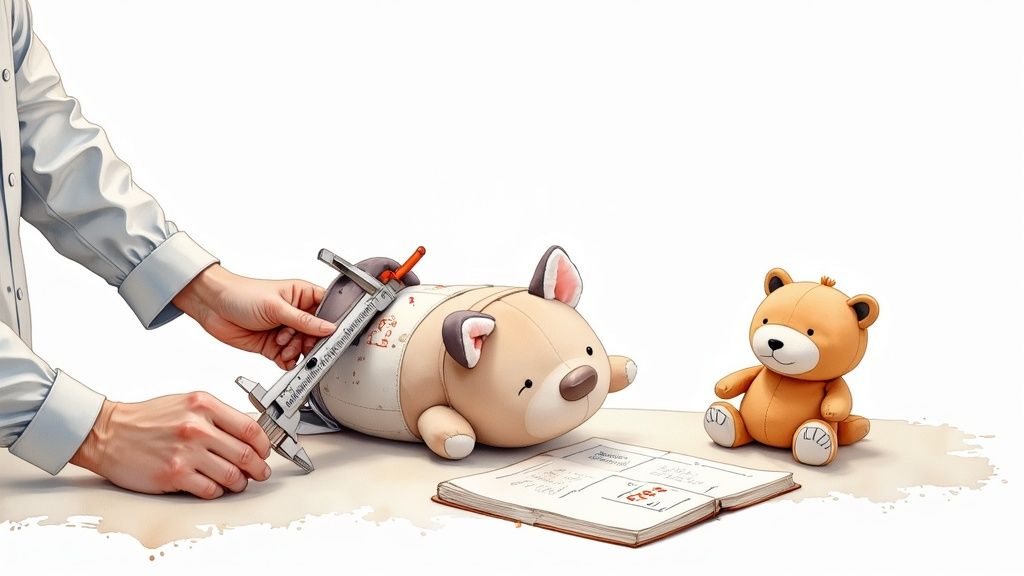
In plush toy manufacturing, quality control is not a final step; it is a continuous process integrated into every stage of production. For our clients, understanding this system provides the assurance that every unit delivered will meet their brand’s standards.
Let me walk you through what a robust quality control (QC) system looks like from inside the factory.
Stage 1: Raw Material Inspection
Before any fabric is cut, our QC team inspects all incoming raw materials. We unroll bolts of fabric to verify color consistency against the approved Pantone standard, check for weaving defects, and confirm that the material’s weight and texture match the master sample. The same rigorous inspection applies to all components, from embroidery thread to PP cotton stuffing. No material enters the production line without passing this initial check.
This first stage is critical for preventing widespread issues later. Catching a slight color deviation here saves thousands of units from being produced incorrectly.
Stage 2: In-Process Quality Checks
Once production begins, our QC inspectors are on the factory floor, monitoring each stage of assembly. This is not a random spot-check but a systematic review at every critical production point.
- During Cutting: We ensure the cut fabric pieces precisely match the master patterns. A minor deviation at this stage can result in a misshapen final product.
- During Embroidery: Inspectors check for clean stitching, correct thread colors, and proper alignment. A poorly rendered logo or an off-center eye is identified and corrected immediately.
- During Sewing: Seams are regularly pull-tested to ensure they are secure and durable. We look for uniform stitch length and ensure there are no gaps.
- During Stuffing: The team verifies that each toy is filled to the correct density. This guarantees a consistent feel across the entire order—not too firm, not too flimsy.
The philosophy behind in-process QC is straightforward: it is far more effective to prevent defects than to find them at the end. This active, hands-on monitoring is the hallmark of a reliable manufacturing partner.
Our factory’s location in Zhejiang provides a strategic advantage, placing us near major manufacturing centers. Guangdong province, for example, is the undisputed hub of China’s toy market, commanding over 31.2% of the market share due to its vast infrastructure and supplier networks. Proximity allows for efficient material sourcing and collaboration. You can learn more about this dominant market position with research from iMarc Group.
Stage 3: Final 100% Inspection
After a plush toy is fully assembled, it undergoes final inspection. While some factories may only inspect a random sample, we conduct a 100% full inspection of every single unit. Each toy is individually handled and examined by a trained inspector against a strict checklist.
Our inspectors verify:
- Overall Appearance: The toy must be clean, with no dust, dirt, or stray threads.
- Symmetry and Shape: It must be an exact match to the approved master sample. Ears, limbs, and facial features must be symmetrical.
- Seam Strength: All seams must be tightly closed with no weak points.
- Accessory Security: All attached components, like eyes and noses, must be completely secure.
- Final Cleaning: As a final safety protocol, every toy passes through a needle detector before being cleared for packaging.
This comprehensive, multi-stage approach is our commitment to quality. It ensures that the products arriving at your warehouse are precisely what you ordered, ready to represent your brand.
Partnering with FunEnjoy for Your Plush Toys
We’ve detailed the processes and standards of a quality-focused plush toy manufacturer because this is the philosophy we embody at FunEnjoy PlushToys. We understand that selecting a partner for your plush toys wholesale needs is a significant decision based on trust, transparent communication, and confidence in your partner’s commitment to quality.
We don’t just manufacture toys; we build long-term partnerships. Our entire workflow, from initial design consultation to final delivery, is structured to provide clarity and peace of mind. With over a decade of OEM and ODM experience, we have navigated and solved nearly every challenge a wholesale buyer might encounter.
How We Bring Your Vision to Life
Our methodology is built on a deep understanding of the manufacturing journey. We have integrated the best practices covered in this guide directly into our daily operations.
- Unyielding Safety Standards: For us, EN71 and ASTM F963 are not optional guidelines; they are the mandatory baseline for everything we produce. All materials are sourced and tested to meet these critical international safety standards, protecting your customers and your brand.
- Transparent Prototyping: The sampling stage is a collaborative process. We provide clear, frequent updates with detailed photos to fine-tune the design with you. Our goal is simple: the physical prototype you approve must be a perfect match for your vision before mass production begins.
- Rigorous Multi-Stage QC: Quality control is a continuous function, not an afterthought. We inspect raw materials upon arrival, conduct in-process checks during sewing and stuffing, and perform a 100% final inspection on every finished toy. This ensures consistent quality across your entire order.
Our goal is straightforward: to be the manufacturing partner you can depend on without reservation. We demonstrate our expertise by solving problems, upholding quality, and delivering on our promises—time and again.
By embedding these principles into our factory’s DNA, we remove the guesswork and risk from sourcing. We manage the production complexities so you can focus on building your brand. Consider us your dedicated team on the ground, ready to bring your plush toy ideas to life with precision, care, and quality.
Got Questions About Wholesale Plush Toys? We’ve Got Answers.
We speak with brand managers, entrepreneurs, and buyers like you every day. If you’re new to commissioning custom plush toys, you likely have many practical questions. This is completely normal.
Here are direct, no-fluff answers from the factory floor to the questions we hear most frequently.
What’s a Realistic Budget for My First Order?
A typical first production run involves three primary costs. Let’s assume an MOQ of 500 to 1,000 units.
First is the sample fee, which typically ranges from $100–$300 per design. This covers the labor and materials for your initial prototype. Most reputable manufacturers, including us, will refund this fee upon placement of your bulk production order.
Next is the unit production cost. For a small to medium-sized, moderately complex plush toy, the per-unit price might be in the $2–$4 range. Therefore, your total production budget could be anywhere from $1,500–$5,000, plus shipping costs.
How Do I Make Sure the Final Product Looks Like My Design?
This is accomplished through a rigorous prototyping and approval process. A professional manufacturing partner will never begin mass production without your explicit, physical approval of a final sample.
To ensure accuracy, provide a detailed design file or “tech pack.” This document should specify materials, Pantone colors, dimensions, and embroidery details. The more detail you provide, the more accurate the initial prototype will be.
Our most critical advice: Never approve mass production until you are 100% satisfied with the physical sample in your hands. This is your most important quality control checkpoint. Scrutinize the fabric, stitching, and shape.
Once approved, this prototype becomes the “master sample”—the official quality standard against which every unit in your production run will be measured.
What Are the Biggest Mistakes New Buyers Make?
We’ve observed several common pitfalls. The single biggest mistake is choosing a supplier based solely on the lowest price. This almost invariably leads to compromises in quality, safety, or both, which can cause irreparable harm to a brand’s reputation.
Another common error is providing vague design specifications. If your instructions are ambiguous, the final product will be as well. Be precise. Finally, underestimating shipping times and costs is a frequent problem. Plan your logistics well in advance to avoid launch delays and unexpected fees that can strain your budget.
At FunEnjoy PlushToys, we don’t just make toys; we build partnerships. We’re here to guide you through every step and make sure your project is a huge success.
Ready to bring your plush toy idea to life? Contact us for a no-obligation quote today!