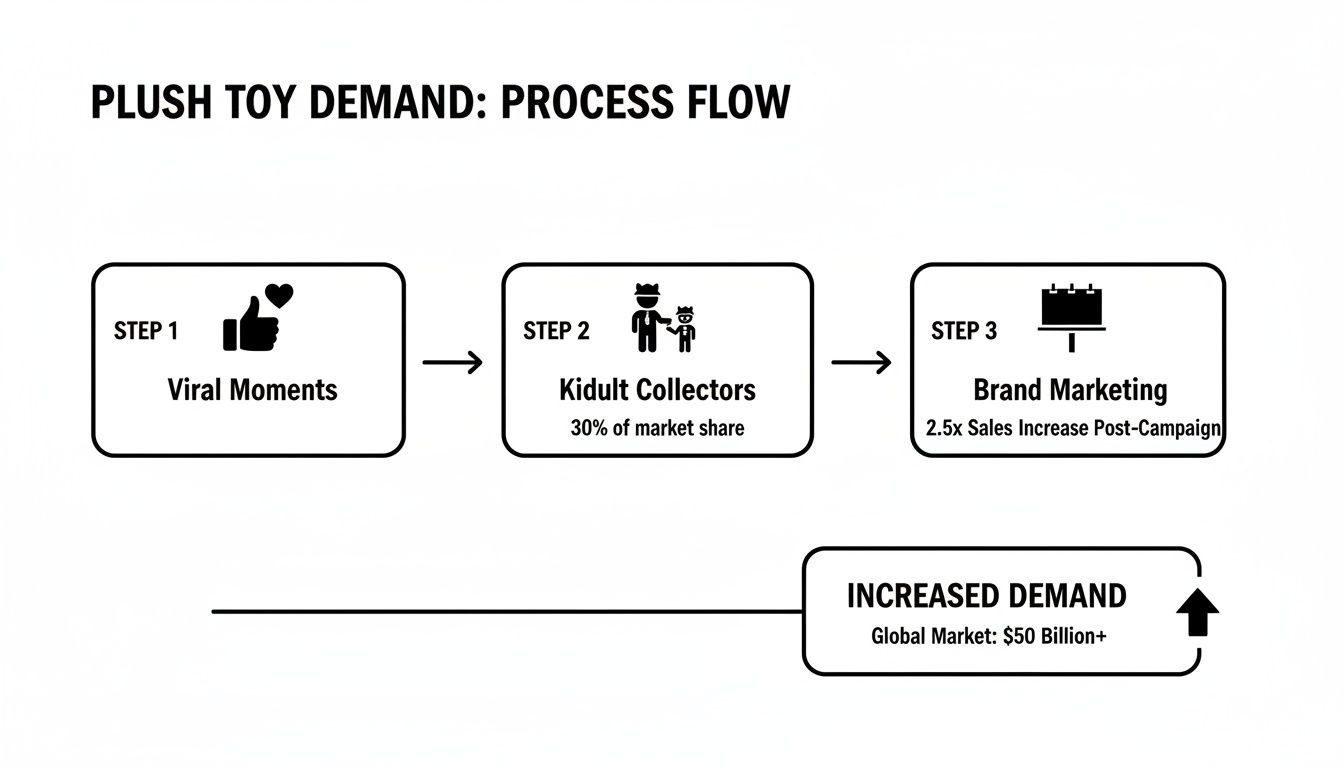
From our factory floor in China, the demand for large plush stuffed animals has become impossible to ignore. This isn’t just about children’s toys anymore. We’re fulfilling orders for global brands using giant plushies as high-impact marketing tools, for “kidult” collectors seeking premium display pieces, and for retailers creating immersive in-store experiences.
This guide provides a manufacturer’s perspective on the entire process, from initial design to final delivery, offering the practical, B2B-focused insights necessary to navigate the world of custom plush manufacturing.
The Market for Large Plush Toys: A Global Overview
The visual impact of an oversized plush toy is undeniable. In a retail setting, it’s an immediate focal point. At a trade show, it’s a photo opportunity waiting to happen. This inherent shareability is a key driver of its commercial appeal. A single, well-placed giant plush can generate significant organic social media engagement, turning customers into brand ambassadors.
This trend is supported by strong market data. The global stuffed animals and plush toys market was valued at USD 12.65 billion in 2024 and is projected to reach USD 26.23 billion by 2033, growing at a CAGR of 8.35%. China is central to this growth, not only as a massive consumer market but as the world’s primary manufacturing hub. You can explore more about these market projections for a deeper analysis.
Benefits for B2B Buyers
From a strategic standpoint, investing in large custom plush toys offers several advantages for businesses:
- Brand Mascots: A tangible, huggable mascot builds a powerful emotional connection with customers that digital advertising cannot replicate.
- Promotional Merchandise: Limited-edition large plushies can become highly sought-after collector’s items, driving event attendance and customer loyalty.
- Retail Experience: In an era of e-commerce, unique physical props like giant stuffed animals help brick-and-mortar stores create memorable, shareable experiences that draw in foot traffic.
Types of Large Plush Stuffed Animals
Large plush toys are categorized primarily by their design complexity and intended use.
- Standard Characters: These are based on simple, rounded designs (e.g., bears, bunnies) and are the most straightforward and cost-effective to produce.
- Licensed Characters: Replicating characters from media (anime, games, films) requires extreme precision to match the intellectual property (IP) holder’s style guide. These are often complex and carry higher costs due to licensing and intricate details. The specialized segment of cartoon and character-based plush toys is the highest-value subsector within China’s plush toy market. For more on this, see the character-based toy market on Technavio.
- Promotional Plushies: These are designed as marketing tools, often featuring company logos or specific brand colors, and are built for durability in high-traffic environments.
The Manufacturing Process: A Factory Workflow
Bringing a custom plush toy from concept to reality follows a meticulous, multi-stage process. Understanding this workflow is critical for any brand looking to source effectively.
Step 1: Design & Prototyping (Sampling)
The process begins with your design, typically submitted as a detailed technical pack (tech pack). Our team first analyzes the design for manufacturing feasibility. We assess potential issues with structural integrity, material suitability, and safety compliance, which are especially critical for oversized items.
From there, our pattern master translates the 2D design into a 3D pattern. The fabric is then cut—often with automated machinery for precision—and any embroidery or printing is applied to the flat panels before assembly.
The prototype, or “sample,” is then hand-sewn by our most experienced technicians. The typical sampling timeline is 5–10 working days. We provide detailed photos and videos for initial review, followed by shipping the physical sample for final approval. This sample, once approved, becomes the “golden sample”—the quality benchmark for the entire production run.
Manufacturer’s Tip: Do not rush the sampling stage. Any flaw you approve in the prototype is a flaw you are approving for every unit in mass production. Be meticulous.
Step 2: Mass Production
Once the golden sample is approved, we move to mass production:
- Material Procurement: We order all necessary fabrics, filling, and accessories in bulk.
- Cutting: Fabric is cut in layers using automated cutters to ensure consistency across thousands of pieces.
- Embroidery/Printing: All decorative elements are applied.
- Sewing: Assembly lines are set up, with each worker specializing in a specific part of the sewing process.
- Stuffing: The plush “skins” are filled with PP cotton using blowing machines for even distribution.
- Finishing & QC: The final seams are sewn shut, and each unit undergoes a detailed final inspection before packing.
OEM vs. ODM Explained
It is vital to understand the two primary manufacturing models:
- OEM (Original Equipment Manufacturer): You provide a complete, production-ready design. We act as your manufacturing arm, producing the item exactly to your specifications. You retain full ownership of the intellectual property. This is the most common model for established brands.
- ODM (Original Design Manufacturer): You can select from our pre-existing designs and customize them with your branding, or collaborate with our design team to develop a new concept from scratch. This model offers a faster route to market for businesses without in-house design resources.
Pricing Factors: What Impacts Your Cost
The per-unit cost of a large plush toy is a direct reflection of material choices, design complexity, and order volume. A price that seems too low is often a red flag for compromised quality or unethical labor practices.
Materials & Filling
The single largest cost driver is the material.
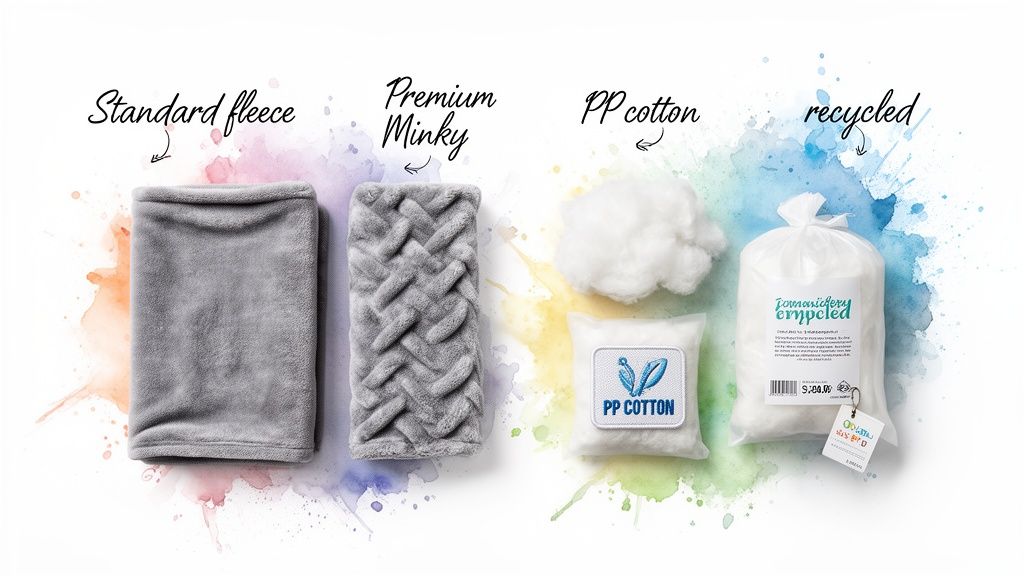
- Outer Fabric: Standard options like PV fleece or velboa offer a good balance of cost and quality. Premium materials like minky, long-pile faux fur, or custom-dyed fabrics significantly increase the cost but provide a more luxurious feel.
- Filling: We primarily use PP (polypropylene) cotton. A-grade virgin PP cotton is the softest, most resilient, and most expensive option. Lower-grade or recycled fillings reduce costs but can result in a lumpy texture and may not meet stringent safety standards.
Design Complexity
- Pattern Pieces: A simple plush might require 10-15 pattern pieces. A complex character with intricate details could need over 70. Each additional piece increases cutting and sewing labor costs.
- Details: Intricate embroidery, appliqué patches, and plastic accessories (like safety eyes) all add to the per-unit cost.
- Internal Structure: Many large plush toys require an internal plastic or metal armature to stand or hold a pose. This adds significant material and assembly costs.
Cost Reduction Tips
To reduce costs without sacrificing core quality, consider these strategies:
- Simplify the Design: Reduce the number of unique fabric colors or embroidery details.
- Use Stock Materials: Choosing fabrics the factory already has on hand eliminates the need for us to meet high supplier MOQs for custom materials.
- Increase Order Volume: Larger orders allow for economies of scale in material purchasing and production line efficiency.
Minimum Order Quantity (MOQ)
MOQ is a manufacturing necessity, not an arbitrary barrier. We must purchase raw materials in bulk from our own suppliers, and setting up a production line carries fixed costs. MOQ ensures that production is financially viable.
For large plush stuffed animals, a typical MOQ ranges from 100 to 500 pieces. This can be higher for designs requiring custom-milled fabrics or unique components.
If a standard MOQ is too high, a good manufacturing partner will work with you on solutions, such as using in-stock materials to enable a smaller run or arranging for a phased production schedule. A productive discussion about MOQ should be a collaborative problem-solving session. For a deeper dive, check our guide on sourcing stuffed animals in bulk.
Quality Control & Safety Standards
Quality control is not a single step but a continuous process. A failure in safety compliance can lead to product recalls, financial loss, and irreparable brand damage.
Our Quality Inspection Steps
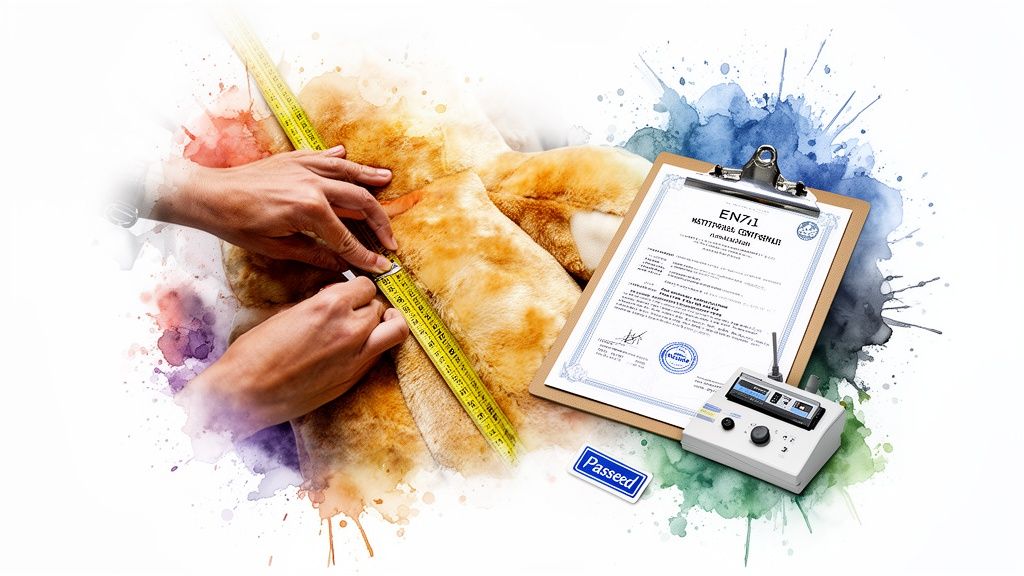
- Incoming Material Inspection: All fabrics and fillings are checked for defects, color consistency, and contaminants before production begins.
- In-Process Inspection: QC staff monitor the assembly lines, checking seam strength, embroidery quality, and construction accuracy at random intervals.
- Final Inspection: Every single finished unit is inspected for symmetry, proper stuffing, and the security of all attached parts (e.g., eyes, noses) before being packaged.
Navigating EN71 & ASTM Standards
For toys, the two most critical international safety standards are EN71 (Europe) and ASTM F963 (USA). Compliance involves rigorous third-party laboratory testing for:
- Physical & Mechanical Safety: Pull tests on seams and small parts to prevent choking hazards.
- Flammability: Ensuring materials self-extinguish at a safe rate.
- Chemical Safety: Testing for harmful substances like lead, phthalates, and banned AZO dyes.
Critical Insight: Any reputable factory will readily provide you with their certificates for EN71 and ASTM. If a potential supplier is hesitant or dismissive when asked for these documents, consider it a major red flag and cease discussions. The growth of China’s domestic toy market, projected to reach USD 50.6 billion by 2033, has also driven local regulations to be among the strictest in the world, reinforcing the need for compliance. You can discover more insights about China’s toy market growth here.
Logistics and Shipping from China
An experienced manufacturer’s services should extend to logistics. We manage the entire shipping process, from factory pickup to final delivery, providing all necessary documentation for customs clearance.
The two primary shipping options are:
- Sea Freight: The most cost-effective option for large orders, with a transit time of approximately 30-40 days to the US or Europe.
- Air Freight: Faster (7-10 days) but significantly more expensive, suitable for urgent shipments or high-value, low-volume orders.
We can arrange shipping under FOB (Free on Board) terms, where your freight forwarder takes over at the port, or DDP (Delivered Duty Paid), where we handle all logistics, customs, and duties to your warehouse door.
How to Choose a Supplier
Choosing a manufacturing partner is a strategic business decision. Look beyond the lowest price and evaluate potential partners on their expertise, transparency, and communication.
Key criteria should include:
- Proven Track Record: Look for experience with international brands and a portfolio that demonstrates quality and complexity.
- Certifications: Verify their compliance with international safety standards like EN71, ASTM, and quality management systems like ISO 9001.
- Communication: A good partner acts as an extension of your team, providing clear, proactive communication and expert guidance throughout the process.
- End-to-End Service: The best suppliers manage everything from prototyping and QC to packaging and global logistics.
A factory that pressures you into rushed decisions, provides vague answers, or is unwilling to share compliance documentation is not a partner but a liability. For a detailed comparison, see our guide to reputable stuffed animal companies.
Why FunEnjoy is a Trusted Manufacturer
Since our establishment in 1993, FunEnjoy PlushToys has been dedicated to manufacturing excellence. We have had the privilege of serving as a trusted supplier for global brands like Sanrio and Starbucks, a testament to our ability to meet the highest standards of quality and safety at scale.
Our factory is fully certified with ISO 9001, BSCI, SEDEX, and SCAN, reflecting our commitment to ethical production, quality management, and supply chain security. We are not simply a factory; we are a strategic partner invested in the success of our clients.
From initial concept to final delivery, our team provides the expertise and transparency necessary to bring your vision for large plush stuffed animals to life.
At FunEnjoy PlushToys, our mission is to make the entire journey, from initial idea to final delivery, as clear and simple as possible. If you’ve got a concept for a custom plush toy, our team has the expertise to help bring it to life. Contact us today to get started.