How to make plush toys is a meticulous, multi-stage process and a true partnership between a brand and its manufacturer. From our factory in Yiwu, China, we see this journey as far more than sewing and stuffing—it is a precise operation that spans technical planning, material execution, and production coordination. Many first-time buyers underestimate this complexity, which often leads to costly delays and miscommunication.
This guide explains how to make plush toys from a manufacturer’s perspective, pulling back the curtain on the entire workflow—from the technical design phase to navigating global logistics. Our goal is to equip you with practical, factory-level knowledge to manage your project with confidence, avoid common pitfalls, and successfully move from a concept sketch to a container of finished goods.
Market Overview: The Booming Global Plush Toy Industry
Understanding how to make plush toys has become increasingly important as the global plush toy market experiences explosive growth, projected to expand from USD 13.71 billion in 2025 to USD 26.23 billion by 2033. This surge is driven by a strong demand for collectibles and licensed characters, with the Asia-Pacific region, led by China, dominating production.
China currently sources 85% of toys sold in the US, a testament to both the scale and technical expertise required to understand how to make plush toys at a commercial level.For brands, this presents a massive opportunity, but also highlights the need to partner with a manufacturer who understands market trends and quality standards. You can find more insights about the plush toy market on Straits Research.
Benefits of Partnering with an Expert Manufacturer
Navigating the complexities of plush toy production alone is a significant challenge, especially for brands still learning how to make plush toys at a commercial scale. A seasoned manufacturing partner offers far more than just production capacity; they provide a strategic advantage.
- Cost Efficiency: Experienced factories optimize material usage, streamline production lines, and leverage economies of scale to deliver competitive pricing without sacrificing quality.
- Quality Assurance: Established manufacturers have robust, multi-stage quality control systems built into their workflow, ensuring every unit meets your standards and international safety regulations.
- Supply Chain Management: A good partner handles the entire process, from sourcing certified raw materials to managing export logistics, simplifying your operations.
- Technical Expertise: We provide invaluable guidance on material selection, design feasibility, and cost-engineering to transform your concept into a producible, market-ready toy.
Types of Plush Toys: Understanding Your Options
When you approach a manufacturer, it’s crucial to know the two primary engagement models, as they define the entire project’s scope and timeline.
- OEM (Original Equipment Manufacturer): This is for creating a completely unique product. You provide a detailed, original design (your tech pack), and we act as your dedicated production partner to manufacture it to your exact specifications. This is the path for brands with a distinct creative vision.
- ODM (Original Design Manufacturer): This is a faster route to market. You select a pre-existing design from our factory’s catalog, which we then customize with your branding, colors, and minor modifications. It’s an efficient way to launch a product line without the intensive upfront design investment.
The success of collectible toys like Pop Mart’s Labubu, which generated US$418 million in revenue in 2024, showcases the capability of Chinese manufacturers to produce high-quality, trend-setting OEM products. More details are available in this article about China’s booming collectible toy market on China Briefing.
The Manufacturing Process: An Inside Look
Once you approve the final prototype, your project moves from the sampling room to the main production floor. This is a highly structured workflow designed for precision and scale.
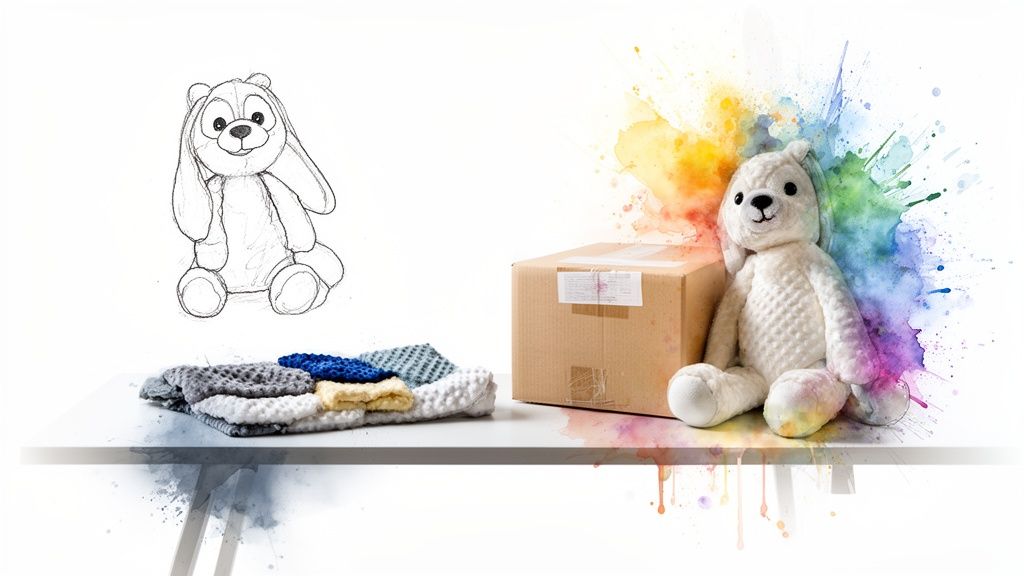
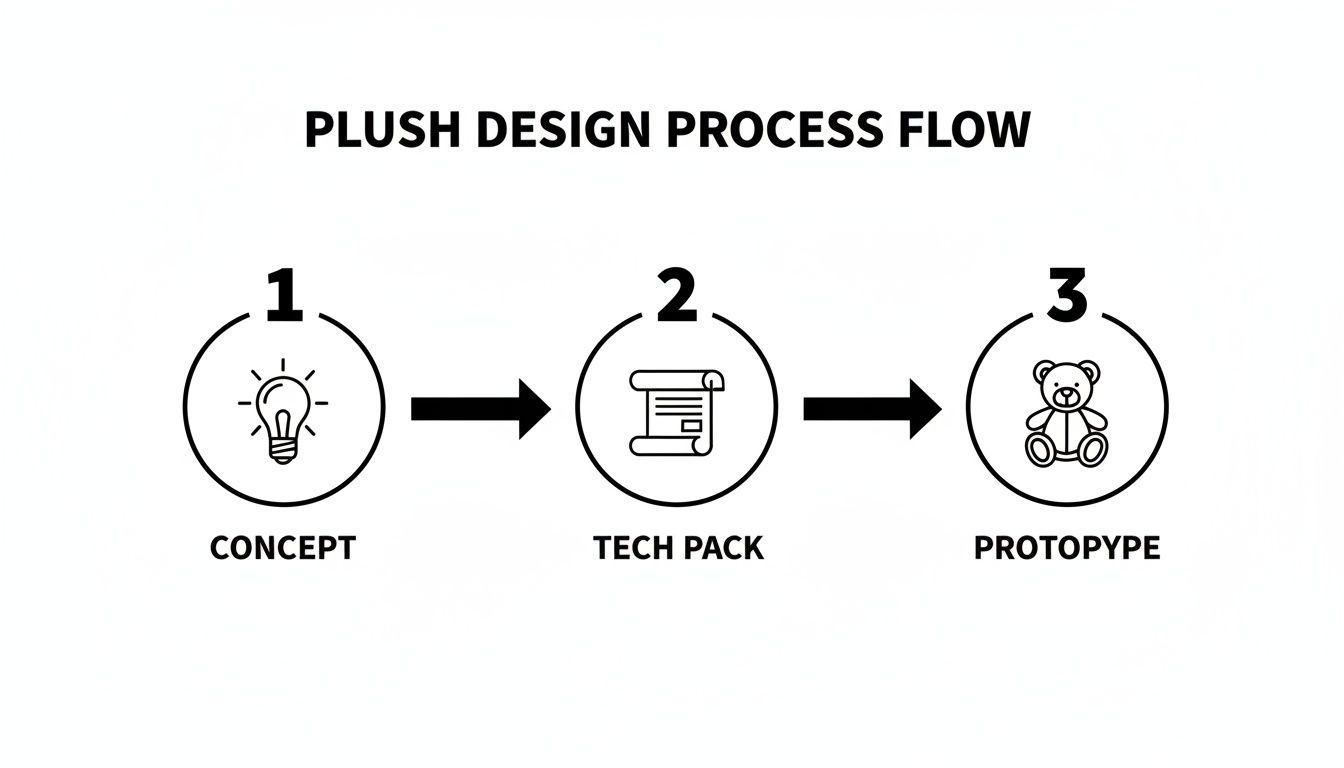
Step 1: Design, Prototyping, and Sampling
This foundational stage translates your vision into a manufacturable reality. Clear communication here prevents costly errors later.
The Technical Blueprint (Tech Pack)
The tech pack is the single most critical document in plush toy manufacturing. It eliminates ambiguity and ensures our team understands your exact requirements. A comprehensive tech pack must include:
- Multi-View Illustrations: Front, back, and side views with callouts for specific features.
- Material Specifications: Precise fabric types (e.g., Minky, Velboa) and filling (e.g., PP cotton, foam pellets).
- Dimensions and Measurements: Exact sizing for the overall toy and individual components.
- Color References: Pantone (PMS) codes for all fabrics and embroidery threads to ensure perfect color matching.
Materials and Fillings
The choice of materials directly impacts the toy’s look, feel, safety, and cost.
| Component | Material Type | Key Characteristics | Best For | Relative Cost |
|---|---|---|---|---|
| Fabric | Minky Fabric | Ultra-soft, plush pile, slight stretch | Premium baby toys, luxury collectibles | High |
| Fabric | Velboa (Crystal Velvet) | Short pile, smooth, durable | Standard retail toys, character plush | Medium |
| Fabric | Velour | Soft with a slight sheen, good stretch | Classic teddy bears, apparel details | Medium-High |
| Filling | PP Cotton | Lightweight, soft, hypoallergenic | Most standard plush toys | Low |
| Filling | Foam Pellets | Provides weight and structure | Bean bags, weighted sensory toys | Medium |
Making the right material choices is a core part of the process when you design your own plush toy.
The Sampling Timeline
Prototyping is an iterative process. It’s a collaborative feedback loop designed to perfect the product before mass production.
- First Sample Creation (7-10 days): Our pattern makers and sample team create the first physical prototype based on your tech pack.
- Client Review & Feedback: We ship the sample to you. You provide specific, measurable feedback (e.g., “increase head diameter by 2cm”).
- Revision Cycles (5-7 days per revision): We implement your changes and create a revised sample. Most projects require 1-3 revision cycles.
Step 2: Mass Production Workflow
With the approved prototype as our guide, we scale up production with precision.
- Fabric Cutting: For volume orders, we use custom steel dies and hydraulic presses to cut dozens of fabric layers simultaneously, ensuring perfect uniformity.
- Embroidery and Printing: Facial features and logos are applied using multi-head embroidery machines or screen-printing while the fabric panels are still flat.
- Panel Stitching: Skilled sewing teams work in an assembly line, with specialists for each component (e.g., attaching limbs, closing seams).
- Stuffing and Shaping: The stitched “skins” are filled with a precise weight of PP cotton using high-pressure air hoses, then hand-shaped to match the prototype.
- Final Assembly: The toy is closed with a hidden stitch, accessories are securely attached, and each unit is brushed and cleaned. You can learn more about stitching techniques in our guide on how to sew a stuffed animal.
Pricing Factors: What Impacts Your Cost?
Understanding the key cost drivers is essential for budgeting and making informed decisions.
- Complexity & Size: More intricate designs with many small parts require more labor and time, increasing the cost per unit.
- Materials: Premium fabrics like Minky or custom-dyed materials cost more than standard Velboa.
- Order Quantity (MOQ): Higher volumes allow us to spread fixed setup costs (like making cutting dies) over more units, significantly lowering the price per toy.
- Accessories: Special features like sound boxes, custom tags, or complex embroidery add to the final cost.
A common tip to reduce cost is to simplify the design slightly or increase the order quantity to benefit from economies of scale.
MOQ (Minimum Order Quantity) Explained
One of the first questions we receive is about our Minimum Order Quantity (MOQ), which typically ranges from 500-1,000 pieces for custom designs. This number isn’t arbitrary; it’s based on production economics. Setting up for a new project involves fixed costs for creating cutting dies, programming embroidery machines, and allocating a production line. An MOQ ensures we can operate efficiently and offer you a viable price per unit.
Quality Control and Safety Standards
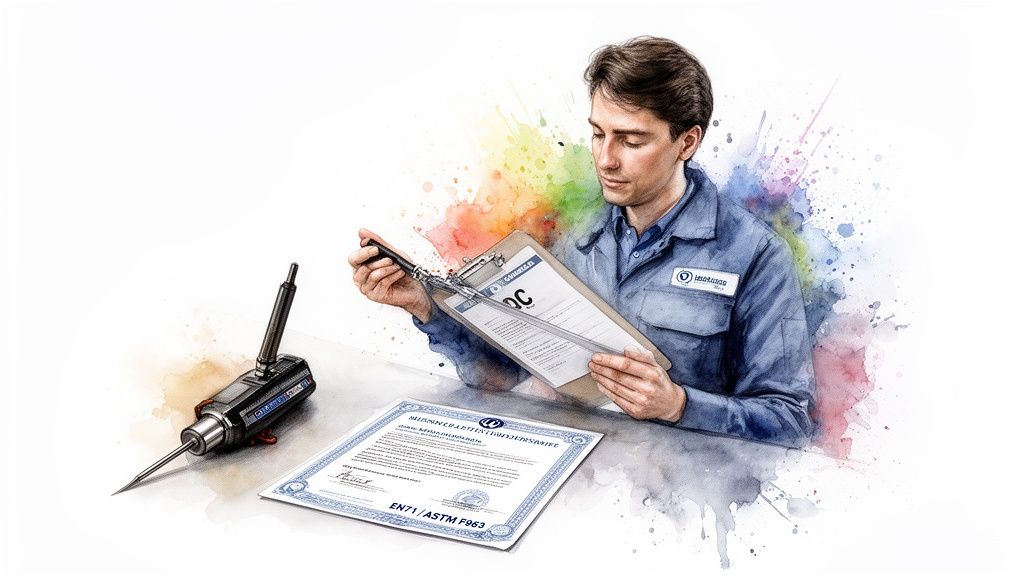
Quality and safety are non-negotiable. A failure here can lead to recalls and irreparable brand damage. Our quality control (QC) is a multi-stage process integrated throughout production.
Key Quality Inspection Steps
- Raw Material Inspection: We check all incoming fabrics, fillings, and threads for defects and color consistency against the approved standard.
- In-Process Inspections: Our QC team checks embroidery alignment, seam strength, and stuffing weight at key points on the assembly line.
- Final Inspection: Every finished toy is inspected by hand for aesthetic flaws, seam integrity, and accessory security.
- Metal Detection: After final assembly, every toy passes through a metal detector to ensure no broken needle fragments are inside—a critical safety step.
Adherence to Global Safety Standards
Compliance with international safety standards is mandatory for market access. The two most critical standards for our clients are:
- EN71 (European Union): Governs toy safety, covering mechanical properties, flammability, and chemical composition.
- ASTM F963 (United States): The standard consumer safety specification for toy safety, covering similar hazards like choking, sharp points, and lead content.
Manufacturer’s Warning: Partnering with a factory that does not have demonstrable experience with EN71 and ASTM F963 is a significant risk. A failed test can result in your entire shipment being rejected at customs, a costly and entirely avoidable problem.
Logistics: From Our Factory to Your Warehouse
Once production and QC are complete, we manage the logistics to get your products to you.
- Packaging: Toys are packed into individual polybags, then into master cartons designed for international shipping.
- Shipping Options:
- Sea Freight: Cost-effective for large orders, with transit times of 20-40 days.
- Air Freight: Faster (5-10 days) but more expensive, ideal for urgent shipments.
- Customs & Duties: We handle export clearance from China. You will need a customs broker in your country to manage import clearance, duties, and taxes.
How to Choose the Right Supplier
Choosing your manufacturing partner is the most critical decision you will make. A cheap quote from an unreliable factory can quickly become your most expensive mistake.
Essential Vetting Checklist
- Communication: Is their team responsive, professional, and fluent in English? Poor communication during quoting signals future problems.
- Factory Certifications: Ask for third-party audits like BSCI (Business Social Compliance Initiative) or ISO 9001, which verify ethical labor practices and quality management systems.
- Proven Experience: Review their portfolio. Do they have experience manufacturing for your target market (e.g., USA, EU) and with toys of similar complexity?
- Transparency: A good partner will be open about their QC process and welcome a third-party inspection of your production run.
Common Problems and Risks of Low-Quality Factories
- Intellectual Property Theft: Unscrupulous factories may sell your design to other clients. Always sign a legally binding Non-Disclosure Agreement (NDA) before sharing your tech pack.
- Inconsistent Quality: A great prototype means little if the mass-produced units are flawed due to poor QC.
- Hidden Costs: A low initial quote may be followed by unexpected charges for materials, packaging, or corrections.
- Failed Safety Tests: Cutting corners on materials can lead to non-compliance with EN71/ASTM standards, rendering your product unsellable.
Why FunEnjoy is a Trusted Manufacturer
Bringing a plush toy to market is a complex journey, and understanding how to make plush toys at a professional level requires experience across design, production, and logistics. At FunEnjoy PlushToys, we have spent decades perfecting every step of this process, from initial design consultation to global logistics.
Our commitment to transparency, rigorous quality control, and deep expertise in international safety standards reflects our understanding of how to make plush toys that meet both creative expectations and global compliance requirements. As a trusted manufacturing partner, we are dedicated to transforming your vision into a high-quality, safe, and successful product for the international market.
Whether you are looking for plush toys wholesale or a fully custom creation, our team is ready to guide you.
Ready to start your plush toy project? Contact our team today for a free quote and let’s build something amazing together.