How to Make a Hand Puppet at a commercial scale is far more complex than a simple craft project. For brands looking to launch a hand puppet line, the process involves shifting from a creative idea to a scalable, manufacturable product. As a plush toy manufacturer based in China, we manage this transition daily. This guide provides a manufacturer-level perspective on how to turn your design concept into a market-ready product, focusing on the practical realities of mass production.
An Overview of the Hand Puppet Manufacturing Market
The global toy market is vast, and hand puppets represent a stable, evergreen niche. Brands looking to produce hand puppets at scale invariably turn to China, which has been the world’s largest manufacturing sector for over 15 years. Specialized hubs like Dongguan, Yangzhou, and Qingdao are home to factories with decades of experience in plush toy production.
However, the landscape is varied. It ranges from small workshops to large-scale, certified factories. Understanding this ecosystem is the first step for any serious buyer.
Why Brands Choose to Manufacture Hand Puppets
Beyond their play value, hand puppets offer distinct benefits for businesses, educational institutions, and content creators:
- Educational Tools: Puppets are widely used in schools and therapy to aid in social-emotional learning and storytelling.
- Brand Mascots: Companies transform their mascots into physical products, creating a tangible connection with their audience.
- Merchandising: For entertainers and IP holders, puppets are a high-margin merchandise item.
- Creative Play: Unlike static toys, puppets encourage interaction, creativity, and communication skills.
Types of Hand Puppets for Mass Production
From a manufacturing standpoint, puppets are categorized by their construction complexity, which directly impacts cost and production time.
Simple Glove Puppets
These are the most basic and cost-effective designs, typically made from a few pieces of felt or plush. They are quick to produce and ideal for large promotional runs.
Puppets with Legs and Detailed Features
These designs involve more pattern pieces, separate limbs, and often require more complex assembly. They offer greater character detail but come at a higher cost.
Puppets with Moving Mouths (Full-Body)
These are the most complex, requiring an internal structure to allow for mouth movement. The pattern is intricate, and assembly demands skilled workers, making them a premium product.
The Professional Hand Puppet Manufacturing Process
A professional factory operates on a standardized workflow to ensure consistency, quality, and efficiency. This process is non-negotiable for achieving a reliable outcome at scale.
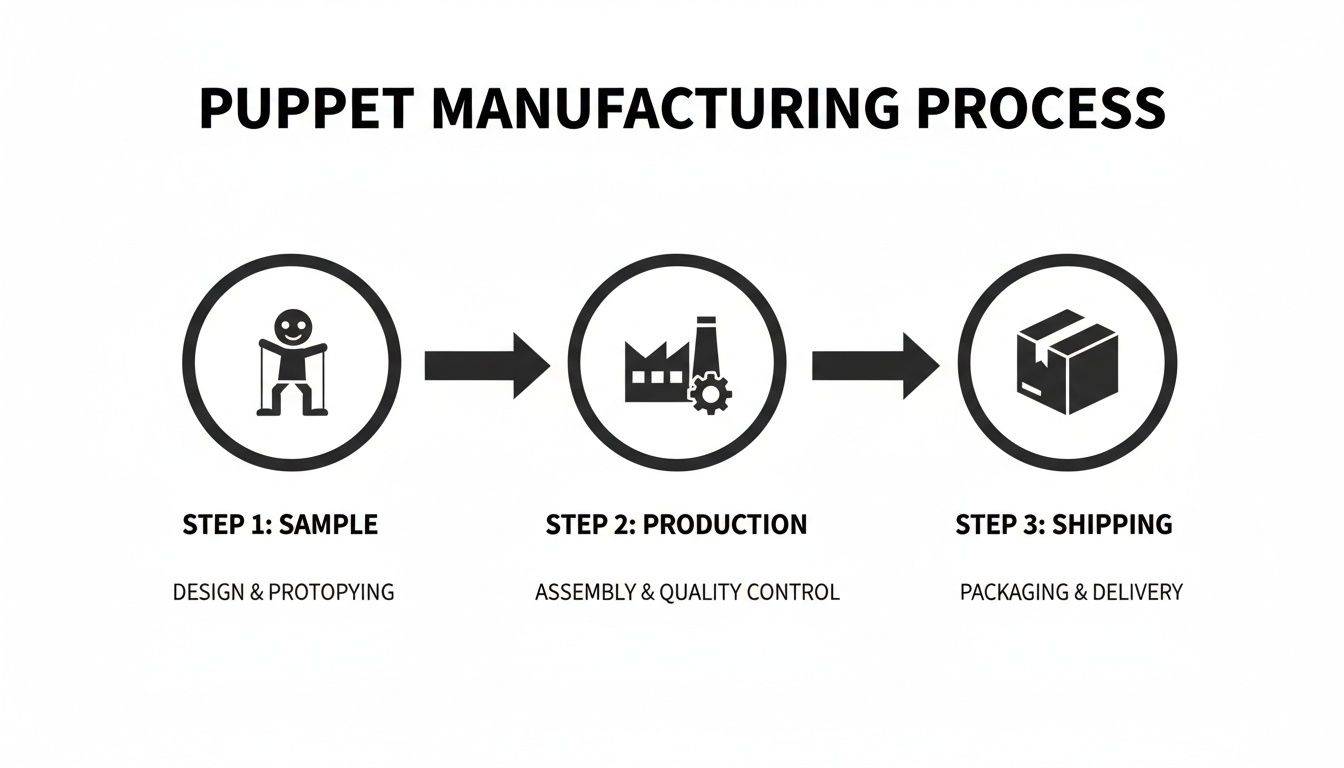
Step 1: Prototyping and Sampling (5-10 Days)
This is the most critical phase. You provide a “tech pack”—a detailed design document with sketches, material specifications, and color codes.
- Pattern Making: Our master pattern-maker translates your 2D design into a 3D pattern. This is a highly skilled job, as it determines the final shape and ease of assembly.
- Material Sourcing: We procure fabrics and accessories based on your specifications.
- Sample Creation: A dedicated sample team hand-crafts the first prototype.
- Client Review: We ship the sample to you for approval. Any revisions are made at this stage.
Manufacturer’s Insight: Multiple sample revisions are the single biggest cause of project delays. A detailed tech pack is essential to minimize back-and-forth communication and speed up the timeline.
Step 2: Mass Production (20-30 Days)
Once the final sample is approved, we move to full-scale production.
- Material Procurement: We order all raw materials in bulk.
- Automated Cutting: The digitized patterns are sent to laser cutters, which precisely cut hundreds of layers of fabric at once. This ensures uniformity across every unit.
- Assembly Line Sewing: The cut pieces are moved to sewing lines. Each sewer specializes in a specific part—one may only attach eyes, while another sews limbs. This division of labor is key to efficiency and consistent quality. For a deeper understanding of documenting these steps, see this guide on SOP writing 101.
- Stuffing and Finishing: The puppets are filled with a pre-weighed amount of PP cotton to ensure consistent density. Facial features are added via embroidery or other methods.
- Final Assembly: The puppet is closed, cleaned, and trimmed of any loose threads.
Step 3: Quality Control and Logistics
This final phase ensures the product meets all specifications before it leaves the factory.
- In-Line & Final QC: Inspections occur throughout production and a final check is performed on the finished batch.
- Safety Testing: Products are sent to third-party labs (like SGS or Intertek) for EN71 or ASTM certification.
- Packaging: Puppets are individually bagged, then packed into master cartons according to your requirements.
- Shipping: We coordinate with freight forwarders for shipment via sea or air.
Key Factors That Influence Puppet Pricing
The factory price for a custom hand puppet typically ranges from US$1.18 to US$5.50. The final cost is determined by several factors:
- Design Complexity: A puppet with 20 pattern pieces will cost significantly more than one with 5 due to increased sewing time.
- Size: Larger puppets require more material and stuffing. The standard size is typically 8–12 inches.
- Materials: Standard polyester plush is cost-effective. Premium materials like minky fabric, faux fur, or custom-printed textiles increase the unit cost. A detailed bill of materials template is used to track every component.
- Order Quantity (MOQ): Higher volume reduces the per-unit cost.
- Finishing Details: Complex embroidery, appliqués, or accessories add to labor and material costs.
Manufacturer’s Insight: To reduce costs, consider simplifying the design. For example, reducing the number of embroidery colors or combining small pattern pieces can lower production time without compromising the character’s appeal. We often advise clients on these “Design for Manufacturability” (DFM) adjustments.
Understanding Minimum Order Quantity (MOQ)
Factories cannot produce just a few puppets. The MOQ is necessary to cover the costs of setup, material procurement, and production line configuration. For hand puppets, the industry-standard MOQ is 500–1,000 pieces per design.
Factories with lower MOQs (e.g., 100-300 pieces) are often smaller workshops. While flexible, they may lack the robust quality control systems and certifications of larger manufacturers, posing a potential risk for buyers. If you are just starting, you can learn more about how to design your own plush toy before committing to a large order.
Quality Control and Safety Standards
For any toy brand, quality and safety are non-negotiable. Reputable manufacturers integrate quality control into every step.
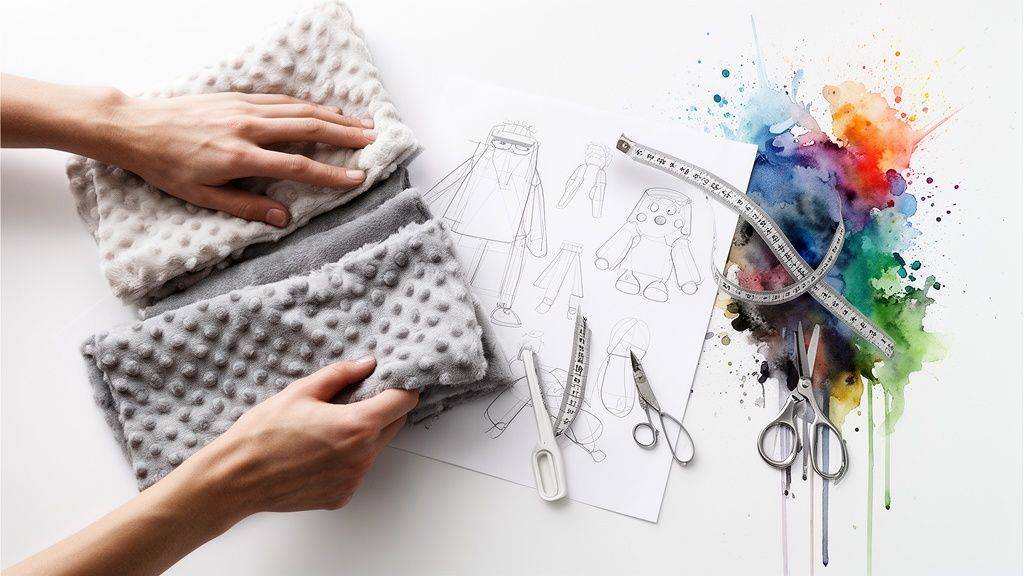
The Quality Inspection Process
- Incoming Quality Control (IQC): All raw materials (fabric, thread, stuffing) are inspected upon arrival to ensure they match the approved specifications.
- In-Process Quality Control (IPQC): Inspections are conducted at key assembly stages (e.g., after sewing, after stuffing) to catch defects early.
- Final Quality Control (FQC): A final inspection is performed on the packed goods, often using the AQL 2.5 standard, a statistical sampling method to verify the quality of the entire batch.
Critical Safety Standards (EN71 & ASTM)
Puppets sold in the US and EU must comply with strict safety regulations.
- ASTM F963 (USA): This standard tests for physical hazards (choking risks from small parts), flammability, and hazardous chemical content (e.g., lead, phthalates).
- EN71 (EU): This is the European standard required for the CE mark. It is more comprehensive and covers mechanical properties, flammability, and the migration of specific chemical elements.
A reliable factory will be experienced in manufacturing products to meet these standards and will manage the third-party lab testing process for you. If you are interested in the manual process, you can find some basic principles in our guide on how to sew a stuffed animal.
The Logistics of Shipping and Delivery
Once production is complete, the final step is getting the products to your warehouse.
- Packaging: Products are compressed and packed into cartons to minimize shipping volume.
- Shipping Terms (Incoterms): Most factories quote prices based on FOB (Free On Board), which means the price includes delivery to the port in China. The buyer is responsible for ocean freight, customs clearance, and inland transport in their country.
- Freight Options: Sea freight is the most common and cost-effective method for bulk orders, though it takes longer (30-40 days). Air freight is faster (5-10 days) but significantly more expensive, reserved for urgent shipments.
How to Choose the Right Hand Puppet Supplier
Selecting the right partner is crucial for success. Here is what to look for:
- Industry Specialization: Choose a factory that specializes in plush toys, not a generalist trading company.
- Certifications: Ask for proof of certifications like ISO 9001 (for quality management) and social compliance audits like BSCI or Sedex.
- Experience with Your Market: A supplier familiar with EU and US safety standards (EN71/ASTM) will be able to navigate compliance requirements smoothly.
- Clear Communication: Your contact should be fluent in English and provide prompt, detailed responses.
- Transparency: A good factory will be open about its processes and welcome a factory visit or third-party inspection. Be wary of suppliers who are hesitant to share information.
OEM vs. ODM
- OEM (Original Equipment Manufacturer): You provide a unique design, and the factory produces it for you. This is for brands with their own IP.
- ODM (Original Design Manufacturer): You choose an existing design from the factory’s catalog and rebrand it as your own. This is a faster, lower-risk way to enter the market. Many factories, including us, offer both services.
Exploring platforms that provide an overview of the puppet toy manufacturing landscape can also provide a list of potential partners.
Why FunEnjoy is a Trusted Manufacturer

At FunEnjoy Plush Toys, we are not a trading company; we are a factory. With over a decade of experience, we provide end-to-end manufacturing services for brands worldwide.
- Expertise: We specialize exclusively in plush and stuffed toys, including complex hand puppets.
- Certified Quality: Our factory holds both ISO 9001 and BSCI certifications, ensuring our processes meet the highest international standards for quality and ethical production.
- Global Compliance: We have extensive experience producing toys that comply with EN71, ASTM, and other global safety standards.
- Direct Communication: Our team works directly with clients to provide guidance on design, materials, and cost optimization.
If you are considering ordering stuffed animals in bulk, partnering with an experienced and certified manufacturer like FunEnjoy de-risks the process and ensures you receive a high-quality, safe, and commercially viable product.
At FunEnjoy PlushToys, we blend decades of manufacturing experience with an unwavering commitment to quality and safety. We help bring your vision to life, guiding you from a simple concept to a market-ready product that meets the world’s highest standards. https://funenjoytoys.com