So, you have an idea for a custom pet plush. But how do you take that spark of an idea and turn it into a real, huggable product sitting on a store shelf? As a manufacturer, this is a journey we guide clients through every single day. Transforming a photo or a sketch into a high-quality, retail-ready plush toy is a detailed, collaborative process. It’s far more than just stitching and stuffing; it’s a carefully managed production workflow.
Let’s pull back the curtain and walk through the entire lifecycle of creating a custom pet plush from a factory’s perspective. We’ll cover the key decisions you’ll make, realistic timelines, cost factors, and the quality standards that separate a professional product from a cheap imitation. The goal is to provide the practical, manufacturer-level knowledge you need to manage your project with confidence.
The Custom Pet Plush Market: An Overview
The global appetite for stuffed animals and plush toys is massive—the market is projected to grow from USD 13.71 billion in 2025 to USD 26.23 billion by 2033, according to Straits Research. Within this, the custom pet plush niche is booming. This growth is fuelled by pet owners wanting unique, high-quality products that immortalize their companions and brands seeking distinctive promotional items. As people become more focused on health and sustainability, we’re also seeing rising demand for eco-friendly and hypoallergenic materials.
Benefits of Creating a Custom Pet Plush for Your Brand
For businesses, a custom pet plush is more than just a toy; it’s a powerful branding tool. It creates a tangible, emotional connection with your audience in a way digital marketing can’t. Whether it’s a mascot, a promotional giveaway, or a retail product, a well-made plush serves as a lasting physical advertisement. It builds brand loyalty and offers a unique product that sets you apart in a crowded marketplace.
Types of Custom Pet Plush Toys
While the concept seems straightforward, “custom pet plush” covers several distinct categories, each with different manufacturing considerations.
OEM vs. ODM Manufacturing
Understanding the difference between Original Equipment Manufacturer (OEM) and Original Design Manufacturer (ODM) is crucial for B2B buyers.
- OEM (Original Equipment Manufacturer): This is the most common route for custom projects. You provide us with your unique design (a sketch, tech pack, or photo), and we manufacture it exclusively for you. You own the intellectual property.
- ODM (Original Design Manufacturer): This involves selecting one of our existing, pre-designed plush models and customizing it with your branding, such as adding a logo or changing fabric colors. It’s a faster and often more cost-effective option than starting from scratch.
The Manufacturing Process: From Concept to Container
The journey from a digital file to a finished product is a meticulous, hands-on process on our factory floor.
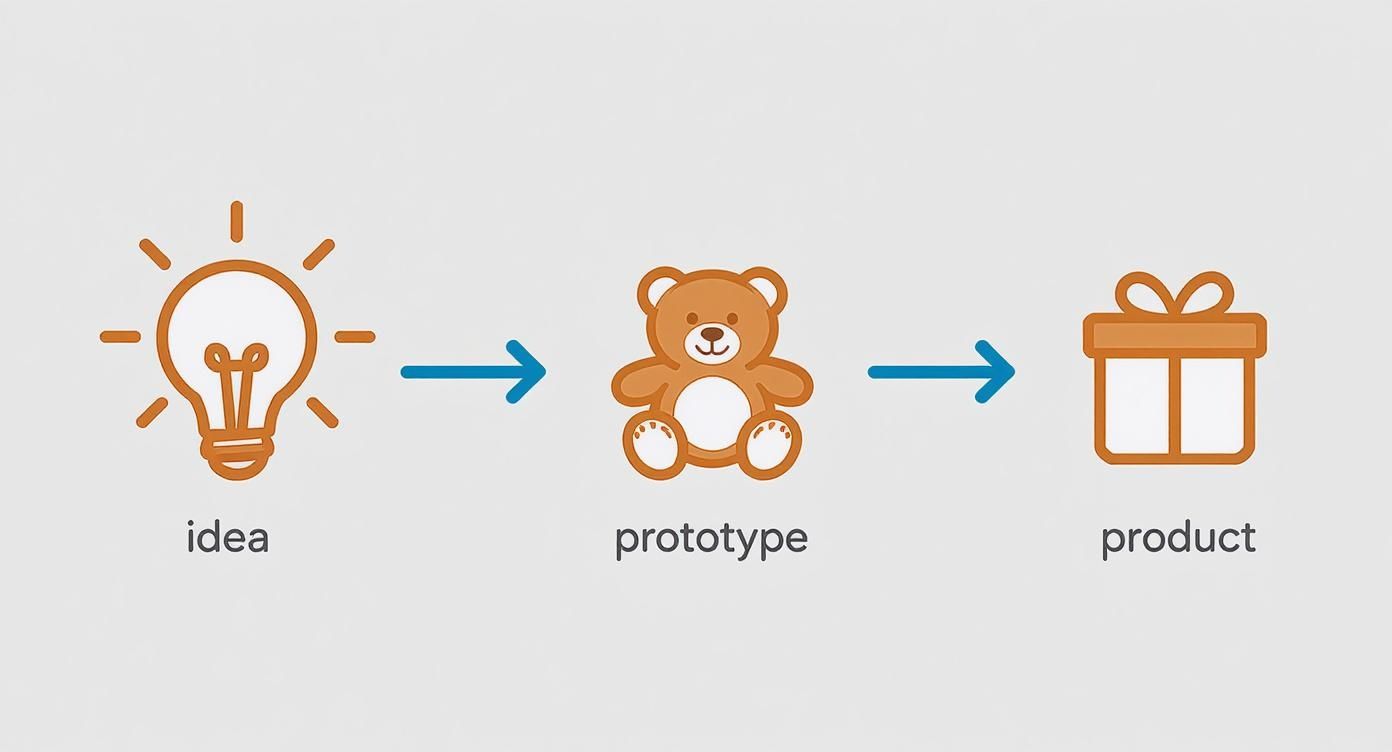
Step 1: Design & Prototyping (Sampling)
This is where the magic happens. We call it ‘sampling’ in the factory, and it’s the most critical, hands-on collaboration before mass production. Our seasoned pattern masters take your 2D design and translate it into a three-dimensional pattern.
- Pattern Creation: Our masters create paper or digital patterns for every single piece of the plush.
- Cutting & Embroidery: We use these patterns to cut the chosen fabric. Details like facial features or logos are embroidered onto the flat fabric pieces before sewing.
- Sewing, Stuffing & Finishing: The pieces are stitched together, stuffed with PP cotton, hand-shaped, and meticulously closed.
The first prototype is rarely the final one. We rely on your specific, actionable feedback to make revisions. Vague notes like “the face looks weird” are not helpful. Effective feedback is precise: “Move the eyes 3 mm closer together and lower the embroidered mouth by 2 mm.”
Manufacturer’s Insight: The real skill of a pattern master is not just cutting fabric, but interpreting the soul of a 2D design. They must understand how flat shapes will curve, how seams will pull, and how the filling will affect the final posture to bring a character to life.
The entire sampling process, including revisions, typically takes 7 to 15 business days per iteration. Our goal is to arrive at the “golden sample”—the one prototype you officially approve for mass production. This sample becomes the benchmark against which every unit in the final run is measured.
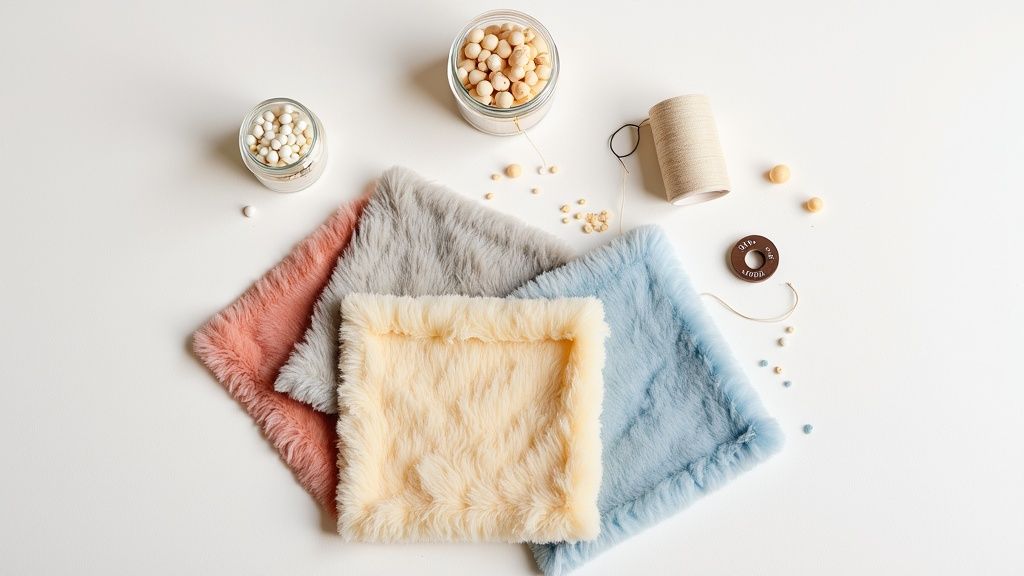
Step 2: Material Selection
The materials dictate the toy’s final look, feel, safety, and unit cost.
- Outer Fabric: Minky (Crystal Super Soft Plush) is the go-to for a luxurious, soft feel ideal for retail. For more durable, budget-conscious projects, we use Velboa, a short-pile faux fur that holds prints exceptionally well.
- Filling: Over 95% of our plush toys use Polypropylene (PP) Cotton. It’s hypoallergenic, lightweight, machine washable, and resists clumping. For a weighted “beanie” feel, we add plastic pellets sealed in a secure inner pouch.
- Features: Plastic safety eyes and noses provide a classic 3D look and are secured with locking washers to pass safety pull tests. For any toy aimed at infants (under 3), embroidered features are mandatory to eliminate choking hazards.
Step 3: Mass Production
Once you’ve approved the “golden sample,” we fire up the production line. A typical run of 500-1,000 units takes about 30 to 45 days. This timeline covers everything from ordering raw materials to cutting, sewing, stuffing, quality control, and final packing. Peak season (August-November) can extend these lead times, so planning ahead is crucial.
Key Pricing Factors: What Impacts Your Unit Cost?
The final price per unit is determined by material costs, design complexity, and labor time. Every design decision has a direct impact on the bottom line.
| Cost Factor | Low-Cost Option | High-Cost Option | Impact on Final Product |
|---|---|---|---|
| Material Quality | Standard velboa or short-pile fabric | High-pile minky, faux fur, organic cotton | Affects the plush’s softness, texture, and perceived value. |
| Size | Small (under 8 inches) | Large (over 15 inches) | Directly impacts material and stuffing consumption. |
| Complexity | Simple shapes, fewer than 10 pattern pieces | Intricate shapes, 20+ pattern pieces, complex limbs | Significantly increases sewing time and labour costs. |
| Details | Printed eyes, simple one-colour embroidery | Plastic safety eyes, multi-colour dense embroidery, appliqués | Adds character and detail but requires more machine time and materials. |
| Accessories | No accessories | Custom-made clothing, ribbons, plastic accessories | Each added item increases material cost and assembly time. |
Pro Tip to Reduce Cost: The smartest way to lower your unit cost is to simplify the design. Reducing the number of individual pattern pieces (e.g., integrating paws into the leg piece) drastically cuts down on sewing labor. Similarly, opting for single-color or lower stitch-count embroidery can make a significant difference.
Understanding Minimum Order Quantity (MOQ)
One of the first questions B2B buyers ask is, “What’s your minimum?” For most custom pet plush projects, the MOQ is between 500 and 1,000 units per design. This number isn’t arbitrary; it’s based on the economics of mass production.
- Material Sourcing: Fabric mills have their own large minimums. We must order a full dye lot of your custom color.
- Machine Setup: Calibrating cutting machines, programming embroidery stations, and preparing sewing lines involves significant setup time. Spreading this fixed cost over a larger run makes the unit price viable.
- Production Efficiency: A run of 500+ units allows our teams to establish a smooth, efficient workflow, minimizing errors and maximizing output.
While a smaller run is technically possible, the per-unit cost would be prohibitively high. For broader variety without high volume per design, consider our ready-made plush toys for wholesale.
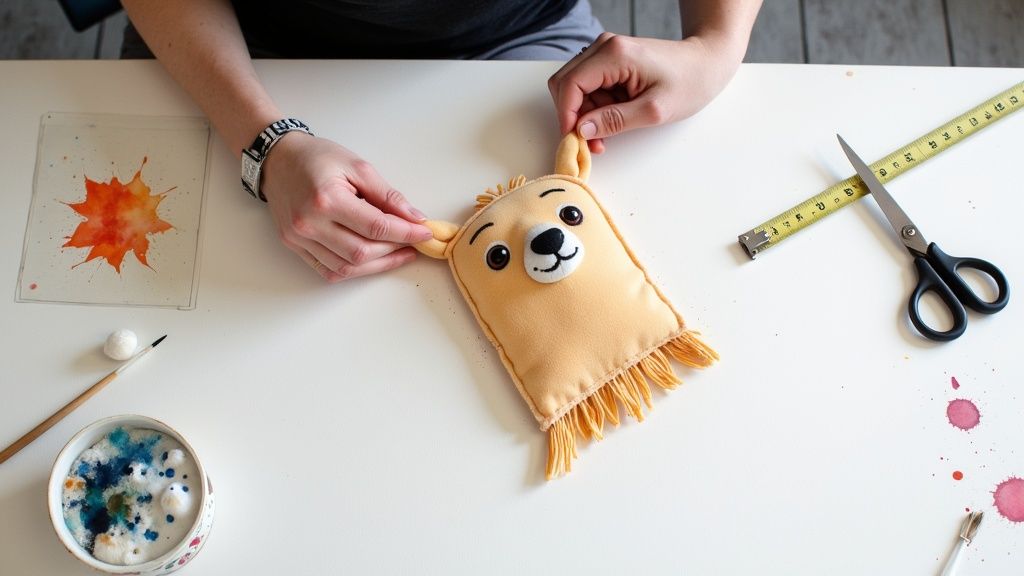
Quality Control and Safety Standards
Making sure the thousandth plush toy is identical to the approved sample is where a reliable manufacturer proves their worth. Our quality control (QC) is a multi-stage process.
Our Inspection Steps
- Raw Material Inspection: We check all incoming fabric bolts and filling for defects before they enter the production line.
- In-Line Sewing Checks: Our QC team constantly pulls items from the sewing line to check seam strength and stitch consistency against the golden sample.
- Post-Stuffing Inspection: Each toy is checked for proper firmness, shape, and feel.
- Final AQL Inspection: Before packing, the entire batch undergoes a final inspection based on the Acceptable Quality Limit (AQL) standard, where a random sample is scrutinized for any defects.
Meeting International Safety Standards
A beautiful toy is worthless if it isn’t safe. We design and manufacture every custom pet plush to meet the stringent legal requirements of major global markets.
Adherence to these standards is non-negotiable. We’re talking about physical stress tests (pulling on eyes and limbs to ensure they don’t come off), flammability tests, and deep chemical analysis to guarantee materials are free from harmful substances like lead and phthalates. Failing here can lead to costly recalls and serious legal trouble for your brand.
The two primary standards are EN71 for the European Union and ASTM F963 for the United States. Choosing a manufacturer that is ignorant of or non-compliant with these standards is one of the biggest risks a buyer can take. Low-quality factories often cut corners here, exposing your brand to significant liability.
Logistics: Getting Your Product Home
Once production is complete and has passed final QC, our logistics team takes over. We offer a complete end-to-end service, managing the entire shipping process from our factory gate to your warehouse door. We provide options for sea freight (cost-effective) and air freight (faster) and handle all necessary customs documentation to ensure a smooth transit to North America, Europe, or anywhere else in the world.
How to Choose the Right Supplier
Choosing a manufacturing partner is the most important decision you will make. Look for a supplier who demonstrates:
- Expertise and Transparency: They should be able to explain their entire process clearly and offer proactive advice on design and materials.
- Robust Quality Control: Ask about their specific QC steps and their familiarity with EN71 and ASTM F963 standards.
- Clear Communication: A responsive and collaborative partner is essential, especially during the prototyping phase.
- Social Compliance: Reputable factories should have certifications like BSCI or SEDEX, ensuring ethical labor practices.
Common problems buyers face with low-quality factories include inconsistent quality, missed deadlines, poor communication, and a lack of understanding of safety regulations. These issues can destroy a product launch. For a deeper look at our process, explore our article on crafting the perfect plush. Our extensive experience creating high-quality wholesale plush animals means we can manage the specific needs of any project.
Why FunEnjoy is a Trusted Manufacturer
Picking the right manufacturing partner is a relationship built on trust, communication, and a shared commitment to quality. At FunEnjoy Factory, we position ourselves as your manufacturing consultants, not just an assembly line.
Our Advantages
- Deep, Hands-On Experience: Our pattern makers possess decades of experience, turning complex 2D drawings into beautifully balanced 3D prototypes. This expertise is critical for achieving a high-quality final product.
- Proactive Cost-Saving Advice: We proactively suggest design tweaks or material alternatives that can lower your unit cost without sacrificing quality. For example, we might recommend a slightly different sewing technique that reduces labor time.
- Rigorous Quality & Safety Commitment: Our multi-stage QC process is embedded in every step, guaranteeing consistency and full compliance with EN71 and ASTM F963 safety standards.
- Transparent Project Management: From your initial quote to final shipment, our team ensures you are informed and confident at every stage. We understand that your success is our success. You can discover more insights about pet industry trends on funlandpet.com.
This commitment to reliability, transparency, and expert guidance is why global brands trust FunEnjoy to make their custom pet plush project a smooth and successful reality.
Ready to bring your own custom pet plush idea to life? At FunEnjoy PlushToys, we combine decades of expertise with a commitment to quality and transparent communication. Let our team guide you from concept to a finished product that delights your customers. Start your project with us today!