As manufacturers, we transform a simple drawing into a tangible, huggable plush toy. This process is a specialized craft, blending precision engineering, artistic material selection, and rigorous safety compliance. This guide provides an inside look from the factory floor, detailing the entire journey from initial concept to final shipment of your custom animal plush.
The Global Epicenter of Plush Manufacturing
The relationship between a brand and its factory is a critical partnership. The foundation of a successful project is built on clear, realistic expectations from day one, which is the most effective way to prevent the delays and cost overruns that plague many projects. The powerful emotional connection that plush toys create is why so many brands are leveraging them for merchandise and promotions.
Based in China, we operate at the heart of the global toy industry. This strategic position grants us unparalleled access to premium materials, a highly skilled workforce, and the sophisticated supply chains required to execute complex projects seamlessly.
A Market Overview from the Source
China’s dominance in toy production is undeniable. We manufacture over 70% of all plush toys sold globally, handling countless custom animal plush projects for brands of all sizes.
The domestic market alone underscores this immense capacity. Valued at approximately USD 11.32 billion in 2024, it continues to expand. This robust local demand fuels innovation and enhances production capabilities, directly benefiting our international partners. For more detailed market analysis, you can explore data about global plush toy market growth on FutureMarketInsights.com.
Manufacturer’s Insight: Global brands partner with Chinese factories not just for cost advantages, but for the fully integrated manufacturing ecosystem. Our long-standing relationships with fabric mills, embroidery specialists, and certified testing labs allow us to manage complex projects that would be a logistical nightmare to coordinate elsewhere.
Strategic Benefits for B2B Buyers
A custom animal plush serves multiple strategic purposes. Understanding these applications helps focus your design and production goals for maximum impact.
- Promotional Merchandise: A well-designed plush is a highly effective marketing tool for product launches, events, and brand campaigns.
- Corporate Gifting: A custom mascot creates a memorable and unique corporate gift, strengthening brand identity with clients and employees.
- Licensed Characters: A significant portion of our work involves translating characters from animation, games, and illustrations into high-quality physical products.
- Retail Collections: Developing an exclusive line of plush toys can become a signature offering that defines a brand’s presence in the competitive toy market.
This guide will equip you with the practical, manufacturer-level knowledge needed to navigate the production process with confidence.
The Prototyping Phase: Crafting the Perfect Sample
The prototype, or sample, is the most critical stage where your design transitions from a 2D concept into a physical product. This is the bridge between your idea and mass production. A precise, well-executed prototype ensures a smooth manufacturing run; a flawed one guarantees delays and unexpected costs.
The process begins with your design brief, known in the industry as a “tech pack.” This is the single most important document you will provide. Vague instructions are the primary cause of sample revisions. A comprehensive tech pack is your best tool for getting the prototype right on the first attempt.
What a Manufacturer Needs in a Tech Pack
From our perspective on the factory floor, a detailed tech pack signals that a client is serious about quality and efficiency. It provides a clear vision that allows us to assign our best pattern makers and sample team immediately.
Here’s what our most successful partners always include:
- Orthographic Views: Clean drawings from the front, back, and side perspectives.
- Precise Dimensions: Height, width, and depth specified in centimetres. Ambiguous terms like “medium-sized” are unusable.
- Material Map: A clear diagram indicating exactly which materials are used for each part (e.g., “short-pile velboa for the body, minky fabric for inner ears”).
- Pantone Colour Codes: Specify Pantone codes for all fabrics and embroidery threads to ensure exact colour matching.
- Detailed Callouts: Notes specifying details like embroidery type (satin stitch vs. fill stitch), appliqué placement, or unique sewing techniques.
A common mistake is a brief that simply requests “soft fabric.” To us, this could mean a dozen different materials with varying textures, pile heights, and costs. Specifying “Crystal Super Soft Velboa, 2mm pile height” tells our sourcing team exactly what to procure, saving days of guesswork.
The Sampling Timeline and Revision Process
Creating the first physical sample is a highly skilled craft. Our pattern makers translate your 2D drawings into precise fabric patterns. This initial prototype, often called a “first-off” sample, typically takes 7 to 10 working days to complete after receiving a comprehensive tech pack.
Typical Sampling Timeline for a Custom Animal Plush
| Phase | Typical Duration | Key Activities & Manufacturer Notes |
|---|---|---|
| Tech Pack Review | 1-2 Working Days | We analyze your design for manufacturing feasibility and clarify any missing details. A clear tech pack is essential. |
| Pattern Making | 2-3 Working Days | Our masters draft the 2D patterns for each component of the plush. Complexity is the primary time factor. |
| Material Sourcing & Cutting | 1-2 Working Days | We procure and cut the specified fabrics and materials according to the newly created patterns. |
| First Sample Sewing & Assembly | 3-4 Working Days | Cut pieces are sewn, stuffed, and finished. Intricate details like complex embroidery add to this stage. |
| Revisions (Per Round) | 5-7 Working Days | After receiving your feedback, we adjust the pattern and remake the sample. Most projects require 1-2 revision rounds. |
This timeline demonstrates that clear, specific, and actionable feedback is as critical as the initial tech pack. Instead of “the nose looks wrong,” provide instructions like, “the nose should be 1cm lower and embroidered with a vertical satin stitch.” Each revision cycle adds another 5 to 7 days, and most projects require one or two rounds to achieve perfection. To see how these prototypes transition into full-scale manufacturing, learn more by exploring our guide to crafting the perfect plush with our production process.
From Sample Approval to Mass Production
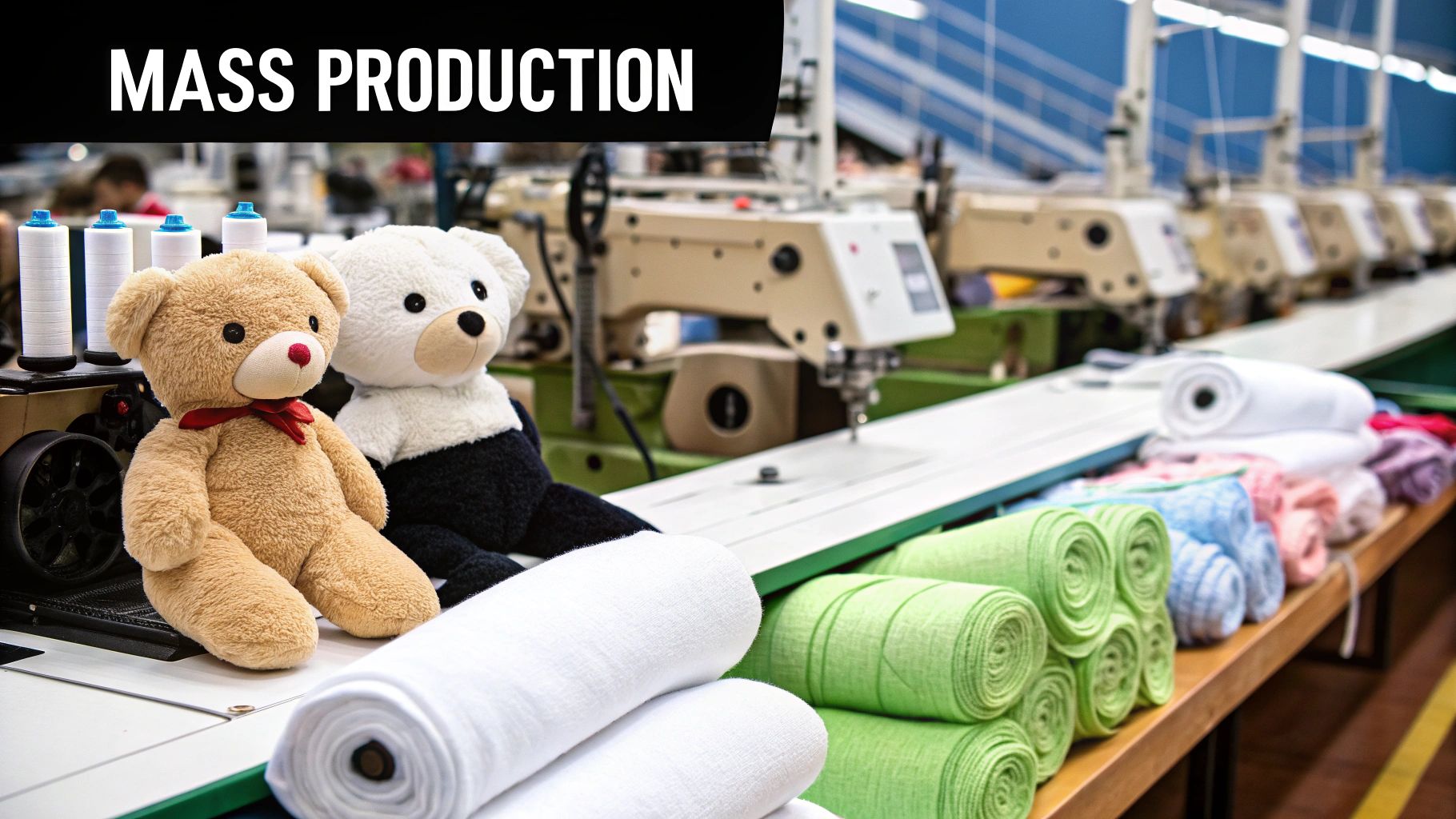
Once the final prototype is approved, our operations shift from the artisanal craft of a single sample to the orchestrated efficiency of the production line. This is where your vision scales, as we prepare to replicate your approved sample into hundreds or thousands of identical, high-quality units.
At this stage, precision and consistency are paramount. The creative phase is complete; our focus now is on flawlessly executing the approved design to ensure the last unit is identical to the first.
The Production Workflow
Upon receiving your approval, we create a Production Specification Sheet. This master blueprint contains every detail from the prototype—fabric Pantone codes, embroidery stitch counts, precise stuffing weights—for our production team.
The production workflow proceeds as follows:
- Material Procurement: We place bulk orders for all specified fabrics, threads, accessories, and stuffing from our network of trusted, audited suppliers who provide material safety certifications.
- Die Cutting: The soft patterns from prototyping are converted into steel-rule dies. These are used with hydraulic presses to cut hundreds of fabric layers simultaneously, ensuring absolute uniformity.
- Embroidery and Printing: All detailing is done while the fabric pieces are flat. This is far more efficient and yields higher quality results than attempting to embroider or print on a finished 3D toy.
- Assembly Line Sewing: Our sewing teams are organized into specialized stations. One group may only sew ears, another attaches limbs, and a third closes final seams. This division of labour increases speed and maintains consistency.
- Stuffing and Shaping: Each plush is filled with a precise weight of stuffing using a blowing machine for even density. Skilled workers then hand-shape each unit to match the approved prototype.
- Finishing and QC: The final seam is hand-sewn closed. Each toy is then air-cleaned to remove loose fibers, and a final quality inspection ensures it meets all specifications.
Materials and Filling: The Core Components
Your choice of materials directly impacts the final look, feel, and cost of your custom animal plush.
- Outer Fabric: The most common choices are Velboa, a durable, low-pile, and cost-effective fabric ideal for standard toys, and Minky, a premium fabric known for its ultra-soft texture and slightly longer pile, which adds perceived value at a higher cost.
- Filling: The industry standard is Polypropylene (PP) Cotton, a hypoallergenic, lightweight, and machine-washable synthetic polyester fiber. It provides a soft, huggable feel, maintains its shape well, and complies with all international safety standards like EN71 and ASTM F963.
OEM vs. ODM: Choosing the Right Partnership
Understanding the difference between OEM and ODM is key to selecting the right manufacturing path for your brand.
| Model | Your Role | Our Role | Best For |
|---|---|---|---|
| OEM (Original Equipment Manufacturer) | Provide a complete, original design (tech pack). | Manufacture your exclusive design exactly to your specifications. | Brands with strong intellectual property and a clear creative vision. |
| ODM (Original Design Manufacturer) | Choose from our catalogue of existing designs. | Customize our design with your branding (logo, tags, colours). | Businesses needing a proven product that can be brought to market quickly. |
Manufacturer’s Insight: The majority of our clients engage us for OEM projects. They provide a unique character design, and our role is to execute their vision. ODM is better suited for brands that lack in-house design resources but want a unique product.
For a deeper dive, review our OEM and ODM plush toy project capabilities.
Understanding Minimum Order Quantity (MOQ)
The Minimum Order Quantity (MOQ) is a fundamental aspect of mass production. For most custom plush designs, the MOQ is typically 500 to 1,000 units. This is not an arbitrary number; it is dictated by the economics of manufacturing.
Fabric suppliers have their own minimums for custom-dyeing materials to your specified Pantone colours. The setup costs for cutting dies and embroidery machine programming are also significant. Spreading these fixed costs across a larger production run is what makes the per-unit price commercially viable for your business.
Managing Production Costs: A Buyer’s Guide
A primary concern for any buyer is the final cost. The unit price of your custom plush is not a single figure but the sum of numerous design and production decisions. The key is to balance size, complexity, material choices, and order quantity.
The plush toy market is experiencing significant growth. The Asia-Pacific region is projected to contribute about 30% of market growth between 2024 and 2029, according to a Technavio’s report on the global stuffed animal toys market. Understanding the factors that drive cost will enable you to compete effectively in this expanding market.
Key Factors Influencing Unit Cost
Every decision, from fabric choice to design complexity, impacts the final quote. The table below outlines the primary cost drivers from a manufacturer’s perspective.
Key Factors Influencing Custom Plush Toy Costs
A comparative look at how different product specifications directly impact the final unit price, helping buyers make informed budget decisions.
| Cost Factor | Lower Cost Option | Higher Cost Option | Manufacturer’s Insight |
|---|---|---|---|
| Size & Complexity | Simple, smaller shapes (under 20cm) with fewer pattern pieces. | Large, complex designs with many separate parts (wings, tails, clothes). | The number of unique pattern pieces directly correlates to labor costs for cutting and sewing. Simplifying a design is the most effective way to reduce price. |
| Material Choice | Standard Velboa or similar short-pile fabrics in stock colours. | Premium Minky, custom-dyed fabrics, or multiple fabric types on one toy. | Custom-dyeing fabric requires a large minimum order from the mill. Utilizing our existing stock colours eliminates this cost and potential waste. |
| Facial Details | High-quality screen printing or heat transfer for intricate details. | Multi-layered, dense embroidery for logos and facial features. | Embroidery is priced by stitch count. A 10,000-stitch design costs significantly more than a 3,000-stitch one. Printing is an excellent alternative for complex graphics. |
| Order Quantity (MOQ) | Higher volume orders (e.g., 2,000+ units). | Minimum order quantity (e.g., 500 units). | Fixed setup costs (e.g., creating cutting dies) are amortized across the entire order. A larger order results in a lower cost per unit. |
This breakdown helps identify strategic trade-offs. A cost-saving change in one area can free up the budget for a premium feature elsewhere.
Practical Tips to Reduce Cost
Budget management is about making intelligent design and production choices, not sacrificing quality.
- Simplify Your Design: Analyze your character. Can the arms be integrated into the main body pattern instead of being attached separately? This single change reduces cutting and sewing time, directly lowering labor costs.
- Increase Order Volume: Moving from 500 units to 1,000 can often result in a 10-15% reduction in unit price as setup costs are distributed over more items.
- Optimize Detailing: For intricate facial expressions or logos, consider screen printing instead of embroidery. It provides a sharp, clean look at a fraction of the cost, especially for complex graphics.
- Choose Standard Materials: Ask us about our in-stock fabrics and colours. Using existing inventory avoids the costs and minimums associated with custom material production.
Manufacturer’s Insight: For a complex, multi-coloured logo on a small plush, we often recommend a high-quality woven label. We stitch the label onto the plush, achieving a professional look for a fraction of the cost of direct embroidery.
Proactive communication about your budget goals allows us to recommend clever, cost-effective solutions to bring your design to life.
Quality Control and Safety Compliance
For any reputable manufacturer, quality and safety are integrated into every stage of the production process. A well-designed plush is worthless if it is poorly constructed or unsafe. This is a non-negotiable principle.
For brands, compromising on quality by choosing a low-cost, low-quality factory is a significant risk. This can lead to failed safety tests, expensive product recalls, and irreparable damage to your brand’s reputation.
Our Multi-Stage Quality Inspection Process
Quality control is a continuous process, not a final check. We implement inspections at every critical stage of production.
- Raw Material Inspection: Before production begins, all incoming fabrics are inspected for colour accuracy against Pantone standards, weaving defects, and correct weight and texture.
- In-Process Inspection: Line supervisors conduct random checks during sewing to ensure seam strength, stitch consistency, and correct alignment of features like embroidery. This allows us to correct minor deviations before they are replicated across hundreds of units.
- Stuffing and Weighing: Every plush is weighed after sewing to ensure it receives the precise amount of filling. This guarantees a consistent feel and prevents products from being too firm or too limp.
- Final Inspection: Every single finished plush undergoes a 100% visual inspection. Our QC team checks for open seams, loose threads, and overall shape, comparing each unit against the approved “golden sample” to ensure consistency.
A common defect we screen for is an “open seam”—a small gap in the stitching, often where a limb joins the body. It requires a trained eye and a manual pull test on every major seam of every plush to be detected.
Navigating International Safety Standards
Compliance with international safety standards is the most critical part of the process. The two primary certifications are EN71 (for the EU) and ASTM F963 (for the US). These are legal requirements.
Key Tests for EN71 and ASTM F963
These standards cover a range of potential hazards, with a focus on several key areas for plush toys:
- Physical and Mechanical Tests: We test for any sharp points or edges on components like plastic eyes. We also perform “pull tests” on appendages (ears, tails) to ensure they cannot be detached by a child, creating a choking hazard. This is mandatory for all custom wholesale plush animals.
- Flammability Testing: A sample of the material is exposed to a flame to measure the rate of spread. To pass, the fabric must self-extinguish within a specified time, ensuring it is not a fire risk.
- Chemical and Heavy Metal Analysis: Samples of all components—fabric, thread, stuffing, and accessories—are sent to an accredited third-party laboratory. They test for hazardous substances like lead, phthalates, and cadmium to ensure they are well below legal limits.
Partnering with a manufacturer who is an expert in these standards is essential for protecting your customers and your business.
Packaging and Logistics
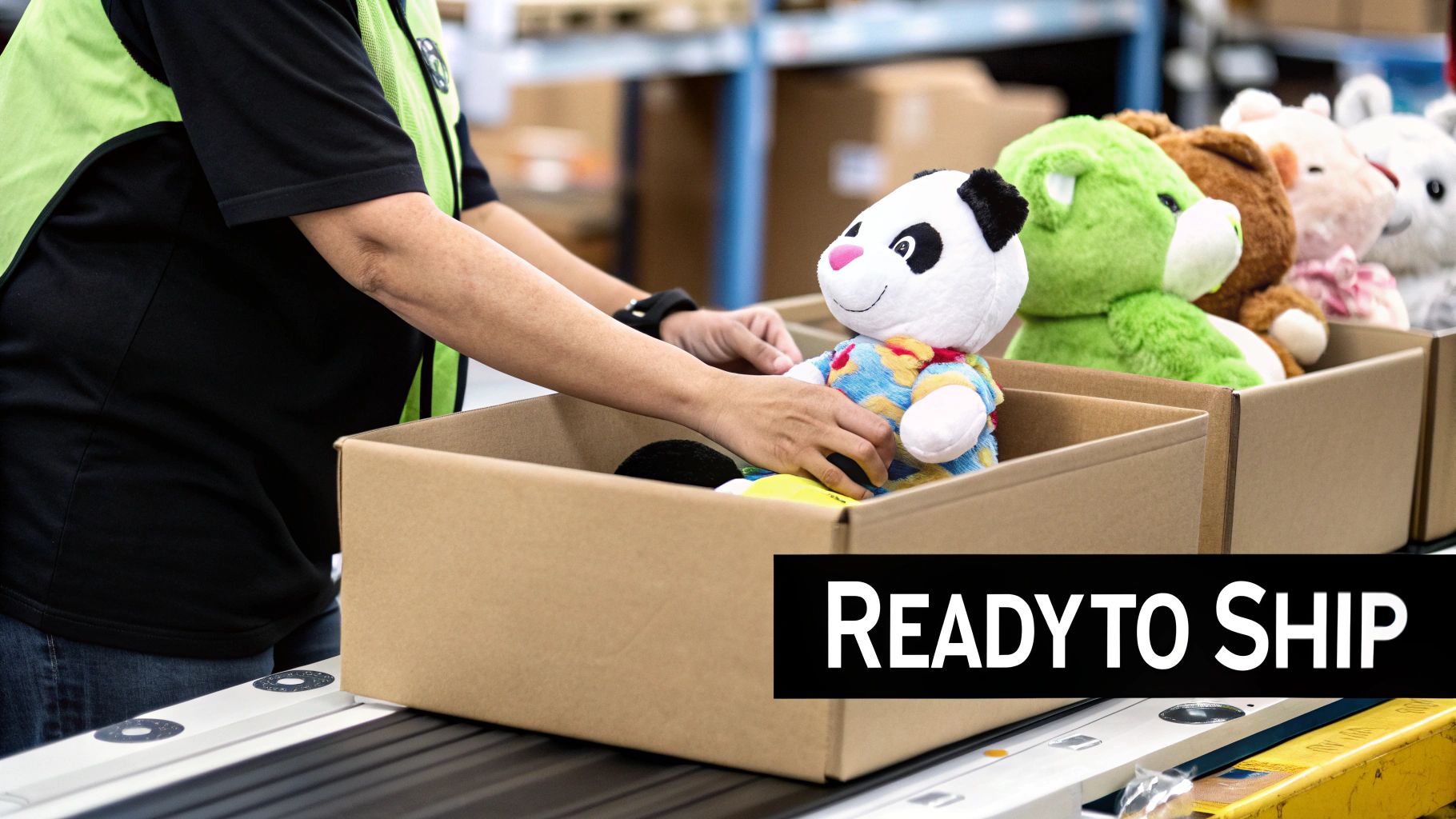
The final stage of the manufacturing journey is packaging and shipping. This is the last touchpoint from our factory and the first impression for your customer. Effective packaging protects your product, while smart logistics ensure timely and cost-effective delivery.
Let’s review the options to find the optimal balance of protection, branding, and cost.
Packaging and Branding Options
- Standard Polybags: The default option. Sealing each plush in a clear polybag is the most economical way to protect it from dust and moisture during transit. This is a practical, no-frills solution.
- Custom-Printed Boxes: For a retail-ready, premium experience, a branded box is the ideal choice. It elevates the perceived value and creates a better unboxing experience but adds to the unit cost and shipping volume.
- Branding Elements: Details like woven labels with your logo stitched into a seam and custom-printed hang tags attached with a plastic barb add a professional finish. Hang tags are also useful for displaying product information and barcodes.
Navigating Shipping and Freight
Understanding shipping terms (Incoterms) is crucial for managing your budget and responsibilities. The most common terms are EXW and FOB.
A Quick Tip from the Factory Floor: For most new clients, we recommend FOB (Free On Board). Under FOB terms, we manage all logistics within China, including transport to the port, export customs clearance, and loading the goods onto the vessel. Your responsibility begins only after the shipment is on board, which greatly simplifies the process.
EXW (Ex Works) means your responsibility begins at our factory door. You must arrange for pickup, export clearance, and ocean freight, which requires significant logistical expertise in China.
Finally, you must choose between sea and air freight.
- Sea Freight: The industry standard for bulk orders. It is far more cost-effective than air but requires a longer transit time, typically 30-45 days to major ports in North America or Europe.
- Air Freight: The fastest option, with delivery in 7-10 days. However, the cost can be 5 to 10 times higher than sea freight. It is suitable only for urgent deadlines or small, high-value shipments.
Making informed decisions on packaging and logistics ensures your custom animal plush arrives safely, on time, and ready to impress your customers.
Ready to turn your idea for a custom animal plush into a real, high-quality product? The team at FunEnjoy PlushToys has spent decades helping brands worldwide create safe, memorable, and beautifully crafted plush toys.