As manufacturers operating from the heart of China’s toy industry, we see the Classic Sonic Plush not just as a toy, but as a consistent commercial asset. For B2B buyers, understanding the intricate production process of Classic Sonic Plush is the key to unlocking its market potential. This guide offers a manufacturer’s perspective on transforming a design concept into a high-quality, globally compliant product.
Market Overview: Why Classic Sonic Plush Remains a B2B Best-Seller
The demand for licensed character plush, particularly icons like Classic Sonic Plush, is not a fleeting trend; it is a stable pillar of the toy industry. The character’s multi-generational appeal creates a reliable commercial opportunity for retailers, promotional agencies, and merchandise brands. The primary buyers are not only children but also Millennial and Gen Z adults who grew up with the character, purchasing for their own collections or for the next generation.
This nostalgia is a powerful economic driver. According to market data, China’s stuffed and plush toys market reached USD 976.3 million in 2023, with cartoon characters being the fastest-growing segment. This growth is fueled by younger demographics: 43% of plush purchases were made by consumers born after 2000, with another 36% from those born in the 90s. While traditional stuffed animals hold a large market share, cartoon-based toys are projected to see the highest growth, with an 8.5% compound annual growth rate through 2030. You can review more data in the China market outlook from GrandView Research.
Benefits for B2B Buyers
For B2B buyers, a classic Sonic plush is a strategic product. However, successful execution requires a deep understanding of several complex domains:
- Intellectual Property (IP) Licensing: Adherence to SEGA’s brand guidelines is non-negotiable for legal compliance and product authenticity.
- Material Science: Fabric choices, from soft Minky to durable Velboa, directly influence the product’s tactile quality, aesthetics, and unit cost.
- Global Safety Compliance: Meeting international standards like EN71 (Europe) and ASTM F963 (USA) is mandatory for market access and consumer safety.
This guide provides an inside look at the manufacturing workflow, from initial design to final shipment.
The Manufacturing Process: From Design to Mass Production
The journey of a classic Sonic plush begins with a 2D design file, which serves as the technical blueprint. Our first task is to translate this flat concept into a three-dimensional physical prototype, a critical stage where the character takes tangible form.
Step 1: Prototyping and Sampling
The process begins with our pattern makers, who deconstruct the 2D design into precise fabric patterns for Sonic’s head, quills, body, and limbs. Accuracy at this stage is paramount; a deviation of even a few millimeters can compromise the final proportions.
This initial sampling stage typically requires 5 to 10 working days. This timeline allows for meticulous hand-stitching and iterative adjustments based on client feedback.
Material Selection (Types)
The choice of material is a balance of tactile feel, appearance, durability, and cost.
- Soft Minky (Crystal Super Soft): This is the industry standard for high-end retail plush. Its short, dense pile provides a velvety softness that enhances perceived value, making it ideal for Sonic’s main body.
- Velboa: A durable, short-pile fabric, Velboa is a cost-effective alternative often used for promotional toys or products designed for heavy use. It sacrifices some of the luxurious feel of Minky for resilience.
- Felt: Reserved for small, decorative details like eye irises or shoe buckles. Its stiffness and non-woven structure are suitable for appliqués but not for the main body.
Once the material is cut, our most experienced sewing technicians assemble the first prototype. Simultaneously, Sonic’s facial features are rendered using high-precision embroidery machines. A physical sample is then sent to the client for review. Clear, consolidated feedback is crucial to maintaining the project timeline. For B2B buyers preparing their initial concept, our guide on how to design your own plush toy offers practical advice.
Step 2: Mass Production Workflow
With prototype approval, we transition to mass production, a process typically completed within 20-30 days.
- Automated Cutting: Approved digital patterns are fed into automated cutting machines that slice through hundreds of fabric layers with precision, ensuring uniformity across the entire production run.
- Computerized Embroidery: Sonic’s facial expressions are programmed into multi-head embroidery machines, ensuring consistent and accurate stitching on every unit.
- Assembly Line Sewing: The cut pieces move to specialized sewing teams. One team handles small components (ears, limbs), while another assembles the main body. This division of labor enhances both speed and quality.
- Stuffing and Closing: The empty plush “skins” are filled with PP cotton using blowing machines to achieve a consistent firmness. The opening is then closed with a hidden stitch, making the seam invisible.
OEM vs. ODM Manufacturing
It is vital for buyers to understand the two primary manufacturing models:
- OEM (Original Equipment Manufacturer): The most common model for licensed products. The client provides a complete tech pack with all specifications. Our role is to execute the manufacturing exactly as specified.
- ODM (Original Design Manufacturer): The client provides a concept, and our in-house team collaborates on design, material selection, and prototyping. This is ideal for creating original characters to complement an existing product line.
Our experience with both models is showcased in our portfolio of stuffed toy projects.
Pricing Factors and Cost Control
Understanding the cost structure of Classic Sonic Plush is essential for budget planning. The final per-unit price is a direct result of material choices, size, complexity, and order quantity.
What Impacts Cost?
- Materials & Filling: Premium Minky fabric costs more than standard Velboa. The volume of PP cotton required is determined by the plush’s size and density.
- Size and Complexity: A larger plush requires more materials and labor. A complex design with numerous individual parts, intricate stitching for Sonic’s quills, and detailed embroidery demands more skilled labor, increasing the cost.
- Order Quantity: This is the most significant factor. Larger orders benefit from economies of scale, as the fixed costs of pattern making and machine setup are distributed over more units, drastically reducing the per-unit price.
MOQ (Minimum Order Quantity)
Our typical MOQ for a custom classic Sonic plush ranges from 100 to 500 pieces. This threshold is necessary to run our production lines efficiently and secure favorable pricing on raw materials. A 100-300 piece order is suitable for market testing, while orders of 500+ units achieve the most competitive pricing.
Tips to Reduce Cost
- Simplify Details: Consider high-quality printing for smaller details instead of embroidery. Reducing the number of individual fabric pieces can also lower labor costs.
- Adjust Size: A small reduction in height (e.g., 2-3 cm) can lead to significant savings in fabric and stuffing across a large order.
- Optimize Materials: For promotional items, substituting premium Minky with a high-quality Velboa is a practical way to reduce costs without a major impact on visual appeal.
Open communication about your budget allows us to engineer a product that meets your quality standards and financial targets.
Quality Control and Safety Standards
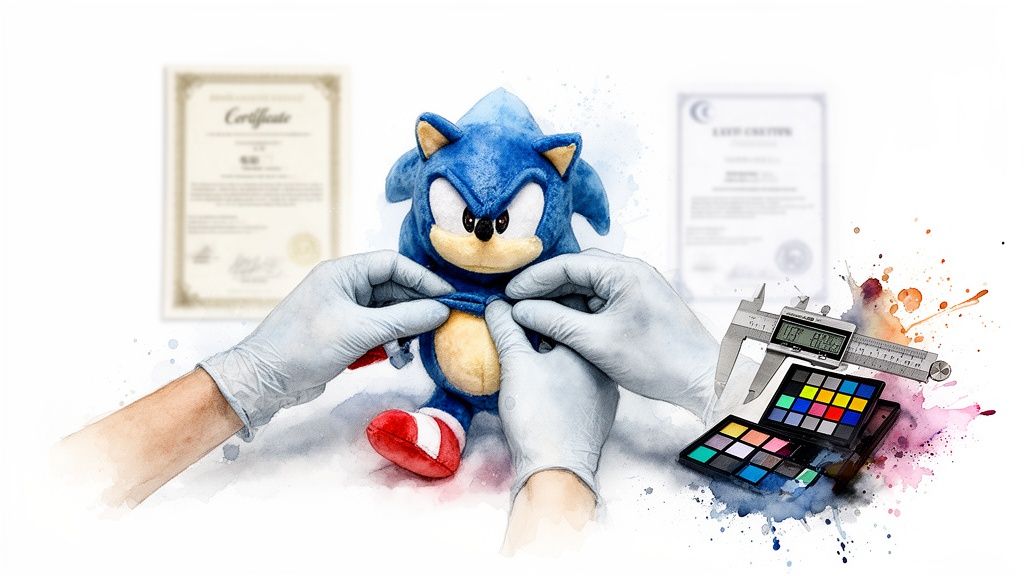
Ensuring every classic Sonic plush is safe and durable is our highest priority. A robust quality control system is integrated throughout our entire production workflow to mitigate risks and protect your brand. Low-quality factories often cut corners here, leading to product recalls that can destroy a brand’s reputation.
Quality Inspection Steps
- Raw Material Inspection: All incoming fabrics are checked for color consistency against Pantone codes, defects, and texture. PP cotton filling is verified to be 100% new and contaminant-free.
- In-Process Quality Control (IPQC): Supervisors on the factory floor conduct continuous spot checks on stitching, embroidery precision, and component attachment strength.
- Metal Detection: Every stuffed plush passes through a calibrated metal detector to ensure no broken needle tips or metal fragments are present. This is a critical safety step.
- Final Product Audit: A dedicated QA team performs a final inspection on a sample size determined by the AQL (Acceptable Quality Level) standard, checking for appearance, seam strength, cleanliness, and correct labeling.
Safety Standards (EN71/ASTM)
Compliance with international safety standards is mandatory for market access. The primary standards for plush toys are EN71 (Europe) and ASTM F963 (USA).
- Physical & Mechanical Tests (EN71-1 / ASTM F963): Technicians apply specific force to components like ears and limbs to ensure no small parts detach and become choking hazards.
- Flammability Test (EN71-2 / ASTM F963): Fabric is exposed to a flame to test its rate of combustion. It must self-extinguish or burn slowly.
- Chemical & Heavy Metal Analysis (EN71-3 / ASTM F963): Dyes and other materials are analyzed for toxic elements like lead and mercury to ensure the product is non-toxic.
We manage the entire third-party lab testing and certification process, providing you with the necessary documentation for legal market entry.
Logistics: From Factory to Warehouse
Once production and final inspections are complete, we manage the logistics of shipping your order from China.
For large B2B orders, sea freight is the most cost-effective method. Products are packed into master cartons and loaded into a shipping container. Transit time to US or European ports is typically 30-45 days. We handle all Chinese export documentation.
For time-sensitive orders, air freight is available at a significantly higher cost.
Buyers must arrange for a customs broker in their own country to handle import duties, taxes, and final delivery from the port to their warehouse. Coordinating this early is crucial for a smooth delivery process.
How to Choose a Supplier
Selecting the right manufacturing partner is the most critical decision in your project. A low-cost quote is often a red flag, indicating compromises on materials, labor ethics, or safety.
B2B Buyer-Focused Insights
- Common Problems Buyers Face: Buyers often encounter communication barriers, unexpected delays, and quality inconsistencies when working with inexperienced factories.
- Risk of Low-Quality Factories: The biggest risk is a product recall due to safety failures, which can lead to legal action and irreversible brand damage.
- How Brands Choose a Supplier: Experienced brands vet suppliers based on their IP experience, social compliance audits (BSCI/ICTI), and expertise in global safety standards, not just price.
Key Vetting Criteria
- Proven IP Experience: Request to see their portfolio of other licensed characters they have produced.
- Transparent Communication: Ensure your point of contact is fluent in your language and responds promptly.
- Verifiable Certifications: Ask for copies of their ICTI or BSCI audit reports to verify ethical practices.
- Safety Standard Expertise: They should demonstrate a thorough understanding of EN71 and ASTM F963.
The right partner acts as a consultant, guiding you through material selection, cost optimization, and regulatory compliance. For more insights, our guide on the top stuffed animal companies offers additional advice.
Why FunEnjoy is a Trusted Manufacturer
At FunEnjoy PlushToys, we build partnerships on transparency, expertise, and a commitment to quality. We understand the nuances of producing licensed characters like the classic Sonic plush and guide our B2B clients through every step of the process. Our robust quality control systems, deep knowledge of international safety standards, and ethical manufacturing practices ensure your product is not only well-made but also safe and compliant for any market in the world.
If you are ready to begin your custom plush project or have further questions, our team is prepared to provide the expert guidance you need. Visit us at https://funenjoytoys.com to learn how we can bring your vision to life.