Welcome to the world of plush manufacturing! As a dedicated factory, we at Funenjoy want to pull back the curtain on what it really takes to order bulk stuffed animals for your business. Think of this guide as your complete roadmap, covering everything from that first spark of an idea to the final delivery, so you feel confident every step of the way.
Your Guide To Sourcing Bulk Stuffed Animals
If you’re a retailer, brand manager, or marketing agency, learning how to source plush toys directly from a manufacturer can be a total game-changer. It’s so much more than just placing an order; it’s about forming a partnership to bring your creative vision to life. Here at Funenjoy, we’ve spent decades turning simple sketches and big ideas into high-quality, safe, and incredibly huggable products for brands all over the world.
This guide will walk you through that entire journey. We’ll be your insider on the factory floor, sharing practical tips and breaking down the key stages of production. Let’s cover the essentials you absolutely need to know.
What You Will Learn
From our perspective as manufacturers, the best projects always happen when our clients are well-informed. We believe in total transparency, and this guide is designed to give you that clarity.
You’ll get a solid handle on:
- The OEM Process: How we take your unique design and turn it into a physical prototype that’s ready for mass production.
- Materials and Safety: A look at the different fabrics and fillings we use, and why meeting global safety standards like EN71 and ASTM is completely non-negotiable.
- MOQ and Production: What a Minimum Order Quantity (MOQ) actually means and how it affects your project’s budget and viability.
- Factory Insights: Real production tips that can help save you time and money while making sure your final product is top-notch.
The market for plush toys is buzzing and continues to grow. To put it in perspective, the China stuffed and plush toys market generated around USD 976.3 million in revenue, with bulk stuffed animals making up a massive 35.95% of that. Projections show this market could nearly double by 2030, which highlights the incredible opportunity waiting for businesses like yours.
Our goal is simple: to give you the knowledge you need to navigate the sourcing process like a pro. We’ll share insights that help you make smart decisions, whether you’re creating a one-off promotional item or launching a full retail line. For a closer look at our offerings, check out our guide on wholesale plush animals.
Let’s start this journey of creating something wonderful together.
Bringing Your Custom Plush Toy to Life with OEM
Alright, let’s step onto the factory floor. When you decide to create a plush toy that’s 100% unique to your brand, you’re diving into the world of OEM, or Original Equipment Manufacturing.
Think of us as your personal workshop. OEM is the hands-on process where we take your specific design—your character, your mascot, your one-of-a-kind idea—and turn it into a real, huggable product. It’s where the magic really happens.
The whole journey kicks off with your vision. To get the ball rolling, you’ll need to send over a design file. This can be anything from a detailed 2D sketch showing the front, back, and side views, to a full-blown 3D model. The more detail you can pack in upfront, the better. Things like specific colour shades (Pantone codes are a lifesaver here!), dimensions, and any special touches like embroidery or tiny clothing will help us nail the prototype on the first try.
Choosing the Right Materials
With your design in hand, the next big decision is materials. This choice is massive—it affects how the toy looks, feels, and ultimately, what it costs. It’s like a chef picking out ingredients; the quality of what goes in absolutely defines the final dish.
We’ll walk you through all the options, but here’s a quick rundown of the fabrics we work with every day:
- Soft Plush Fabric: This is the classic stuff. Think of your favourite childhood teddy bear—that super-soft, cuddly material. It’s perfect for creating that warm, comforting feel.
- Velboa: This fabric has a shorter pile, making it sleek and really durable. It’s a great choice for toys that will see a lot of handling, like promotional giveaways or brand mascots.
- Minky Fabric: If you want to add a touch of luxury, Minky is the way to go. It’s known for its incredibly silky, ultra-soft texture that just feels premium.
- Fillings: The industry standard is PP cotton (polypropylene). It’s lightweight, hypoallergenic, and gives that wonderful, squishy feel everyone loves. We only use fillings that meet strict safety standards for cleanliness and resilience.
The Prototyping and Refinement Stage
Once we’ve locked in the design and materials, our skilled artisans get to work creating the very first physical sample, the prototype. This is the moment your idea finally takes shape, and it’s a really exciting part of the process.
We’ll ship this prototype to you for review, and this is where we need you to be picky! Your honest feedback is crucial. Is the stitching just right? Is the expression on its face perfect? Does it feel the way you imagined?
A bit of back-and-forth here is totally normal and, frankly, essential. You might have notes, and we’ll revise the sample based on your feedback. Sometimes we get it perfect on the first go; other times it might take two or three tries. We’ll keep tweaking it until you’re holding the sample in your hands and can say, “Yes, this is it.”
That approved sample becomes our “master sample,” the gold standard we use to make sure every single toy in the full production run is an exact match.
This diagram breaks down the journey from your initial spark of an idea all the way to the finished product leaving our factory doors.
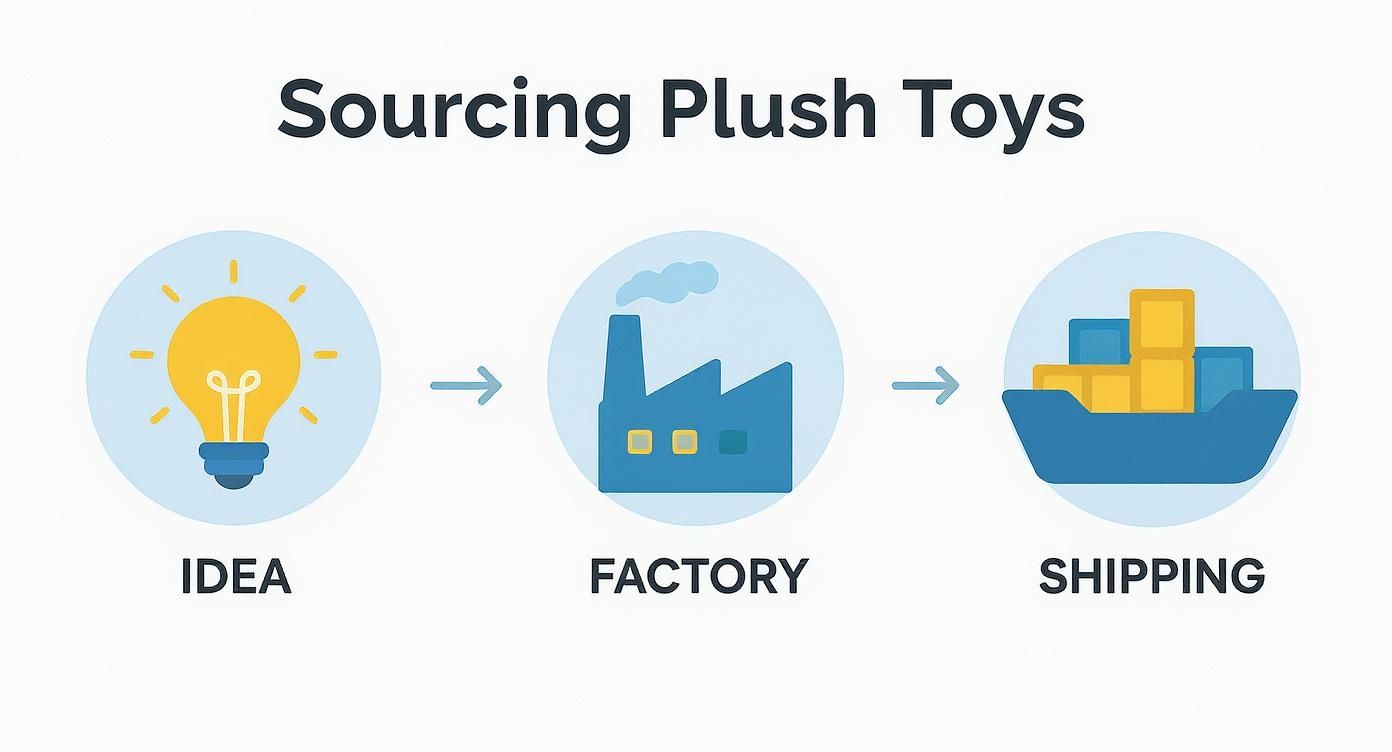
As you can see, it’s a straightforward path where your concept is brought to life through our expertise before being shipped out into the world.
Factory Tip: When you give feedback on a prototype, get specific! Instead of saying “the head looks too big,” try something like, “let’s reduce the head diameter by 10%.” Precise feedback like this helps us make the right adjustments quickly and keeps your project on schedule.
The OEM route gives you total creative control over your product. For any brand wanting to create something truly their own, it’s the only way to go. You can see how we’ve helped others by checking out some of our past OEM and ODM plush toy projects.
Once your prototype gets the final sign-off, we’re ready to jump into the next exciting phase: calculating the costs for your full production run.
Getting to Grips with MOQs and Production Costs
Alright, your prototype is signed off and looks fantastic. Now it’s time to talk numbers. When it comes to ordering bulk stuffed animals, everything really boils down to two things: the Minimum Order Quantity (MOQ) and what each plushie will cost to make. Here at Funenjoy, we like to be completely upfront about this stuff—it’s the only way to plan your budget properly and make sure your project is a runaway success.
One of the first questions we always get is, “Why do you have an MOQ?” It’s a great question, and the answer isn’t just some arbitrary number we pull out of a hat. It’s all about the practicalities of the manufacturing process and our supply chain.
Think of it this way: a baker wouldn’t fire up their entire industrial kitchen just to bake a single, custom-decorated cupcake. It just wouldn’t make sense. We face a similar situation. We have to buy materials like fabric and PP cotton filling in huge rolls and bales from our own suppliers. Setting up the machinery for your specific design—the fabric cutters, the sewing lines, the embroidery machines—also takes a fair bit of time and effort. An MOQ simply ensures that the production run is large enough to be efficient, which helps keep the price reasonable for everyone.
What to Expect for Minimum Order Quantities
The MOQ for your plush toy can swing quite a bit depending on how big or complex it is. It’s really a balancing act between the setup costs and the number of units we produce. A straightforward design might have a lower MOQ, whereas something with lots of fiddly bits could require a larger first order.
To give you a general idea, our standard MOQ for most custom plush projects is 500 pieces per design. For smaller or simpler items like keychains, this might be slightly higher to make the production run viable.
We always try to be as flexible as we can. For certain designs, especially for new clients looking to test a product, we’ve been able to get the MOQ as low as 100–300 pieces. The best thing to do is just have a chat with us about what you need.
What’s Inside a Plush Toy’s Price Tag?
Understanding a price quote is a lot easier when you know exactly what you’re paying for. The final cost of your bulk stuffed animals isn’t just one number; it’s a combination of several key things that all contribute to a safe, high-quality toy.
Let’s break down the main cost drivers.
First up are the materials. This is the most direct cost. The type of fabric you choose (a standard velboa versus a premium minky, for example), how much PP cotton fill is needed, and any extra accessories like plastic eyes or printed t-shirts all affect the final price. Naturally, more complicated designs with lots of different colours or detailed embroidery will take more time to assemble, pushing up the labour cost for each unit.
Another huge piece of the puzzle is safety testing. We’re serious about making sure every single toy meets strict international safety standards like EN71 for Europe and ASTM F963 for the USA. The cost of getting that certification is built into the overall budget. Finally, you have packaging and logistics—this covers everything from the simple poly bag each toy comes in to custom-printed gift boxes and the master cartons we use for shipping. When you understand these moving parts, we can have a much more productive conversation about how to tweak a design to fit your budget, without ever compromising on quality or safety.
The sheer scale of manufacturing in China is what makes this all possible. With the country’s broader toy market projected to hit around USD 2.85 billion, it stands as a global powerhouse in the industry. This incredible infrastructure is what allows buyers to source a massive variety of bulk stuffed animal products so efficiently. You can learn more about what’s happening in China’s dynamic toy market trends.
Navigating Global Toy Safety Standards
When you’re bringing a custom plush toy to life, especially one for kids, safety isn’t just another box to tick. It’s the entire foundation. At Funenjoy, we live and breathe this philosophy. Before a single one of your bulk stuffed animals even thinks about leaving our facility, it has to go through a gauntlet of tests to make sure it’s 100% safe for its final home, whether that’s a boutique in Paris or a big-box store in Philadelphia.
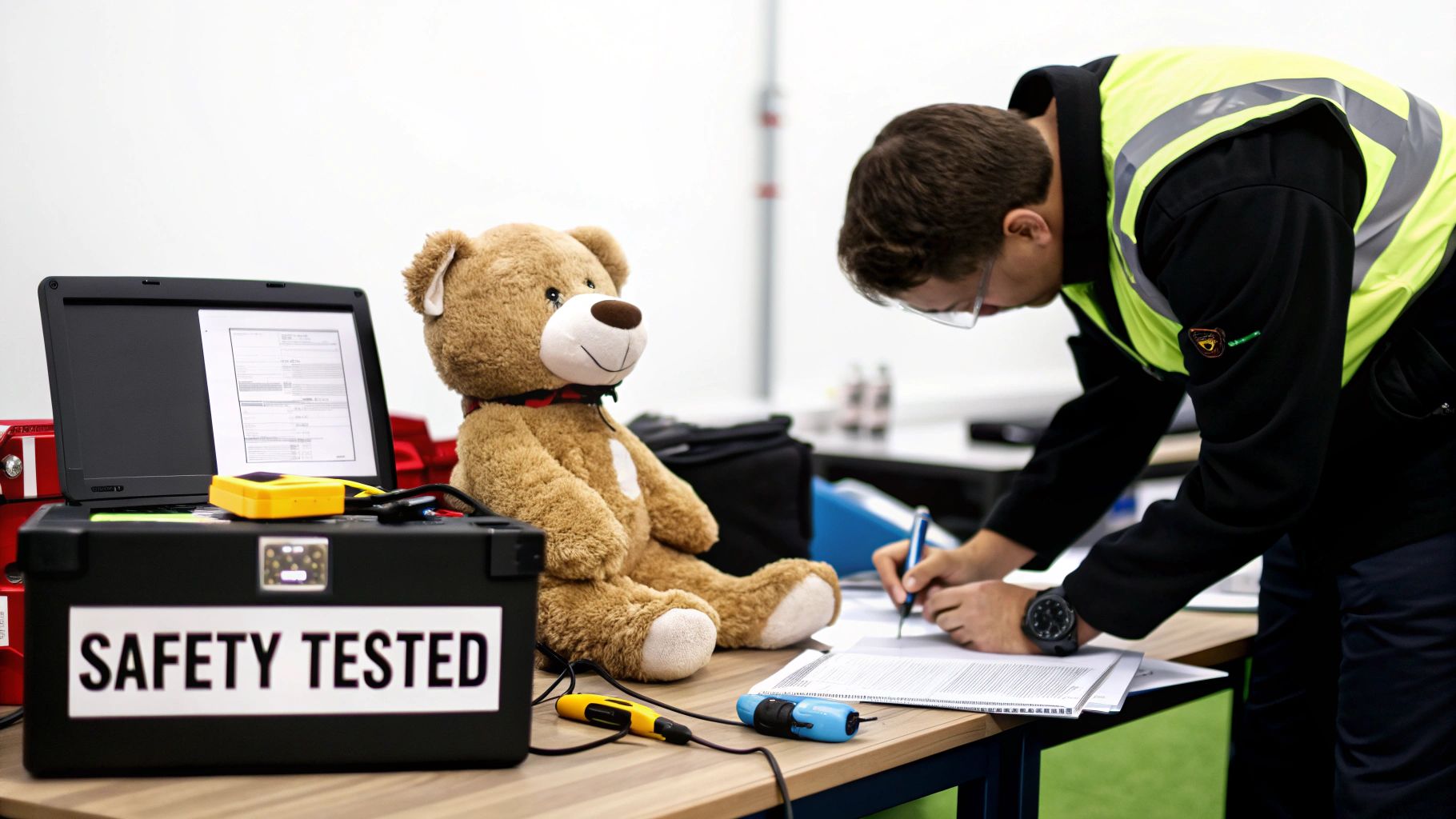
Getting to grips with the major international safety standards is one of the most important things you can do as a brand. Think of it as your promise to your customers that the products you’re selling are not just well-made, but also completely responsible. Let’s break down the two big ones you absolutely need to know.
The Two Pillars of Plush Toy Safety
While there are lots of local rules out there, two standards have become the global benchmarks for toy safety. If your plushies pass these, you’re good to go in the world’s largest consumer markets.
- EN71 (Europe): This is the gold standard across the EU. It’s a seriously comprehensive set of rules covering everything you can imagine, from a toy’s physical strength to the chemicals used in its dyes. To sell a plush toy in Europe, it must carry a CE mark, which is the official signal that it meets EN71 standards.
- ASTM F963 (USA): In the United States, this is the law. Overseen by the Consumer Product Safety Commission (CPSC), ASTM F963 is just as rigorous. Its main focus is on preventing hazards like choking on small parts, injuries from sharp points, and exposure to nasty chemicals.
Meeting these standards is way more than just paperwork. It means putting your plush toys through real, physical stress tests that mimic all the weird and wonderful ways a child might play with them.
From the Factory Floor: We always tell our clients to think of safety testing as an insurance policy for their brand. It’s what protects your customers, your hard-earned reputation, and your entire business from any potential fallout. It’s a non-negotiable part of our promise to you.
What Safety Tests Actually Involve
So, what really happens when a plush toy gets sent off for testing? It’s not a quick glance-over. It’s a scientific process where every component is pushed to its limit to find any potential weakness.
A typical testing protocol looks something like this:
- Physical and Mechanical Tests: We literally try to pull the toy apart. Eyes, ears, and limbs are yanked with a specific amount of force to make certain they won’t pop off and become a choking hazard. Seams are put under stress to ensure they won’t split and spill the stuffing everywhere.
- Flammability Testing: The fabrics and fillings are exposed to a flame to see how quickly (or hopefully, slowly) they burn. The goal is to ensure that if a toy ever did catch fire, a child would have more than enough time to drop it and get to safety.
- Chemical Screening: This is a huge one. We meticulously screen for a whole list of harmful substances. The labs check for heavy metals like lead and mercury, banned phthalates (chemicals sometimes used to soften plastics), and toxic dyes. Every single material, right down to the sewing thread, has to be proven safe.
Our Internal Quality Control Process
Official third-party certification is absolutely essential, but real safety begins long before a toy ever sees a testing lab. Here at Funenjoy, we’ve built a multi-stage quality control (QC) process right into the DNA of our production line.
Our QC checklist is exhaustive and starts from day one:
- Raw Material Inspection: The moment fabrics, threads, and fillings arrive, we’re all over them. We check for any defects, ensure the colours are consistent, and confirm everything is clean and ready.
- In-Production Checks: Our line supervisors are constantly walking the floor, monitoring the sewing, embroidery, and stuffing stages. They’re trained to spot things like a slightly crooked seam, a loose thread, or stuffing that isn’t quite right.
- Final Inspection: Before a single toy is packed, it gets a final, hands-on check. We assess its overall look and feel for any foreign objects hidden inside, and then, just to be extra sure, we run it through a metal detector.
This obsessive focus on quality control means we catch and fix tiny issues before they become big problems. It’s how we make sure that the final batch of your bulk stuffed animals not only meets but truly exceeds global safety standards, ready for a happy home.
Packaging and Shipping Your Finished Order
So, your custom plush toys have passed their final quality checks and look absolutely perfect. Awesome! Now for that final, crucial step: getting them from our factory floor here in China all the way to your warehouse. At Funenjoy, we’ve learned over the years that smart packaging and logistics are just as vital as the toy itself. How your bulk stuffed animals are packed and shipped can make a huge difference to your final costs and delivery timeline.
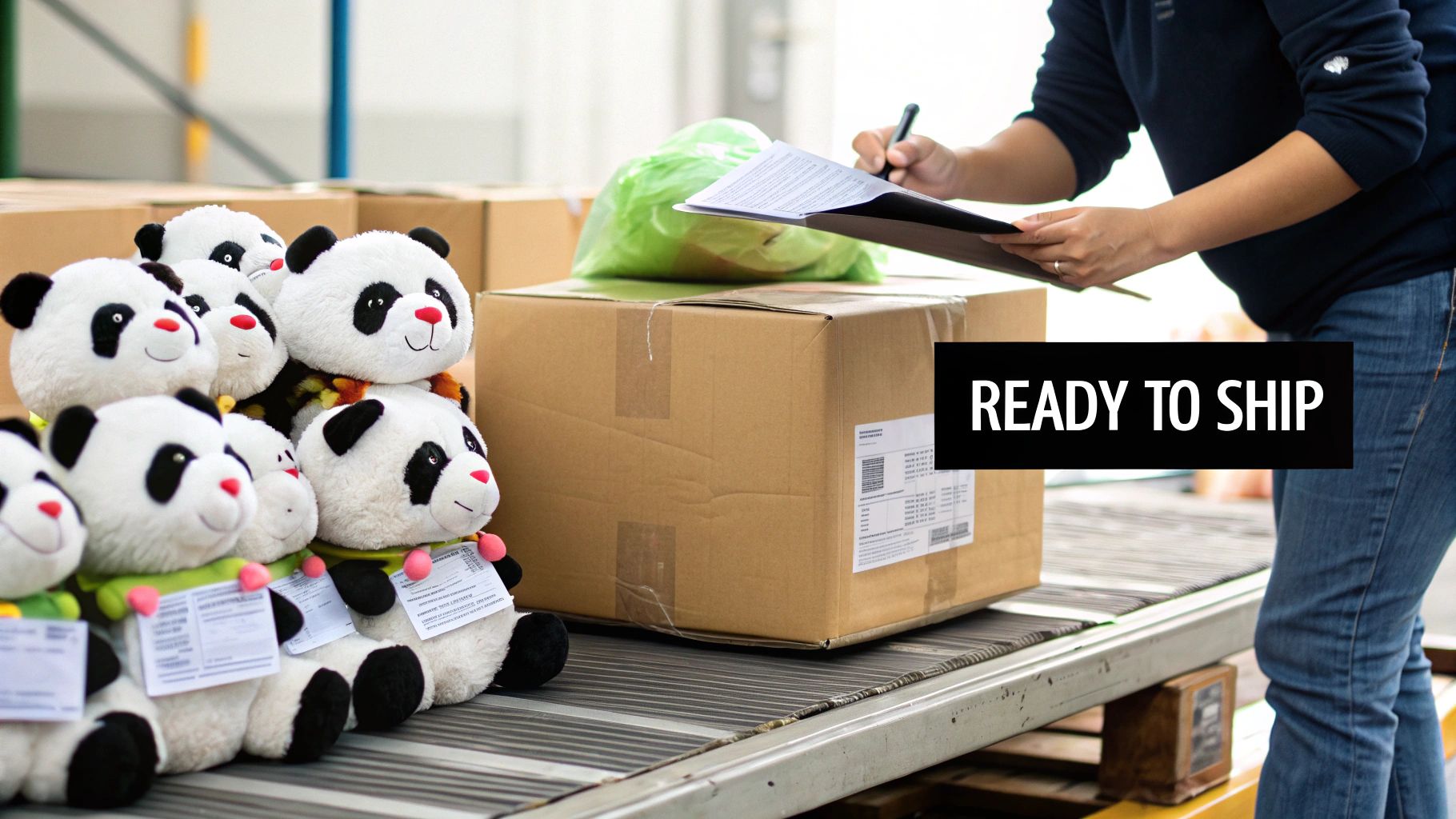
The whole journey really begins with picking the right packaging. It’s a decision that echoes down the line, affecting everything from product safety to your final freight bill.
Selecting the Right Packaging for Your Plush Toys
Your packaging choices are always a balancing act between presentation, protection, and price. For most clients, the go-to standard is a simple, clear poly bag for each individual plush. It’s a straightforward solution that keeps each toy clean and safe from dust and moisture during its long trip.
Of course, if your plush is a premium retail item, you might want something a bit more special. Think custom-printed gift boxes or branded fabric bags. While these options look fantastic on the shelf, it’s important to remember they add weight and volume, which will bump up your shipping costs. We’ll always walk you through the pros and cons to find the sweet spot for your brand and budget.
Factory Tip: For bigger orders, we’re big fans of compression packing. We carefully vacuum-seal the plush toys in master bags before boxing them up, which can shrink their volume by an incredible 30-50%. It’s a simple trick that lets us fit way more units into a single shipping carton—and ultimately, into the container. This can lead to some serious savings on your freight costs.
Mastering Shipping and Logistics
Once your toys are expertly packed and ready to go, it’s time to sort out the shipping. You’ll hear a few industry terms thrown around, but the most important one to get your head around is FOB (Free On Board).
FOB is a really common shipping agreement. It basically means that we, as the factory, are responsible for getting your order to the port (like Shanghai or Ningbo) and loaded onto the ship. Once it’s on board, the responsibility—and the cost of the main sea freight, insurance, customs clearance, and final delivery—is handed over to you.
Here’s a quick rundown of how the shipping process usually plays out:
- Work with a Freight Forwarder: This is your logistics partner, your expert on the ground. They’re the ones who will book space on a cargo ship, handle all the complicated paperwork, and guide your shipment through customs in your home country.
- Customs Clearance: Your freight forwarder takes care of all the documentation needed to get your goods cleared. This means declaring the product type and value correctly so the right duties and taxes are paid.
- Final Delivery: After clearing customs, your forwarder arranges the last leg of the journey, getting the cartons from the port to your warehouse or distribution centre.
The global demand for plush toys just keeps growing, with some stuffed animal market growth trends showing a potential jump from USD 12.65 billion to USD 26.23 billion by 2033. China’s role as a manufacturing hub is at the heart of meeting this demand, which makes getting the shipping right more critical than ever.
Understanding these final steps helps ensure a smooth, predictable delivery, getting your new products into your customers’ hands without any nasty surprises. And if you’re looking for some pre-designed options, you can always check out our selection of custom plush toys ready to ship.
Got Questions About Ordering Bulk Plush Toys?
Jumping into the world of custom manufacturing can feel like a big step, and it’s totally normal to have a lot of questions. As a factory, we’ve pretty much heard them all, and we believe the best partnerships are built on clear, honest answers.
Think of this section as a chat with one of our experienced project managers. We’re pulling back the curtain and using our hands-on factory knowledge to tackle the most common things B2B buyers ask us. Our aim is to make the whole process feel less mysterious so you can move forward with total confidence.
So, What’s the Full Timeline from Start to Finish?
From the moment you say “go!” to the day your custom plushies are ready to ship, a few key things need to happen. A good rule of thumb for a typical custom project is anywhere between 65 and 95 days. I know that might sound like a long time, but great quality and craftsmanship just can’t be rushed.
Here’s what that timeline actually looks like on the factory floor:
- Making the First Sample (5–10 Days): This is where your 2D design becomes a real, physical prototype you can hold. If we need to tweak it a few times to get it perfect, this stage can take a bit longer—which is why sending us super-detailed designs from the get-go is a huge help!
- Full-Scale Production (20–30 Days): Once you give the final prototype your seal of approval, we fire up the production lines. This is the busiest part, involving everything from cutting fabrics and detailed embroidery to sewing, stuffing, and adding those final, charming touches.
- Quality Checks & Packing (3–5 Days): After assembly, every single toy gets a thorough inspection from our quality control team. Only then do we carefully pack them up, ready for their journey.
- The Big Trip: Shipping (25–45 Days): This is often the longest leg of the journey. Sending a container by sea from China to North America or Europe takes time, plus you have to account for customs clearance before the final delivery to your warehouse.
While this is a solid estimate, it’s always smart to build a little wiggle room into your own schedule, especially if you’re aiming for a specific launch date.
How Do Payments Work?
Getting a handle on the payment structure is key to managing your project’s budget. In our industry, the terms are pretty standard across the board. Like most factories, we ask for a 30% deposit to get things started. This initial payment lets us lock in your production slot and order all the raw materials needed for your project.
The final 70% balance is due just before we ship your order. Of course, we won’t ask for that final payment until you’re completely happy. We’ll send you plenty of photos and videos of the finished products for your approval. This two-part system works well because it gives both of us security—we can start production with confidence, and you can be sure you love the result before it leaves our facility.
A Quick Tip from the Factory Floor: We always recommend using a wire transfer (T/T). It’s the most secure and common method for international B2B payments. It creates a clear paper trail for both of us, which keeps the financial side of things smooth and transparent from day one.
How Do You Protect My Design and Ideas?
This is a big one, and we take it very seriously. Your design is your creative property, and protecting it is fundamental to how we do business. We get that you’re trusting us with something valuable, and we’ve built our process around honouring that trust.
The first and most important step is signing a Non-Disclosure Agreement (NDA). We’re more than happy to sign an NDA before you even send us a single sketch. This is a legally binding contract that guarantees your concepts and designs will be kept completely confidential and will never be shared with anyone else or reproduced for another client. Simple as that.
But it goes beyond just paperwork. Our factory’s culture is built on integrity. Everyone on our team, from the sales reps to the talented people sewing your plushies, understands how important client confidentiality is. Your unique designs are treated with respect and are used only for your order.
Can I Order Fewer Than Your Standard MOQ?
We totally get it. Not everyone, especially a new brand or someone testing a new product, can commit to a huge order right out of the gate. Our Minimum Order Quantity (MOQ) helps us run the production lines efficiently, but we always try to be flexible where we can.
Whether we can do a smaller run really comes down to the specifics of your project.
A few things we look at:
- The Complexity of Your Design: Simpler plushies that don’t need niche materials or super intricate sewing are much easier to handle in smaller batches.
- What Materials You Need: If your design uses a fabric we already have in stock, a smaller run is often possible. The challenge comes when we have to special-order materials, as our suppliers usually have their own high minimums.
- How Busy We Are: Sometimes our production schedule is booked solid. During quieter times, we have more room to slot in smaller, more custom orders.
It’s important to know that the price per toy will be higher on a smaller order, since all the initial setup costs are spread over fewer pieces. But the best thing to do is just talk to us. Let’s have a real conversation about what you need. We’ve often found creative ways to help new clients get started, sometimes with orders as low as 100–300 pieces. We want to be your partner in this, and we’ll always do our best to find a solution that works for everyone.
We hope this has helped clear up some of the big questions about ordering bulk stuffed animals. At Funenjoy Toys, our mission is to make this whole process feel easy and transparent, helping you turn a great idea into an amazing, high-quality product.
Ready to get started on your own custom plush project? Contact us today for a free quote and let’s bring your vision to life.