From our factory floor in Yiwu, China, we see keychain plush not as simple trinkets, but as a critical, high-volume product category. They represent an intersection of collectibility, brand promotion, and accessible merchandise. For us as manufacturers, they are a consistent staple of our production lines, ordered by everyone from global entertainment brands to small businesses creating custom mascots.
A keychain plush is a powerful tool. It’s an affordable, tangible piece of a brand that a customer can carry with them, creating a connection that larger, more expensive merchandise often can’t match.
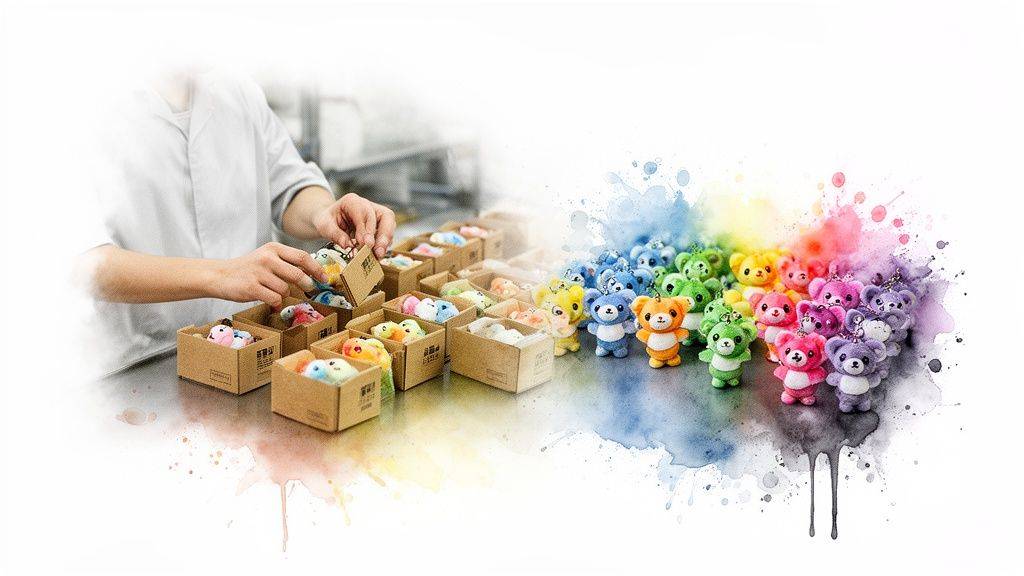
An Inside Look at the Keychain Plush Market
As a manufacturer, we have a direct, real-time view of market demand through the orders we fulfill. The trends are unmistakable: we see massive runs of licensed characters for media franchises, custom mascot designs for corporate events, and unique artist creations for direct-to-consumer sales. The global appetite for well-made keychain plush is robust and diverse.
The commercial appeal is rooted in accessibility. Unlike a larger plush toy, a keychain plush is an impulse purchase. It allows fans to own a piece of their favorite IP without a significant financial commitment, making these items incredibly effective marketing vehicles.
Key Market Growth Drivers
From our production data, we see several key factors fueling the consistent growth in keychain plush orders:
- The Collector’s Mentality: Limited editions and character series drive repeat purchases, transforming casual buyers into dedicated collectors. We are frequently commissioned to produce entire “waves” of characters designed to build this long-term engagement.
- IP and Media Collaborations: The entertainment, gaming, and anime industries leverage keychain plush for brand extension. These are typically high-volume, high-stakes orders that form a regular part of our production schedule.
- E-commerce and Social Media: Online platforms have created a massive direct-to-consumer channel. The small, photogenic nature of keychain plush makes them ideal for viral marketing on platforms like TikTok, driving demand for unique and custom designs.
Here in Yiwu, the heart of China’s toy manufacturing industry—where our factory, FunEnjoy PlushToys, has operated since 1993—keychain plush are a significant part of the ecosystem. They are a core component of China’s stuffed and plush toys market, which was valued at USD 1,298.9 million in 2025 and is projected to reach USD 2,808.9 million by 2033, growing at a 10.2% CAGR. You can review the full analysis from Grand View Research.
Deconstructing a Keychain Plush: Materials and Components
From a manufacturer’s perspective, the quality of a finished keychain plush is determined long before the first stitch. It begins with the raw materials. Your choices here dictate the product’s feel, durability, safety, and ultimate cost. For a buyer, understanding these components is crucial for developing a product that meets brand standards.
Every keychain plush consists of three primary elements: the outer fabric (the “skin”), the inner filling (the “stuffing”), and the keychain hardware. Compromising on any one of these can undermine the entire product, leading to customer complaints and reputational damage.
The Fabric Shell
The fabric is the primary point of physical contact with the customer, making its selection one of the most critical decisions. Different materials offer distinct textures and are suited for different designs, complexities, and budgets.
- Short-Pile Velboa: This is our workhorse material. It is durable, cost-effective, and provides an excellent surface for printing and detailed embroidery. It’s the standard choice for a majority of keychain plush projects due to its ability to create clean, well-defined character shapes.
- Minky Fabric: When a client requests an exceptionally soft, premium feel, we recommend minky. It has a plusher, more luxurious texture than velboa, which elevates the perceived value of the product. We typically use it for high-end collectible plush where tactile quality is a key selling point, though it comes at a higher material cost.
- Faux Fur: For designs requiring a shaggy or fluffy appearance, such as monsters or long-haired animals, faux fur is the only viable option. The pile length can be customized. However, it is a more expensive material and requires specialized sewing skills to work with correctly.
Filling and Stuffing
What’s inside is equally important. The filling determines the plush’s shape, its “squish” factor, and its ability to retain form over time. Using low-grade filling is a common shortcut for low-quality factories; it clumps, deforms, and can ruin the product’s feel.
We use 100% new Polypropylene (PP) cotton exclusively. This is the non-negotiable industry standard for safe, high-quality plush toys. It is hypoallergenic, machine-washable, and offers excellent shape retention. We advise all clients to avoid factories that use recycled or mixed materials, as these often contain unknown contaminants and will almost certainly fail safety testing. For a more premium feel, a high-resilience PP cotton can be sourced, which provides a bouncier, more substantial feel.
Manufacturer’s Pro-Tip: Stuffing consistency is a key quality indicator. We use calibrated filling machines to ensure every plush in an order has the exact same density. Inconsistent or lumpy stuffing is a tell-tale sign of a low-tier factory using manual, unregulated processes.
The Keychain Hardware
The hardware is what functionally turns your plush into a keychain, and its quality is non-negotiable. A clasp that rusts or a ring that breaks renders the product useless and reflects poorly on your brand. We source hardware specifically for durability and corrosion resistance.
Common hardware options include:
- Lobster Clasps: Versatile, user-friendly, and a very popular choice.
- Split Rings (Keyrings): The classic, traditional option offering maximum security.
- Ball Chains: A lower-cost alternative suitable for smaller, lighter plush.
We strongly recommend stainless steel or a nickel-plated zinc alloy. These materials provide the best balance of strength, appearance, and rust resistance, ensuring the keychain’s longevity.
The Manufacturing Blueprint: From Design to Mass Production
Translating a design concept into thousands of identical keychain plushies is a precise, multi-stage process. From the moment we receive your design file, our entire operation is geared toward consistent, scalable execution.
The process begins with the creation of a technical pack (“tech pack”). This is the master blueprint for the product. It must specify every detail: fabric types, Pantone color codes, embroidery placement, hardware type, and dimensions. A comprehensive tech pack is the foundation for a successful production run.
The Prototyping and Sampling Phase
This is where the design becomes tangible. Our expert pattern makers create a physical template from your artwork. Our dedicated sampling team then uses this template to cut the specified fabrics and hand-assemble the first unit.
This initial prototype, or “first-off” sample, is critical for validation. We typically produce and ship this sample within 5–10 working days. You then review it for shape, size, feel, and fidelity to your concept. We absorb your feedback and execute revisions until you approve the “master” sample for production.
Once the design and materials are finalized, we move to production planning. Efficiently scheduling a large run is vital for a smooth process. Understanding Production Capacity Planning for Modern Manufacturers is crucial for keeping projects on track from prototype to final delivery.
Mass Production Workflow
With your final sample approval, the project transitions to mass production. This is where factory efficiency, process control, and quality assurance systems are paramount. Every step is managed to ensure each unit is an exact replica of the sample you approved.
To provide clarity, here is a visual representation of the core components that converge during the production process.
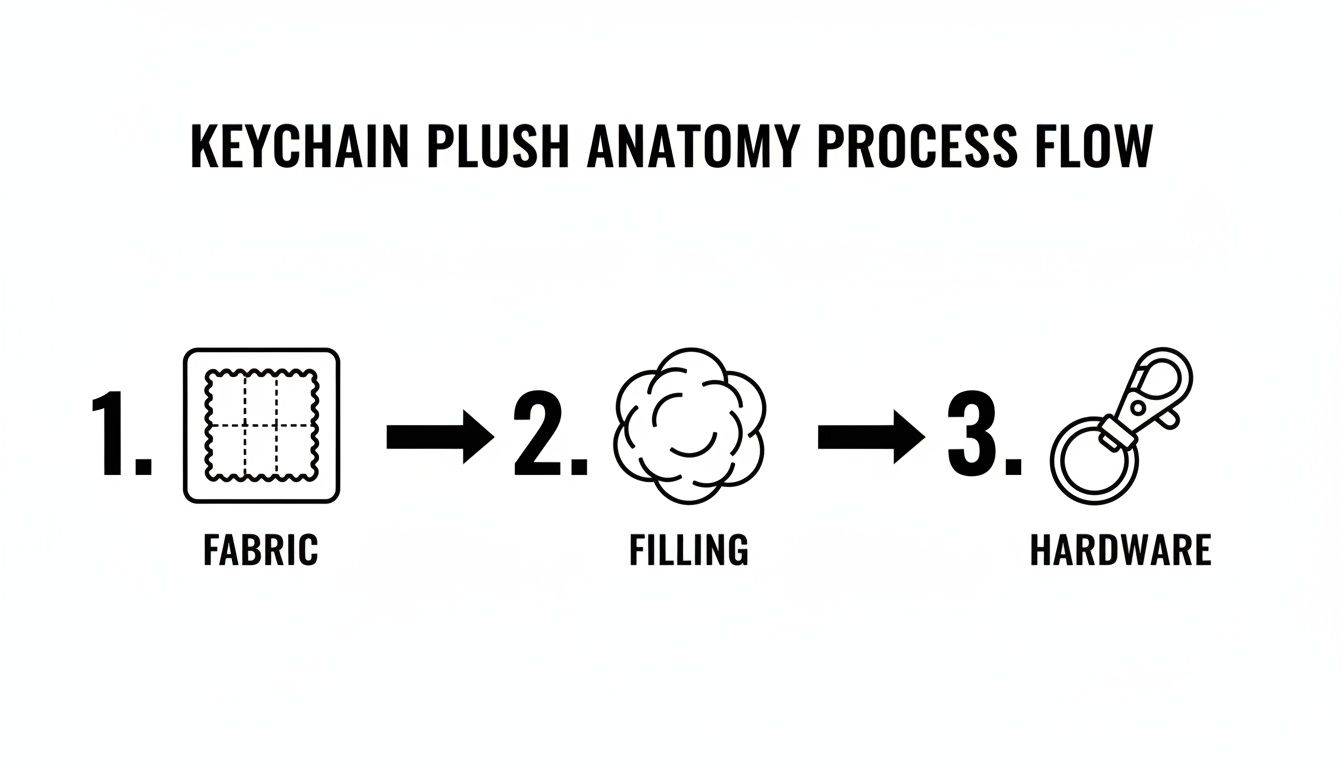
As shown, the fabric, filling, and hardware are the foundational elements of every keychain plush we produce.
Our production line follows a strict sequence:
- Fabric Cutting: Using industrial die-cutters, we cut hundreds of layers of fabric at once from hardened steel templates. This guarantees uniformity across the entire batch.
- Embroidery and Printing: All decorative details, such as logos or facial features, are applied to the flat fabric pieces before assembly. This ensures maximum precision and quality.
- Sewing and Assembly: Our skilled sewing teams stitch the fabric pieces together, leaving a small opening for stuffing. This is one of the most labor-intensive stages.
- Stuffing: We use a specialized air-blowing machine to fill each plush with a precise weight of PP cotton, ensuring consistent density and feel across all units.
- Closing and Finishing: The stuffing opening is closed with a neat, hidden ladder stitch. We then trim any stray threads for a clean, professional finish.
- Hardware Attachment: The keyring, clasp, or chain is securely attached to a reinforced fabric loop on the plush.
- Final Inspection: Every single unit undergoes a final quality check for stitching integrity, material flaws, and overall appearance before being packaged.
Understanding the timeline is essential for planning. This table breaks down the typical duration for each stage of the custom keychain plush manufacturing process, helping buyers manage their project schedules effectively.
Keychain Plush Production Timeline At A Glance
| Production Stage | Typical Duration | Key Activities & Manufacturer Notes |
|---|---|---|
| Tech Pack & Quote | 1-3 Days | We review your design files, confirm materials and specifications, and provide a detailed price quotation. Clear specifications are key to an accurate quote. |
| Prototyping | 5-10 Days | Our pattern makers and sample team create the first physical sample. The timeline depends on complexity and material sourcing. |
| Sample Revisions | 3-7 Days per revision | We implement adjustments based on your feedback. This iterative process continues until you formally approve the “master” sample. |
| Mass Production | 25-40 Days | This is the core manufacturing phase. The duration is heavily dependent on order quantity (MOQ) and design complexity. |
| Quality Control | (Ongoing) | Inspections are integrated throughout the production workflow, with a final, intensive check before packaging. This is built into the production time, not added on. |
| Shipping | Varies (5-40 Days) | Air freight is faster but more expensive (5-10 days). Sea freight is the economical choice for bulk orders but takes longer (25-40 days). |
This structured workflow is essential for delivering large orders on schedule and to the exacting quality standards your brand requires. While this covers keychains, the core principles apply to larger items. For a more comprehensive overview, you can explore our complete manufacturer’s guide on how to make plush toys, which details the entire creation process for all plush types.
Understanding OEM vs. ODM for Your Keychain Plush Project
When initiating a new keychain plush project, one of our first discussions will be about OEM versus ODM. As a manufacturer, we consider this a foundational decision that dictates the project’s scope, timeline, and required resources.
This choice determines your development path. The right decision depends on your level of creative readiness, your budget, and your time-to-market goals. A mismatch can create significant friction. Choosing ODM with a fully developed design can be creatively restrictive, while attempting OEM without a detailed tech pack will stall the project before it starts.
The OEM Model: Your Design, Our Execution
Original Equipment Manufacturing (OEM) is the path for clients with a clear, specific, and fully realized vision for their keychain plush. In this model, you provide the complete design blueprint, and our role is to execute its production precisely to your specifications.
OEM places you in complete creative control. You dictate every detail, from the exact Pantone color of the fabric to the type of embroidery stitch used.
- Your Responsibility (The Brand): Provide a comprehensive “tech pack” that includes detailed character artwork, material specifications, color codes, and any other unique requirements.
- Our Responsibility (The Manufacturer): We handle procurement, pattern making, sample development, and mass production to meet your exact standards. Our expertise is in faithfully and consistently replicating your design at scale.
A classic OEM project involves a video game company commissioning a plush keychain of its lead character. They provide detailed 3D models and strict brand guidelines. Our job is to perfectly translate that IP into a physical product, ensuring every unit is a faithful representation.
The ODM Model: Our Designs, Your Brand
Original Design Manufacturing (ODM) is an excellent solution for brands needing a faster time-to-market or those without in-house design resources. With ODM, you select a design from our factory’s existing catalog of pre-developed, market-tested products. We then customize it with your branding.
Customization can range from adding a branded tag or changing fabric colors to match your corporate identity. Because the core design, tooling, and pattern work are already complete, the ODM path significantly reduces development time and cost.
We can also function in a hybrid ODM capacity, taking a rough concept from you and using our design expertise to develop it into a unique product. For example, we could adapt one of our proven teddy bear patterns into your company mascot. This collaborative approach is ideal for promotional items or retail lines where speed is a priority.
For inspiration, you can browse the wide variety of character types we produce in our general stuffed animals collection.
What Goes Into the Price? A Look at Costs and MOQs
When budgeting for a custom keychain plush project, it is essential to understand the cost structure. As a manufacturer, we don’t assign arbitrary prices; we build them from the ground up based on material, labor, and complexity. The more a buyer understands these cost drivers, the more effectively they can balance creative ambition with their target price.
Cost fundamentally breaks down into two main variables: design complexity and order quantity. A simple, round character with printed features will always be less expensive to produce than a complex creature with multiple fabric types, intricate embroidery, and small, sewn-on accessories. The primary reason is labor—the more sewing, cutting, and hand-finishing a design requires, the higher the production cost.
Primary Cost Drivers in Keychain Plush Production
Beyond the basic shape, several key factors significantly influence the unit price. When we prepare a quote, we are calculating the cumulative impact of each of these elements.
The main factors are:
- Materials: Premium fabrics like minky or long-pile faux fur are more expensive than standard velboa. The choice of metal hardware also matters; a stainless steel clasp has a different cost than a basic ball chain.
- Size and Details: A larger plush requires more fabric and filling, directly increasing material cost. Similarly, dense, high-stitch-count embroidery requires more machine time and thread, making it more costly than printing.
- Special Features: Integrating electronics, such as a sound chip or an LED light, introduces new components and additional assembly steps, which increases the price.
- Packaging: The final presentation affects cost. Custom-printed backing cards, individual polybags, or branded gift boxes add to the unit cost compared to bulk shipping.
This is precisely why a detailed tech pack is so valuable. It allows us to provide an accurate, itemized quote, eliminating budget surprises during production.
To help you strategize, we’ve created a table breaking down how different choices impact your budget.
What Impacts Your Keychain Plush Cost
This table provides a transparent view of the primary factors influencing the final unit price. Use it to understand the cost structure and make informed decisions that align with your budget.
| Cost Factor | High-Cost Example | Low-Cost Example | Manufacturer’s Insight |
|---|---|---|---|
| Design Complexity | A character with 5 different fabric colors, 3D limbs, and intricate embroidery. | A simple round or square shape with printed features and one fabric color. | Every additional seam and assembly step increases labor cost, a significant component of the final price. |
| Materials | Super-soft minky fabric, long-pile faux fur, or custom-dyed materials. | Standard velboa or felt. | Premium fabrics offer a superior tactile experience but come at a higher cost. Standard options can still be high-quality and are very cost-effective. |
| Size | A larger 15 cm plush keychain. | A smaller 8 cm plush keychain. | More material and stuffing are required for larger items, directly increasing the cost per unit. |
| Features & Details | High-stitch-count embroidery for logos and facial features; added accessories like hats or bows. | Printed logos and faces using heat transfer or silkscreen. | Embroidery provides a premium, textured look but is significantly more time-consuming and expensive than printing. |
| Special Add-ons | An internal sound module that plays a custom jingle, or a small LED light. | A standard keychain with no electronic components. | Electronics require component sourcing, additional wiring, and careful assembly, adding significant cost. |
| Packaging | Custom-printed backing card, individual polybag, and a branded display box. | Bulk packed in a master carton with no individual packaging. | Custom packaging enhances retail appeal but adds material and labor costs to each unit. |
By adjusting these variables, you can guide the final cost. A small change, such as shifting from embroidery to a high-quality print, can often yield significant savings without compromising the core design.
Understanding Minimum Order Quantity (MOQ)
For those new to manufacturing, the term Minimum Order Quantity (MOQ) is fundamental. It is the smallest number of units a factory will produce in a single run. For a manufacturer, the MOQ is not an arbitrary barrier; it’s a practical necessity driven by the economics of mass production.
Setting up a production line involves significant fixed costs, from creating die-cut tooling to calibrating embroidery machines for a specific design. When spread across thousands of units, these setup costs become a negligible part of each item’s price. For a very small run, however, the per-unit setup cost would be prohibitively high.
Factory Insight: Many large factories in China have MOQs ranging from 1,000 to 5,000 pieces per design. We have structured our facility for greater flexibility. For most keychain plush projects, our MOQ starts at just 100–500 pieces. This makes custom manufacturing accessible to smaller brands, startups, and for limited promotional events.
The most direct way to reduce your price-per-unit is to increase your order volume. For example, increasing an order from 500 to 1,000 units can often reduce the unit cost by 10–15%. This is a direct result of amortizing fixed setup costs over a larger number of items. This principle of economy of scale is what made Guangdong province a manufacturing juggernaut, commanding 31.2% of China’s massive USD 22.8 billion toy market. You can explore the data behind this manufacturing scale in IMARC Group’s latest industry analysis.
Ensuring Quality Control and Global Safety Standards
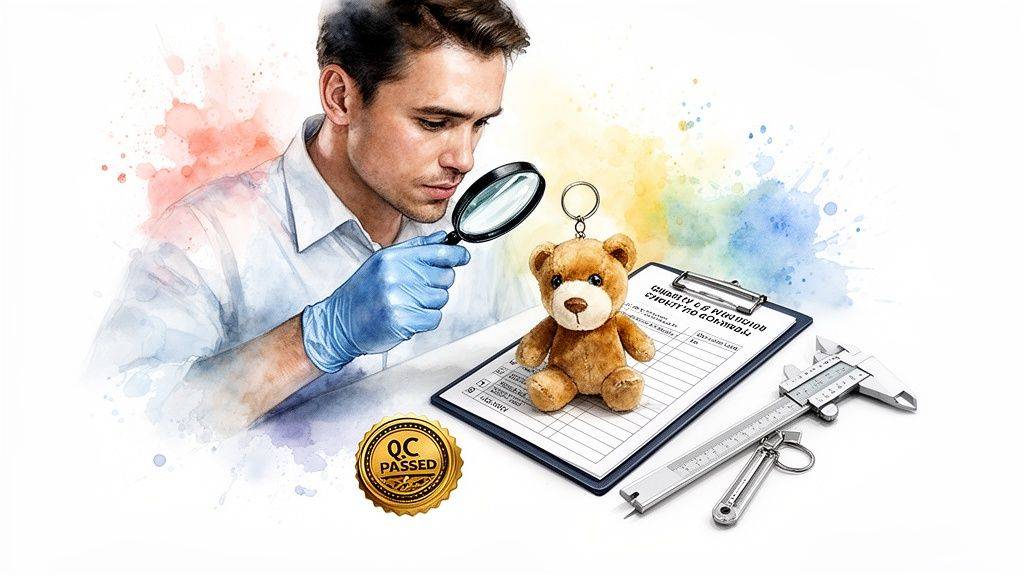
For global brands, quality and safety are not features; they are foundational requirements. A single quality failure or a failed safety test can cause irreparable brand damage and significant financial loss. This is why our quality control (QC) is not a final step, but a continuous process integrated into every stage of manufacturing your keychain plush.
Our QC process begins at material receiving. Every bolt of fabric is inspected for color consistency and correct texture against the approved standard. All hardware, such as clasps and rings, is checked for strength and finish. No material enters the production floor until it has passed our internal quality gates.
Our Multi-Stage Inspection Process
The key to consistent quality is early detection. We do not wait for the final inspection to identify defects. Our QC team is present on the production floor, conducting checks throughout the manufacturing process to correct deviations in real-time.
- In-Line Sewing Inspection: As plushies are being assembled, line supervisors perform continuous checks for seam neatness, stitch strength, and correct component attachment. This is where we ensure every limb and feature is attached securely and symmetrically, matching the approved sample.
- Post-Stuffing Check: After stuffing, each keychain is weighed and palpated to ensure it has the correct density and shape. We check for lumps or under-filled areas, ensuring every unit has the same tactile feel as the master sample.
- Final Piece-by-Piece Inspection: Before packaging, every single finished keychain plush undergoes a final, 100% manual review. We trim any loose threads, check embroidery for defects, and test the keychain hardware. Only perfect units are approved for shipment.
Adhering to International Safety Standards
Compliance with global safety standards is mandatory, especially for products that may be handled by children. Our factory has extensive experience producing goods that meet the stringent requirements of both European and North American markets. These certifications are your assurance that the product is safe for end-users.
Manufacturer’s Viewpoint: Safety testing is a critical risk management service we provide. A product that is certified compliant with EN71 and ASTM F963 is not just a legal requirement—it is a safe product. This protects your brand from product recalls, legal liability, and reputational harm.
The two primary standards in the toy industry are:
- EN71 (European Union): The EU’s comprehensive safety standard for toys. It includes physical and mechanical tests (e.g., no sharp points, no small parts that can detach), flammability tests, and chemical composition analysis (enforcing strict limits on heavy metals like lead and cadmium).
- ASTM F963 (USA): The mandatory toy safety standard in the United States. Similar to EN71, it specifies requirements for mechanical hazards, flammability, and the restriction of toxic elements to ensure product safety. Our commitment to these standards applies to every stuffed toy we produce, regardless of size.
Choosing the Right Plush Toy Manufacturer
Selecting a manufacturing partner for your keychain plush is one of the most critical business decisions you will make. This is not about finding the lowest price; it is about entrusting a partner with your brand’s reputation. We have seen it countless times: a brand chooses an unqualified supplier based on a low quote and ends up with quality defects, missed deadlines, and significant financial losses.
To mitigate this risk, you must look beyond surface-level claims on a website. You need to find verifiable proof of experience, capability, and transparency. A good manufacturer acts as an extension of your team, invested in your product’s success.
Vetting a Potential Supplier: A Practical Checklist
When evaluating a factory, demand tangible proof, not just verbal assurances. A professional manufacturer will readily provide documentation and transparent answers.
Key areas to investigate:
- Experience and Portfolio: How long have they been in business? Request to see examples of keychain plush they have produced for other brands. A factory with a decade or more of experience has encountered and solved a wide range of production challenges.
- Factory Audits and Certifications: Request their business license and any third-party factory audit reports (e.g., BSCI, Sedex). Critically, you must verify current EN71 and ASTM F963 test reports for their materials. This is non-negotiable and demonstrates their capability to produce for major international markets.
- Communication and Transparency: Is their sales and project management team responsive, professional, and fluent in your language? Clear, timely communication is the bedrock of a successful project. Evasiveness or reluctance to answer detailed questions about their processes is a major red flag.
Evaluating Production and Sampling Capabilities
Once you have a shortlist based on credentials, it’s time to evaluate their practical capabilities. The quality of their samples and their discussion of production processes will reveal their true standards.
Manufacturer’s Perspective: We believe the sample is a promise. The quality of the sample you receive is a direct preview of the quality of your mass-produced order. A factory that rushes the sampling process or charges exorbitant fees often signals future problems.
Look for a factory with a structured and reasonably timed sampling process, typically 5–10 days. This indicates they have an organized system for translating designs into physical products.
Inquire about their production capacity and standard lead times. A reliable partner can provide a dependable production schedule and demonstrate they have the skilled labor and line capacity to handle your order volume—whether 500 pieces or 50,000—without compromising on quality control.
Your Keychain Plush Manufacturing Questions Answered
With decades of experience manufacturing keychain plush, we’ve addressed nearly every question from buyers. To help you begin your project with clarity, here are direct answers to the most common inquiries we receive.
What Is a Realistic MOQ For a Custom Keychain Plush?
For many factories, a typical Minimum Order Quantity (MOQ) for a fully custom keychain plush is 1,000 pieces. We recognize this is not always feasible for new brands or limited-edition promotions.
Our flexible production lines allow us to accommodate smaller orders, with MOQs often starting as low as 100–500 pieces. The exact number depends on your design’s complexity and materials, but this lower threshold makes custom production accessible for testing new designs or for special events.
How Long Does The Sample and Production Process Take?
Once your tech pack is finalized, we can typically produce and ship a physical sample within 5–10 days.
After you approve the final “master” sample, a standard mass production run of 1,000-5,000 units usually takes 25-40 days. We adhere to these timelines to help you plan your launch with confidence. Remember, the production clock starts after final sample approval. Any design changes at that point will require new patterns and will reset the timeline.
What Separates a High-Quality Keychain Plush From a Cheap One?
The difference is immediately apparent in the materials and construction. A low-quality plush uses thin, flimsy fabric, the stitching is uneven or loose, and the stuffing is lumpy because it’s often made from undeclared recycled textile waste. The hardware is another tell-tale sign—it will feel lightweight, flimsy, and will likely rust.
In contrast, a high-quality keychain plush is made with dense, soft fabric, features clean and precise stitching, and has a smooth, consistent fill of 100% new PP cotton. The hardware is solid, durable, and corrosion-resistant. Most importantly, a premium plush is certified to meet safety standards like EN71/ASTM. Low-cost products almost never pass these tests, posing a significant risk to your brand. The difference lies in the feel, the durability, and the certified safety.
At FunEnjoy PlushToys, we are experts in getting these details right. With our deep, hands-on manufacturing experience, we are here to guide you in creating a keychain plush that meets the highest standards of quality and safety.