As a manufacturer with over three decades on the factory floor in China, we’ve witnessed the keychain plush toy evolve from a simple accessory into a high-impact, strategic product for brands worldwide. These are no longer just trinkets; they are powerful tools for brand engagement, collectibles, and significant revenue drivers.
This guide shares our direct, practical knowledge to help B2B buyers navigate the complexities of design, sourcing, and manufacturing. We will cover the entire process from a factory perspective, providing the insights you need to turn your concept into a high-quality, market-ready product.
Market Overview: Why Keychain Plush Toys are a Strategic Choice
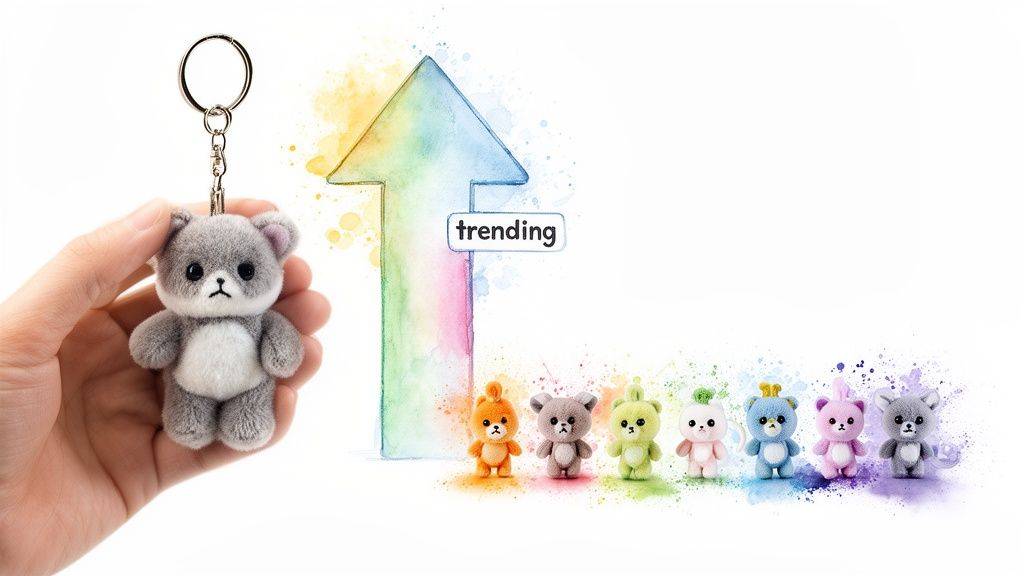
We see market shifts from the ground up. The demand for custom keychain plush toys is not a fleeting trend; it’s a sustainable market driven by powerful consumer behaviors and savvy brand strategies. Global brands leverage these items as collectibles and promotional tools, tapping into the “kidult” phenomenon—adults purchasing toys for themselves—and the viral nature of platforms like TikTok, where unboxing and collection trends drive massive engagement.
Key Growth Drivers and Statistics
From our vantage point, the data confirms what we see in production orders. The broader stuffed and plush toy market in China is projected to reach USD 2,808.9 million by 2033, growing at a 10.2% CAGR.
Within this, the keychain plush toy is a standout performer. Its low price point makes it an ideal impulse buy at retail and online. On platforms like TikTok, toys priced under 30 yuan—the sweet spot for keychains—achieved a staggering 56% CAGR between 2021-2024.
From a manufacturer’s perspective, the logic is clear: keychain plush toys have lower material costs and faster production cycles than larger plushies. This translates to lower financial risk for brands, enabling them to test new designs and react to market trends with agility.
Of course, to capitalize on this, presentation is key. Learning how to take better product photos is crucial for showcasing the quality and appeal of your final product.
Benefits of Keychain Plush Toys for B2B Buyers
| Benefit | Manufacturer’s Insight | Relevance for Buyers |
|---|---|---|
| High Margin Potential | Lower production costs (materials, labor) compared to larger toys create a wider margin at retail. | Offers a high-ROI product that can boost profitability on both individual sales and average order value. |
| Brand Ambassadorship | A keychain travels with the customer, attached to keys, bags, or backpacks, providing daily brand exposure. | Delivers continuous, low-cost marketing and keeps your brand top-of-mind long after the initial purchase. |
| Collectible & Viral Nature | The low price point encourages collecting multiple designs, fueling social media trends and community building. | Taps into the powerful “kidult” market and leverages organic, user-generated content for marketing. |
| Logistical Efficiency | Their small size and light weight significantly reduce shipping and warehousing costs per unit. | Lowers overhead costs and simplifies inventory management, making it an accessible product for businesses of all sizes. |
Types of Keychain Plush Toys: OEM vs. ODM
One of the first strategic decisions a buyer makes is the production model. This choice dictates your level of creative control, development timeline, and upfront investment.
- OEM (Original Equipment Manufacturer): You provide a completely unique, proprietary design, and we manufacture it exclusively for you. This is the path for brands with strong intellectual property (IP), licensed characters, or a highly specific vision. It requires a full development cycle, from pattern-making to prototyping, resulting in a longer timeline and higher initial costs.
- ODM (Original Design Manufacturer): You select a pre-existing, factory-proven design from our catalog and customize it with your branding, colors, and accessories. This is a faster, more cost-effective route to market, ideal for promotional giveaways or private-label retail where speed and budget are primary concerns.
Factory Recommendation: Choose OEM if your design is your core asset. Opt for ODM if your priority is getting a quality, branded product to market quickly and efficiently.
The Keychain Plush Toy Manufacturing Process
Transforming a design file into thousands of finished products is a precise, multi-stage process. Understanding this workflow from a factory’s perspective helps you make informed decisions and avoid common pitfalls.
Step 1: Prototyping & Sampling (5-10 working days)
This is the most critical creative stage. Our technicians create a physical “master” sample from your design.
- Pattern Creation: Your 2D or 3D design is deconstructed into a set of flat fabric patterns—the blueprint for your plush. For complex shapes, this requires deep expertise.
- Material Sourcing & Cutting: We source the exact fabrics and accessories you’ve specified. The patterns are then used to cut the material with precision, often using laser cutters for small, intricate parts.
- Embroidery/Printing: Details like logos or facial features are applied to the flat fabric pieces. We run tests to ensure color accuracy and stitch density are perfect.
- Assembly & Stuffing: A skilled artisan sews the pieces, stuffs the plush with the chosen filling, and attaches the keychain hardware.
You receive this prototype for approval. This is your opportunity to request revisions. A standard quote typically includes one to two rounds of adjustments to ensure the final sample is perfect before mass production begins.
Step 2: Mass Production (20-30 days)
Once the sample is approved, we scale up.
- Mass Cutting: The approved patterns are used to cut thousands of pieces at once using automated fabric cutters for absolute consistency.
- Assembly Line Production: The cut pieces move to our specialized assembly lines. Over 200 craftspeople work in dedicated stations—sewing, embroidery, stuffing, and final assembly. This division of labor ensures high efficiency and consistent quality across the entire run.
- Stuffing & Closing: Each unit is filled to the precise density agreed upon during sampling, then expertly stitched closed.
- Hardware & Accessory Attachment: The keychain clasps and any other accessories are securely attached.
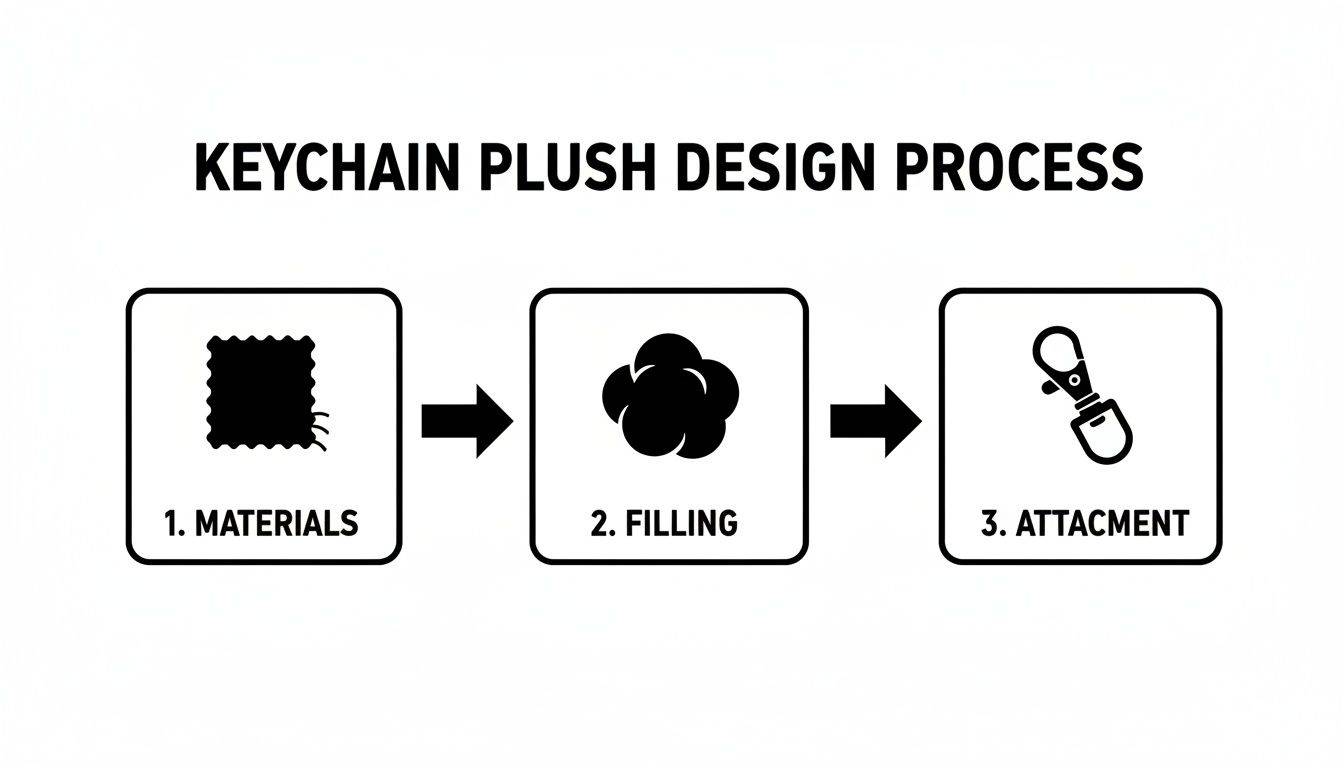
This systematic process allows us to produce high volumes of keychain plush toys while maintaining the quality established in the prototype stage. You can design your own plush toy with our expert guidance through this entire process.
Pricing Factors: What Impacts Your Cost?
Understanding the cost structure is essential for budgeting and design optimization. The final price per unit is a direct result of materials, complexity, and volume.
Material Choices
- Fabric: The “skin” of your plush.
- Short-Pile Plush (Velboa): The industry workhorse. It’s durable, cost-effective, and ideal for printing vibrant, detailed designs. Its stable, non-stretch nature is perfect for small, intricate shapes.
- Minky Fabric: A premium option with a soft, velvety texture that signals higher quality. While it costs more, it’s the right choice for high-end collectibles.
- Filling: The “heart” of your toy.
- 100% New PP Cotton: The gold standard. It’s hypoallergenic, lightweight, and ensures compliance with EN71/ASTM safety standards. This is our default for premium toys.
- Recycled Polyester (rPET): An eco-friendly option made from recycled plastics. It offers a powerful sustainability story for your brand.
Design Complexity
The more complex your design, the more labor it requires.
- Number of Pieces: A simple sphere (2 pieces) is far cheaper to produce than a character with separate limbs, ears, and a tail (10+ pieces). Each additional seam adds labor time and cost.
- Embroidery: The number of colors, stitch density, and total area of embroidery directly impact machine time and cost.
- Attachments: A standard plastic clip is more economical than a custom-engraved metal lobster clasp. Adding accessories like tiny clothing also increases labor costs.
Factory Tip to Reduce Cost: Simplify your design. Reducing the number of fabric pieces and embroidery colors are the most effective ways to lower the per-unit price without compromising the core appeal of your keychain plush toy.
Minimum Order Quantity (MOQ)
MOQ is the minimum number of units we can produce in a single run to be efficient. For a custom keychain plush toy, our MOQ typically starts at 100–500 pieces.
Ordering a higher quantity is the most direct way to reduce your per-unit cost. Larger orders allow us to spread fixed costs (like pattern development and machine setup) over more units, creating significant economies of scale.
Quality Control & Safety Standards
For any reputable brand, quality and safety are non-negotiable. A low-quality product can damage your brand’s reputation, while a non-compliant one can lead to legal issues and recalls. We integrate quality control throughout our entire manufacturing process.
Multi-Stage Inspection Process
- Incoming Quality Control (IQC): All raw materials (fabric, filling, clasps) are inspected upon arrival for defects, color consistency, and strength before they enter the production line.
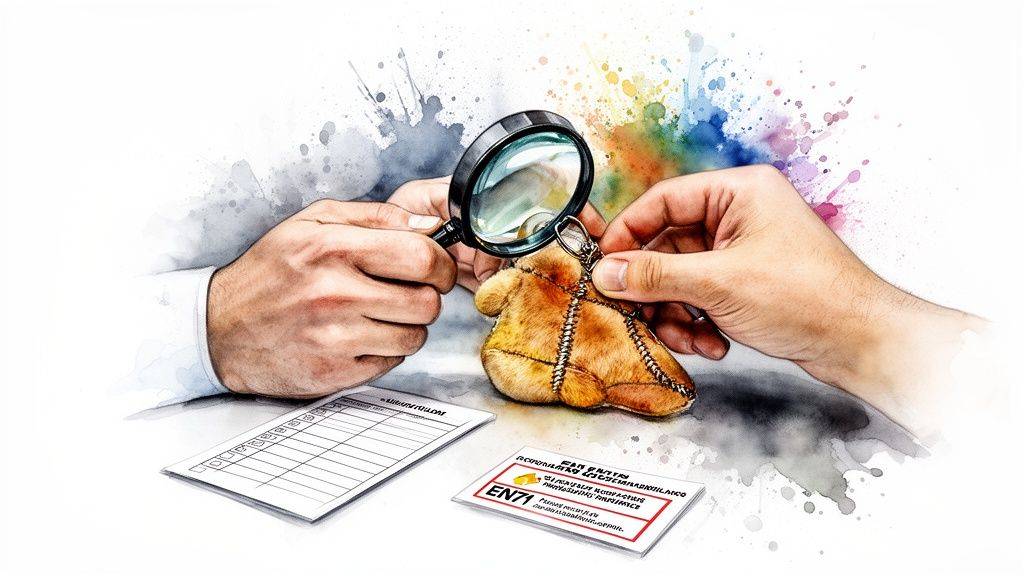
- In-Process Quality Control (IPQC): Our QC teams perform spot checks on the assembly line. This includes pull-testing seams, checking embroidery alignment, and ensuring consistent stuffing density. This catches issues early.
- Final Quality Control (FQC): Every single finished keychain plush toy is 100% inspected by hand. We check for cosmetic flaws, correct labeling, and secure attachment of all parts before packaging.
Navigating EN71 and ASTM Safety Standards
Selling toys in international markets requires compliance with strict safety laws. The two most important are:
- EN71 (Europe): Governs toy safety in the EU.
- ASTM F963 (USA): The mandatory safety standard for toys sold in the United States.
Both standards include rigorous tests for:
| Test Category | What It Covers | Why It’s Critical for Keychain Plush Toys |
|---|---|---|
| Physical & Mechanical | Checks for small parts that could detach (choking hazard), sharp points, and seam strength. | Essential for an item that will be handled frequently and potentially by children. We conduct pull tests to ensure all components are secure. |
| Flammability | Measures how quickly a material ignites and the rate of flame spread. | A crucial safety requirement to prevent fire hazards. |
| Toxic Elements | Screens for heavy metals like lead and cadmium, and harmful chemicals like phthalates in all materials. | Guarantees the product is non-toxic and safe, even if it comes into contact with a child’s mouth. |
We design for compliance from day one, selecting materials and construction techniques that ensure your product will pass these mandatory tests. Working with an experienced manufacturer who understands these regulations is your best protection against risk. For more packaging ideas for your finished product, you can explore our stuffed toy solutions.
Logistics and Shipping
Once production and final inspection are complete, we manage the logistics to get your order to you.
- Packaging: Products are packed to your specifications—individual poly bags, custom gift boxes, or bulk cartons.
- Shipping: We coordinate with trusted freight forwarders for both air and sea freight.
- Air Freight: Faster (5-10 days) but more expensive. Ideal for urgent orders.
- Sea Freight: More economical (30+ days). The standard choice for large-volume orders where cost is a priority.
We handle all customs documentation to ensure a smooth transit from our factory to your warehouse.
How to Choose a Supplier
Choosing a factory is the most critical decision you will make. A good partner is an extension of your team, providing expertise and transparency. A bad one can lead to production nightmares, quality issues, and brand damage.
The most common mistake we see is buyers choosing a supplier based on the lowest price alone. This often leads to working with low-quality factories that cut corners.
Key Vetting Steps
- Request a Factory Audit: Insist on a third-party audit or a personal visit. A refusal is a major red flag. A transparent factory has nothing to hide. Look for social compliance certifications like BSCI or Sedex, which verify ethical labor practices.
- Verify Specialization: Ask for examples of similar keychain plush toys they have produced. A factory that primarily makes large teddy bears may lack the precision equipment and skills needed for small, detailed items.
- Scrutinize their QC Process: Ask for documentation of their IQC, IPQC, and FQC procedures. A professional manufacturer will have this well-documented.
- Check for Global Brand Experience: A history of working with major international brands demonstrates their ability to meet strict quality standards, complex logistics, and compliance requirements. Our guide to top stuffed animal companies offers more context on what sets leading manufacturers apart.
Common problems buyers face with inexperienced factories include poor communication, missed deadlines, inconsistent quality (the bulk order doesn’t match the approved sample), and unexpected costs. A vetted, experienced partner mitigates these risks.
Why FunEnjoy is a Trusted Manufacturer
With over 30 years of experience, we have been the trusted manufacturing partner behind countless keychain plush toy projects for global brands. Our process is built on a foundation of expertise, transparency, and an unwavering commitment to quality.
- Expertise: We have specialized production lines and skilled artisans dedicated to small, intricate plush items.
- Transparency: We welcome factory audits and provide clear, detailed communication at every stage of production.
- Compliance: We are experts in EN71 and ASTM standards and hold BSCI certification, ensuring your products are safe and ethically produced.
- Reliability: We have a proven track record of delivering high-quality products on time and on budget.
Ready to bring your keychain plush toy idea to life with a partner you can trust?