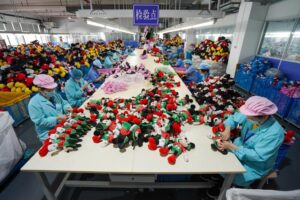
Stuffed toy production involves much more than sewing fabric and adding filling. For brands, retailers, IP owners, and promotional product companies, understanding the manufacturing process helps reduce sampling mistakes, control unit costs, and create plush toys that meet safety and quality requirements. In this guide, we explain how stuffed toys are made, from design review and material selection to cutting, sewing, stuffing, quality control, and bulk production.
How Are Stuffed Toys Made?
Stuffed toys are made by reviewing the design, selecting fabrics and filling, developing a sample, cutting fabric panels, adding embroidery or printing, sewing, stuffing and shaping, and checking the finished product before packing. Specify the outer fabric, internal filling, and construction details separately, then check the finished toy against the approved sample.
Anatomy of a Stuffed Toy: Materials and Construction
To create a superior stuffed toy, one must understand its components. From a manufacturer’s perspective, a toy is a combination of carefully selected materials and precise assembly techniques. This knowledge enables you to develop a clear “tech pack”—the blueprint for your toy—and confidently evaluate samples. It elevates your communication with a supplier from “I want something soft” to a professional dialogue, ensuring the final product aligns perfectly with your brand’s vision.
Outer Shell: Fabric Selection
The fabric, or ‘skin’, is the consumer’s first point of contact and is critical to the tactile experience. Your choice impacts softness, durability, appearance, and cost. While countless fabrics exist, a few proven options are staples in high-quality toy manufacturing.
- Standard Velboa: The workhorse of the industry. This short, low-pile faux fur is durable and cost-effective, ideal for classic teddy bears and toys designed for frequent handling.
- Minky (Cuddle Fabric): For premium softness, Minky is the top choice. Known for its plush, silky feel and signature dotted texture, it is preferred for baby toys and high-end characters where a luxurious touch is essential. It is more expensive and requires greater skill in sewing.
- Sherpa Fabric: This fabric mimics the look and feel of sheep’s wool—fluffy, curly, and cozy. It adds a warm, rustic texture to toys like lambs or llamas but can be challenging for detailed embroidery due to its deep pile.
- Fleece: A soft, fuzzy, and pilling-resistant material, fleece is a versatile all-around choice. We often use it for apparel and accessories on a toy, as its edges can be cut cleanly without fraying.
Filling: Internal Composition
The filling is as crucial as the exterior. It determines the toy’s huggability, weight, and ability to retain its shape over time. The goal is to achieve the perfect balance between softness and structural integrity.
A common error among new buyers is a lack of specificity regarding filling. Simply requesting ‘stuffing’ can result in a lumpy, inconsistently packed product. Achieving a uniform feel across a large production run requires precise material specification.
Specify the filling by its verified fibre composition, grade, and target fill weight. Confirm these details in the material specification and approved sample rather than relying on a trade name alone.
- Fibre filling: Record the verified fibre composition and grade. Compare the approved sample for softness, shape, and filling consistency. Washing instructions should reflect the finished product, including its fabric, filling, and accessories.
- Trade names such as PP cotton: Ask the supplier to identify the actual fibre composition. A trade name alone does not establish that a filling is a different polymer or a higher quality grade.
- Weighted beads or pellets: If the design requires additional weight, specify the material, quantity, and containment method. Suitability must be assessed for the intended age group and product requirements.
Construction Details
The final quality of a stuffed toy is determined by its construction. High stitch density—more stitches per inch—creates stronger seams that resist popping under pressure. We reinforce stress points where limbs and tails join the body. For facial features and logos, the choice is typically between embroidery and screen printing. Embroidery offers a high-end, textured finish that is durable but more costly and less suited for fine details. Screen printing is a cost-effective method for simple graphics but may crack or fade over time. These choices are critical for creating a toy that is not only beautiful but also safe and durable.
The Manufacturing Workflow: From Concept to Carton
The journey from a design file to a finished stuffed toy is a multi-stage process optimized for quality and efficiency. Understanding this workflow demystifies production timelines, highlights critical quality control points, and fosters a more effective partnership between a brand and its manufacturer.
The entire operation is a sequence of precise, interconnected stages. This diagram illustrates the basic layers of a stuffed toy’s construction.
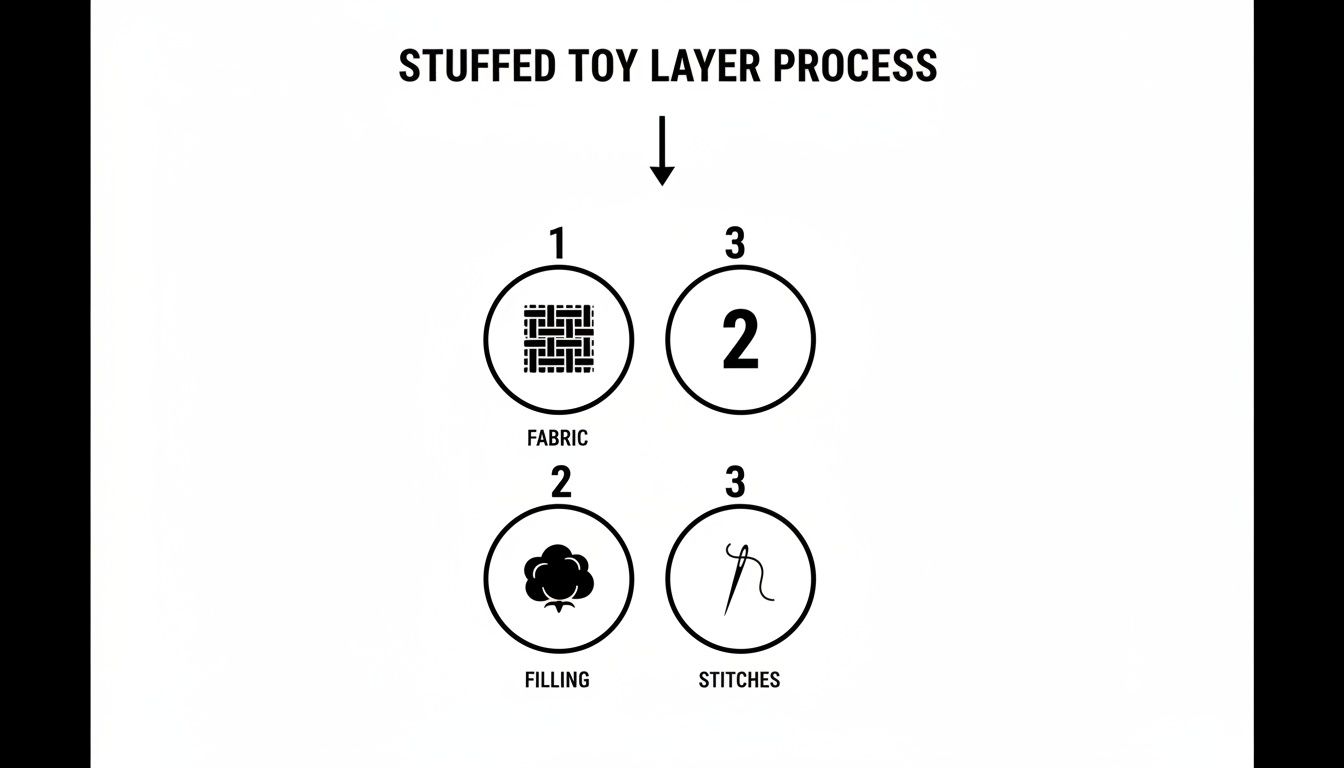
Now, let’s walk through the detailed eight-stage journey from idea to finished product.
Stage 1: Prototyping
- Design and Tech Pack Review: Your tech pack is our manufacturing blueprint. It must contain dimensions, Pantone color codes, material specifications, and embroidery files. Our first step is a feasibility review to ensure the design can be manufactured at scale with the chosen materials.
- Pattern Making and Sampling: Once the tech pack is approved, our pattern masters draft the individual fabric pieces. These are hand-cut and sewn to create the first physical sample, or prototype. Initial sample development typically takes 10 working days after the project specifications are confirmed. Revisions and shipping are not included; the timing for each revision is confirmed separately.
Stage 2: Mass Production
- Material Sourcing and Cutting: Upon sample approval, we order raw materials in bulk. All incoming materials undergo quality inspection. Approved fabric is then layered and cut using computer-guided laser cutters for large orders, ensuring perfect uniformity across thousands of pieces.
- Embroidery and Detailing: Before assembly, flat details like facial features or logos are machine-embroidered onto the cut fabric pieces. This is far more efficient and yields a cleaner result than attempting to embroider a three-dimensional object. For more details on this process, see our guide on how to make plush toys.
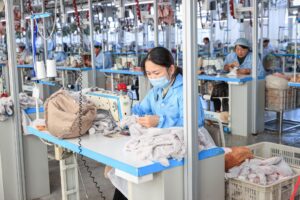
- Sewing and Assembly: Skilled sewing teams assemble the cut and embroidered pieces. The toy is stitched inside-out to conceal seams, leaving a small opening for the stuffing stage.
Stage 3: Finishing and Quality Control
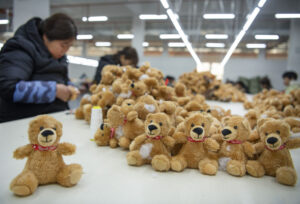
- Stuffing and Shaping: The assembled “skins” are turned right-side out and sent to the stuffing station. The specified filling is distributed through the toy, then shaped by hand. Check fill weight, density, and the finished shape against the approved sample.
- Final Finishing and Inspection: The stuffing opening is closed with an invisible ladder stitch. The toy then undergoes a final inspection where seam strength, attachment security, and overall appearance are checked against the approved prototype. Any stray threads are trimmed.
- Packaging and Loading: Each finished toy is tagged, placed in a protective polybag, and packed into master cartons. Cartons are weighed, labeled, and prepared for shipment.
Typical Production Timeline
| Stage | Typical timing | Scope |
|---|---|---|
| Initial sample | 10 working days after project specifications are confirmed | Excludes revisions and sample shipping |
| Sample revisions | Confirmed for each revision | Additional time depends on the requested changes |
| Bulk production | Typically 35 days after sample approval for orders below 30,000 pieces | Excludes shipping; larger orders require an individual schedule |
| Shipping | Quoted separately | Depends on destination and transport method |
Sampling, revisions, bulk production, and shipping are separate stages. Confirm the complete project schedule before placing an order.
Understanding Pricing and Minimum Order Quantity (MOQ)
The two most common questions from buyers are, “How much will my stuffed toy cost?” and “What is your MOQ?” There is no standard price list for custom products; each project is unique. However, the logic behind pricing and MOQs is directly tied to the operational costs of manufacturing. Understanding this logic empowers you to make informed decisions that align with your budget.
Key Factors Impacting Unit Cost
The final unit price is a sum of material costs and the labor required for assembly. Seemingly small design modifications can lead to significant cost savings at scale. When preparing a quote, we analyze several key factors:
- Materials: Fabric and filling specifications affect the quote. Filling costs depend on the verified fibre composition, grade, and fill weight.
- Size: A larger toy requires more fabric and filling, increasing material and labor costs.
- Complexity: The number of individual pattern pieces and sewing operations directly impacts labor time. A simple spherical character is far less labor-intensive than a dragon with separate wings, horns, and scales.
- Order Volume: Economies of scale are significant. Larger orders reduce the per-unit cost because one-time setup expenses (pattern making, machine calibration) are distributed across more units, and we receive better pricing on bulk raw materials.
- Safety Testing: Certification for standards like EN71 (Europe) or ASTM F963 (USA) requires third-party lab testing, the cost of which is factored into the project.
The Rationale Behind MOQ
Our usual MOQ is 1,000 pieces per design. Simple designs may be accepted at 500 pieces, subject to a review of the design and specifications.
Our fabric suppliers have their own MOQs. To custom-dye a specific Pantone color, we may need to purchase a minimum of several hundred meters of fabric. An order below our MOQ would leave us with a large quantity of unused, paid-for material. The MOQ ensures that production runs are efficient and economically viable for both the factory and the client.
The applicable MOQ depends on the design and material requirements. Confirm the MOQ for each design before finalising an order.
Market trends also support this model. China’s “emotional economy” was valued at 2.7 trillion yuan in 2024, with consumers willing to pay a premium for high-quality products that create an emotional connection. This has fostered a high-margin market where superior design and quality justify premium pricing, making even complex toys highly profitable. Brands like Pop Mart report gross profit margins around 65-70%, comparable to luxury goods. You can read the full analysis on China’s emotional economy for deeper insights.
Practical Tips to Reduce Costs
You can control the final price without sacrificing quality. Here are three strategies we recommend:
- Simplify the Design: Reducing the number of separate fabric panels or simplifying an embroidered logo can significantly cut down on labor time and cost.
- Select Materials Strategically: If a premium fabric is over budget, consider a high-quality short velboa. It offers excellent softness and durability at a more accessible price point.
- Increase Order Volume: Placing a larger initial order is the most direct way to lower your unit cost. The price difference between 500 and 2,000 units can be substantial.
Quality Control and Global Safety Standards
For stuffed toys, quality and safety are non-negotiable. A single safety failure can lead to product recalls, damage brand reputation, and, most critically, endanger a child. Our manufacturing process is built around a robust quality management system designed to prevent issues before they arise. For any brand selling internationally, compliance with global safety standards is mandatory.
Major International Toy Safety Standards: EN71 & ASTM F963
The global toy market is primarily governed by two major safety standards: EN71 for the European Union and ASTM F963 for the United States. Both aim to ensure child safety but have distinct testing protocols. These standards cover everything from physical durability to the chemical composition of materials.
| Requirement Area | EN71 (European Union) | ASTM F963 (United States) |
|---|---|---|
| Mechanical & Physical | Focuses on hazards like small parts, sharp edges, and seam strength. A key test ensures no small parts detach during use. | Includes rigorous “use and abuse” tests (drop, torque, tension) to simulate rough play and prevent physical hazards. |
| Flammability | Tests how quickly a material ignites and the rate of flame spread. Toys must be self-extinguishing or burn very slowly. | Similar flammability tests to ensure the toy does not pose a fire hazard when exposed to an ignition source. |
| Chemical Safety | Part 3 restricts the migration of 19 heavy metals (e.g., lead, cadmium) from toy materials. | Sets strict limits on lead and 8 other heavy metals. Also regulates phthalates in toys for children under 3. |
| Labelling | Requires the CE mark, manufacturer details, and specific age-appropriateness warnings (e.g., “Not suitable for children under 36 months”). | Mandates tracking labels for batch identification and clear age-grading labels. |
We partner with accredited third-party labs to certify that each production run meets the specific standards for your target market.
A key piece of manufacturing wisdom: designing for compliance from the outset is far more cost-effective than remediating a failed product. For instance, choosing embroidered eyes over plastic ones for an infant toy can be the difference between passing and failing a small parts test.
Multi-Stage Quality Inspection Process
Quality is not a final check; it is integrated into every stage of production. A reliable plush manufacturer implements a multi-stage inspection process to identify and correct issues early, minimizing waste and ensuring the final product meets all specifications.
- Incoming Quality Control (IQC): All raw materials are inspected upon arrival. We check fabrics for color consistency and defects and verify that fillings meet the required grade before they enter the production line.
- In-Process Quality Control (IPQC): Our QC team conducts random checks on the factory floor during key stages like sewing and stuffing. They monitor stitch density, embroidery alignment, and stuffing consistency, allowing for real-time adjustments.
- Final Quality Control (FQC): Every single finished toy undergoes a comprehensive final inspection. This is a 100% check to identify any aesthetic flaws, structural weaknesses, or potential safety issues before packaging.
How to Choose a Manufacturing Partner
Selecting the right factory is the most critical decision in the stuffed toy production process. This partnership extends beyond price; it’s about finding a supplier with the technical expertise, ethical standards, and logistical capabilities to execute your vision reliably and safely. A strong partner acts as an extension of your team, identifying potential production issues and ensuring every unit meets global standards. A poor choice can lead to missed deadlines, inconsistent quality, and severe brand damage.
Understanding OEM vs. ODM
First, you must understand the two primary manufacturing models:
- OEM (Original Equipment Manufacturer): You provide the complete design via a tech pack, and we manufacture it to your exact specifications. This model is ideal for brands with in-house design capabilities.
- ODM (Original Design Manufacturer): We provide existing, market-tested designs that you can customize with your branding, colors, or minor modifications. This is a faster and more cost-effective route to market.
The collectible toy segment of China’s plush market is projected to exceed USD 21.5 billion by 2025, growing at an astonishing 35% annually. This boom, driven by licensed IP and innovative packaging, creates massive opportunities for both OEM and ODM partnerships. Discover more insights about China’s collectible toy market.
Turn Customer Preferences into Clear Specifications
For character merchandise, translate the intended look and feel into measurable requirements: dimensions, Pantone colors, fabric texture, embroidery placement, and packaging. Confirm these details on the sample before bulk production. For broader market context, see this plush toys market report.
Vetting a Potential Supplier
Due diligence is essential before committing to a production run. Look beyond marketing materials and request concrete evidence of a factory’s capabilities and compliance.
A reliable partner should provide:
- Factory Audits: Request recent social compliance reports like BSCI or SEDEX. These third-party audits verify ethical labor practices, which is critical for protecting your brand’s reputation.
- Prototyping Quality: The quality of a sample is a direct reflection of a factory’s skill. Scrutinize the prototype for stitch quality, shape accuracy, and adherence to your tech pack.
- Logistics Experience: Inquire about their experience shipping to your country. An experienced manufacturer will be well-versed in customs documentation, import regulations, and can offer various shipping terms (FOB, DDP) to suit your needs.
The Dangers of Low-Quality Factories
The temptation to choose the lowest-priced supplier is a significant risk. What appears to be a cost-saving measure often results in higher costs due to production errors, delays, and quality failures.
We frequently hear from brands who faced disastrous outcomes with low-cost factories: missed deadlines, final products that bear little resemblance to the approved sample, and entire shipments being rejected at customs due to safety violations.
Choosing a manufacturing partner is a long-term strategic decision. A reputable factory invests in skilled labor, modern equipment, and robust quality control systems. While this may result in a slightly higher unit cost, it provides the reliability and peace of mind necessary to build a successful and sustainable brand. For further context, our overview of leading stuffed animal companies offers additional industry perspective.
Frequently Asked Questions from a Manufacturer’s Perspective
Over years of guiding brands through the custom manufacturing process, we have found that certain questions arise consistently. Here are direct, factory-floor answers to some of the most common inquiries.
What is a tech pack and why is it so important?
A tech pack is the master blueprint for your stuffed toy. It is the single most critical document you will provide. A comprehensive tech pack includes precise measurements, material types, Pantone color codes, embroidery files, and placement details for all components. For a manufacturer, a detailed tech pack eliminates ambiguity, ensures the first prototype is close to your vision, provides a clear benchmark for quality control, and allows for an accurate price quote.
What is a realistic timeline for sampling?
Initial sample development typically takes 10 working days after the project specifications are confirmed. This excludes sample revisions and shipping. The number of revisions depends on the design and feedback, and the schedule for each round should be confirmed separately. Consolidated feedback on shape, dimensions, materials, and details helps the team review changes efficiently.
Can you handle international logistics and shipping?
Yes. An experienced manufacturer should manage the entire logistics process. We offer various shipping terms (Incoterms) to meet your needs:
- FOB (Free On Board): We are responsible for transporting the goods to the designated port in our country. From there, your freight forwarder takes over.
- DDP (Delivered Duty Paid): We manage the entire process, including freight, customs clearance, duties, and final delivery to your warehouse. This is a comprehensive, hassle-free option.
We maintain a network of trusted freight forwarding partners to ensure your products arrive safely, on time, and within budget.
At FunEnjoy PlushToys, we combine decades of manufacturing expertise with a commitment to quality, transparency, and safety. We work as your partner to bring your creative vision to life, ensuring every stuffed toy is a high-quality product that meets the most stringent global standards. Start your custom plush project with us today!