How to make a plush doll at a commercial scale is an intricate process that takes a simple concept to a globally distributed product. It moves far beyond hobbyist crafting, demanding a deep understanding of design translation, international safety standards, and the operational realities of B2B manufacturing. This guide is not for DIY projects; it is an inside look at the commercial production process, written for brands, IP holders, and businesses aiming to manufacture plush toys at scale.
The B2B Plush Manufacturing Landscape: A Market Overview
As a manufacturer with over 30 years on the factory floor in China, we have seen the evolution of this industry firsthand. The journey from a 2D sketch to a tangible, safe, and marketable product is one we navigate daily. China’s role as the epicenter of global toy manufacturing is built on a foundation of specialized infrastructure, a skilled labor force, and decades of refined production techniques.
The country accounts for over 70% of the world’s toy production, with exports projected to reach $54 billion in 2025. This scale is driven by manufacturing hubs like Zhejiang, where our company, FunEnjoy PlushToys, was founded in 1993. More industry insights are available from resources like Cosmosourcing.
For B2B buyers, the primary objective is to find a manufacturing partner who can expertly navigate this complex environment. Your role is to provide a clear vision; your manufacturer’s role is to execute that vision with precision, ensuring compliance with standards like EN71 and ASTM F963. This guide will deconstruct the entire process, providing the practical knowledge needed to transform your concept into a finished product.
The Manufacturing Process: From Concept to Container
The transition from a flat drawing to a physical, three-dimensional plush doll is the most critical phase of development. It sets the standard for the entire production run, and a precise prototype—the “golden sample”—is the only guarantee of a successful final product.
Phase 1: Design, Prototyping, and Sampling
This stage begins with your design brief. While a simple sketch is a starting point, a manufacturer requires a detailed technical package. This brief serves as our shared blueprint; the more thorough it is, the faster we can produce an accurate sample. A complete brief should include:
- Orthographic Views: Front, back, and side views of the character are essential to capture all details accurately.
- Detailed Dimensions: Precise height, width, and depth specifications.
- Material Callouts: Specify the desired fabrics (e.g., minky, velboa, sherpa), filling (e.g., PP cotton, recycled fill), and any special components like plastic safety eyes or internal sound boxes.
- Embroidery and Print Files: Vector files for any logos, facial features, or patterns.
Manufacturer Insight: The most common cause of prototyping delays is an incomplete design brief. Providing multi-view artwork and a comprehensive list of specifications can reduce sampling time by several days. The typical sampling timeline is 5-10 days.
Based on your design readiness, you will choose between two production models:
- OEM (Original Equipment Manufacturer): You provide a complete technical package. We act as the executor of your precise design. This is ideal for established brands with in-house design teams. You retain 100% of the IP.
- ODM (Original Design Manufacturer): You provide a concept, and our team collaborates with you to develop the final, manufacturable design. This is suited for startups or brands needing technical design expertise. If you’re looking for a little inspiration, you can explore some ideas when you design your own plush toy.
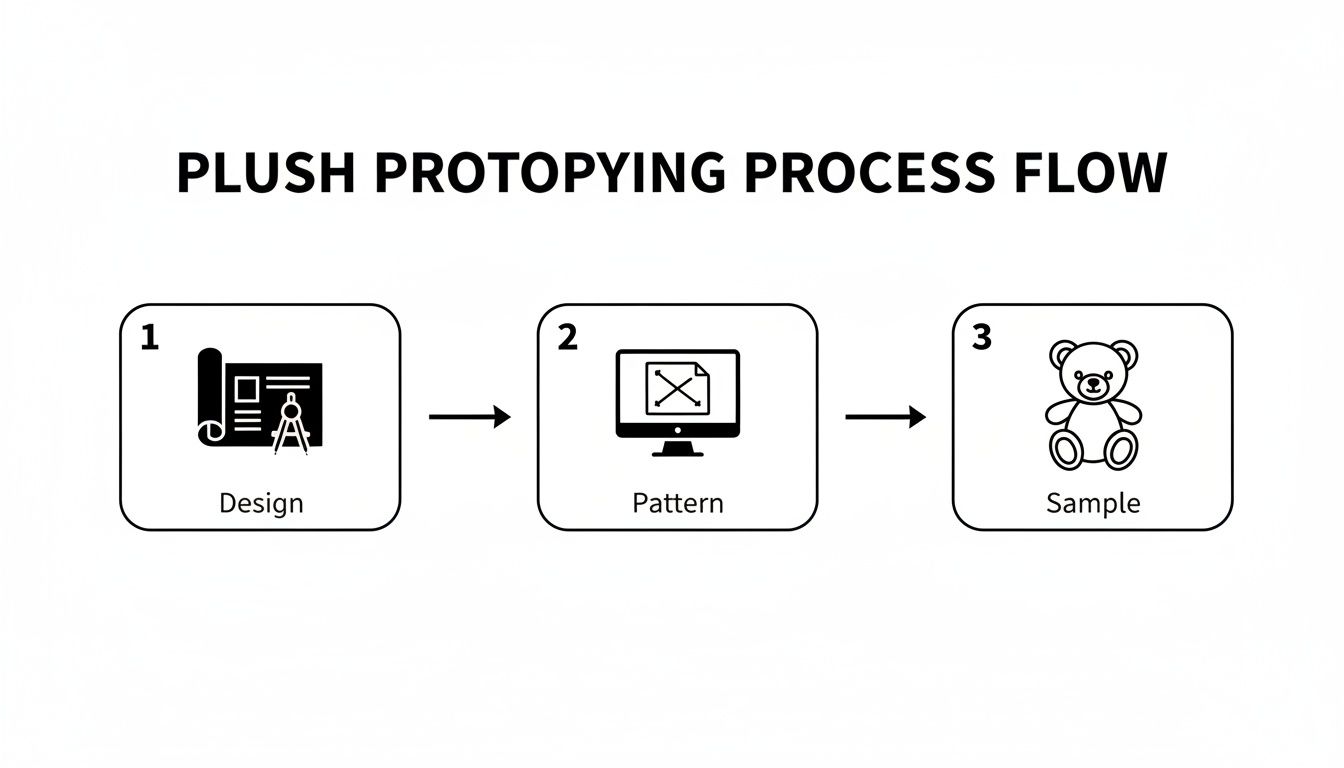
The prototyping process is iterative. Our pattern makers use your 2D art to create a digital 3D pattern, which is used to cut the fabric for the first physical sample. We send this sample for your review. Common feedback involves adjustments to stitching, stuffing density, or shape. This revision loop continues until you approve the final “golden sample,” which becomes the definitive standard for mass production. This speed is a hallmark of China’s toy industry, which is projected to grow from $13.71 billion in 2025 to $26.23 billion by 2033. You can read the full research about the toy market forecast for more on this market trend.
Phase 2: Mass Production Workflow
With the golden sample approved, the factory floor shifts into mass production mode. The goal is absolute consistency.
- Fabric Cutting: We use automated laser cutters guided by the digital CAD patterns from the prototyping phase. This ensures sub-millimeter precision for every piece and cauterizes fabric edges to prevent fraying.
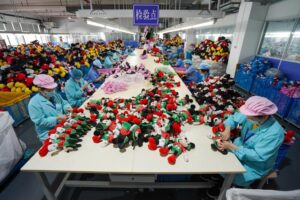
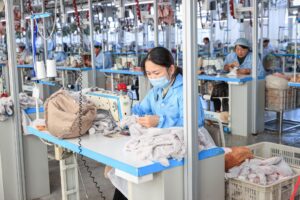
- Embroidery & Sewing: Fabric pieces are sent to specialized stations. Multi-head embroidery machines stitch details like eyes and logos onto the flat fabric pieces before assembly for perfect placement and efficiency. Sewing is handled by assembly line teams, where each sewer specializes in a specific component (e.g., limbs, heads) to maximize speed and quality. For more detail on sewing, see our guide on how to sew a stuffed animal.
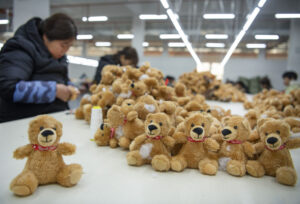
- Stuffing & Finishing: The sewn “skins” are filled using calibrated machines that inject a precise amount of PP (polypropylene) cotton to match the approved sample’s density and feel. Plastic safety eyes and noses are attached with locking washers to meet safety standards. The stuffing opening is closed with an invisible ladder stitch, and each doll is cleaned of loose threads.
- Final Inspection & Metal Detection: Every single unit undergoes a final quality check and is passed through a metal detector—a critical, non-negotiable step to ensure no broken needle fragments are present.
Pricing, MOQ, and Cost Factors for B2B Buyers
Understanding the commercial aspects of plush manufacturing is crucial for profitability. The final unit cost is not arbitrary; it is a direct calculation based on design, materials, and volume.
What Impacts Your Unit Cost?
Several key variables determine the final price per plush doll:
- Design Complexity: The single biggest cost driver. A plush with many small, intricate pattern pieces requires significantly more sewing time and labor than a simple, rounded design.
- Materials: Premium fabrics like long-pile faux fur, custom-dyed materials, or specialty fillings (e.g., recycled polyester, weighted beads) increase raw material costs.
- Size: A larger doll requires more fabric and filling, directly impacting the material cost.
- Order Volume: Economies of scale are significant. A larger order allows for bulk material purchasing and more efficient production line setup, lowering the per-unit cost.
- Packaging: A simple polybag is the baseline. Custom-printed boxes, hangtags, or display cartons add to the final cost but enhance retail presence.
Manufacturer Tip to Reduce Cost: Simplifying a design is the most effective way to lower costs. For example, combining two pattern pieces into one or reducing the stitch count on embroidery can yield significant savings without compromising the overall quality.
Understanding Minimum Order Quantity (MOQ)
The Minimum Order Quantity (MOQ) is the minimum number of units a factory will produce in a single run. This is necessary to cover the fixed costs of production setup. For custom plush toys, a typical MOQ ranges from 100 to 500 pieces.
Beware of factories offering extremely low MOQs (e.g., under 50 units), as they often outsource to smaller, unregulated workshops, leading to quality control and communication issues. A manageable MOQ demonstrates a factory’s willingness to partner with growing brands.
Quality Control and Global Safety Standards
For any brand selling toys, safety and quality are non-negotiable. A product recall can cause irreparable brand damage and significant financial loss. A robust, multi-stage Quality Control (QC) process is the only way to mitigate this risk. Choosing a supplier based on the lowest price often means they are compromising on these critical steps.
Our Multi-Step Quality Inspection Process
- Incoming Quality Control (IQC): All raw materials are inspected upon arrival. We check fabric rolls for color consistency against approved swatches and test fillings for purity and density.
- In-Process Quality Control (IPQC): Supervisors conduct random spot-checks on the assembly line to monitor stitching quality, embroidery alignment, and accessory attachment.
- Final Quality Control (FQC): Every finished unit undergoes a 100% manual inspection to check for aesthetic flaws, seam strength, and overall construction against the golden sample. This is followed by metal detection.
Adherence to International Safety Standards (EN71/ASTM)
Compliance with international safety standards is mandatory. The two most critical for plush toys are:
- EN71 (Europe): Governs toy safety, covering mechanical properties, flammability, and chemical composition.
- ASTM F963 (USA): The standard consumer safety specification for toy safety, with strict requirements for small parts, sharp edges, and hazardous substances.
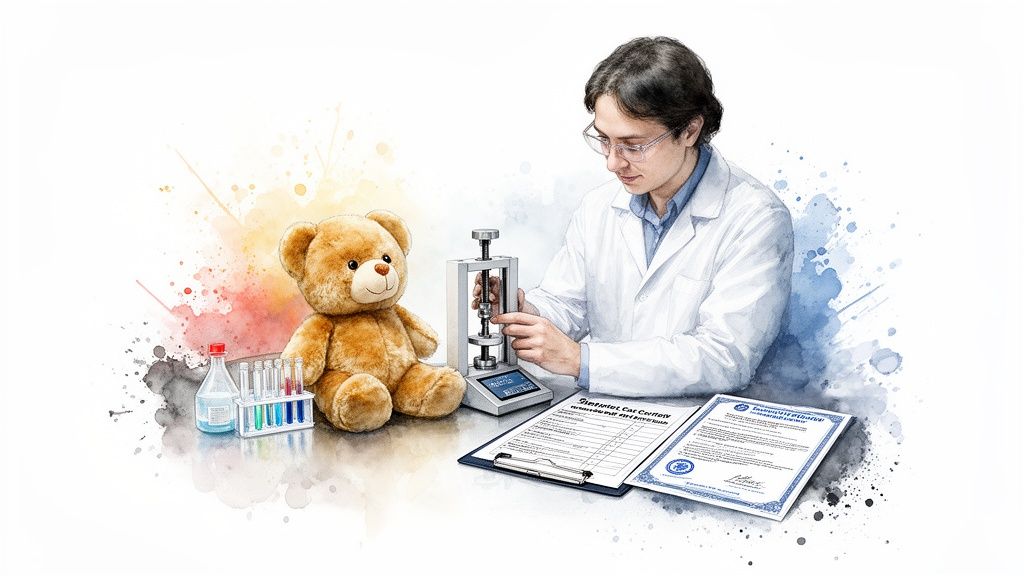
These standards require rigorous testing for choking hazards (pull tests on eyes and seams), flammability, and the presence of heavy metals or harmful chemicals like phthalates. Your manufacturer must be able to provide certification and testing reports from accredited third-party labs.
The Risks of Low-Quality Factories
Partnering with a low-cost, unverified factory introduces significant risks, including uneven stuffing, weak seams that tear easily, misaligned facial features, and failure to meet safety standards. These are not minor cosmetic flaws; they are indicators of a flawed manufacturing process that can jeopardize your entire project.
Logistics: From Factory Floor to Your Warehouse
Once production and final QC are complete, the plush toys are packaged according to your specifications (e.g., individual polybags, master cartons). We handle all export documentation and coordinate with your freight forwarder for shipment by sea or air, ensuring a seamless handover for international transit and customs clearance in your destination country.
How to Choose a Supplier
Selecting a manufacturing partner is the most critical decision in this process. You are entrusting them with your brand’s reputation. Look beyond price and evaluate potential partners on these key differentiators:
- Transparent Communication: A reliable partner provides clear, consistent updates and responds promptly.
- Sampling Efficiency: The ability to produce an accurate prototype within 5-10 days demonstrates expertise and efficiency.
- Production Timelines: A standard production run should take approximately 20-30 days after sample approval.
- Flexible MOQs: A willingness to offer MOQs in the 100-500 piece range shows a commitment to partnering with brands of all sizes. For businesses scaling up, understanding the world of plush toys wholesale is crucial.
- Proven Expertise: An experienced manufacturer can provide guidance on material selection and design modifications to optimize for cost and manufacturability while ensuring full compliance with EN71 and ASTM F963.
Why FunEnjoy is a Trusted Manufacturer
At FunEnjoy PlushToys, we combine over three decades of manufacturing experience with a commitment to quality and partnership. We offer end-to-end solutions, from design consultation and rapid prototyping to mass production and logistics management. Our process is built on transparency, adherence to the highest safety standards, and a deep understanding of the global toy market. We don’t just manufacture products; we build long-term relationships to help our clients succeed.
Ready to bring your own plush creation to life with a partner you can trust? At FunEnjoy PlushToys, we blend decades of hands-on experience with a real passion for quality. We’re here to make sure your vision becomes a huggable reality. Start your custom plush project with us today!