Stuffed Animal Companies searching for a reliable manufacturing partner will quickly find that most roads lead to Asia. This isn’t just about chasing lower costs; it’s about tapping into a manufacturing ecosystem that has been fine-tuned over decades. As a factory based in the heart of this industry, we see firsthand why global brands—from Sanrio to small startups—choose this path. It’s about leveraging an infrastructure built for quality, speed, and scale.
Market Overview: An Insider’s View of the Plush Toy World
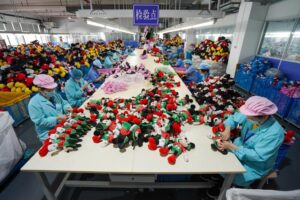
Forget the high-level market reports for a moment. The reality on the ground is an incredibly interconnected supply chain. Here in China, we’re not just a single factory; we’re part of a massive network of raw material suppliers, specialized machinery providers, and generations of skilled workers, all clustered together. This unique environment is why we can take a digital design and turn it into a high-quality physical sample in days, not weeks. That kind of turnaround is almost impossible elsewhere.
Why China Dominates the Plush Market
The numbers tell a significant part of the story. China manufactures an estimated 85% of all toys sold worldwide, a figure that holds especially true for plush toys. Places like Yiwu and Dongguan are the epicenters of this industry. In 2023 alone, China’s toy exports reached $52.9 billion, with plush toys making up a huge slice of that pie. For a deeper dive into these trends, see this comprehensive report on the stuffed animals and plush toys market.
This long history has cultivated a deep pool of expertise. It’s not just about stitching fabric. It’s about understanding the subtle ways different textiles stretch, mastering intricate embroidery, and engineering patterns that are both aesthetically pleasing and efficient for mass production. When a client requests a specific texture, our proximity to hundreds of local fabric mills means we can source the perfect material almost immediately.
The Real Value Beyond Cost
While competitive pricing is a factor, the real advantage is how this ecosystem supports complex projects and large orders without sacrificing quality. The ability to scale production from a few hundred pieces to tens of thousands is a direct result of this established infrastructure.
This deep-rooted capability allows experienced stuffed animal companies to offer advantages that are tough to find elsewhere:
- Rapid Prototyping: A tight-knit supply chain means faster material sourcing and sample creation.
- Scalability: Existing production lines and a skilled workforce can handle sudden demand spikes.
- Specialized Craftsmanship: Decades of focus on plush toys have perfected skills in pattern making, sewing, and finishing.
Choosing to manufacture here isn’t just a cost-saving measure. It’s a strategic decision for brands that require quality, speed, and reliability from their stuffed animal companies.
The Manufacturing Process: From Design to Delivery
Transforming a simple drawing into thousands of identical plush toys is a precise blend of art and science, mixing high-tech machinery with skilled handiwork. Let’s walk through how a digital file becomes a finished product on our factory floor.
The entire workflow, from initial design to final packaging, is a carefully managed process.
It breaks down into three core stages: design finalization, prototype approval, and mass production.
Step 1: Prototyping and Sampling
It all begins with your design. Our pattern masters deconstruct your 2D artwork into a 3D digital pattern, creating a blueprint of individual fabric pieces. This step is critical—it dictates the toy’s final shape, posture, and feel. A common problem buyers face is underestimating this stage; a flawed pattern guarantees a flawed product.
Using this pattern, we create the first physical prototype. This sample is your first opportunity to hold your creation and ensure it matches your vision before committing to a large order. Creating this initial sample typically takes 5–10 days. We then ship it for your review. Based on your feedback—perhaps the ears need to be larger or the embroidery thread is the wrong shade—we tweak the pattern and create a revised sample. This iterative process continues until the prototype is perfect.
A mistake new buyers often make is rushing the prototype stage. Think of the sample as the master copy. Every detail you approve—from stitch tightness to stuffing density—is what we replicate thousands of times. Do not rush this step.
Step 2: Mass Production
With your final approval on the pre-production sample, the factory floor shifts into high gear.
- Material Cutting: We feed the approved digital patterns to automated laser cutters. Lasers ensure every piece of fabric is cut with absolute precision, which is non-negotiable for consistency across thousands of units.
- Embroidery and Printing: Before sewing, we add details like eyes and logos using computerized embroidery machines for speed and uniformity.
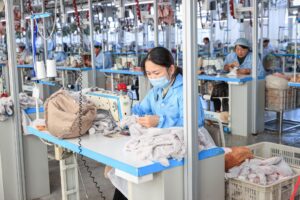
- Sewing Assembly: Cut pieces move to our skilled sewing teams. Each sewer typically focuses on a specific part—one handles limbs, another attaches the head—to maximize efficiency and maintain quality.
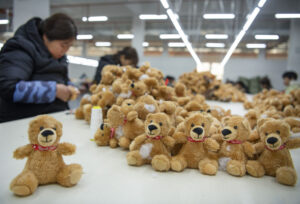
- Stuffing and Closing: The sewn “skins” go to the stuffing station. We use blowing machines for even distribution of PP cotton, but the final shaping is done by hand by experienced workers to achieve the correct balance of softness and structure.
To ensure consistency from toy #1 to toy #10,000, we manage variables carefully. For example, to avoid color variations, we order the entire quantity of fabric needed for a job from a single dye lot. For stuffing, each toy is weighed to ensure it has the exact “squish factor” as the approved prototype.
For more technical details, you can learn how to make plush toys in our in-depth guide.
Materials and Quality Control
The look, feel, and safety of a plush toy are determined by deliberate choices in materials and a robust quality control process. This is where a brand’s reputation is either made or broken. Getting it wrong can lead to recalls, customer complaints, and serious brand damage.
Common Materials & Filling Types
The outer fabric is the first point of contact, so it must feel right. Polyester-based fabrics are common for their softness and durability.
- Soft Velboa: A low-pile faux fur, smooth to the touch, and excellent for printed designs.
- Minky Fabric: Super-soft with a slight stretch, ideal for extra-cuddly characters.
- Crystal Super Soft Plush: A slightly shinier, silky fabric for a more premium feel.
Sustainability is no longer a niche request; it’s a core requirement for many global brands. This has pushed manufacturers to adopt recycled materials like rPET (from ocean plastics) and organic cotton. While traditional fabrics dominate, the demand for natural options like wool is rising. More data can be found on the plush toy market on Grandviewresearch.com.
The filling defines the toy’s weight and “huggability.”
- PP Cotton (Polypropylene): The industry standard—lightweight, hypoallergenic, and machine washable.
- Weighted Beads (Plastic or Glass): Used in the base or paws to help a toy sit upright and provide a comforting weight.
- Foam/Memory Foam: Best for toys requiring a specific, rigid shape.
Quality Inspection Steps
A rigorous, multi-stage quality control (QC) process is non-negotiable. It’s not a single check at the end; it’s woven into every step.
- Raw Material Inspection: Incoming fabric rolls are inspected for color consistency, defects, and proper weight. Fillings are checked for purity.
- In-Line Sewing Inspections: Supervisors constantly spot-check stitched parts for seam strength, alignment, and embroidery quality. This catches errors before they are repeated.
- Metal Detector Screening: A critical safety step. Every finished toy passes through a metal detector to ensure no broken needle fragments or other contaminants are inside.
- Final AQL Inspection: Before packing, we perform a final inspection based on Acceptable Quality Limit (AQL) standards. A random sample is meticulously checked against criteria like measurements, stitching, and overall finish.
A factory that skimps on QC is a major risk. A low price often comes at the expense of safety, leading to hazardous products and costly recalls. Always ask a potential partner to detail their full QC workflow.
Safety Standards (EN71/ASTM)
All materials and processes must meet strict international safety standards. The two most important certifications for Western markets are:
- EN71 (Europe): This standard covers mechanical properties (no small parts falling off), flammability, and chemical safety (testing for substances like lead and phthalates).
- ASTM F963 (USA): The mandatory US standard, covering similar hazards like sharp edges, choking risks, and material toxicity.
A reputable factory must provide recent, valid test reports for these standards. If a supplier cannot, it is a serious red flag.
Pricing Factors: What Really Drives Your Costs
The term Minimum Order Quantity (MOQ) isn’t an arbitrary number; it’s based on the economics of manufacturing. Fabric comes on massive rolls, and ordering a small amount incurs a premium. Setting up a production line—calibrating machines, cutting patterns, and training the sewing team on your specific design—has a fixed setup cost. Spreading that cost over 5,000 units is more economical than spreading it over 50.
Understanding MOQ Ranges
For a fully custom design, most established manufacturers have an MOQ around 500 pieces. This is the point where material costs become reasonable and the production line runs efficiently. However, we understand new brands or limited editions can’t always meet this. It is often possible to negotiate lower MOQs, sometimes starting at 100–300 pieces, especially for simpler designs.
Beware of factories offering extremely low prices on tiny orders. This is a red flag. It often means they are outsourcing your project to small, unvetted workshops with no quality control.
Key Cost Drivers
The final unit price is influenced by several factors. Understanding these allows you to make smarter budget decisions.
| Cost Factor | Description | Impact on Price (Low/Medium/High) |
|---|---|---|
| Pattern Complexity | The number of individual fabric pieces. A simple shape may have 2, while a complex character could have over 50. | High |
| Material Choice | Standard plush vs. specialty fabrics like minky, faux fur, or custom-dyed materials. | Medium |
| Size & Weight | Larger toys require more fabric, stuffing, and increase shipping costs. | Medium |
| Embroidery/Printing | Stitch count, number of colors, and surface area covered by embroidery or screen printing. | Medium |
| Accessories | Adding custom-molded plastic eyes, clothing, ribbons, or sound boxes. | High |
| Safety Testing | Standard tests vs. additional, client-specific lab certifications (e.g., for infants under 3). | Low |
| Custom Packaging | Basic polybag vs. a printed gift box, branded hang-tags, or retail display units. | Medium |
A toy with 30-50 pattern pieces will always cost significantly more than one with two. More pieces mean more cutting, handling, and sewing time.
Tips to Reduce Cost
Lowering your price doesn’t have to mean compromising on quality. Strategic tweaks can make a real difference. We once had a client with intricate embroidery on the mascot’s feet—a detail rarely seen. By simplifying it, we saved them nearly $0.50 per piece, a $2,500 saving on their 5,000-unit order.
Simplifying the pattern itself is another effective strategy. Combining two fabric pieces into one by adjusting a seam reduces both cutting and sewing time without altering the final look. For those considering larger volumes, exploring plush toys wholesale options can also provide more cost-effective paths.
How to Choose a Supplier: B2B Buyer-Focused Insights
Selecting a manufacturing partner is the most critical decision you will make. It’s not about finding the lowest price; it’s about finding a reliable, transparent factory that functions as an extension of your team. A quote that seems too good to be true usually signals future problems.
OEM vs. ODM
First, understand the difference between these two models:
- OEM (Original Equipment Manufacturer): You provide the complete, detailed design. The factory’s role is purely production. You retain full creative control and IP ownership. This is the most common model for custom plush toys.
- ODM (Original Design Manufacturer): You choose from the factory’s existing designs and add your branding. This is faster and requires less design work from you, but the base design is not exclusive.
Look for Verifiable Credentials
Before discussing designs, vet a factory’s credentials. A professional manufacturer will readily share these.
- Factory Audits: Ask for BSCI (Business Social Compliance Initiative) or SEDEX (Supplier Ethical Data Exchange) audit reports. These prove the factory operates ethically and safely.
- Quality Management Systems: An ISO 9001 certification is a strong indicator of a formal, documented quality system.
- Safety Certifications: They must provide recent EN71 and ASTM F963 test reports for similar products.
If a factory hesitates to provide these documents, walk away. It is an immediate deal-breaker.
Checklist for Vetting Stuffed Animal Companies
- Can you show me examples of products you’ve made for recognizable brands? A strong portfolio is the best evidence of their capabilities.
- What is your in-house production capacity per month? Vague answers often mean they outsource work to unvetted workshops.
- Can you walk me through your complete Quality Control process? Ask to see their actual QC checklists and documentation.
- How do you protect my intellectual property (IP)? A professional factory will offer a Non-Disclosure Agreement (NDA) upfront.
- What are the most common production problems you face, and how do you solve them? A factory that claims “we never have problems” is not being honest. An experienced partner will openly discuss managing dye lot variations or complex sewing challenges.
One of the biggest risks is “quality fade,” where the mass-produced units slowly decline in quality compared to the perfect approved sample. A robust, multi-stage QC process is the only defense.
Finally, prioritize communication. Ensure your main contact is fluent in your language, responds promptly, and is transparent about any issues. Exploring directories of wholesale stuffed animals can help identify established suppliers with a history of quality production.
Why FunEnjoy Is a Trusted Manufacturer
We’ve discussed the theory of finding a great manufacturing partner. Now, let us show you how we apply these principles daily at FunEnjoy. This isn’t just a checklist; it’s how we’ve operated since 1993. Our team of 200 skilled artisans has helped brands of all sizes navigate the challenges of plush toy production.
What We Bring To The Table
Our experience allows us to offer a straightforward, honest process. We act as an extension of your team, dedicated to your success.
- Flexible MOQs: We believe great ideas shouldn’t be gated by high order minimums. We can start with just 100–500 pieces.
- Rapid Sampling: Our dedicated prototyping team can create a physical sample from your design in only 5–10 days.
- Commitment to Safety: This is non-negotiable. Every product we manufacture is guaranteed to meet EN71 (Europe) and ASTM F963 (USA) safety standards.
This is not a sales pitch. It’s an invitation to experience a true manufacturing partnership built on transparency, expertise, and a shared goal of creating exceptional products.
Our goal is to help you bring your vision to life, reliably and professionally.
Your Top Questions Answered
We’ve helped countless creators navigate the manufacturing process. Here are straightforward answers to the most common questions we receive.
What’s a realistic timeline for a custom plush toy order?
A typical project has several phases. Design and sampling usually take 5-10 business days, including revisions based on your feedback. Once the sample is approved, mass production takes 30 to 45 days, depending on order quantity and design complexity. Finally, ocean freight from China to North America or Europe adds another 30-40 days. In total, it is wise to plan for a lead time of three to four months from design submission to final delivery.
How do I ensure my design IP is protected?
Protecting your intellectual property is paramount. Before sharing any design files, sign a Non-Disclosure Agreement (NDA) with any potential supplier. A trustworthy factory will have strict internal protocols to ensure your designs are never shared or copied. Your manufacturing agreement should also clearly state that you own the design, patterns, and any custom tooling created for your project.
Will my price per unit decrease with a larger order?
Yes, absolutely. This is due to economies of scale. Larger orders allow us to purchase raw materials in bulk at a lower cost per unit. They also make our production lines more efficient by reducing the per-unit impact of setup costs. We typically offer tiered pricing, so your price per piece will decrease as you increase order quantity from 500 to 5,000 or 10,000 units. Always ask for a price breakdown for different volumes.
At FunEnjoy PlushToys, we combine decades of hands-on experience with a commitment to quality and transparency. We are here to guide you through the entire process, ensuring your vision becomes a safe, high-quality, and successful product. Bring your plush idea to life with us.