Stuffed Animal of Pet creation isn’t just about making a toy. From a manufacturer’s perspective, it’s a technical process that translates an emotional concept—a client’s beloved pet—into a physical, marketable product. Our role is to manage the complex interplay of design, materials, and production to capture the pet’s likeness while meeting strict cost, quality, and safety targets.
Market Overview: The Business Case for Custom Pet Plushes
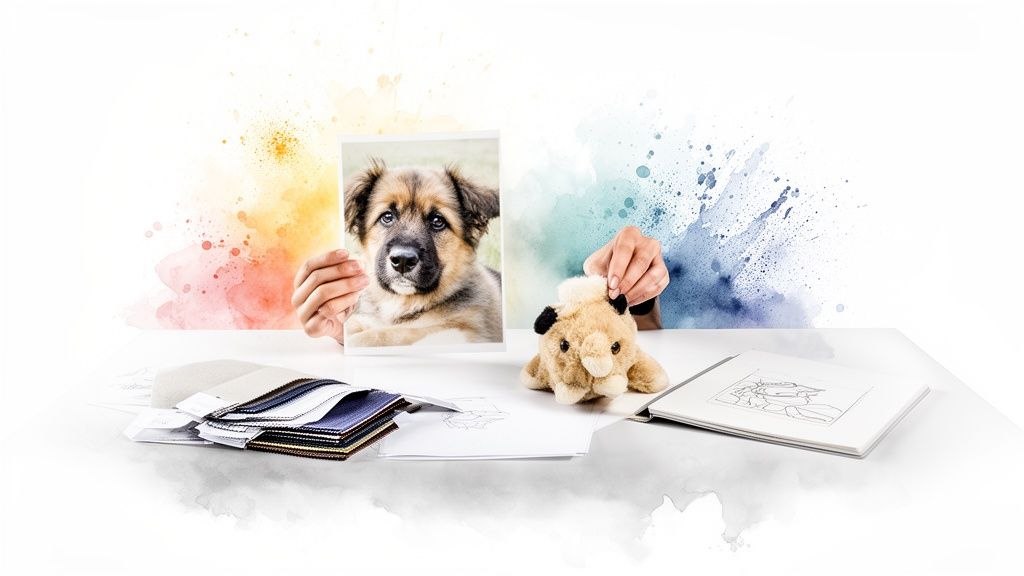
The demand for custom pet plushes is no longer a niche market; it’s a significant growth sector. As a factory operating in China, the global hub of toy manufacturing, we see this trend reflected directly in our order books. Brands are capitalizing on the “pet humanization” phenomenon, where consumers view their pets as family members and are willing to spend on high-value, personalized products.
This emotional connection is the core market driver. A custom plush serves as a unique gift, a brand mascot, or a comforting memorial item. Social media amplifies this demand, as images of pets with their plush counterparts generate viral engagement, creating massive market exposure for brands.
China’s manufacturing infrastructure is uniquely positioned to meet this demand. The plush toy industry is a cornerstone of our export economy. According to official statistics, China’s toy market reached USD 22.8 billion in 2024 and is projected to hit USD 50.6 billion by 2033. This isn’t just about volume; it reflects deep market penetration, with over 100 million pet-owning households in China alone. You can learn more about the China toys market growth for a detailed analysis.
From a production standpoint, our function has evolved. We’ve moved from mass-producing generic toys to executing precision-engineered emotional products. Each pet replica is a custom project requiring meticulous pattern-making, strategic material selection, and skilled artisanship to achieve the desired level of realism and quality.
This guide provides a manufacturer-level perspective on the entire production lifecycle. We will cover everything from design and material specification to mass production, quality control, and logistics, equipping you with the practical knowledge needed to successfully bring a custom stuffed animal of a pet to market.
The Manufacturing Process: From Concept to Container
Bringing a digital design to life is a multi-stage process governed by strict production workflows. Understanding these steps is critical for B2B buyers to manage timelines, costs, and quality expectations. This is how your idea for a stuffed animal of a pet becomes a finished product, ready for shipment.
The process begins when we receive your design specifications. The first step is creating a 2D pattern, which serves as the sewing blueprint. Our pattern masters analyze your 3D design or photos, breaking down the form into a series of flat fabric components. A complex, realistic animal might require 20-30 individual pattern pieces that must interlock perfectly.
Prototyping and Sampling
With the pattern finalized, we move to cutting. For simple shapes, skilled workers use electric cutters to slice through stacked layers of fabric. For intricate components like small paws or unique markings, we utilize laser cutting for absolute precision. Next, pieces go to embroidery, where computer-controlled machines stitch eyes, noses, and other details.
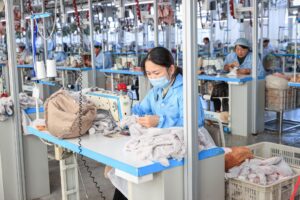
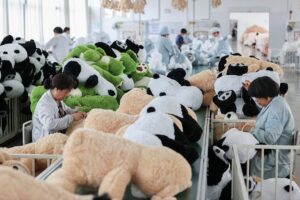
The cut and embroidered pieces are then assembled by our sewing teams. This is a highly skilled task, as operators must stitch the flat pieces together, turn them inside out to hide seams, and create a smooth, symmetrical 3D form. This stage is a major factor in determining labor costs.
This flowchart shows the core elements our design team considers right at the beginning.
Every decision, from fabric type to filling density, directly impacts the final prototype’s aesthetics, feel, and unit cost.
The Critical Sampling Stage
The most crucial phase is the creation of the first physical sample (prototype). This is the master reference for mass production. It is a non-negotiable checkpoint for verifying design accuracy, material quality, and overall construction before committing to a full production run. A typical sampling timeline is 5 to 10 working days. You provide feedback, we revise the sample, and this loop continues until you provide formal approval.
The sample is more than a preview; it is a contractual tool. It allows you to approve material hand-feel, stitch quality, stuffing density, and safety features. Any changes must be made at this stage to avoid costly errors and delays in mass production.
Our detailed guide on how to make plush toys offers a more granular look at each production step. The market for pet-themed plush toys is a huge slice of China’s consumer landscape, and the entire stuffed toy industry is booming. Here at FunEnjoy PlushToys, we’ve had a front-row seat to this growth, producing custom versions of popular breeds for major brands since 1993. To give you an idea, official data shows China’s plush toy exports shot past 5 billion units in 2023, with animal designs making up roughly 70% of that massive number.
Pricing Factors: What Drives Your Per-Unit Cost?
Let’s discuss the two most critical commercial factors for B2B buyers: Minimum Order Quantities (MOQs) and the key variables that determine your final per-unit price. Understanding these is essential for accurate budgeting and successful project execution.
MOQs are not arbitrary. They are a function of manufacturing economics. Setting up machinery, sourcing custom-dyed fabric lots, and dedicating a production line involves significant fixed costs. MOQs allow us to amortize these costs over a viable number of units.
For most custom pet plushes, a typical MOQ ranges from 100 to 500 pieces. Simple designs using stock materials fall at the lower end. Complex designs with multiple custom materials or integrated electronics will require a higher volume commitment.
Decoding the Price Tag: A Manufacturer’s Breakdown
Your unit cost is a direct calculation of the resources required to produce it. Several key factors heavily influence the final price. Knowing these allows you to make strategic decisions to meet your target cost without compromising quality.
- Design Complexity: This is the primary cost driver. A plush with numerous pattern pieces (e.g., realistic paws, separate ears, multi-part tail) requires significantly more cutting and sewing labor than a stylized, simple shape.
- Size and Material Consumption: Larger plush toys use more fabric and filling. Furthermore, premium materials like long-pile faux fur or Minky fabric have a higher cost per meter than standard soft boa (velboa).
- Decorative Processes: The extent of embroidery, screen printing, or airbrushing directly impacts cost. Intricate, multi-color embroidered eyes and airbrushed fur gradients are more labor-intensive and thus more expensive than simpler features.
- Accessories and Compliance: Adding components like internal squeakers, custom sound modules, or branded woven labels and hangtags adds to the unit price. Costs associated with third-party safety testing (EN71/ASTM) are also factored in.
Manufacturer’s Tip: One of the most common mistakes buyers make is underestimating the cost impact of complexity. For example, reducing a pattern from 25 pieces to 18 by simplifying the leg construction can decrease sewing time per unit. This minor design tweak can yield a noticeable cost reduction over a large production run.
Tips to Reduce Cost
Achieving a target price point does not require sacrificing your core design. Strategic adjustments can reduce costs effectively. Openly discussing your budget with your manufacturing partner is the first step.
- Increase Order Quantity: Economies of scale are significant in plush manufacturing. Doubling an order from 500 to 1,000 units can substantially lower the per-unit cost by spreading fixed costs more thinly.
- Simplify the Pattern: As noted, reducing the number of separate fabric pieces is a direct way to cut labor costs.
- Optimize Material Selection: If budget is a constraint, consider using a high-quality stock soft boa instead of a custom-dyed premium faux fur. We can often source a stock color that provides a very close match.
- Bundle Production Runs: If you have multiple smaller designs, such as a series of different animal characters, consolidating them into a single, larger production order can unlock volume pricing. For smaller, simpler items, our guide on creating a plush toy keychain illustrates how scale affects pricing differently.
Key Factors Influencing Per-Unit Cost
This table breaks down how different production choices can affect your final price.
| Cost Factor | Description | Impact Level (Low/Medium/High) |
|---|---|---|
| Design Complexity | The number of unique pattern pieces and sewing operations required. | High |
| Order Quantity | The total number of units in the production run. | High |
| Material Quality | The type of fabric used (e.g., standard boa vs. premium faux fur). | Medium |
| Size | The overall dimensions of the plush, which dictates material usage. | Medium |
| Embroidery/Printing | The amount and intricacy of decorative details. | Medium |
| Accessories | Adding items like sound boxes, squeakers, or custom tags. | Low |
A clear understanding of these cost drivers facilitates a more productive partnership with your manufacturer, enabling you to balance creative vision with commercial viability.
Quality Control & Safety Standards (EN71/ASTM)
Creating a visually appealing custom plush is only the first step. The absolute priority for any reputable manufacturer—and for your brand—is ensuring every unit is safe, durable, and compliant with international standards. Quality control (QC) and safety compliance are not afterthoughts; they are integral to protecting your brand’s reputation and mitigating legal risk.
Our QC process begins with raw material inspection. Each bolt of fabric is checked for color consistency, texture, and defects. All filling must be new, clean, hypoallergenic PP cotton. Plastic components like eyes and noses are verified to be non-toxic and securely fastened.
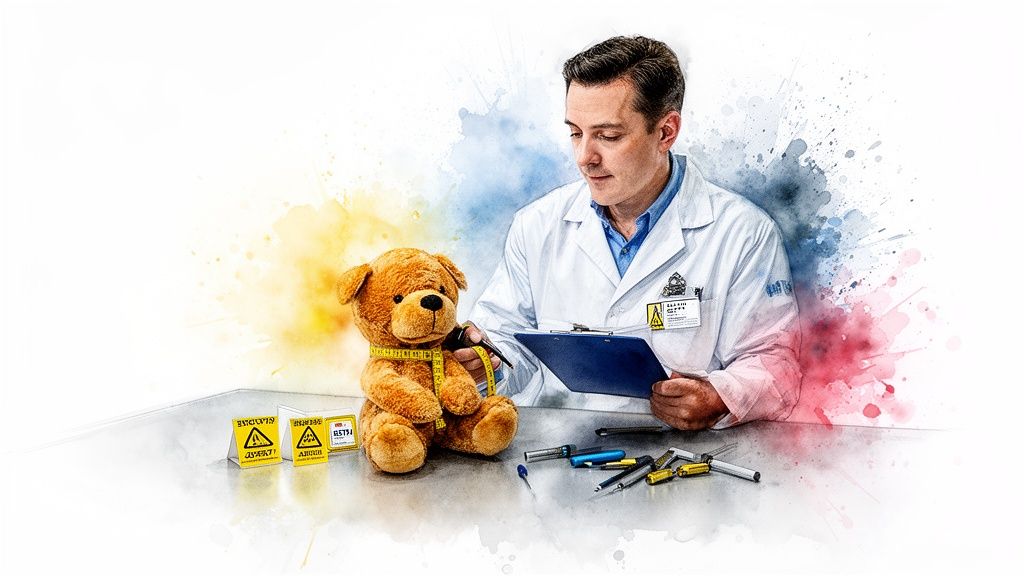
Upholding International Safety Mandates
If you plan to sell in the European Union or the United States, adherence to their respective toy safety standards is mandatory. The two primary standards are EN71 (for the EU) and ASTM F963 (for the US).
To achieve certification, we submit production samples to accredited third-party laboratories. These labs conduct a battery of rigorous tests to identify potential hazards.
Key tests include:
- Physical & Mechanical Tests: Seams, eyes, and small parts are subjected to tension tests to ensure they do not detach and create a choking hazard. Drop tests and torque tests assess structural integrity.
- Flammability Tests: Materials are exposed to a controlled flame to measure the rate of spread. The material must self-extinguish within specified limits to prevent fire risk.
- Chemical Analysis: This is a critical test that screens for heavy metals (e.g., lead, mercury), banned phthalates, and other toxic substances in all materials.
Expert Warning: Partnering with a factory that compromises on safety compliance is the single greatest risk to your business. It exposes you to product recalls, brand damage, and significant legal and financial liabilities. A fully certified product is not an expense; it is a fundamental requirement of doing business.
Our Multi-Stage Quality Inspection Process
Beyond third-party certification, we implement our own multi-stage QC process throughout the production line. This proactive approach is designed to prevent defects rather than simply catching them at the end.
- Post-Cutting Inspection: All pattern pieces are checked for dimensional accuracy.
- Post-Embroidery Inspection: Every embroidered component is reviewed for clarity, neatness, and thread security.
- In-Line Sewing Inspection: Before stuffing, shells are inspected for seam strength, alignment, and overall construction quality.
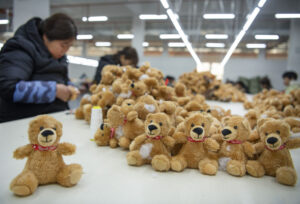
- Final Inspection: After stuffing and closing, each finished plush undergoes a final review for shape, cleanliness, and symmetry. It is then passed through a metal detector to ensure no broken needle fragments are present.
China’s manufacturing prowess is the engine of the global plush toy market. Replicas of pets, from golden retrievers to siamese cats, make up a huge 39.85% of the entire stuffed animal category. This is driven partly by parents who see educational value in these toys, with some reports showing 45% higher playtime engagement. Here’s a critical stat for any brand: factories that maintain 100% compliance with standards like EN71 experience up to 90% fewer recalls. For more details, you can dive into the global stuffed animals market report.
This layered, systematic approach ensures that the product delivered to your customer is not only a high-quality representation of their pet but also unequivocally safe.
How to Choose a Supplier: B2B Buyer Insights
Selecting the right manufacturing partner is the most critical decision in your supply chain. This partnership will directly influence product quality, safety compliance, and your brand’s reputation.
Resist the temptation to select a supplier based solely on the lowest price quote. A low price often signals compromises in material quality, labor standards, or safety compliance—risks that can lead to production delays, defective products, and brand damage. A reliable partner acts as an extension of your team, providing technical expertise and transparent communication throughout the entire process.
What Brands Look for in a Supplier
When vetting potential factories, look beyond the unit cost and conduct thorough due diligence. A competent manufacturer should provide clear, direct answers to your technical and operational questions.
Key evaluation criteria include:
- Communication: Are their responses prompt, clear, and professional? Vague answers or slow communication during the quoting stage are major red flags for future problems.
- Transparency: A trustworthy partner will be open about their production workflow, from material sourcing and QC checkpoints to their final inspection process.
- Proven Experience: Request their portfolio. Have they successfully manufactured a realistic stuffed animal of a pet before? Can they provide samples of comparable complexity and quality?
- Verified Certifications: Do not accept verbal confirmation. Request copies of their factory audits and certifications, such as ISO 9001 (quality management systems) and BSCI (Business Social Compliance Initiative). These documents provide objective proof of their commitment to international standards.
As a point of reference, think about what established manufacturers bring to the table. Our 30+ years of experience at FunEnjoy and partnerships with global names like Sanrio and The North Face are built on providing that complete, end-to-end service. That’s the calibre of reliability you should be aiming for.
Common Problems Buyers Face with Low-Quality Factories
- “Bait and Switch”: The approved sample is high quality, but the mass production uses inferior materials.
- Poor Stitching & Construction: Resulting in high defect rates and durability issues.
- Failed Safety Tests: Leading to shipment rejection, recalls, and legal liability.
- Inconsistent Production: Colors, sizes, and details vary significantly across the production run.
- Communication Breakdown: Unresponsive contacts and a lack of transparency once a problem arises.
Choosing the right supplier is a risk management decision. A slightly higher unit cost from a reputable, certified factory is an investment in product quality, safety, and brand protection.
Why FunEnjoy is a Trusted Manufacturer
Choosing a manufacturing partner is a critical decision. At FunEnjoy PlushToys, we’ve built our reputation over 30 years by delivering on three core principles: expertise, quality, and reliability. We are not just a production line; we are a full-service partner for brands worldwide.
- Deep Industry Expertise: With decades of experience, we have the technical knowledge to execute complex designs, from intricate embroidery to multi-material construction. Our partnerships with global brands like Sanrio and The North Face are a testament to our capabilities.
- OEM/ODM Flexibility: Whether you have a production-ready tech pack (OEM) or need our in-house design team to develop your concept from a sketch (ODM), we have the resources to support you.
- Uncompromising Quality & Safety: Our factory is ISO 9001 and BSCI certified, and our products are designed to meet and exceed international safety standards, including EN71 and ASTM F963. We implement rigorous, multi-stage QC protocols to ensure every unit meets your specifications.
- Transparent Communication: Our experienced project managers provide clear, consistent communication from the initial quote to final delivery. We believe a successful partnership is built on trust and transparency.
Ready to get started? The team at FunEnjoy PlushToys has been turning creative ideas into high-quality plush toys for decades. We know what it takes to get it right—from safety standards to sourcing the perfect fabric. Let’s work together to create something your customers will absolutely love. Get your free quote today.