As a plush toy manufacturer in China, we see the entire lifecycle of a product, from a simple sketch to a global bestseller. What truly defines popular stuffed animals isn’t just a cute design; it’s a combination of market insight, meticulous engineering, and flawless execution on the production line.
This guide offers a manufacturer’s perspective on how popular stuffed animals are developed and produced, and what it really takes to bring a successful plush toy to market.
Market Overview: What’s Driving Demand in Popular Stuffed Animals?
From our factory floor, we have a front-row view of the trends shaping the global toy market. Demand for popular stuffed animals has clearly moved beyond the traditional kids’ toy aisle, expanding into collectibles, gifting, and brand-driven merchandise.
Time and again, our production experience shows that popular stuffed animals don’t succeed by chance. A small number of critical factors—ranging from market positioning to production execution—are what consistently turn an initial concept into a scalable, high-volume manufacturing program.
The Power of Digital Culture and Media
Digital media is the single largest demand driver today. Characters from video games, anime, and viral social media trends come with built-in audiences, significantly reducing the risk of launching popular stuffed animals for brands.
When a character gains online traction, demand for merchandise is immediate. In many cases, popular stuffed animals become the fastest and most scalable product format to capitalize on that momentum.
This extends beyond entertainment properties. We’ve seen a massive uptick in orders for plush versions of:
- Corporate Mascots: Brands are bringing their logos to life for events and merchandise.
- Meme Characters: Internet phenomena are being turned into limited-edition collectibles.
- Creator IP: YouTubers and influencers are monetizing their brands by turning their avatars into plushies for their followers.
The “Kidult” Craze and Collectibles
A significant portion of the market is now made up of “kidults”—adults purchasing toys for themselves. These consumers are a key driver behind today’s popular stuffed animals, demanding high-quality, collectible products rooted in nostalgia and iconic franchises.
This shift fuels demand for stuffed animals with exceptional detailing and premium materials, allowing brands to position them at higher retail price points.
We see this directly in the technical specifications we receive. A plush for a collector often requires more complex embroidery, premium fabrics, and collector-friendly packaging. The quality expectations are simply higher.
A Shift in Consumer Values
Today’s shoppers, especially millennials and Gen Z, care about what a brand stands for. Their values directly influence their purchasing decisions, and we’ve seen this change the types of manufacturing requests we get.
- Sustainability: We’re getting more requests for toys made from recycled materials like rPET (recycled polyester).
- Sensory and Wellness Toys: Weighted plushies and those with unique, calming textures are becoming popular for their anxiety-reducing benefits.
The Manufacturing Process: From Sketch to Sample
Every great popular stuffed animal starts as an idea, but the pre-production stage is where the foundation for a successful, scalable product is built. For popular stuffed animals, this process begins with the design brief—what we in the industry call a “tech pack.”
This document serves as the blueprint for your plush toy. A robust tech pack includes 2D drawings (front, back, and side views), precise measurements, fabric specifications, and—critically—specific Pantone color codes.
An instruction like “light blue” is subjective; a Pantone number is a universal standard that eliminates guesswork and prevents costly errors.
Choosing Your Manufacturing Path: OEM vs. ODM
Before production, you must decide how you want to partner with a manufacturer. This choice defines the project’s scope and timeline.
| Attribute | OEM (Original Equipment Manufacturing) | ODM (Original Design Manufacturing) |
|---|---|---|
| Design Control | 100% creative control. The design is your exclusive IP. | You choose and customize a pre-existing factory design. |
| Development Time | Slower; everything is built from scratch. A typical sample takes 2-4 weeks with revisions. | Much faster; the base design and tooling already exist. |
| Initial Cost | Higher due to custom pattern and potential mold development. | Lower, as you leverage existing patterns and tooling. |
| Uniqueness | Completely unique to your brand. | Less unique; other brands may use the same base model. |
| Best For | Brands with unique IP, character-driven products, and licensors. | Promotional items, quick market entry, or budget-conscious projects. |
If you’re creating a new character, you are on the OEM path. If you need a branded mascot for a trade show and can adapt an existing design, ODM is the more efficient choice. For more details, explore our guide on how to design your own plush toy.
The Prototyping Process: A Manufacturer’s Reality
With a tech pack and manufacturing path chosen, we create the first physical sample. This is an iterative process requiring clear communication.
- Pattern Making: Our masters translate your 2D drawings into a 3D paper pattern. The complexity of this pattern is a primary cost driver.
- Material Cutting: We use the patterns to cut your chosen fabrics, often with lasers for precision on complex shapes.
- First Assembly: The pieces are sewn, embroidered, and stuffed to create the first prototype.
The first sample is rarely perfect. Its purpose is to be a physical starting point for refinement. Vague feedback like “make it cuter” is not actionable. We need precise instructions like, “reduce snout length by 1cm” or “increase eye embroidery width by 3mm.” Each revision cycle adds time and cost, so a detailed tech pack is crucial for an efficient process.
A Look Inside The Plush Toy Production Line
Once you approve the final prototype, mass production begins. The goal is to replicate that perfect sample thousands of times with absolute consistency.
Materials & Filling Types: The Foundation
The material choices dictate the toy’s final feel, durability, and cost.
- Plush Fabric: Most popular stuffed animals use textiles like Soft Boa, Velboa, or premium Minky. Minky offers a luxurious feel ideal for high-end collectibles, while Velboa provides an excellent balance of softness and durability.
- Eco-Friendly Options: Requests for rPET (recycled polyester from plastic bottles) have increased significantly as brands prioritize sustainability.
- Filling: The industry standard is virgin polypropylene (PP) cotton, which is hypoallergenic and resilient. For weighted or sensory toys, we use plastic or glass pellets to provide specific heft and feel.
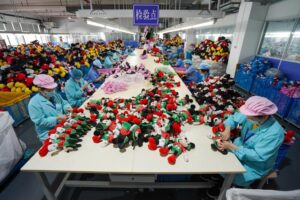
Production Workflow: From Fabric To Final Toy
Mass production is a systematic process where each stage is monitored to maintain quality.
- Fabric Cutting: Industrial laser cutters slice multiple fabric layers simultaneously, ensuring every piece matches the master pattern with perfect precision.
- Embroidery and Printing: Details like facial features and logos are applied while the fabric is flat for maximum quality and accuracy.
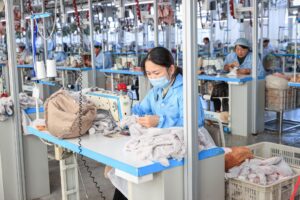
- Sewing and Assembly: Skilled sewing teams stitch the flat pieces together, a labor-intensive step that transforms 2D shapes into a 3D shell.
- Turning and Stuffing: The sewn shells are turned right-side out. Specialized machines blow in PP cotton to the exact density specified, ensuring a consistent feel across the entire run.
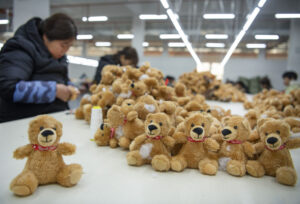
- Closing and Finishing: The final seam is closed by hand with an invisible stitch. Accessories like ribbons or custom hangtags are attached.
A common buyer mistake is underestimating how design complexity impacts labor costs. A pattern with many small pieces requires more sewing time, directly increasing the unit price. Simplifying a pattern by just 10-15% can often lead to significant cost savings.
To see more, you can take a deep dive into our production process and the technology we use.
Pricing Factors, MOQ, and Global Logistics
Understanding the business side of manufacturing is essential for a successful product launch. This includes unit cost, order minimums, and shipping.
What Impacts Cost? Key Pricing Factors
The final unit price is a direct result of design and material choices.
- Material Selection: Premium fabrics like minky cost more than standard velboa.
- Design Complexity: The number of individual pattern pieces directly impacts labor time and cost.
- Size and Weight: Larger toys require more materials and increase shipping costs.
- Embroidery and Printing: High stitch counts or multi-color prints add to the unit cost.
We can often “value-engineer” a design by making minor adjustments—like simplifying an embroidered logo or reducing pattern pieces—to meet budget targets without compromising the overall quality.
MOQ Ranges: Understanding Minimum Order Quantities
Our Minimum Order Quantity (MOQ) for custom plush toys is typically 500 to 3,000 pieces per design. This is not an arbitrary number; it reflects the economics of mass production. Setting up a production line—creating cutting dies, programming embroidery machines—incurs fixed costs. Spreading these costs over a larger volume significantly reduces the price per unit. Producing a small batch is inefficient and makes the unit cost commercially unviable for most clients.
Exploring plush toys wholesale options can offer more insight into how volume affects pricing.
Logistics: Navigating Global Shipping
Understanding shipping incoterms is crucial for calculating your total landed cost.
- FOB (Free On Board): This is the industry standard. We cover all costs to get your products loaded onto the vessel at the port (e.g., FOB Shanghai). Once the goods are on board, ownership and risk transfer to you. You are responsible for ocean freight, insurance, customs, and final delivery.
- EXW (Ex Works): With EXW, our responsibility ends when your product leaves our factory. Your freight forwarder manages everything from that point on.
For most international buyers, FOB provides the clearest and most balanced division of responsibilities.
Quality Control and Safety Standards
For a reputable manufacturer, safety is not an afterthought; it is integrated into every step. Partnering with a low-cost factory that cuts corners on quality control is a direct path to product recalls, legal issues, and irreversible brand damage.
Quality Inspection Steps: Our Multi-Stage Process
Effective quality control is a continuous process.
- Raw Material Inspection: All incoming fabrics and fillings are inspected for defects and color consistency against the approved master sample.
- In-Process Checks: Line supervisors conduct random spot checks during sewing and stuffing to verify seam strength, embroidery placement, and stuffing density.
- Metal Detection: Every single toy passes through a calibrated metal detector to find any stray metal fragments, such as a broken needle tip. This is a critical, non-negotiable safety step.
- Final Product Inspection: Based on AQL (Acceptable Quality Limit) standards, a dedicated team performs a final inspection. They conduct pull tests on attached parts (eyes, noses) and verify all details against the approved prototype.
Safety Standards (EN71/ASTM)
Compliance with international safety standards is mandatory. For toys sold in major Western markets, two certifications are essential:
| Standard | Key Focus Areas |
|---|---|
| EN71 (Europe) | Covers mechanical properties, flammability, and the migration of chemicals. Part 3, which governs chemical safety, is famously strict. |
| ASTM F963 (USA) | Also tests for physical and mechanical hazards but has specific rules for small parts, lead, and phthalates, governed by the Consumer Product Product Safety Improvement Act (CPSIA). |
These certifications are your brand’s insurance, proving to retailers and consumers that your product is safe.
The Risk of Low-Quality Factories
Choosing a supplier based on the lowest price often costs more in the long run. A factory without robust QC systems is a liability. Common problems we see from brands switching to us include inconsistent production quality, failed lab tests leading to costly delays, and catastrophic product recalls that destroy brand trust.
How to Choose a Supplier: B2B Buyer Insights
Selecting the right manufacturing partner is one of the most critical decisions you will make.
What Brands Look For in a Supplier
Experienced brands evaluate potential factories on more than just price. Key criteria include:
- Technical Expertise: Can the factory handle your design’s complexity? Ask for examples of similar products they’ve made.
- Communication: Is their team fluent in your language? Are they responsive and transparent? Clear communication prevents costly misunderstandings.
- Social Compliance Audits: Reputable brands require audits like BSCI or Sedex to ensure ethical labor practices.
- Proven Track Record: A long history of working with international brands is a strong indicator of reliability and experience with global logistics and safety standards.
Tips to Reduce Cost Without Sacrificing Quality
Work collaboratively with your manufacturer to optimize your design for production.
- Simplify the Pattern: Reducing the number of small fabric pieces is the most effective way to lower labor costs.
- Optimize Embroidery: Reduce stitch count where possible without losing design integrity.
- Increase Order Volume: The single best way to lower your unit cost is to increase your order quantity.
A true manufacturing partner acts as a consultant, helping you find the right balance between your creative vision and your budget.
Why FunEnjoy is a Trusted Manufacturer
At FunEnjoy PlushToys, we build transparent, long-term partnerships. With decades of experience, a deep commitment to safety and quality, and a team dedicated to clear communication, we are equipped to bring your most creative and popular stuffed animals to life. Our process is designed to protect your investment and ensure a final product that meets the highest global standards.