From our factory floor in China, we’ve learned a simple truth: the soul of a plush toy isn’t its outer fabric—it’s what’s inside. The right plush toy stuffing dictates how huggable a toy is, how long it lasts, whether it passes critical safety inspections, and ultimately, your final production cost.
As manufacturers, we see firsthand how this hidden component can make or break a brand. Choosing the stuffing is a core strategic decision, not a minor production detail. It defines the product from the initial prototype to the final unboxing.
Why High-Quality Stuffing is Non-Negotiable
The first interaction a customer has with a plush toy is touch. That tactile experience—its softness, its firmness, how it sits in your hands—is the first signal of quality. This entire impression comes down to the filling. Low-quality, inconsistent stuffing feels lumpy or hollow, and no amount of clever design can fix a poor first impression.
The Foundation of Safety and Durability
Beyond feel, stuffing is the cornerstone of safety and longevity. This is non-negotiable for any product, especially those intended for children. The filling must meet stringent international standards like EN71 in Europe and ASTM F963 in the USA. This isn’t just about a certificate; it means the material itself is:
-
Hypoallergenic: To prevent allergic reactions in sensitive users.
-
Contaminant-Free: Rigorously tested to ensure no harmful chemicals or foreign objects are present.
-
Resilient: Engineered to withstand compression, rough play, and washing without clumping or degrading.
A well-made plush toy maintains its shape and softness after years of use. This durability comes from using high-grade, virgin polyester fibers that resist compaction. It’s what transforms a toy from a temporary product into a lasting companion.
The Unseen Impact on Production and Logistics
From a business perspective, your choice of stuffing creates a ripple effect across your entire operation. The density and material type directly determine your unit cost, as we purchase raw fiberfill by weight. Furthermore, a heavier toy increases shipping costs—a critical factor when managing a global supply chain. High-quality plush toy stuffing is not an expense; it is an investment in your brand’s integrity, customer satisfaction, and long-term success.
Types of Plush Toy Stuffing: A Manufacturer's Breakdown
When you create a plush toy, the stuffing is a core technical component. Communicating with precise terminology is key. A request for "soft stuffing" is a vague starting point; a specification for 7D virgin polyester fiberfill provides a precise blueprint for production.
The industry standard is polyester staple fibre (PSF). This synthetic material is ubiquitous for good reason: it’s resilient, naturally hypoallergenic, and cost-effective. However, not all polyester is created equal. We work with different grades daily, each selected for a specific application.
Polyester Fiberfill: The Industry Workhorse
The technical specifications of fiberfill define a toy's final texture and performance. The most critical factor is denier, a unit of measurement for the fineness of the fiber.
-
7D Fiberfill: This is a finer, silkier fiber. We utilize 7D when a client requires a premium, cloud-like softness. Its lightweight and highly compressible nature makes it ideal for infant toys or high-end collectibles where a gentle feel is paramount.
-
15D Fiberfill: This is a thicker, more robust fiber. It provides greater structure and firmness. We use 15D for larger stuffed animals that must be self-supporting or for toys designed for heavy play, as it offers excellent resilience.
Beyond denier, fiber quality is critical. We exclusively use A-grade virgin PSF. This means it is produced from new materials—not recycled content—ensuring a pure white color, superior cleanliness, and zero contaminants. Cheaper, B-grade recycled fibers often have a grayish tint and lose their loft over time, resulting in lumpy, inferior products.
You will also encounter the term Polypropylene (PP) Cotton. This is a misnomer; it is not cotton but another type of polyester fiberfill. It is valued for its excellent loft and resistance to compression, making it a reliable choice for a wide range of plush toys that need to maintain a full, plump appearance.
This concept map illustrates how stuffing is central to the three pillars of a great plush toy: huggability, durability, and safety.
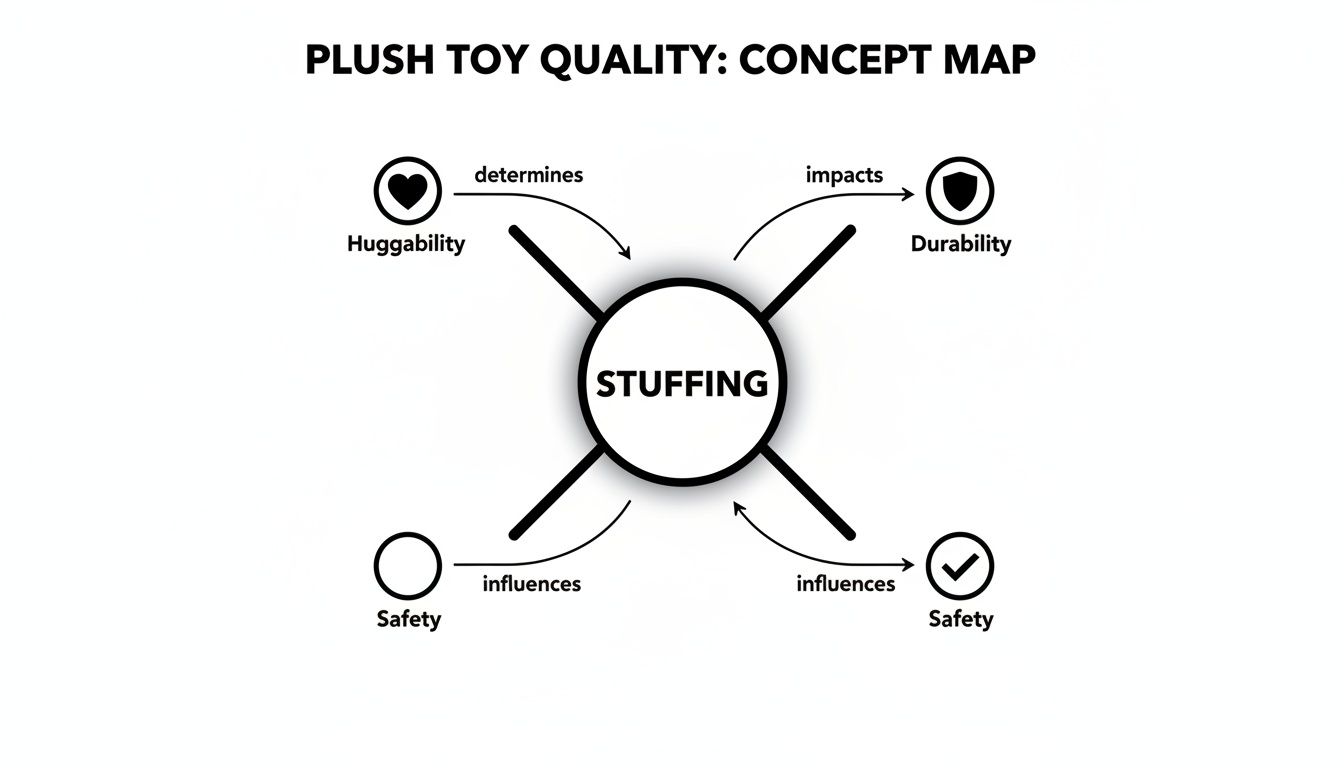
As you can see, the internal component directly shapes the user experience, product lifespan, and safety compliance.
A Manufacturer's Comparison of Plush Toy Filling
To provide a clear overview, here is an inside look at the most common stuffing materials we handle. This table breaks down their properties, best uses, and relative costs from a mass production standpoint.
| Material | Technical Properties | Ideal Application | Safety Profile | Relative Cost |
|---|---|---|---|---|
| Polyester Fiberfill | Lightweight, resilient, hypoallergenic, excellent loft. Available in various deniers (e.g., 7D for softness, 15D for firmness). | The go-to for almost all standard plush toys, from small characters to large stuffed animals. | Excellent. Non-toxic and meets all major safety standards like EN71 and ASTM F963 when sourced from reputable suppliers. | $ (Most cost-effective) |
| PP Cotton | A type of polyester known for high elasticity and resistance to compression. Very springy. | Great for toys that need to maintain a firm, full shape over time. A reliable all-rounder. | Excellent. Shares the same safety profile as standard polyester fiberfill. | $ (Comparable to polyester) |
| Plastic Pellets | Small, dense polyethylene beads. Used for weighting, not as a primary fill. | Placed in the base, paws, or bottom to help a toy sit upright and provide a satisfying, hefty feel. | Safe, but must be contained in a secondary inner pouch to prevent choking hazards. This is a critical QC step. | $$ (Higher material & labour cost) |
| Foam (Cut & Beads) | Cut foam provides rigid structure; Expanded Polystyrene (EPS) beads offer a unique, crunchy texture. | Cut foam is for props or toys needing a defined shape. EPS beads for beanbag-style toys or sensory products. | Generally safe, but material choice is crucial. EPS beads pose an inhalation/choking risk if the toy is damaged. | $$$ (Can be more expensive) |
The optimal choice depends entirely on your product's design, target audience, and price point. Polyester fiberfill remains the industry standard for its balanced performance, safety, and cost.
Specialty Fills for Functional Design
While polyester handles most applications, certain designs require specialized materials for function or feel. These are often used in conjunction with standard fiberfill.
Plastic Pellets (Poly-Pellets)
These non-toxic plastic beads add weight and stability. We strategically place them in the paws, feet, or base of a toy to enable it to sit upright or to provide a satisfying, premium weight.
From a production standpoint, pellets must be sealed within a securely stitched inner fabric pouch before being placed inside the toy. This is a non-negotiable safety protocol to eliminate any risk of leakage, which would create a choking hazard. It is a critical quality control checkpoint.
Foam and Foam Beads
Expanded polystyrene (EPS) beads offer a unique sensory experience and a light but firm body. They create a distinct sound and feel. For toys requiring a rigid shape, such as character-themed cushions or props, we use precision-cut foam.
Navigating Global Toy Safety Standards
For brands selling into global markets, safety compliance is not a final step; it is integrated into every stage of production. The two primary regulatory frameworks we adhere to are EN71 for the European Union and ASTM F963 for the United States.
These standards are the definitive rulebooks for safe toy manufacturing. They dictate the physical and chemical properties of every component, with a significant focus on the stuffing, as it can pose chemical, flammability, and choking risks.
In practice, this means every batch of polyester fiberfill arriving at our facility must be accompanied by supplier documentation verifying it is free from heavy metals, phthalates, and other restricted substances. We then conduct our own verification tests to ensure compliance.
Key Safety Checks for Stuffing and Construction
Our quality control team enforces these standards directly on the factory floor through a series of hands-on checkpoints.
-
Flammability Testing (EN71-2): We test the rate of flame spread for both the stuffing and outer fabric. The material must be self-extinguishing or burn at an extremely slow rate, providing sufficient time for a child to drop the toy in case of accidental exposure to a flame.
-
Chemical Analysis (EN71-3 / ASTM F963-17 Section 4.3.5): Stuffing samples are sent to certified third-party laboratories to test for a list of toxic elements. This ensures no harmful substances can leach out, even if a child chews on the toy.
-
Physical and Mechanical Tests (EN71-1 / ASTM F963-17 Section 4): This focuses on structural integrity, especially seam strength. We perform "pull tests" on seams to ensure they can withstand significant force without rupturing and exposing the filling, which would create an immediate choking hazard.
A common failure point for inexperienced factories is weak seam construction. Using single stitching or low-quality thread is a critical error. Our standard is double-stitching on all load-bearing seams to ensure stuffing remains securely inside throughout the product’s lifespan.
The Importance of Material Purity
The first safety decision is the raw material itself. We use 100% virgin polyester fiberfill exclusively. It is naturally hypoallergenic and clean. Using recycled or "B-grade" fibers introduces the risk of unknown contaminants and allergens—a risk that is unacceptable in children’s products. Partnering with a factory that compromises on safety is a significant liability. A product recall can irreparably damage a brand.
The Manufacturing Process: From Raw Fiber to Finished Toy
Transforming a compressed bale of raw fiber into the soft heart of a finished toy is a meticulously controlled process. Consistency and safety are paramount at every step.
It begins with a rigorous inspection of incoming raw materials. Polyester staple fibre (PSF) arrives in tightly packed bales. We immediately pull samples from each batch to verify purity, color consistency, and texture, rejecting any material with contaminants or off-spec fibers.
Once approved, the compressed fibers are processed through a carding machine. This industrial machine uses large, toothed rollers to separate and fluff the fibers, transforming the dense material into a uniform, airy cloud. This step is critical for achieving a light, springy feel and preventing the dense, lumpy spots found in low-quality toys.
Stuffing Techniques for Precision and Scale
With the fiber prepared, we move to the stuffing stage. We employ two primary methods, selected based on the toy’s design and production volume.
-
Machine Blowing: For high-volume orders of standard-shaped toys, this is our primary method. An operator uses a high-powered blower to inject the fiberfill directly into the fabric shell. It is fast, efficient, and ensures consistent density across thousands of units.
-
Manual Stuffing: For intricate designs with narrow limbs or complex shapes, we utilize skilled craftspeople. Hand-stuffing allows for the precision needed to fill every detail perfectly without over-stretching seams or leaving hollow areas.
Regardless of the method, one parameter is meticulously monitored: fill weight. Every stuffed toy is weighed on a calibrated digital scale to ensure it matches the exact specification of the approved prototype. This guarantees that the first toy in a production run has the same feel and density as the last.
Consistency in fill weight is a key indicator of a professional manufacturer. A deviation of just a few grams can alter a toy's posture and feel, leading to an inconsistent product line that undermines brand quality.
Final Steps: Quality and Safety Assurance
A toy is not complete once it is filled. The final steps are crucial for durability and safety.
First, the stuffing opening is sewn shut using a hidden "ladder stitch," creating a closure that is both invisible and secure. We use high-tensile thread and double-stitching to ensure this final seam is as strong as the rest of the toy.
Finally, every single unit passes through a calibrated metal detector. This is a non-negotiable safety check to detect any broken needle tips or other metal fragments that could have accidentally entered the product during production. Only after passing this inspection does the toy proceed to final cleaning, quality assurance, and packaging. The complete ecosystem of raw material production and advanced manufacturing makes China a global leader. For more on this, our guide to custom stuffed animals and plush toys provides a broader view.
Pricing Factors: Understanding Your Production Costs
To bring a plush toy to market successfully, you must understand the cost structure. The final unit price is a direct result of decisions made regarding materials, design complexity, and order volume. From a factory perspective, plush toy stuffing is a primary cost driver.
The price of polyester fiber is linked to global commodity markets. Furthermore, the amount of stuffing required—the fill weight—directly impacts material costs. A firm, densely packed toy will always cost more to produce than a soft, lightly filled one due to the higher volume of raw material used.
Breakdown of Production Costs
The ex-factory price of a plush toy is determined by several key factors. Successful sourcing involves balancing these elements to meet quality targets within your budget.
-
Raw Materials: This includes the outer fabric, thread, and the stuffing itself. Using A-grade virgin polyester has a higher material cost but is essential for quality and safety.
-
Fill Weight: Measured in grams per toy, this directly impacts material costs and shipping weight. A 10-gram variance per unit becomes significant over a large production run.
-
Labour and Complexity: Stuffing a simple sphere is quick and can be automated. A character with long, thin limbs requires manual stuffing by a skilled worker, which increases labour costs.
-
Compliance and Testing: The cost of third-party lab testing for standards like EN71 and ASTM F963 is factored into the production plan. This is a mandatory and non-negotiable expense.
OEM vs. ODM: Which Manufacturing Path is Right for You?
The manufacturing model you choose also significantly impacts cost and timeline.
-
Original Equipment Manufacturing (OEM): You provide a completely custom design, and we manufacture it to your exact specifications. This offers total creative control but typically involves higher development costs for pattern making, sampling, and revisions. The initial prototype and mold fee usually ranges from $100 to $500, with a timeline of 7-10 days.
-
Original Design Manufacturing (ODM): You select a pre-existing design from our catalog and customize it with your branding. This approach is faster and more cost-effective as the development work is already complete. It is an excellent option for brands needing to bring a proven product to market quickly.
The choice between OEM and ODM is a strategic one. OEM is for creating a unique product from scratch. ODM is for efficiently launching a market-tested design.
Understanding MOQ and Cost Optimization
Minimum Order Quantity (MOQ) is a common point of confusion for new buyers. Our typical MOQ of 500 to 1,000 pieces per design is calculated to cover the costs of raw material procurement (our suppliers have their own MOQs), production line setup, and labor efficiency.
However, there are ways to optimize costs. Designing a toy for efficient stuffing can reduce labor time. Scheduling production during our off-peak seasons (typically after the pre-Christmas rush) can sometimes allow for more flexible terms. For brands looking to scale, exploring options for plush toys wholesale is a smart way to build cost-effective, long-term partnerships.
How to Choose a Quality Manufacturing Partner
Selecting a factory is the most critical decision your brand will make. This is a partnership that defines your product's quality, safety, and reputation. A true partner understands that details like plush toy stuffing are central to the promise you make to your customers.
It is easy to be swayed by a low price, but you must differentiate between a true manufacturing partner and a low-cost vendor. A cheap supplier may cut corners by using B-grade recycled stuffing. This saves them money but results in lumpy toys, potential safety hazards, and brand damage. A real partner will insist on using A-grade virgin fibers and be transparent about their material sourcing.
Key Questions for Vetting Suppliers
When engaging with potential factories, ask specific, technical questions.
-
Stuffing Material: "Can you provide the technical specification sheet for your standard A-grade polyester fiberfill? What is your QC process for incoming raw fiber?"
-
Quality Control: "For a production run of 5,000 units, how do you ensure consistent fill weight? What is your acceptable variance in grams?"
-
Safety Compliance: "Please provide your most recent third-party test reports for EN71 and ASTM F963. How often are your metal detectors calibrated, and can we review the calibration log?"
A factory that provides detailed, transparent answers and documentation demonstrates confidence in its processes. Hesitation or vague responses are significant red flags.
What to Look for During a Factory Audit
An on-site audit provides invaluable insight. When you visit, go directly to the stuffing workshop. It should be clean, dry, and organized to prevent fiber contamination.
Examine their production line. Are the stuffing machines well-maintained? Are calibrated scales used for every unit? Observe the final seam closure—it must be tight and secure. These operational details separate professional manufacturers from high-risk suppliers. Reviewing the quality of established stuffed animal toys can provide a benchmark for what to expect.
Ultimately, choosing a partner means finding a factory that operates as an extension of your own team—one that protects your brand by obsessing over every detail.
Frequently Asked Questions About Plush Toy Stuffing
As manufacturers, we field many questions about the internal components of plush toys. Here are direct answers to the most common inquiries.
What is the real difference between A-grade and B-grade fiberfill?
A-grade fiberfill refers to virgin polyester staple fiber (PSF). It is a new material—pure white, highly resilient, clean, and hypoallergenic. It ensures consistent softness and a premium feel across all units.
B-grade is typically recycled fiber. While more economical, it can have a grayish tint and lower resilience, leading to lumpy toys over time. Critically, it carries a higher risk of containing contaminants and requires rigorous testing to be deemed safe for use in toys.
For any toy intended for children, we exclusively use A-grade virgin fiber. This is a non-negotiable standard to guarantee safety, quality, and durability.
How much does stuffing weight affect my final cost?
Stuffing is a primary cost driver. The final unit price is directly tied to the amount of fiberfill used, which we purchase by the kilogram. A toy designed to be firm and dense requires more material, increasing the unit cost.
This also has a major impact on logistics. Shipping costs are calculated based on actual weight or volumetric weight, whichever is greater. Heavier toys are more expensive to ship. We work with clients to optimize the fill weight, achieving the desired feel while managing both production and freight budgets.
Can we use natural stuffing like cotton or wool?
While technically possible, we strongly advise against using natural fillings like cotton or wool for mass-produced plush toys for several practical reasons.
First, the raw material cost is significantly higher than polyester fiberfill. Second, natural fibers are highly absorbent and retain moisture, creating a risk of mold, mildew, and allergens—a major safety and liability issue.
Finally, they lack durability. After washing, natural fibers tend to compact and clump, permanently altering the toy's shape and feel. High-quality polyester fiberfill is the industry standard because it is hypoallergenic, washable, durable, and cost-effective, all while meeting every international safety standard.
Ready to create a high-quality custom plush toy with the perfect stuffing? The team at FunEnjoy PlushToys is here to bring your vision to life with expert guidance and transparent manufacturing. Contact us today to start your project!