Buying wholesale stuffed animals is the most direct route for brands, retailers, and creators looking to bring a new plush product to life. It’s all about partnering directly with a specialised manufacturer to produce your toys in bulk.
Going this route almost always means a significantly lower cost per unit compared to buying from a middleman or distributor, making it the smartest strategy for creating custom designs or keeping your retail shelves stocked.
Your Starting Point for Sourcing Plush Toys
So, you’re ready to dive into the world of plush toys. It’s an exciting move, whether you’re launching a brand-new character or hand-picking a unique collection for your shop. Think of this guide as your roadmap. We’re here to walk you through the entire process, from that first spark of an idea to holding a finished, market-ready product in your hands.
This whole journey, from concept to finding the right factory to getting that final product, follows a pretty clear path.
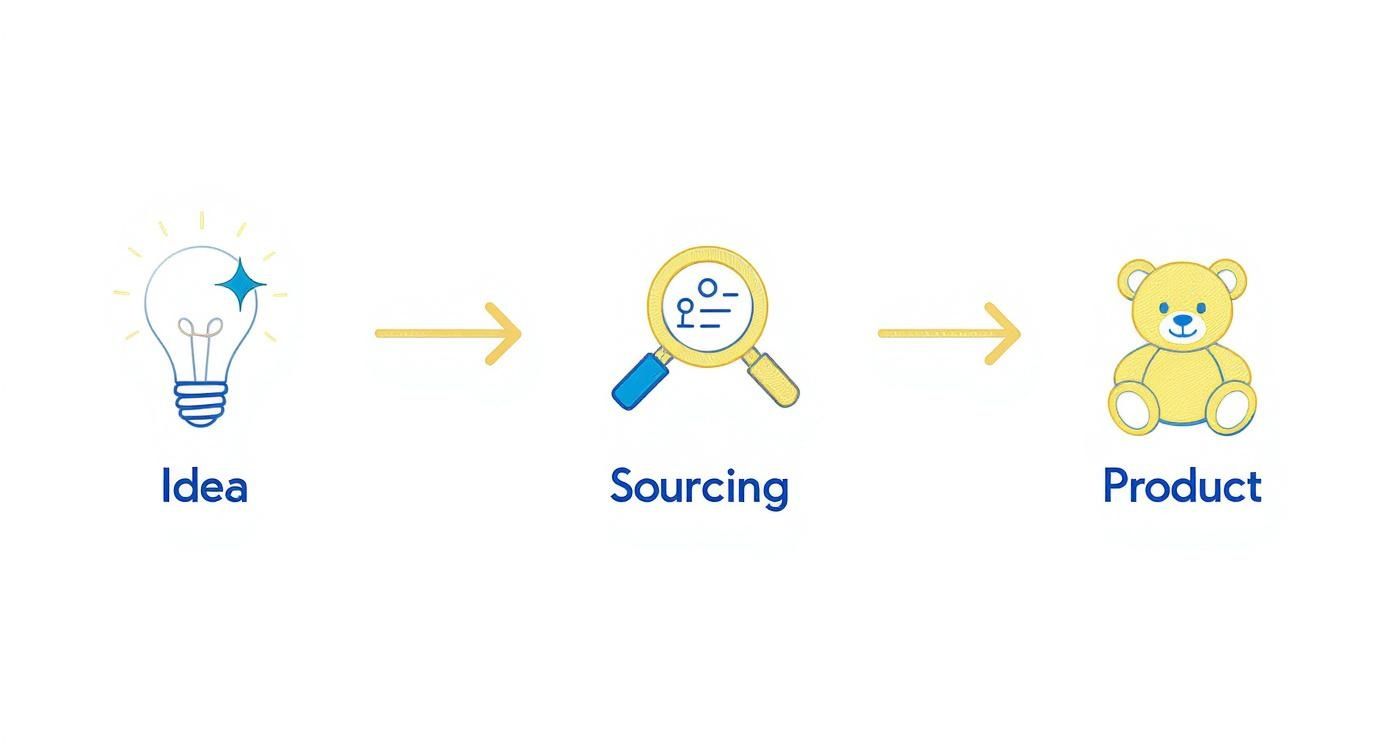
As you can see, success starts long before the first stitch is sewn. It all begins with a great idea and, just as importantly, the right manufacturing partner.
Understanding the Industry Landscape
The plush toy market is a big, bustling place, and it’s growing every year. For businesses willing to learn the ropes, it’s a golden opportunity.
The key players you’ll encounter range from huge, full-scale factories pumping out thousands of orders to smaller, boutique workshops that are masters of highly detailed, custom jobs. Figuring out which one you need is your first major decision. Are you looking to produce 10,000 units of a simple teddy bear, or do you need a team of artisans to perfectly capture a complex, licensed character with intricate embroidery? Your answer changes everything.
You’ll also notice that certain regions, especially in Asia, are the undisputed epicentres of plush toy manufacturing. This isn’t by accident. It’s the result of decades of experience, deep supply chains for materials, and a huge pool of skilled labour. This concentration of know-how has created a fiercely competitive and innovative environment.
Why China Dominates the Plush Market
When you talk about wholesale plush toys, you simply can’t avoid talking about China. The country is the world’s toy factory, and its command of the plush sector is massive.
To put it in perspective, China’s stuffed and plush toys market pulled in revenue of around USD 976.3 million in 2023. The classic stuffed animals segment? It took the biggest piece of the pie at 35.95%. Better yet, the market is projected to grow at a compound annual growth rate of 8.5% through 2030. That tells you all you need to know about its strength and potential. If you want to dig into the numbers, Grand View Research has some great data.
This isn’t just about cranking out high volumes. It’s about a deeply connected ecosystem—fabric suppliers, accessory makers, and logistics pros—all working together to bring a plush concept to life with impressive speed and cost-efficiency.
Throughout this guide, we’ll show you exactly how to tap into this global marketplace. From finding the right partners to nailing the details of design, sampling, and shipping, we’ve got you covered. Consider this your briefing before we get into the nitty-gritty that will turn your vision into a huggable reality.
How to Find and Vet Your Perfect Supplier
Choosing your manufacturing partner is, without a doubt, the single most critical decision you’ll make when you’re sourcing stuffed animals. This isn’t just about finding a vendor; you’re looking for the team that will bring your designs to life. Get this right, and you’re golden. Get it wrong, and it can affect everything from product quality to your brand’s reputation.
A great partnership begins with knowing where to look. While a quick search online is a decent start, the real gems are often found on specialised platforms or, even better, at industry events where you can shake hands and have a real conversation.
Kicking Off Your Digital Search
The internet has opened up a world of global manufacturers, but you need to know which digital doors to knock on. For anyone in the plush toy game, these are the essential starting points.
- Alibaba: It’s the undisputed heavyweight of B2B sourcing. You’ll find an absolutely massive directory of manufacturers here. The downside? Its sheer size means you have to be savvy to filter out the noise and find the real plush toy specialists.
- Global Sources: Think of it as a cousin to Alibaba. Many in the industry feel it has a slightly more rigorous vetting process for the suppliers it lists, which can be a huge plus. It’s a fantastic place to find established factories with a solid history of exporting.
- Made-in-China.com: No surprises here—this platform is laser-focused on Chinese manufacturers. Since China is the heart of the plush toy production world, it’s another top-tier resource for finding experienced factories.
The Power of a Handshake: In-Person Connections
As useful as online platforms are, nothing beats meeting a potential partner face-to-face. Trade shows are absolutely invaluable for this. You get a genuine feel for a company’s professionalism and can build a real relationship from the get-go.
If you’re serious about sourcing, the Canton Fair is a must. Held twice a year in Guangzhou, China, it’s the biggest trade fair on the planet. Walking the halls lets you physically touch and feel product samples, meet the management team, and ask detailed questions right then and there. Ten minutes of direct interaction can reveal more than a week of back-and-forth emails ever could.
Digging Deeper: The Vetting Process
Alright, you’ve got a shortlist of potential suppliers. Now the real work begins. Vetting is all about methodical investigation—making sure a supplier can actually deliver on quality, safety, and reliability. This is how you separate the seasoned pros from the pretenders.
Start with their website. It’s your first impression. Does it look professional? Is the English clear and well-written? Do they proudly showcase a portfolio of past work, especially with plush toys? An outdated site with blurry photos and grammatical mistakes is a major red flag. If they don’t pay attention to their own shop window, how much attention will they pay to your products?
Next, it’s time to reach out and start asking the right questions. Your primary goal is to gauge their experience, especially with clients in your part of the world.
Don’t just ask, “Do you export?” Dig deeper. Ask for specific examples of projects they’ve done for clients in North America or Europe. This tells you if they’re truly familiar with crucial international safety standards (like ASTM F963 or EN71) and the headaches of international shipping.
It’s also crucial to verify their claims. If a factory boasts a production capacity of 500,000 units a month, ask them to show you. Photos or videos of their production lines buzzing with activity, or even redacted documents from previous large orders, will do. A good supplier will be transparent and have nothing to hide. To really understand what sets a top-tier partner apart, it helps to see what an experienced custom plush toy manufacturer looks like in action.
I recommend using a simple checklist to keep your evaluations organised. It lets you compare each potential partner side-by-side, taking the emotion out of it.
| Vetting Criteria | Supplier A | Supplier B | Supplier C |
|---|---|---|---|
| Years in Business | 15+ years | 5 years | 8 years |
| Specialisation | Custom plush, licensed IP | Generic stuffed animals | Promotional toys |
| Key Markets Served | USA, EU, Japan | USA | Primarily domestic |
| Safety Certifications | EN71, ASTM, ICTI | Claims compliance | None listed |
| Responsiveness | Replies within 12 hours | Replies within 48 hours | Replies within 24 hours |
This kind of structured approach helps you make an objective choice based on what truly matters for your business. Trust me, the time you invest in proper vetting is the best insurance policy against costly mistakes and delays down the line.
Getting Down to Brass Tacks: Quotes, Samples, and MOQs
Alright, you’ve done the legwork and have a solid list of potential suppliers. Now for the exciting part—seeing your plush toy concept start to take physical form. This stage is all about crystal-clear communication, getting your hands on actual samples, and crunching the numbers that will make or break your project’s profitability.
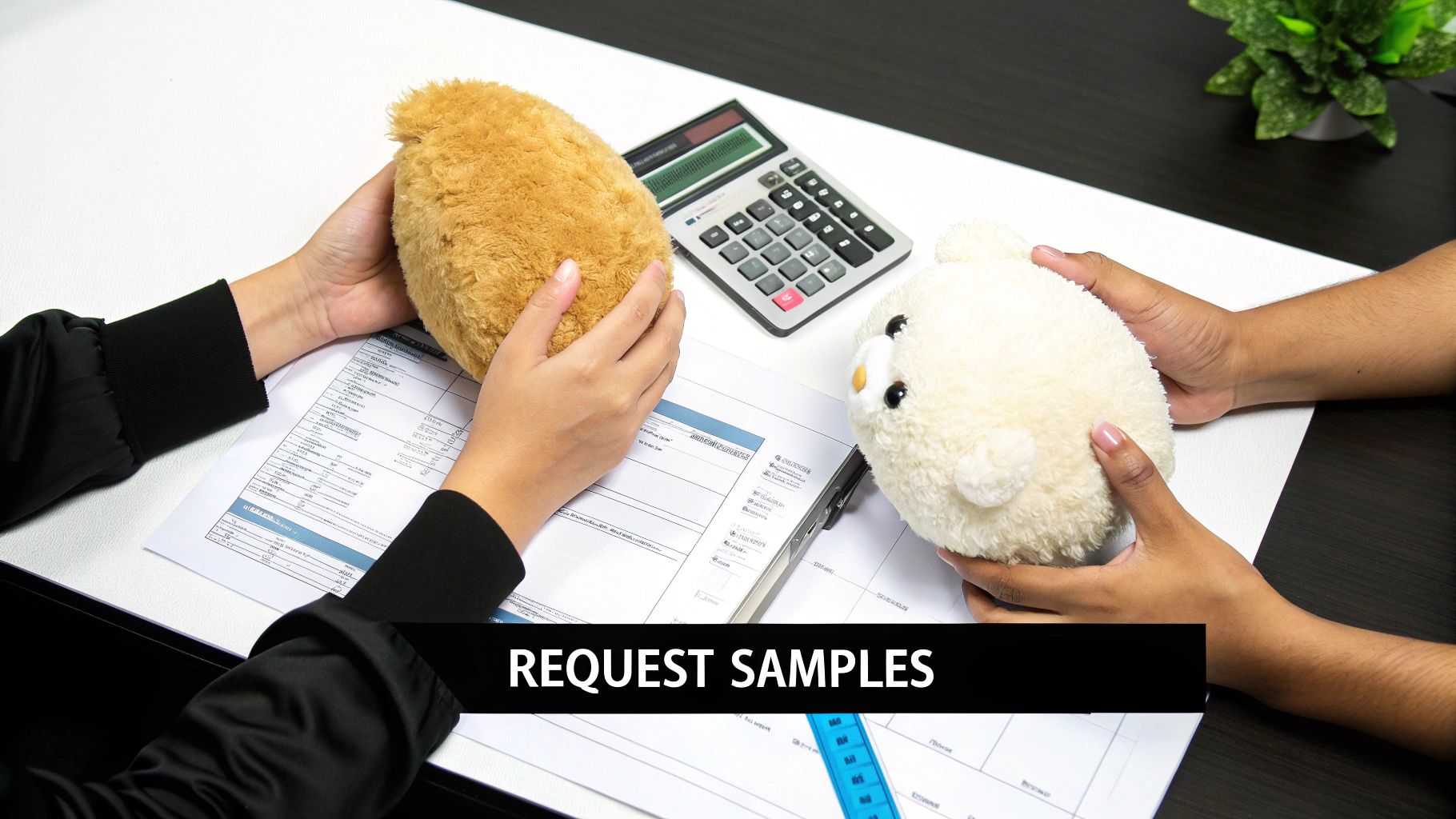
First things first, you need to send out a detailed Request for Quotation (RFQ). Think of your RFQ as the architectural blueprint for your plush toy. The more detail you pack in, the more accurate and useful the quotes you get back will be. Trust me, vague requests only lead to vague pricing and big headaches down the line.
A thorough RFQ shows you’re serious and sets a professional tone for the entire partnership from day one.
How to Craft an RFQ That Gets Results
A strong RFQ is your secret weapon for getting quotes you can actually compare. If one supplier quotes you based on premium minky fabric while another prices out a standard polyester, you’re not comparing like for like. A detailed RFQ forces everyone to quote on the exact same specifications.
To make sure you get clear, comparable pricing, your RFQ needs to be buttoned up. Here’s a little checklist to get you started.
Sample Request for Quotation (RFQ) Checklist
Use this table as a guide to ensure you’re providing all the critical information manufacturers need to give you an accurate quote. The more you give them, the better the pricing you’ll get back.
| Information Category | Specific Details to Include | Example |
|---|---|---|
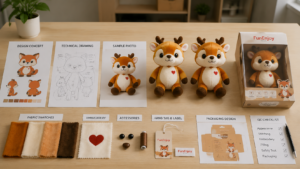
| Design & Concept | Attach all design files: sketches, 3D models, or a full tech pack. Include front, back, and side views. | “Attached: Panda_Character_TechPack_V2.pdf with all views and callouts.” |
| Physical Dimensions | Specify exact height, width, and depth. Use centimetres or inches consistently. | “Target height: 25cm (from feet to top of head). Width: 15cm (at widest point).” |
| Material Specs | List all fabrics, stuffing, and other components. Be specific! | “Body: Short-pile plush. Tummy patch: White minky fabric. Eyes: 12mm black plastic safety eyes. Stuffing: 100% PP cotton.” |
| Colour Matching | Provide Pantone colour codes for all fabrics, embroidery threads, and printed elements. | “Main body fabric: Pantone 19-4008 TCX (Black Onyx). Embroidery for nose: Pantone Cool Gray 1 C.” |
| Safety & Compliance | State the safety standards required for your target market. | “Product must comply with EN71 (EU) and ASTM F963 (US) standards. Please provide certificates.” |
| Quantity & Timeline | State your desired order quantity and your ideal delivery date. | “Initial order quantity: 1,000 units. Need final product delivered to our UK warehouse by October 1st.” |
Putting in this effort upfront empowers suppliers to give you a precise unit cost, sample cost, and a realistic production timeline.
From Prototype to Perfection: The Sampling Process
Once a supplier sends a quote that looks promising, it’s time to move on to sampling. This is where your design finally jumps off the screen and into the real world. You’ll typically go through a couple of sample stages, and each one has a very specific job.
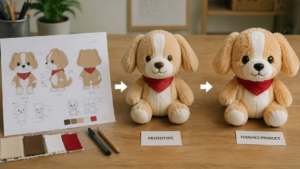
First up is the prototype sample. This is the factory’s initial take on your design, built to check the overall shape, construction, and feel of the materials. Don’t be surprised if it needs a few tweaks—that’s completely normal. Your job is to provide clear, actionable feedback. Instead of “the head looks weird,” try “let’s make the snout 1cm shorter and move the eyes 5mm farther apart.” For more tips on this, our guide on the custom plush toy process breaks it down perfectly.
After you’ve signed off on the prototype, you get the pre-production sample (PPS). This one is different. It’s made on the actual production line with the final, bulk-ordered materials. The PPS is your last, best chance to catch any mistakes before you give them the green light for the full run.
A Note From Experience: Your pre-production sample needs to be perfect. If it isn’t, do not approve it. This sample is the gold standard for what your customers will receive. Any flaw you see here will be multiplied across your entire order.
Making Sense of Minimum Order Quantities (MOQs)
Finally, let’s talk about the Minimum Order Quantity, or MOQ. This is simply the smallest order a factory is willing to produce in one go. MOQs are a reality because setting up for a new project costs the factory real money—they have to source materials in bulk, calibrate machines, and get the assembly team up to speed.
These numbers are hugely influenced by the global manufacturing landscape. With over 70% of all plush toys made in China, the scale of production there really sets the benchmark for pricing and MOQs around the world. These factories leverage enormous economies of scale to keep prices competitive.
For custom stuffed animals, you’ll often see MOQs starting around 500 to 1,000 pieces. That number can feel a bit daunting if you’re just starting out, but it’s often more flexible than you think. If you’re launching a brand-new design, don’t be afraid to ask for a smaller test run—say, 300 pieces—with a promise for a much larger reorder if it sells well. Building a good relationship and showing your long-term potential can give you the leverage you need to get a foot in the door.
Ensuring Quality and Safety Compliance
When you’re creating toys for children, safety isn’t just a box to tick—it’s everything. One product recall can tank a brand’s reputation overnight, and for good reason. That’s why getting a firm grip on quality control and international safety standards is absolutely non-negotiable when you’re sourcing wholesale stuffed animals.
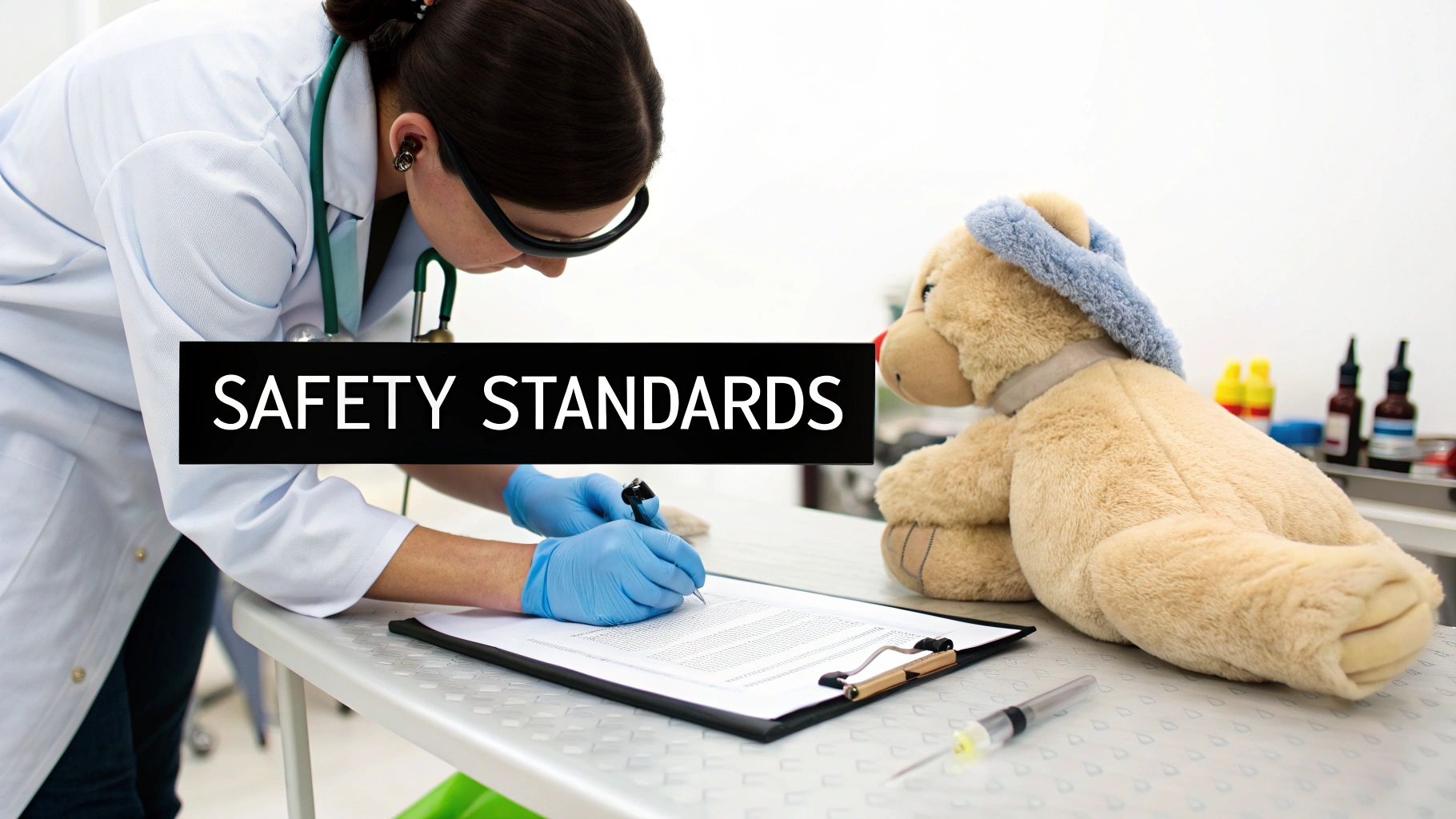
Think of these standards as the universal language of toy safety. A manufacturer who is fluent in them shows a baseline level of professionalism and a commitment to protecting your customers. Your job is to make sure they can back up their claims with cold, hard documentation.
Decoding the Alphabet Soup of Safety Standards
Diving into international certifications can feel like you’re trying to learn a new language made entirely of acronyms. But don’t worry. For plush toys, it really boils down to two key standards, depending on where you plan to sell.
-
ASTM F963 (USA): This is the big one for the United States market. It’s the mandatory safety standard for all toys sold in the US, covering a massive range of potential hazards. We’re talking physical and mechanical tests (like seam strength and small parts), flammability, and chemical limits for things like lead and phthalates. If you’re selling in America, compliance isn’t a suggestion—it’s the law.
-
EN71 (European Union): Selling in the EU? Then you need to know about EN71. It’s the European equivalent, broken into multiple parts that cover everything from mechanical properties (EN71-1) and flammability (EN71-2) to the migration of specific chemical elements (EN71-3).
These standards get incredibly granular. For example, a “pull test” is a standard physical check where a specific amount of force is applied to seams, eyes, and noses to ensure they don’t pop off and become a choking hazard. That’s the level of detail that protects kids—and your business.
How to Verify a Supplier’s Certifications
A supplier telling you they’re “certified” means nothing without proof. Never, ever take their word for it. You need to ask for copies of their certification documents and test reports for products similar to yours.
When you get a report in your hands, play detective and check a few key details:
- The Issuing Lab: Is the report from a recognised, accredited third-party lab like SGS, Intertek, or Bureau Veritas?
- The Date: Is the report recent? Standards get updated, so a report from five years ago might be totally irrelevant.
- The Product Details: Does the product described in the report actually match what you’re ordering? A certificate for a simple plush cube doesn’t guarantee the safety of your complex, multi-accessory character plush.
Don’t be shy about this verification process. Any legitimate, experienced manufacturer will expect your diligence and will gladly provide the necessary documents. If a supplier gets evasive or makes excuses, consider it a massive red flag. Walk away.
When to Bring in the Professionals
For larger orders or if you’re developing a highly custom toy, relying solely on the factory’s own quality control (QC) team is a huge gamble. This is where third-party inspection services become an invaluable investment.
These services are your eyes and ears on the factory floor. You can hire them to perform inspections at different stages of production, giving you crucial checkpoints along the way.
Common Inspection Points:
- Pre-Production Inspection (PPI): Before mass production kicks off, an inspector can verify that the factory has sourced the correct raw materials and components that meet your safety and quality specs.
- During Production Inspection (DPI/DUPRO): This is a game-changer. An inspector visits mid-production to spot-check for issues on the assembly line. It allows you to catch and fix a problem before the entire order is compromised, saving you a potential fortune.
- Pre-Shipment Inspection (PSI): The most common type. Right before your order ships, an inspector randomly samples finished products and checks them against your approved sample and quality checklist. They’ll do visual checks, measurements, and physical tests right there on-site.
Hiring an inspection service might feel like an extra cost, but it pales in comparison to the cost of receiving 10,000 defective units or, even worse, facing a recall. It’s an unbiased assessment of your product’s quality before it leaves the factory, giving you the final say on whether the shipment is good enough to go. It’s the ultimate insurance policy for your wholesale stuffed animals.
Getting Your Plushies Made: From Factory Floor to Your Front Door
Alright, you’ve nailed the design and ticked all the safety boxes. Now for the exciting part: actually making the things! This is where you move from creative concepts to the nitty-gritty of production, packaging, and shipping. Getting a handle on this process is key to keeping your project on time and on budget.
A good manufacturer isn’t just a supplier; they’re your partner in this process. They should be able to give you a clear view of what’s happening every step of the way.
Think of it as a journey. It starts with the approved sample and ends with a shipment of adorable plush toys landing at your warehouse. From ordering the fabric to stitching the last seam, every stage has its own timeline. A small delay early on can easily snowball, so staying in the loop is crucial.
What’s a Realistic Production Timeline?
“So, how long will this take?” It’s the first question everyone asks, and for good reason. While every project has its own quirks, a typical production run for wholesale stuffed animals follows a pretty standard path.
Here’s a rough sketch of what you can expect after you give the final “go” on the pre-production sample:
- Gathering the Goods (1-2 weeks): The factory gets to work ordering all the raw materials in bulk—the fabric, the stuffing, those little plastic eyes, and any other unique bits and pieces for your design.
- Cut & Stitch (1 week): Huge rolls of fabric are precisely cut into pattern pieces using custom moulds. If your design has embroidery—like a logo or facial details—this is when that magic happens.
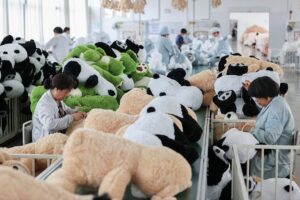
- The Assembly Line (2-3 weeks): This is where your plushies really start to take shape. It’s the most hands-on part of the process, as skilled workers meticulously sew the pieces together.
- Getting Stuffed (1 week): The sewn “skins” are turned right-side-out and filled with soft PP cotton until they’re perfectly squishy. Then, the final seams are expertly closed up.
- Final Touches & QC (1 week): Every single toy gets a final clean-up, a good brushing, and a thorough inspection to catch any defects before it’s cleared for packaging.
Remember, this is just a guide. A massive order or a super-complex design will naturally take a bit longer. If you’re curious to see this in action, you can get a closer look at crafting the perfect plush with a deep dive into our production process.
Don’t Overlook the Packaging
Packaging is so much more than just a box. It protects your plush during its long journey, but it’s also the first thing your customer sees. It’s a huge part of the unboxing experience and can have a real impact on your shipping costs.
You’ve got a few solid options to consider:
- Simple Poly Bags: These are the no-frills, cost-effective choice. They keep dust and moisture out and are perfect for bulk orders that aren’t going straight to a retail shelf.
- Branded Retail Boxes: Want to make a statement? A custom-printed box makes your product look premium and ready for the store. It costs more and adds weight, but the boost in perceived value can be well worth it.
- Custom Hang Tags: These are non-negotiable for retail. This is your space for branding, the barcode, safety info, and care instructions.
- Counter Display Units (CDUs): If you’re selling smaller items like plush keychains, these are a retailer’s dream. A ready-to-go display box encourages those impulse buys right at the checkout counter.
Your packaging choice sends a direct message to your customer. A simple poly bag says “bulk component,” while a thoughtfully designed box says “premium gift.” Align your packaging with your brand’s position in the market.
Making Sense of International Shipping
Getting your finished products from a factory in China to your warehouse can feel daunting, but it’s more straightforward than you might think. It really boils down to understanding a few key shipping terms (called Incoterms) and deciding between sending your goods by sea or by air.
Understanding Incoterms
- EXW (Ex Works): With this one, you’re in the driver’s seat for everything. You have to arrange for pickup right from the factory floor, handle all the export paperwork in China, and manage the entire journey to your final destination.
- FOB (Free On Board): This is the most common and, frankly, the one we recommend for most people. The factory takes care of getting your order to the port in China and clearing it through customs. Your responsibility starts the moment the goods are loaded onto the boat.
Sea Freight vs. Air Freight
Your choice here is a classic trade-off between time and money.
Sea freight is your best bet for saving money, especially on large, heavy orders. It’s way cheaper than air, but it’s also a slow boat, typically taking 30-40 days to cross the ocean.
Air freight is the express route. Your products can be in your hands in about 5-10 days, but you’ll pay a premium for that speed. It’s the perfect solution for time-sensitive orders, urgent restocks, or high-value items where speed is a priority.
Got Questions About Sourcing Wholesale Plush? We’ve Got Answers.
Diving into the world of wholesale stuffed animals for the first time can feel a bit like navigating a new city without a map. There are a lot of moving parts, and it’s totally normal to have questions. We’ve been there.
To help you get your bearings, we’ve compiled some of the most common questions we hear from brands just like yours. Think of this as your practical, no-nonsense FAQ for getting plush production right.
How Should I Make First Contact With a Supplier?
Your first email is everything—it’s your digital handshake. You want to come across as clear, professional, and serious about your project.
Keep it concise. Briefly introduce your brand and what you’re looking for. For example, “We’re looking to create a custom 20cm teddy bear for our upcoming retail line.” If you have a tech pack or design files ready, attach them. This simple step shows you’ve done your homework and aren’t just kicking tyres. A well-structured email with the key details will get you noticed much faster than a long, rambling story.
What Kind of Payment Terms Should I Expect?
When it comes to custom orders, the standard practice is pretty straightforward. Expect to pay a 30% to 50% upfront deposit to get the ball rolling. This covers the cost of raw materials and officially kicks off production.
The remaining balance, typically 50% to 70%, is usually due once production is finished, right before your order is shipped. While you might negotiate different terms down the road once you’ve built a strong relationship with a supplier, you should always budget for this initial deposit structure. A big red flag? A supplier asking for 100% upfront. Never agree to that, as it leaves you with zero leverage if things go wrong.
A manufacturer’s comfort with a standard deposit-and-balance structure is a great sign. It shows they’re legitimate, experienced, and understand the mutual trust required for international trade.
Can I Use My Own Shipping Agent?
Yes, absolutely. Most factories can handle the shipping for you and will have their own logistics partners they work with, but you are never locked in. You always have the option to bring in your own freight forwarder, especially if you’re working under EXW (Ex Works) shipping terms.
Using your own agent can give you a greater sense of control and sometimes even land you better rates, particularly if you have a high volume of shipments. The key is communication. Let your supplier know your plan from the very beginning so everyone is on the same page about who is handling the pickup, customs, and export documents.
What Happens If Production Gets Delayed?
Let’s be realistic: delays can and do happen. It could be a hiccup with raw material suppliers, an unexpected national holiday, or a technical issue on the factory floor. The mark of a great supplier isn’t that delays never happen, but how they handle them when they do.
A good partner will be transparent. They’ll inform you immediately, explain the reason, and provide a clear, revised timeline. This is where having a good relationship really pays off. You can work together to find a solution, maybe by splitting the shipment or using partial air freight to get your most time-sensitive products out the door. My advice? Always build a small buffer into your own project timeline to absorb these kinds of surprises.
What If I Find Defective Products in My Shipment?
This is where your diligence upfront truly matters. A pre-shipment inspection is your best defence, as a third-party service will catch most widespread issues before the goods even leave the factory.
But what if a few faulty items slip through? Your contract is your guide. Most reputable manufacturers want to protect their reputation and will offer a fair solution. This could look like:
- A credit toward your next order.
- Replacing the defective units with your next shipment.
- A partial refund for the value of the damaged items.
When you find an issue, document it immediately. Take clear photos and be specific about the problem. A professional supplier will work with you to make it right.
Ready to skip the sourcing headaches and partner with an expert team that brings your vision to life? At FunEnjoy PlushToys, we’ve been helping brands like Sanrio and The North Face create high-quality, custom plush toys for decades. Let us handle the details, so you can focus on building your brand.
Learn more about our custom manufacturing process and get your free quote at https://funenjoytoys.com.